Musical Poetry cover art

Musical Poetry

Musical Poetry

Written by: Michael Appelt
Listen for free

About this listen

“Musical Poetry” is a podcast where each episode brings one poem and then recites it in the form of a song. Words and music intertwine to create moments of reflection, beauty, and peace.Michael Appelt Social Sciences
Episodes
  • Nothing beside remains
    Jan 11 2026

    When power grows impatient with restraint, poetry remembers.

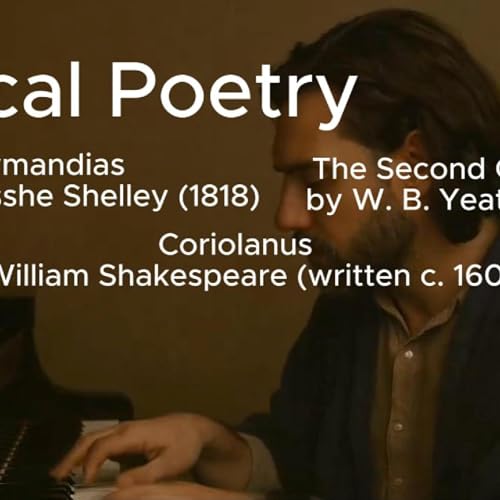
    This episode of Musical Poetry brings together three voices from three centuries in a single musical conversation:

    Ozymandias by Percy Bysshe Shelley — written in the shadow of Napoleon’s fall, reflecting on power after history has passed judgment.

    The Second Coming by W. B. Yeats — written after the First World War, sensing a world where balance fails and something ancient begins to stir.

    Coriolanus by William Shakespeare — offering the human voice of authority convinced that necessity excuses everything.

    Rather than adapting or modernising these works, this episode lets them speak to one another — as prophecy, personality, and aftermath.

    At the centre of the episode is an original musical piece built entirely from their words, arranged to reveal a pattern that repeats across history:

    how power rises, how it justifies itself, and how time eventually responds.

    This is not a political argument.

    It is not a prediction.

    It is a listening exercise, across centuries.

    Stay with the episode to the end, where the three voices converge and the question they leave us with becomes unavoidable.

    Show More Show Less
    12 mins
  • The Darkling Thrush, by Thomas Hardy
    Dec 28 2025

    These are the days between Christmas and New Year, when celebration has faded, time slows, and the future has not yet begun.


    In this episode of Musical Poetry, we present


    “The Darkling Thrush” by Thomas Hardy.

    Written at the very end of 1900 and first published in 1901, the poem stands at the threshold between centuries.


    Hardy looks at a winter landscape that feels exhausted and silent, and then hears a small bird sing, without reason, without explanation.


    This episode sets Hardy’s words against a melancholic, minimalist R&B soundscape, paired with a black-and-white animation that moves slowly, allowing silence and stillness to speak.

    Show More Show Less
    7 mins
  • Dulce et Decorum Est by Wilfried Owen
    Dec 21 2025

    The bells of war are sounding louder again — and yet, have they ever really stopped?In this episode of Musical Poetry, we present Dulce et Decorum Est by Wilfred Owen, one of the most powerful anti-war poems ever written.Owen wrote this poem during the First World War, after witnessing combat at close range. Before the war, he was a teacher and a poet. He was killed in action on 4 November 1918, just one week before the war ended. The poem was published after his death, in 1920.Its final line comes from an old Latin saying:“It is sweet and fitting to die for one’s country.”Owen called this idea the old lie.This reading is offered in remembrance of those who suffer today — in Sudan, in Ukraine, and wherever the bells of war continue to sound.It is also a refusal to ask the young to give their lives for the comfort, possessions, or survival of the old.This is not a call to action.It is an act of witness.

    Show More Show Less
    8 mins
No reviews yet