Season's Savings | ₹5/mo for 3 months

₹199/month after first 3 months. Renews automatically. Terms apply.
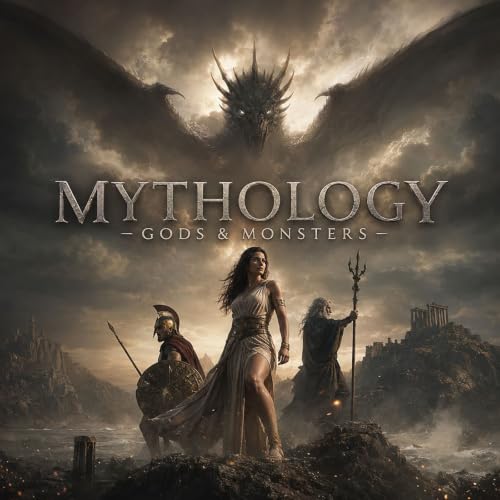
Mythology - Gods & Monsters cover art

Mythology - Gods & Monsters

Mythology - Gods & Monsters

Written by: OBOMEDIA ENTERTAINMENT
Listen for free

About this listen
Mythology hides its heroes in plain sight, dressing a warrior in silk before it lets him pick up a sword. A mother disguises her son as a girl in a palace full of women, and a trumpet blast is all it takes to reveal the boy who will die at Troy. That single moment says everything about this show: gods testing mortals, prophecies nobody escapes, and choices that cost exactly what they promise to cost.

Mythology: Gods & Monsters is a narrated documentary podcast, no host, no chatter, just one complete mythology story per episode, reconstructed in careful detail from ancient sources and the scholarship built around them. Each episode stands alone. You get the full arc of a myth or legend, from the strange rule that sets it in motion to the ending that made it endure for thousands of years, whether that ending is triumphant, tragic, or simply unresolved.

The show moves freely across greek mythology and beyond it, drawing on mythology from cultures far outside the Mediterranean world. You will hear how Zeus watches his own son Sarpedon die at Troy because even gods answer to fate, how a king sits frozen on a chair in the underworld and cannot rise, how a divine smith turns grief into a slaughter of skulls and stolen gold. There is room here for ancient mythology that predates the Olympians, for the dragon-slayer Siegfried and the betrayal waiting for him, for guides with three eyes and cheats who win kingdoms through nerve rather than glory. Gods and monsters share the stage equally, because in these mythology tales neither side plays fair.

If you want legends told with texture, tension, and enough historical grounding to feel real rather than recited, this mythology podcast is built for you. New episodes release regularly, each one a self-contained world you can enter cold. Subscribe now, so the next piece of mythology finds you the moment it drops.Copyright OBOMEDIA ENTERTAINMENT
Science Fiction
Episodes
  • You hold a bellows stone with Loki's stitched mouth - do you worship it?
    Nov 20 2026
    A workman on a Danish beach pulls a thousand-year-old bellows stone with a stitched-mouth god pressed into it - what do you do?

    You hold a bellows stone with Loki's stitched mouth - do you worship it?

    In this episode we follow the stone, the sources that name Loki, and the choices gods and people made around a figure who both binds and unravels. We trace the material find, the medieval poems and sagas, and the living folklore that kept Loki in the corners of daily life - so what does a god pressed into a tool make of a community?

    Person: Loki
    Date: 1950 (discovery)
    Location: Snaptun, Denmark
    Source: Poetic Edda; Prose Edda; Heimskringla; rune poems; skaldic verse; folklore

    - A flat soapstone bellows nozzle with a stitched-mouth portrait was pulled from wet sand on a beach near Snaptun in 1950.
    - The object was a working hearth tool, handled daily rather than a temple votive or vault artifact.
    - Medieval sources (Poetic and Prose Edda, Heimskringla) present Loki as pleasing in appearance, malicious in character, and both helper and saboteur to the gods.
    - Linguistic evidence links Loki to a Germanic root luk (loops, knots, locks), reframing him as a patient binder and tangler rather than a flame.
    - Folklore and dialects in Scandinavia kept Loki alive into modern rural life as Lokke - a presence in mist, cobwebs, crops, and the corner of the room.

    Tired of ads? Listen to this podcast and 200+ more ad-free on OBOMEDIA.
    Try it free for 7 days, cancel anytime: https://obomedia.com/en/gratis?ref=desc-7317495

    © 2026 Created by an independent creator of the OBOMEDIA Network. All rights reserved.
    This episode and its content (audio, text, and related materials) are the property of their respective creator, who is solely responsible for them, and are distributed by the OBOMEDIA Network on platforms such as Apple Podcasts, Spotify, Amazon Music, and Pocket Casts. Reproduction, distribution, editing, or commercial use, in whole or in part, without the creator's prior written permission is prohibited. For permissions, licensing, and business inquiries: business@obomedia.com.
    Show More Show Less
    29 mins
  • Would you keep the lost ring of light or return it to the sun-guardians?
    Nov 19 2026
    A thirty-six-year-old Oxford philologist reads a 1,600-year-old inscription about a lost ring-what would you do with a ring of light?

    Would you keep the lost ring of light or return it to the sun-guardians?

    In this episode, we trace how fragments of old words, a wartime landscape, and a stone inscription shaped one man's imagination across decades. It asks how creative worlds are excavated from language, memory, and personal history, and invites you to consider where your own creations come from.

    Person: J.R.R. Tolkien
    Date: 1928
    Location: Gloucestershire (Dwarf's Hill)
    Topic: archaeology of Middle-earth; philology
    Event: discovery of 1,600-year-old inscription

    - A 1928 visit to a hill riddled with ancient mine shafts led Tolkien to read a 1,600-year-old carved inscription mentioning a lost ring, a curse, and a god with a silver hand.
    - Two lines in the Old English poem Crist I (1914)-including the word Middangeard and the name Earendel-prompted Tolkien, at twenty-two, to write "The Voyage of Earendel the Evening Star."
    - Tolkien linked the Elves to the constructed language Quenya by 1915 and began assembling a mythology around philological sparks rather than plot ideas.
    - Service on the Western Front in 1916 (signals officer at the Somme) left memories of blasted terrain that later informed landscapes like the Dead Marshes and Mordor.
    - The ambiguous Old English word Sigelwara (sun or jewel + dwellers/guardians) led Tolkien to write "Sigelwara Land" (1932-34), turning etymological uncertainty into a mythic concept of hoarded, tangible light.

    Tired of ads? Listen to this podcast and 200+ more ad-free on OBOMEDIA.
    Try it free for 7 days, cancel anytime: https://obomedia.com/en/gratis?ref=desc-7317495

    © 2026 Created by an independent creator of the OBOMEDIA Network. All rights reserved.
    This episode and its content (audio, text, and related materials) are the property of their respective creator, who is solely responsible for them, and are distributed by the OBOMEDIA Network on platforms such as Apple Podcasts, Spotify, Amazon Music, and Pocket Casts. Reproduction, distribution, editing, or commercial use, in whole or in part, without the creator's prior written permission is prohibited. For permissions, licensing, and business inquiries: business@obomedia.com.
    Show More Show Less
    27 mins
  • You, naming the world as lava closed the sky
    Nov 18 2026
    A seeress watches a fissure in Iceland erupt and utters a prophecy - what would you name if the world burned?

    You, naming the world as lava closed the sky

    In this episode, we follow a thousand-year-old Norse poem and the historical eruption that may have inspired it. The episode traces how the Völuspá’s prophetic voice, Heiðr the völva, and the Eldgjá fissure intersect - and asks how a lived catastrophe becomes myth.

    Person: Heiðr (a völva, named twice in the poem)
    Event: Eldgjá eruption, 939 CE (six hundred kilometers of fissure)
    Text: Völuspá (66 stanzas, survives in Codex Regius and Hauksbók)
    Research: 2018 Cambridge study linking Völuspá imagery to Eldgjá
    Context: Iceland ca. 939 - ~60,000 people, oral verse culture, climatic cooling

    - A witness in the poem wakes from trance and offers to recite what she remembers to Odin.
    - The Völuspá compresses creation, golden age, catastrophe, and something beyond apocalypse into sixty-six stanzas.
    - Two medieval manuscripts preserve differing versions of the poem, fueling debates about additions and authorship.
    - Eldgjá’s lava, ash, and sulfur left dendrochronological and ice-core signatures across the North Atlantic.
    - Cambridge researchers argue the poem’s fire imagery and Fimbulwinter correspond to observable volcanic and climatic effects after Eldgjá.

    Tired of ads? Listen to this podcast and 200+ more ad-free on OBOMEDIA.
    Try it free for 7 days, cancel anytime: https://obomedia.com/en/gratis?ref=desc-7317495

    © 2026 Created by an independent creator of the OBOMEDIA Network. All rights reserved.
    This episode and its content (audio, text, and related materials) are the property of their respective creator, who is solely responsible for them, and are distributed by the OBOMEDIA Network on platforms such as Apple Podcasts, Spotify, Amazon Music, and Pocket Casts. Reproduction, distribution, editing, or commercial use, in whole or in part, without the creator's prior written permission is prohibited. For permissions, licensing, and business inquiries: business@obomedia.com.
    Show More Show Less
    23 mins
adbl_web_anon_alc_button_suppression_t1
No reviews yet