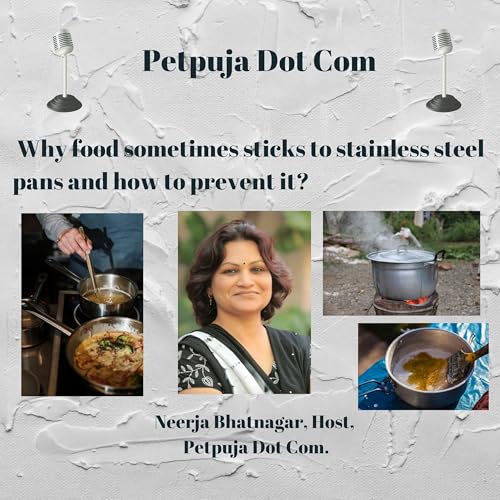
PETPUJA DOT COM cover art

PETPUJA DOT COM

PETPUJA DOT COM

Written by: NEERJA BHATNAGAR
Listen for free

About this listen

This podcast is owned by Neerja Bhatnagar, a food blogger and runs a blog by the same name (https://www.petpuja.org/) for a long time now. She loves to break the myths about food by sharing the science and art behind it. Here you will find facts, trivia, recipes, recent trends, history, stories, science etc. New episode releases on 15th and 30th of every month. You can follow us on the different social media platforms - https://www.instagram.com/awsome_foodie/ https://www.facebook.com/awsome.foodie https://www.petpuja.org/NEERJA BHATNAGAR Art Cooking Food & Wine
Episodes
  • Why does food stick to stainless steel utensils?
    Oct 9 2023

    Welcome to PetPuja Dot Com, the podcast where we explore the fascinating world of food and cooking through a scientific lens. Today, we're diving deep into a topic that everyone has encountered at some point in their cooking journey: why does food stick to stainless steel utensils?

    Cooking is not just an art; it's also a science. The choices we make in the kitchen, from ingredients to utensils, can have a profound impact on the outcome of our dishes. In this episode, we're peeling back the layers of this common kitchen conundrum to understand the science behind why food sticks to stainless steel utensils.

    We'll uncover the mysteries of chemical bonds, the role of temperature, and the secrets to creating that perfect non-stick surface. Whether you're a seasoned chef or just getting started in the world of cooking, this episode will provide you with valuable insights that will elevate your culinary skills.

    So, join us as we embark on this delicious journey into the science of cooking. Get ready to unlock the secrets behind a well-seasoned pan, discover tips to prevent sticking, and gain a deeper appreciation for the magic that happens in your kitchen.

    Welcome to Pet Puja Dot Com, where food meets science, and every bite is a lesson.

    Please do share your suggestions to the email.

    Neerja Bhatnagar

    motivationalmata@gmail.com

    Show More Show Less
    9 mins
  • Cooking Under Pressure: The Science Behind the Amazing Effects of Pressure Cooking on Food
    Sep 25 2023

    Welcome to the Science of Cooking series on our podcast, "Petpuja Dot Com", where we explore the fascinating physics, chemistry, and biology behind everyday dishes. In this episode, we will learn about the science behind pressure cooking, a method of cooking food using high pressure steam. 🍲

    Pressure cooking is not a new invention. It was first developed by a French physicist named Denis Papin in the 17th century. He invented a device called the "digester", which was a sealed pot with a safety valve that could withstand high pressure and temperature. He used it to cook bones and other tough materials in a fraction of the time it would take in a normal pot.

    But how does pressure cooking work? And why does it make food cook faster and more tender? To answer these questions, we need to understand some basic concepts of thermodynamics and chemistry. ( We have covered them in earlier episodes. Pls check.)

    First, let's talk about boiling point. Boiling point is the temperature at which a liquid turns into a gas. For water, the boiling point is 100°C or 212°F at sea level. However, this value changes depending on the atmospheric pressure. The higher the pressure, the higher the boiling point. The lower the pressure, the lower the boiling point.

    This means that when you cook food in a normal pot at sea level, the water can never go above 100°C, no matter how high you turn up the heat. The excess heat escapes as steam. But when you cook food in a pressure cooker, you trap the steam inside the pot and increase the pressure. This raises the boiling point of water to around 120°C or 250°F. This higher temperature allows food to cook faster and more evenly.

    Second, let's talk about collagen. Collagen is a protein that gives structure and strength to animal tissues, such as skin, bones, cartilage, and tendons. Collagen is also what makes meat tough and chewy when it is raw or undercooked. However, when collagen is exposed to high temperature and moisture for a long time, it breaks down into gelatin, a soft and sticky substance that gives meat its juiciness and flavor.

    This means that when you cook meat in a normal pot, you need to simmer it for hours to break down the collagen and make it tender. But when you cook meat in a pressure cooker, you can achieve the same result in minutes, because the higher temperature and pressure accelerate the collagen breakdown.

    So, there you have it: the science behind pressure cooking. In summary, pressure cooking works by increasing the boiling point of water and breaking down collagen faster than normal cooking methods. This results in faster cooking time, more tender meat, and more flavorful dishes.

    If you want to learn more about pressure cooking, check out our website for some delicious recipes and tips. And don't forget to subscribe to our podcast for more episodes on the science of cooking.

    Thank you for listening and happy cooking! 😊

    Neerja Bhatnagar

    petpuja12@gmail.com

    Show More Show Less
    17 mins
  • Chemistry in Cooking
    Sep 17 2023

    🎙️ Welcome to another delectable episode of PetPujaDotCom! 🍽️

    Are you ready to take your culinary skills to the next level? Join us as we embark on a gastronomic journey through the enchanting world of chemical reactions in cooking. 🔍🍳

    In this episode, we'll unravel the science behind what happens in your kitchen when heat meets ingredients. 🧪 From the mesmerizing starch gelatinization that transforms grains into silky goodness, to the protein denaturation that gives your meat that mouthwatering tenderness, and the complex Maillard reaction responsible for the rich flavors in your roasts and bakes, we've got it all covered. 🥖🥩🔥

    But that's not all! We'll also explore the intriguing realm of hydrolysis, a process that unlocks a world of flavors and textures in your dishes.

    Whether you're a seasoned chef or a culinary novice, this episode promises to feed your curiosity and your appetite for knowledge. 🤓🍽️

    Don't miss out on this captivating culinary journey. Tune in now to discover the secret chemistry behind your favorite meals! 🔬👩‍🍳 #CookingChemistry #FoodScience #CulinaryMagic #PetPujaPodcast

    Neerja Bhatnagar

    petpuja12@gmail.com


    Show More Show Less
    21 mins
No reviews yet