Palestine Bookshelf cover art

Palestine Bookshelf

Palestine Bookshelf

Written by: Stephen Heiner
Listen for free

About this listen

Reading and learning about what has really happened in Palestine since 1917. #endtheoccupation2025 Political Science Politics & Government Social Sciences
Episodes
  • Against Our Better Judgement by Alison Weir
    Feb 18 2026
    also viewable on Substack: https://open.substack.com/pub/palestinebookshelf/p/against-our-better-judgement-how Copy of the summary: https://docs.google.com/document/d/1KiBSLYqj5qd2TXU4cE9pLfRGg3Pdis7rd5fwQxwx-Tw/edit?tab=t.b5m4ywn7v93 OVERVIEW The video presents the hidden history of how Zionist lobbying and strategic maneuvers influenced U.S. policy to support the creation and sustenance of Israel, despite strong opposition from American diplomatic, military, and intelligence experts. The host highlights four main takeaways: Israel's dependence on great power backing (first Britain, then the U.S.); Nazi-Zionist collaboration via agreements like Ha'avara; widespread U.S. official opposition to a Jewish state; and Zionist coercion of unwilling Jews to migrate to Palestine. The host describes it as a fascinating, well-documented expose of "plans within plans," reading key historical quotes and passages, expressing reactions like admiration for Zionist cunning mixed with criticism, and tying it to current U.S. complicity in ongoing genocide in Gaza. MAIN THESIS The book and the presenter's commentary argue that the creation of Israel was not driven by U.S. national interests or moral imperatives but by powerful Zionist lobbying that overrode expert warnings, manipulated great powers (Britain during WWI for the Balfour Declaration, then the U.S. post-WWII), involved controversial collaborations (e.g., with Nazis to populate Palestine), suppressed opposition through smears like "anti-Semitic," and coerced Jewish migration—ultimately leading to Palestinian dispossession and long-term U.S. entanglement in conflict. The host frames this as a "special interest" outmaneuvering American principles of self-determination, fueling tragedy in the region and damage to U.S. standing, and inspiring continued advocacy against such policies. HISTORICAL CONTEXT The discussion traces early Zionism's failed attempts to gain Ottoman approval for a Jewish state in Palestine, shifting to Britain amid WWI desperation (high British casualties, failed peace overtures). Zionists promised to sway U.S. Jewish support for Allied entry into the war in exchange for the 1917 Balfour Declaration (favoring a Jewish national home while vaguely protecting non-Jewish rights in a 92% Arab-majority Palestine). Post-WWII, the focus moves to U.S. debates over the 1947 UN partition (opposed as violating self-determination), Truman's decision despite State Department, CIA, and military warnings of regional instability, and Zionist efforts to sideline "Arabists." It connects to broader themes of great power dependency for Israel's survival and actions, echoing prior Palestine Bookshelf reviews on related histories. KEY IDEAS Great power dependency: Israel could not exist or persist (including current actions labeled genocide) without external sponsorship — Britain first, then massive U.S. support. Nazi-Zionist collaboration: The 1933 Ha'avara Agreement transferred Jewish assets to Palestine, breaking boycotts; Nazis sought expulsion, Zionists population growth; propaganda like "A Nazi Visits Palestine" and symbolic medals highlighted irony. U.S. opposition suppressed: Top officials (e.g., Loy Henderson warning of lost moral prestige and endless conflict; Joint Chiefs predicting entanglement; Ambassador Grady on lobbying damage) opposed Zionism as against American values and interests, but faced transfers, smears, and pressure. Forced Jewish migration: Many Jews (especially post-WWII DPs) resisted relocation; Zionists used coercion in camps (ration cuts, floggings, forced education, armed retrieval of orphans from Christian families). Strategic cunning: Zionists' effective, multi-layered tactics (lobbying, secret societies like Parushim involving Brandeis, media influence) outmaneuvered opponents. EVIDENCE AND RESEARCH The presenter relies on direct readings and paraphrases from the book, including Balfour Declaration text, quotes from Samuel Landman (1936 on secret 1916 agreement tying U.S. war entry to Palestine promise), Lloyd George and others confirming Zionist leverage during WWI, Ha'avara details and Nazi propaganda, U.S. officials' memos (Henderson, CIA, Joint Chiefs, Grady, Acheson), Ben-Gurion statements on forced migration and demographics, and reports on camp coercions (e.g., Rabbi Klausner: "the people must be forced"). Extensive endnotes are praised as a "wonderful bibliography." RECEPTION The video positions the book as underappreciated yet explosive, noting its 1950s scandal in Israel over collaboration claims (contributing to government falls, inspiring novels, plays, docudramas). The host stresses its prodigious documentation, concise yet deep value for newcomers and experts, and emotional impact ("you can't make it up," mixed credit for cunning). It counters mainstream narratives, with warnings for heavy content but praise for clarity and sourcing in challenging denial of historical influences. IMPACT AND LEGACY The...
    Show More Show Less
    26 mins
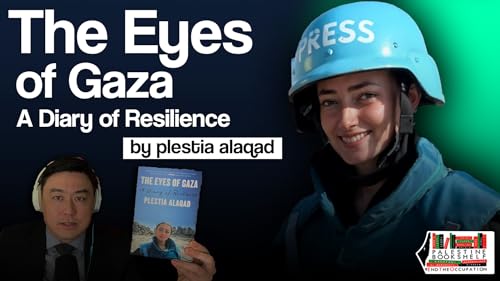
  • The Eyes of Gaza by Plestia Alaqad
    Feb 10 2026

    also viewable on Substack:

    https://open.substack.com/pub/palestinebookshelf/p/the-eyes-of-gaza-a-diary-of-resilience

    Copy of the summary:

    https://docs.google.com/document/d/1KiBSLYqj5qd2TXU4cE9pLfRGg3Pdis7rd5fwQxwx-Tw/edit?tab=t.v06zeiwl7ec0

    OVERVIEW

    The book chronicles her experiences as a young journalist in Gaza starting October 7, 2023, through intense bombing, displacement, evacuation to Australia, and relocation to Lebanon amid continued attacks. The presenter describes it as a powerful, concise (under 200 pages) testament to Palestinian resilience amid what he terms genocide, highlighting everyday humanity, fear, creativity, and survival. He reads key passages aloud, sharing emotional reactions while praising the work's poetic and humanizing quality.

    MAIN THESIS

    The book and the presenter's commentary emphasize that, despite systematic destruction, displacement, and loss in Gaza since October 2023, Palestinians maintain extraordinary resilience, humanity, love, faith, and creativity. Alaqad's diary serves as evidence that people "refuse to let the losses... dictate our future," turning trauma into meaning and survival. The host positions this as inspiration for global advocates in comparatively easier circumstances to support Palestinian causes, while critiquing the normalization of what he calls calculated ethnic cleansing and the world's failure to act justly.

    HISTORICAL CONTEXT

    The discussion centers on the escalation from October 7, 2023, onward, described as a "genocidal period" involving bombing of homes, hospitals, universities, schools, and churches; forced displacement (e.g., over 50,000 from North Gaza); and ongoing attacks even after evacuation (e.g., in Lebanon). References include echoes of Al Nakba (1948) in elders' fears, normalized atrocities, and broader Palestinian suffering. The host connects it to prior works like Children of Shatila, Jenin...Jenin, and Killing Gaza for themes of joy and humanity amid tragedy. No direct October 7 attack details are emphasized; focus is on Gaza's civilian experience.

    KEY IDEAS
    • Resilience amid horror: Palestinians find creative solutions (e.g., using wires as skipping ropes), maintain joy (e.g., in children's eyes despite amputation), and celebrate sacrifices for Palestine.

    • Human stories in crisis: Rescuing a plant for a distressed child; a 5-year-old sole survivor; amputee children dreaming of futures (e.g., Bilsan wanting to teach).

    • Trauma's toll: Survivor's guilt after evacuation; fear louder than words; using English to "escape emotions" as Arabic triggers breakdowns; blocked poetry replaced by "tears on a blank page."

    • Normalized genocide: Basic needs like food/water/shelter become luxuries; world complacency; no "two sides" pretense possible.

    • Immortality and meaning: Honorable death, soul's endurance, constant war but enduring will to live.

    EVIDENCE AND RESEARCH

    The presenter relies heavily on direct readings from Alaqad's diary entries (e.g., hiding in a neighbor's kitchen, reporting on rubble with scattered photos, tent cities near hospitals, lines for water). He references her background as a 21-year-old journalist, her evacuation path, and emotional reflections. Broader context draws from related films/books and personal reactions, with no external primary sources cited beyond the text itself.

    RECEPTION

    The video notes the book's emotional intensity and its role in countering denial/minimization of Gaza's suffering. The host stresses preparation for heavy content but praises its non-sensational, articulate style. The focus is on its power to convey unfiltered Palestinian voices.

    IMPACT AND LEGACY

    The presenter sees the diary as proof of what Plestia calls the Palestinian "trauma glow up" — turning horror into determination and creativity — strengthening advocacy against occupation/genocide. It humanizes individuals, inspires action, and aligns with Palestine Bookshelf's mission of education and fundraising.

    Find other summaries like this at Palestine Bookshelf: www.palestinebookshelf.org

    #EndTheOccupation

    Show More Show Less
    24 mins
  • The Voice of Hind Rajab by Kaouther Ben Hania
    Feb 3 2026
    also viewable on Substack: https://palestinebookshelf.substack.com/p/the-voice-of-hind-rajab-by-kaouther Copy of the summary: https://docs.google.com/document/d/1KiBSLYqj5qd2TXU4cE9pLfRGg3Pdis7rd5fwQxwx-Tw/edit?tab=t.du7723b2pwf9 OVERVIEW The live stream serves as an installment of the "Film Club" series on Palestine Bookshelf, where the host shares thoughts, analysis, and emotional responses after watching the Oscar-nominated film. It focuses on the true story of Hind Rajab, a six-year-old Palestinian girl killed in Gaza on January 29, 2024, during the ongoing conflict. The film uses real audio recordings of Hind's desperate phone calls for help as its core element, blended with dramatized reconstructions of events involving first responders, ambulance dispatchers, and others affected. The presenter describes it as emotionally intense and draining but artistically powerful and respectful, emphasizing its role in humanizing the broader Palestinian experience under occupation and what he frames as genocide in Gaza. MAIN THESIS The film and the presenter's commentary center on using Hind's preserved voice and final moments to expose the human cost of Israel's military actions in Gaza, particularly the killing of civilians (including children) and first responders, and the absurd, deadly "coordination" required with the occupying forces to attempt rescues. The presenter argues that Hind's case stands out due to the rare audio evidence (unlike thousands of other child victims), which allows the tragedy to "speak" directly and spark global awareness. He critiques the systemic brutality—IDF claims of precision strikes contrasted with documented targeting of ambulances and rescuers—and positions the film as a catalyst for questioning the occupation's history and legitimacy, while praising its restrained, articulate storytelling that avoids sensationalism. HISTORICAL CONTEXT The discussion ties Hind's death to the broader Israel-Palestine conflict, starting from the escalation following October 7, 2023, through the ongoing war in Gaza (referred to as genocide/occupation). Specific references include: Hind's family being killed, her hiding in a car at the Fares gas station in an enclosed/militarized zone, and her repeated pleas ("Come help me, please. I'm scared."). Past incidents, such as child killings during the First Intifada, to show this is not isolated. Attacks on humanitarian workers (e.g., ambulances shot despite coordination and visibility). Broader themes: Zionist/Israeli tactics, protests against Palestine-related films (e.g., No Other Land), and the physiological/trauma effects on Palestinians (drawing from the book The Eyes of Gaza by Plestia Alaqad, mentioning stress-induced fainting, rashes, etc.). KEY IDEAS The "spiderweb effect": Hind's death ripples outward, affecting dispatchers (e.g., Rana fainting from grief/exhaustion), first responders, journalists, and audiences worldwide. Absurdity of rescue coordination: Victims/rescuers must beg permission from the same forces attacking them; an 8-minute drive becomes impossible due to delays and dangers. Filmmaking approach: Blends real audio with dramatized scenes in confined spaces (like a dispatch office or balcony), creating tension akin to a stage play (compared to 12 Angry Men). Includes Hind's innocent details—mentioning her "butterfly class," reciting Quran prayers in call-and-response, and family beach videos at the end. Distribution challenges: Limited theatrical release due to protests/threats, but praised for Oscar nomination and respectful involvement of Hind's family. Advocacy tie-ins: The Hind Rajab Foundation pursues war crimes cases (e.g., in Belgium against dual nationals), as Israel does not prosecute its own. EVIDENCE AND RESEARCH The presenter relies on the film's content: Hind's actual audio recordings (which went viral on social media and inspired the director to pivot from another project), director interviews (Ben Hania describing the recordings as a personal call to action), post-screening Q&A with volunteer Alexis Boren (conflict resolution worker in Gaza/West Bank), and visual/dramatized elements showing events. References to IDF actions are drawn from documented incidents of targeting aid workers despite tracking/precision claims. CONTROVERSY AND RECEPTION The film faces barriers to wider release due to protests against Palestine-related cinema. The presenter notes its power to start conversations for those new to the conflict's history, commends its non-threatening tone, and contrasts it with denial or minimization of atrocities. He highlights emotional toll but stresses preparation (e.g., via audio exposure first) to handle it. IMPACT AND LEGACY The presenter views the film as a "crack in glass"—spreading awareness and strengthening arguments against the occupation. It humanizes Palestinians, showcases artistic courage (filmed quickly ~2 years after the event), and supports ongoing advocacy. ...
    Show More Show Less
    20 mins
No reviews yet