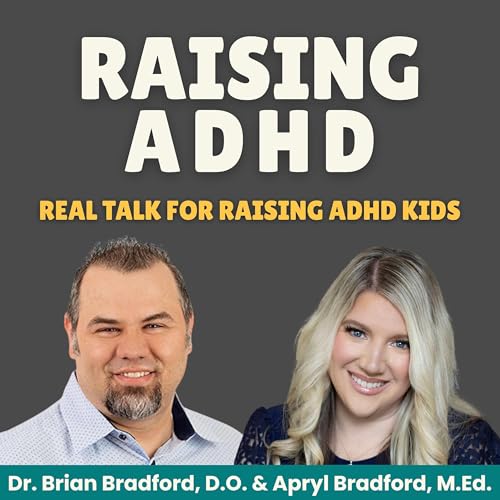
Raising ADHD: Real Talk For Parents & Educators cover art

Raising ADHD: Real Talk For Parents & Educators

Raising ADHD: Real Talk For Parents & Educators

Written by: Dr. Brian Bradford & Apryl Bradford
Listen for free

About this listen

Raising a child with ADHD can feel overwhelming—meltdowns, school struggles, medication decisions, and the constant fear you’re doing it wrong. Raising ADHD is the podcast for parents and teachers who want clarity, strategies, and real-life support.


Hosted by Apryl Bradford, M.Ed. (former teacher and ADHD mom) and Dr. Brian Bradford, D.O. (Child & Adolescent Psychiatrist), this show cuts through the myths and misinformation about Attention-Deficit/Hyperactivity Disorder. Together, Apryl and Dr. Bradford bring both lived experience and clinical expertise to help you:


  • Understand what ADHD really is (and isn’t)
  • Navigate school challenges and partner with teachers
  • Make sense of medication options without the jargon
  • Support your child’s strengths while tackling everyday struggles
  • Feel less alone and more empowered on this journey


Each week, you’ll hear practical tips, the latest insights from the field, and conversations that validate what you’re living through. Whether you’re dealing with emotional outbursts, executive function challenges, or the stigma that still surrounds ADHD, you’ll find real talk and real help here.


If you’ve ever asked yourself, “Am I doing this right?”—this podcast is your answer.

Disclaimer: This podcast is for educational and informational purposes only. It is not medical or psychiatric advice and should not replace professional consultation with a qualified healthcare provider. Always seek the advice of your physician or other licensed professional with any questions you may have regarding your child’s health or behavior.

© 2026 Raising ADHD: Real Talk For Parents & Educators
Hygiene & Healthy Living Parenting Psychology Psychology & Mental Health Relationships
Episodes
  • Why Your ADHD Child Thinks "I'm the Problem" (And How Repair Changes Their Identity)
    Jan 12 2026

    Send us a text


    ADHD kids hear "I'm the problem" on repeat. Learn why repairing after yelling rewrites that story—and what to do when your child won't engage.

    ________________________________________

    There's a sentence ADHD kids learn really early. They don't usually say it out loud, but they're living it internally: I'm the problem.

    Not "that was hard." Not "that didn't go well." But something is wrong with me.

    Here's what the research says: it's not the conflict that damages your relationship—it's the unrepaired conflict. And for kids with ADHD, who've already received thousands more corrections than their peers by elementary school, those unrepaired moments stack into an identity.

    In part two of our repair series, we're going deeper into why repair matters so much for the ADHD brain—especially when rejection sensitivity makes yelling feel like proof they're unlovable.

    In this episode, you'll learn:

    • The critical difference between shame and guilt (and why it matters for ADHD)
    • Why your child refuses to accept your apology (it's protection, not defiance)
    • How to repair when your kid shuts down or says "I don't care"
    • The nonverbal repairs that count just as much as words
    • Language shifts that protect your child's identity
    • Signs that your repair actually worked

    Walk away knowing that every repair—even the ones your child doesn't respond to—becomes data they'll use to trust you again.

    KEY TAKEAWAYS

    • The Shame vs. Guilt Distinction
    • Why Kids Refuse Repair (3 Reasons)
    • How to Repair When They Won't Engage
    • Nonverbal Repairs That Count
    • The Identity-Protecting Language Shift

    Why This Matters for ADHD

    By late elementary school, kids with ADHD have received thousands more negative corrections than their peers. These aren't neutral—they stack into an identity of "I am the problem." Consistent repair doesn't erase consequences; it changes the story from "I am bad" to "that was hard."


    RESOURCES MENTIONED

    • Free Mini Course: Calm the Chaos: The ADHD Parent Reset
    • Related Episode: Part 1 – Stop Sitting in Mom Guilt: How to Repair with Your ADHD Child After You Lose It
    • Related Episode: Why Small Things Trigger Big Meltdowns: How Rejection Sensitivity Dysphoria Hijacks ADHD Brains
    • Related Episode: When ADHD Anger Turns Destructive: Why Punishment Makes It Worse (And What Actually Works)
    Show More Show Less
    27 mins
  • Stop Sitting in Mom Guilt: How to Repair with Your ADHD Child After You Lose It
    Jan 7 2026

    Send us a text

    Yelled at your ADHD child and feel awful? Learn the 5-step repair system that protects your child's self-esteem and actually strengthens your relationship.

    _______________________

    The explosion is over. The house is quiet. Your kid has disappeared into their room, and you're standing there with a pit in your stomach, replaying the look on their face and asking yourself the question no parenting book prepared you for: Am I ruining my kid?

    Here's what you were never taught: the yelling isn't what damages the relationship. It's what happens—or doesn't happen—afterward.

    In this episode, Apryl and Dr. Brian Bradford break down the neuroscience behind why your child can't "learn their lesson" during a blowup (spoiler: their thinking brain is literally offline), and walk you through the exact 5-step repair process that protects your child from developing a shame-based identity.

    Because ADHD kids already hear thousands more corrections than their peers by elementary school. They don't need perfection from you. They need repair.

    You'll learn:

    • Why secure attachment is built through rupture AND repair—not by never messing up
    • The brain science behind why consequences don't work when your child is dysregulated
    • The 5-part repair system you can use tonight (with exact scripts)
    • How to apologize without giving in on your boundaries
    • The "do-over" technique for catching yourself before it escalates
    • Why this one shift can change your child's internal story from "I'm bad" to "I'm learning"

    If you've been carrying guilt about losing your temper, this episode will feel like someone finally handed you the missing manual.


    RESOURCES MENTIONED

    • Free course: "3-Second Calm Reset" at raisingadhd.org/calm
    • Previous episode: When ADHD Anger Turns Destructive: Why Punishment Makes It Worse (And What Actually Works)
    • ADHD Alien comic
    Show More Show Less
    23 mins
  • When ADHD Anger Turns Destructive: Why Punishment Makes It Worse (And What Actually Works)
    Dec 29 2025

    Send us a text

    Destructive anger in ADHD kids is one of the most misunderstood, shame-loaded experiences parents face. The advice most families are given — harsher consequences, bigger punishments, “making it stop” — often makes these episodes happen more often, not less.


    In this episode, Apryl and Dr. Brian walk through what’s actually happening in the ADHD brain during these moments — and the system that helps families stop the cycle without becoming permissive or powerless.

    Thoughts parents have that this episode answers

    • “If I don’t punish this hard, am I raising a future adult who can’t control themselves?”
    • “Why does my kid destroy things over something so small?”
    • “Nothing works — consequences, lectures, taking things away.”
    • “Am I being too soft… or am I missing something?”

    You’re not weak for asking those questions. You’re responding to a nervous system problem with tools that were never designed for ADHD brains.

    What This Episode Walks You Through

    1. Why logic disappears during ADHD anger explosions

    • What’s happening in the amygdala vs. the prefrontal cortex
    • Why reasoning, lecturing, and threats cannot work in the moment
    • The difference between knowing better and being able to do better

    2. The system that reduces destructive behavior over time

    • How to interrupt explosions before they happen
    • Why antecedents matter more than consequences
    • The “positive opposite” strategy that teaches replacement behaviors

    3. Consequences that teach — without escalating the fire

    • Why harsh punishment increases aggression and dysregulation
    • What accountability looks like for ADHD kids
    • How small, boring, predictable consequences actually stick

    4. How this changes for teenagers

    • Why dignity, privacy, and agency matter more as kids get older
    • How to collaborate instead of control
    • What repair sounds like after the storm — without shaming

    5. What teachers can do to prevent public blowups

    • Simple classroom strategies that protect regulation and self-esteem
    • How to intervene quietly before the explosion
    • Why predictability lowers threat for ADHD students

    Why this approach works when others fail

    Most parenting advice treats explosive anger as a behavior problem.
    This episode treats it as a nervous system overload — and responds with strategies that work with ADHD brains instead of against them.

    This isn’t permissive parenting.
    It isn’t “being soft.”
    It’s strategic, research-aligned, and focused on building skills your child will carry into adulthood.

    Want to go deeper?

    • Share this episode with a partner, teacher, or caregiver who needs the full picture
    • Subscribe so you don’t miss the next episode on repairing after blowups
    • Leave a review — it helps other ADHD families find support that actually helps

    You’re not failing.
    You’re learning a different way to lead — because you have a different kid.

    Show More Show Less
    35 mins
No reviews yet