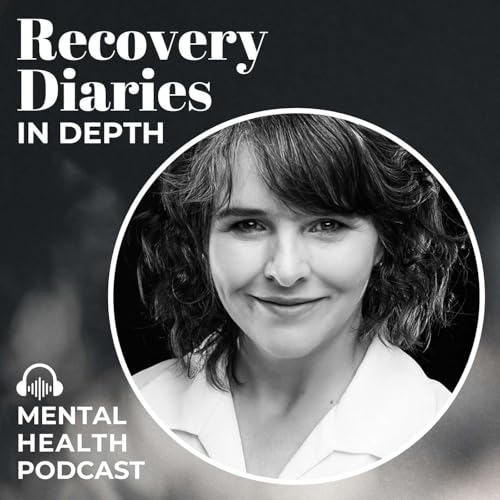
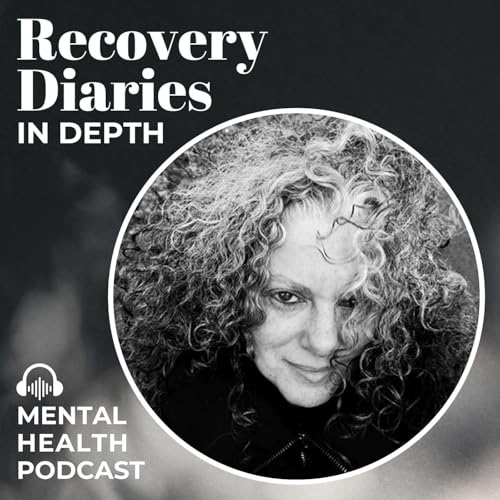
• From Hiding To Helping - Schizophrenia Advocate Rebecca Chamaa | RDID; 206
    Jan 12 2026

    At a recent conference for health advocates from all across the country, our Executive Director and show host, Gabriel Nathan, was reunited with an extraordinary woman and schizophrenia advocate, Rebecca Chamaa. Years earlier, in around 2015, Rebecca had submitted her very first essay, I Have Schizophrenia, about living with mental illness to Recovery Diaries and Gabe, who had just joined the organization as a part-time essay editor, was assigned to work on her piece with her.

    It would take ten years for these two mental health advocates to be physically in the same room and share a warm hug and conversation. So, obviously, Rebecca was going to be a guest on Recovery Diaries in Depth! As you can imagine, she and Gabe had lots to talk about. Rebecca revealed during the conversation about how long (very, very long) she hid her schizophrenia from so, so many people in her life, her experiences with therapists and psychiatrists, medication, and stigma. Rebecca is breathtakingly blunt as she explores her education and outreach, training law enforcement officers and psychiatric nursing staff about schizophrenia and how to safely and helpfully interact with people who live with thought disorders.

    The highlight of the interview, arguably, is Rebecca's reaction to her now decade-old essay on Recovery Diaries; in quiet disbelief at how honest she was during that time. The piece obviously opened the floodgates for Rebecca, because now she has been published in numerous magazines, journals, and newspapers; she teaches writing and she finds joy in life as a person living with schizophrenia who isn't keeping it from anybody, who isn't ashamed of it, and who isn't staying quiet. Please listen to her wonderful interview and share it far and wide; it might just change how somebody sees people with schizophrenia.


    Conversations like the ones on this podcast can sometimes be hard, but they’re always necessary. If you or someone you know is struggling, please consider visiting wannatalkaboutit.com. If you or someone you know is considering suicide, please call, text, or chat 988.

    https://recoverydiaries.org/

    Show More Show Less
    57 mins
  • Surviving Suicidality in a Wonderful World: Javier Ortega-Araiza | RDID; 205
    Dec 22 2025

    Javier Ortega Ariza is a compassionate, sensitive writer who has published two essays with Recovery Diaries, including his moving and powerful essay “Surviving Suicidality To Live In A Wonderful World” which explores a "last walk" he took after deciding to die by suicide, and his beautiful decision to stay. Javier reads this essay aloud on this compelling episode of our podcast, "Recovery Diaries in Depth", which explores men’s mental health, suicidality, hope, resilience, and the bravery of mental health storytelling. Javier and Gabe are two men who have personal experience with contemplating suicide and this intimate and vulnerable conversation is well worth hearing, and sharing.

    Javier sees writing as "exposure therapy"; going to uncomfortable places in his writing to share hope and connection with others. There is a gentleness about him that is undoubtedly the result of how he has decided to view the world; as wonderful and hopeful. He is challenging self-critical voices in his head and working through doubt and fear every day, and helping others do the same.

    In his discussion with Gabe, Javier reflects on what has helped him get and stay healthy; therapy, boundaries, ho‘oponopono, and the not-quite-cinematic text message that arrived mid-walk to remind him of the work and the love that keep him here. Returning to San Miguel years later, he carries the same streets but different eyes, proof that healing isn’t linear and growth can coexist with grief.

    Javier is a living, breathing reminder that, if you stay, your life can change in ways you never dreamed possible. This important conversation should be shared with anyone you know who may be struggling, and anyone you know who appears, like Javier did when he was at his darkest, to have it all, and may very well be struggling in silence. Subscribe, share this with someone who needs it, and leave a review to help more people find stories that keep them here.


    Conversations like the ones on this podcast can sometimes be hard, but they’re always necessary. If you or someone you know is struggling, please consider visiting wannatalkaboutit.com. If you or someone you know is considering suicide, please call, text, or chat 988.

    https://recoverydiaries.org/

    Show More Show Less
    53 mins
  • Living & Thriving with Illogical and Irrational Anxiety: Nicci Attfield | RDID; 204
    Dec 8 2025

    We are so lucky here at Recovery Diaries to have an international community of special, sparkly people coming to us to share their mental health recovery stories. Today's guest on the show is Nicci Attfield, who lives with anxiety and add. Nicci was born in the UK, and is currently living in South Africa. She has published two personal essays with us, (as has her husband, Jacques!) and it was a true delight to sit down with her and talk about her life as a writer, a neurodivergent person, and someone who is living her best life with mental health challenges.

    Nicci opens up about something that any of us who lives with mental illness can identify with; masking. Walking around all day, doing life, engaging in social situations trying to compensate, trying to pass, trying to get through every excruciating moment pretending, pushing through, struggling. It's exhausting. And, for quite some time, Nicci didn't even know what she was masking.

    Nicci tried apps, she tried denial, but it ended up being therapy that helped her find her voice; and she hasn't stopped using it. She opens up about what it is like to find her truth and live a life with self-compassion. She also talks openly about being a spouse of someone who has a trauma history and about her unique approach to helping her husband when he is struggling with an often debilitating, abusive internal monologue. Her strategies might just help you navigate hard times with someone you love!

    Nicci reads her beautiful and poignant essay, "Anxiety: Irrational, Illogical, Catastrophic and, Eventually; Manageable" and she reflects on who she was and where she was in her life when she wrote it, how her newer diagnosis of ADD has informed and changed her approach to her mental health and herself, and what lies ahead for her. Listen to this warm and engaging conversation between two thoughtful human beings, and share it with someone special in your life.


    Conversations like the ones on this podcast can sometimes be hard, but they’re always necessary. If you or someone you know is struggling, please consider visiting wannatalkaboutit.com. If you or someone you know is considering suicide, please call, text, or chat 988.

    https://recoverydiaries.org/

    Show More Show Less
    59 mins
  • A Black Mental Health Advocate & Survivor Speaks: Jasmin Pierre | RDID; 203
    Nov 17 2025

    Jasmin Pierre is the creator of The Safe Place, an award-winning app that offers free and affordable resources centering on Black mental health. Jasmin created The Safe Place for so many reasons-- because, when police respond to psychiatric emergencies and the person in crisis is black, the results can be deadly. Because of the pervasive and dangerous philosophy in many Black homes, like her own, that "what happens in this house stays in this house." Because of cultural barriers fueled by systemic racism and lack of access creating a world where there are precious few Black mental health clinicians, so Black people are stuck with providers who don't look like them, and who, invariably, do not understand their experience. Because so many Black people were brought up to not talk about it.

    Well, Jasmin's talking about it. And, today, she's talking about it on Recovery Diaries in Depth with our Executive Director and host, Gabriel Nathan. Jasmin and Gabe are old friends, having met in-person at an event almost seven years ago. Their shared passion for mental health reform and revolution, and their mutual affection for each other's creativity and compassion is evident in this genuine conversation that covers so many topics, including crisis response, childhood sexual assault and abuse, the importance of rest and refueling, saying "no", and the carceral realities of inpatient psychiatric hospitalization. Jasmin's been a patient, Gabe's been staff, and their shared experience, though extremely different brings nuance and insight to this conversation.

    Jasmin has been a fierce advocate for Black mental health and a source of inspiration and hope for many who have been marginalized in so many ways since the beginning of this country. In their conversation, Jasmin and Gabe talk about suicide prevention, specifically as it relates to the Black community. Jasmin speaks about the inherent media bias surrounding the recent death of Kyren Lacy, a former Louisiana State University football player and wide receiver. Lacy's death, and the media maelstrom around it show us that, while we have made improvements in mental health and suicide; for Black people in America, we still have miles and miles and miles to go before we sleep. We are so grateful to Jasmin for everything she is doing to empower, educate, help, and honor through her extraordinary advocacy. Read her powerful essay about her own trauma and childhood sexual abuse; and share her interview far and wide.

    Conversations like the ones on this podcast can sometimes be hard, but they’re always necessary. If you or someone you know is struggling, please consider visiting wannatalkaboutit.com.


    https://recoverydiaries.org/

    Show More Show Less
    1 hr and 2 mins
  • Police Officer Trauma & PTSD: Officer James Jefferson | RDID; 202
    Oct 27 2025

    Officer James Jefferson, an 18-year police service veteran and wellness coordinator in Canada, is done with the "blue wall of silence." He speaks openly, candidly, honestly, and earnestly about mental health issues in law enforcement, and the series of events that almost resulted in him killing himself with his service weapon. Why? To help other officers who are struggling, just like he did.

    On a wintry night, years ago, James and his partner responded to a homicide-in-progress call. The suspect advanced on the officers, refusing to drop his knife and James and his partner were forced to use lethal force. It was ruled a clean shoot, but that didn't help ease James's mind. He began to fell apart, he began to use drugs and alcohol. He threw caution to the wind, engaging in risky, dangerous behaviors, hoping he would be killed in the line-of-duty and be valorized a hero. He put his gun to is head, like so many other police officers do. Thankfully, James didn't pull the trigger. He got help. And now he's helping others.

    In our candid conversation with James, we put police culture under the microscope and examine its many faults, how its archaic and stigmatizing attitudes towards mental health contribute to officers, and retired officers, taking their own lives. James knows this world all-too-well and, as a wellness officer, he is part of the change that is so desperately, and we're so grateful that he is. Listen to this engaging conversation, and share it with someone you love; whether they wear a badge or not.

    Conversations like the ones on this podcast can sometimes be hard, but they’re always necessary. If you or someone you know is struggling, please consider visiting wannatalkaboutit.com.

    https://recoverydiaries.org/

    Show More Show Less
    53 mins
  • From Squalor and Fear to Thriving and Helping; an Interview with Psychotherapist Sheri Heller | RDID; 201
    Oct 7 2025

    Sheri Heller is many things. She is a psychotherapist, a coach, an interfaith minister, and a supremely talented writer. She is also a trauma survivor, having been raised in the chaos and pain of a home where her mother was suffering from chronic paranoid schizophrenia. Sheri wrote the piece, “An Orphan’s Memorial to Her Dying Mother” and sent it to us, years ago. Our filmmaker, Glenn Holsten, was so moved by the piece that he collaborated with Sheri and animators Sandra & Paul Fierlinger to create a beautiful animated short about her relationship with her mother.

    On our podcast, Sheri talks about how creative expression—writing, psychodrama, performance—can open doors to healing. She offers practical markers of readiness, why a stable witness matters, and how to pace work when somatic memory surges past your defenses.

    We also dig into the broken architecture of mental health care: fragmented services, prohibitive costs, and the patchwork of county policies that make crisis responses inconsistent. Sheri recounts the plainspoken guidance NAMI gave her—advice that balanced compassion with realism—and how it reshaped her approach to caregiving and self-preservation. Her story arrives in the present with a quiet kind of hope: sobriety, a marriage rooted in mutual understanding, a steady practice in Montreal, and the capacity to regulate and re-center when old echoes return. Listen, and share.

    Conversations like the ones on this podcast can sometimes be hard, but they're always necessary. If you or someone you know is struggling, please consider visiting www.wannatalkaboutit.com. If you or someone you know is considering suicide, please call, text, or chat 988.

    https://recoverydiaries.org/

    Show More Show Less
    57 mins
  • Mental Health On The High Seas: A Conversation with Writer/Filmmaker Stephen O'Shea | RDID; 124
    Sep 15 2025

    The most dangerous period for a veteran isn't during during enlistment, but that first year after leaving the military; and the danger almost exclusively comes from the self; a severely elevated risk for suicide. In fact, the suicide rate for non-combat veterans is higher for those who have been in active combat.

    When Navy veteran Taylor Grieger survived a suicide attempt, he made a radical decision—to sail around Cape Horn, the Mount Everest of sailing, to raise awareness for veteran suicide. His close friend Stephen O'Shea joined, not just to document the journey, but to support Taylor, to learn, to help. By doing so, together, Taylor and Stephen created an extraordinary journey and the powerful film "Hell or High Seas." Several short clips related to this extraordinary film live on our site, and are available to view here and here.

    Our conversation with writer and filmmaker Stephen O'Shea takes us deep into the invisible wounds of military service and the profound challenges of transition to civilian life. Stephen shares how veterans' bodies become programmed for adrenaline and stress during service, creating a physiological withdrawal when that environment suddenly disappears. The sailing journey wasn't just adventure for adventure's sake—it was carefully conceived as therapeutic, giving Taylor's body and mind positive associations with stress and excitement rather than negative ones.

    Stephen speaks with authority, energy, and empathy about the plight faced by veterans, but also about his relationship with Taylor and the impact on his own mental health of what they went through together. Stephen's candid sharing about his own mental health struggles after the journey reveals how even a fraction of the stress experienced by service members can create lasting impacts. Their story illustrates why adventure therapy is gaining recognition worldwide—it combines community, purpose, and physical challenge in ways that address the complex dimensions of trauma and transition.

    Today, Taylor runs his own nonprofit, taking veterans sailing as therapy-- "adventure therapy"-- clearly demonstrating how one healing journey can create ripples, on the high seas, that help countless others and Stephen continues making films that are helping to change the world.


    "Hell or High Seas" is available on Amazon Prime. And if you're passionate about mental health stories that inspire hope and change, subscribe to Recovery Diaries for more conversations that illuminate the path from struggle to strength.

    Conversations like the ones on this podcast can sometimes be hard, but they’re always necessary. If you or someone you know is struggling, please consider visiting wannatalkaboutit.com.

    https://recoverydiaries.org/

    Show More Show Less
    49 mins
  • A Vibrant Voice with DID Explores Trauma through Writing | RDID; 123
    Sep 1 2025

    Elizabeth Ann Devine is a non-binary author living with ADHD, PTSD, OCD, and dissociative identity disorder. They have been twice published on Recovery Diaries, and we were delighted to welcome them onto Recovery Diaries in Depth to share their powerful journey of using writing as both survival mechanism and healing practice.

    From early childhood, Elizabeth found sanctuary in libraries, using books and later their own writing as ways to process trauma and family dysfunction. "I probably write more than I live," they admit, highlighting a compulsive creative practice that became essential when other avenues for support proved inaccessible or harmful.


    Their essay "The Plight of the One-Person Mental Health Support System" offers a raw, unfiltered glimpse into living with complex mental health challenges while navigating family relationships shaped by generational trauma. "It's like popping a zit" Elizabeth says about writing, and some of its consequences of breaking family cycles of secrecy, including estrangement and lost relationships.

    "I'm compulsively honest," they say about themselves. Elizabeth has chosen to share their experiences publicly not just for personal healing but to create connection points for others facing similar struggles. The conversation touches on how broader political contexts impact mental health, particularly for marginalized communities, while still finding ways to choose "hope over fear" through daily practices of self-care, creativity, and helping others.

    Elizabeth's essays are as creative as they are brave, and we are honored to have them as part of our community of mental health storytellers. Subscribe to our podcast for more conversations that illuminate the complex, challenging, and ultimately hopeful journeys of recovery.


    Conversations like the ones on this podcast can sometimes be hard, but they’re always necessary. If you or someone you know is struggling, please consider visiting wannatalkaboutit.com.


    https://recoverydiaries.org/

    Show More Show Less
    47 mins