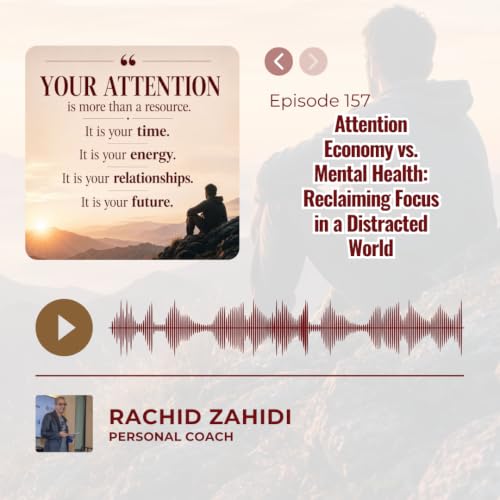
• Attention Economy vs. Mental Health: Reclaiming Focus in a Distracted World
    Jun 19 2026
    How to Protect Your Attention, Reduce Digital Overload, and Build Greater Mental Resilience We live in a world where every notification, headline, app, and algorithm is competing for one thing—our attention. While technology has created incredible opportunities for connection, learning, and convenience, it has also introduced a new challenge: chronic distraction. In this episode of Resilience Across Borders, I explore the growing impact of the attention economy on our mental health and why protecting your focus has become one of the most important resilience skills of our time. Your attention influences your thoughts, your emotions, your behaviors, and ultimately the quality of your life. Yet many of us unknowingly allow external distractions to dictate where our energy goes each day. I share practical, realistic strategies for reclaiming your focus without abandoning technology. From auditing your attention habits and reducing notifications to creating device-free zones and scheduling intentional digital detoxes, this episode provides a simple roadmap for taking back control of your mind. Whether you're looking to improve productivity, strengthen relationships, reduce stress, or simply feel more present in your daily life, these tools can help you become more intentional with one of your most valuable resources—your attention. 🎓 What You'll Learn in This Episode: Understanding the Attention Economy: Learn how social media platforms, apps, advertisers, and digital services are designed to compete for your focus and keep you engaged for longer periods. The Mental Health Cost of Constant Distraction: Discover how interruptions, notifications, and endless scrolling contribute to stress, anxiety, mental fatigue, and reduced productivity. The Attention Audit Method: A practical approach to identifying where your time and focus are currently being spent and recognizing habits that no longer serve you. Building Attention-Friendly Environments: How simple changes to your surroundings can significantly improve concentration and reduce the urge to constantly check your devices. The Power of Single-Tasking: Why multitasking drains mental energy and how focusing on one task at a time improves both effectiveness and well-being. Creating Healthy Digital Boundaries: Strategies for implementing digital sabbaths, phone-free mornings, and intentional technology use without feeling disconnected. Reclaiming Boredom and Creativity: Why moments of stillness and boredom are essential for creativity, reflection, problem-solving, and mental clarity. 💡 Key Takeaways: Your attention is one of your most valuable assets in today's world. Every notification competes with your current priorities and pulls energy away from what matters most. Mental resilience requires intentional focus, not perfect discipline. Technology is not the problem; unconscious technology use is. Small daily habits can dramatically improve your ability to concentrate and stay present. Device-free moments strengthen relationships and deepen meaningful conversations. Boredom often creates the space where creativity, reflection, and problem-solving emerge. The quality of your attention directly influences the quality of your life. 🧘 Practical Reflections How many times do you pick up your phone each day without a specific purpose? Which apps consume the most of your time, and do they truly improve your life? What notifications can you disable today to create more mental space? Where could you create a device-free zone in your home or workplace? When was the last time you spent time without a screen, simply observing your surroundings? What would change if you protected the first and last 15 minutes of your day from digital distractions? 💬 Quotes from the Episode "In today's digital world, your attention has become one of the most valuable commodities on the planet." "The challenge isn't technology itself. The challenge is using technology without allowing it to use us." "Protecting your attention is no longer simply a productivity strategy. It has become a mental health necessity." "Your attention is more than a resource. It is your time. It is your energy. It is your relationships. It is your future." "The quality of your attention shapes the quality of your life." "One of the most powerful acts of resilience is deciding what deserves your focus." Featured Tool The EMO Gym Journal (Emotional Gym) A guided workbook designed to help you gain clarity, stay focused on your priorities, build better habits, and track both growth and rest. Resources & Links 📘 EMO Gym Journal — Available on Amazon 🌐 Blog & Episodes: atresilience.com 🎧 Resilience Across Borders Podcast — New episodes weekly If this episode resonated with you, please: Share it with someone who needs permission to pause Leave a review to help others find the podcast Subscribe so you don't miss ...
    Show More Show Less
    15 mins
  • Daily Habits of Emotionally Resilient People: Building Emotional Fitness That Lasts
    Jun 12 2026
    How to Build Emotional Strength Through Small Daily Habits That Transform Your Resilience Most people think resilience is something you either have or you don't. But in reality, resilience is built quietly, day by day, through the habits you repeat when no one is watching. In this episode of Resilience Across Borders, I break down what I call emotional fitness—the daily practices that shape how you respond to stress, setbacks, and uncertainty. Not theory, not motivation hype, but practical patterns that strengthen your nervous system, your mindset, and your ability to recover faster when life hits hard. What stood out to me recently is this: the habits linked to happiness are almost identical to the habits linked to resilience. That means emotional strength is not a personality trait—it's a trained response. From protecting your sleep and choosing your environment wisely to learning to pause rather than react, this episode walks through nine foundational habits that help you become more grounded, more adaptable, and more in control of your internal state. Because at the end of the day, the strongest people aren't the ones who avoid falling. They're the ones who've trained themselves to rise again—calmly, consistently, and without losing themselves in the process. 🎓 What You'll Learn in This Episode: Why resilience is built through small daily habits, not personality traits How emotional fitness works like physical training for your mind and nervous system The power of pausing between stimulus and response instead of reacting instantly Why sleep is one of the most overlooked tools for emotional stability How your environment and relationships directly shape your resilience Why laughter is a physiological reset for stress and emotional overload The difference between being productive and being truly purposeful How journaling helps you process emotions instead of suppressing them Why self-compassion is stronger than self-criticism for long-term growth How physical care (movement, nutrition, breathing) supports emotional strength. The importance of meaning, connection, and perspective during difficult seasons 💡 Key Takeaways: Resilience is trained through repetition, not built in a single moment Your nervous system needs recovery as much as your mindset needs motivation You don't rise to your intentions—you fall to your daily habits Emotional space between trigger and response is where real control lives The people around you either strengthen your resilience or drain it Purpose gives you endurance when motivation disappears Journaling turns emotional weight into clarity and structure Self-talk either builds resilience or quietly destroys it over time Your body is not separate from your emotional state—it carries it Meaning transforms suffering into something you can grow through 🧘 Practical Reflections Resilience is trained through repetition, not built in a single moment Your nervous system needs recovery as much as your mindset needs motivation You don't rise to your intentions—you fall to your daily habits Emotional space between trigger and response is where real control lives The people around you either strengthen your resilience or drain it Purpose gives you endurance when motivation disappears Journaling turns emotional weight into clarity and structure Self-talk either builds resilience or quietly destroys it over time Your body is not separate from your emotional state—it carries it Meaning transforms suffering into something you can grow through 💬 Quotes from the Episode "What if resilience is actually built through small daily habits that most people overlook?" "The people who recover fastest from setbacks aren't necessarily the strongest." "Resilience isn't built in one heroic moment. It's built in a thousand ordinary moments." "You cannot build resilience on an exhausted nervous system." "The strongest people aren't the ones who never fall. They are the ones who practice getting back up every day." Featured Tool The EMO Gym Journal (Emotional Gym) A guided workbook designed to help you gain clarity, stay focused on your priorities, build better habits, and track both growth and rest. Resources & Links 📘 EMO Gym Journal — Available on Amazon 🌐 Blog & Episodes: atresilience.com 🎧 Resilience Across Borders Podcast — New episodes weekly If this episode resonated with you, please: Share it with someone who needs permission to pause Leave a review to help others find the podcast Subscribe so you don't miss future episodes Remember: be kind to yourself, be kind to others—and stay resilient. 🌊✨
    Show More Show Less
    11 mins
  • Difference Between Necessary Pain and the Mental Loops
    Jun 5 2026
    How to Stop Replaying the Past, Break Free from Mental Loops, and Build Emotional Resilience In this episode of Resilience Across Borders, Rachid Zahidi explores the powerful distinction between "clean pain" and "dirty pain." Clean pain is the natural emotional response to a difficult event. Dirty pain is the additional suffering created through rumination, catastrophizing, self-judgment, resistance, and repetitive emotional replay. Drawing on neuroscience, emotion regulation research, predictive processing theory, and nervous system science, Rachid explains why the brain often struggles to distinguish between a real threat and a remembered one, and how this keeps many people trapped in cycles of stress long after the original event has passed. You'll learn how the brain's threat-detection systems can reinforce painful memories, why unresolved stress responses often become physical symptoms, and how identity-based thinking can transform temporary setbacks into long-term emotional burdens. Most importantly, this episode offers practical strategies for processing pain in healthy ways, interrupting destructive thought patterns, regulating the nervous system, and building the resilience needed to move forward without carrying unnecessary suffering. Whether you're recovering from a personal loss, navigating professional setbacks, rebuilding after disappointment, or simply looking to strengthen your emotional well-being, this episode provides a practical framework for keeping pain clean and preventing it from becoming a permanent part of your identity. 🎓 What You'll Learn in This Episode: The Clean Pain vs. Dirty Pain Framework: Understanding the difference between necessary emotional pain and the additional suffering created by mental habits. The Predictive Brain Effect: How past experiences influence your brain's expectations and shape your emotional reactions to future events. Why Rumination Becomes a Trap: The neuroscience behind repetitive thought loops and how they strengthen emotional suffering. Nervous System Survival States: How unresolved stress can leave the body stuck in fight, flight, freeze, or shutdown responses. Identity and Emotional Pain: Why turning painful experiences into identity statements can prolong suffering. Emotional Processing Strategies: Healthy approaches to working through difficult emotions without suppressing or avoiding them. Practical Tools for Recovery: Techniques for interrupting rumination, regulating your nervous system, and creating new evidence that supports growth and healing. 💡 Key Takeaways: Pain Is Inevitable, Suffering Is Often Amplified: The original event may hurt, but much of our long-term suffering comes from how we mentally revisit and interpret it. The Brain Predicts Based on Experience: Past disappointments can cause the nervous system to scan constantly for future threats, even when danger is no longer present. Rumination Strengthens Emotional Pathways: Repeatedly replaying painful stories reinforces neural circuits, making those emotions more automatic. Your Body Remembers Stress: Emotional experiences don't just live in your thoughts—they can also become stored in physical patterns and nervous system responses. Failure Is an Event, Not an Identity: Healthy resilience comes from separating what happened from who you are. Emotional Regulation Starts with the Body: Sleep, movement, breathing, and recovery often improve emotional clarity before any mindset work begins. New Experiences Create New Beliefs: Healing requires gathering evidence that challenges outdated assumptions and threat predictions. Closure Is Not Always Necessary: Acceptance often creates more freedom than endlessly searching for explanations. 🧘 Practical Reflections Think about a challenge you're currently facing. What part of your emotional response is clean pain, and what part may be dirty pain? Are there any stories you're telling yourself about a setback that go beyond the actual facts of what happened? What recurring thought patterns or mental loops keep pulling you back into old emotional wounds? How does your body typically respond when you're under stress, and what healthy practices help regulate your nervous system? Is there a painful experience you've unintentionally turned into part of your identity? How might you separate the event from your sense of self? What new evidence could you intentionally create that challenges an old belief about yourself or your future? 💬 Quotes from the Episode "Clean pain is the wound. Dirty pain is repeatedly reopening it." "Your brain is not simply reacting to reality—it is constantly predicting reality." "The body often responds to remembered danger similarly to present danger." "Failure is something you experience, not something you become." "Pain becomes much heavier when it turns into identity." "The best antidote to worry is often action." "Healing is not about ...
    Show More Show Less
    19 mins
  • Affirm Your Way to Success: The Power of Positive Statements
    May 30 2026
    How to Break Emotional Patterns and Choose Healthy Love with Intentional Awareness In this episode of the Resilience Across Borders podcast, Rachid Zahidi explores how unconscious emotional programming quietly shapes our romantic choices—and why many people find themselves repeating the same relationship dynamics with different faces. What we often label as "chemistry" is, in many cases, familiarity wired into the nervous system. Rachid breaks down how early emotional experiences shape a personal "blueprint" that influences attraction, decision-making, and how we interpret love. Without awareness, we tend to choose based on emotional intensity, validation, and old wounds rather than alignment and compatibility. Through a grounded, practical framework, this episode guides you in interrupting automatic patterns, slowing emotional reactivity, and re-evaluating attraction through the lens of values, consistency, and emotional safety. You'll learn why healthy love can initially feel unfamiliar or even "boring," and how to retrain your system to recognize stability as safety rather than disconnection. Ultimately, this conversation is about reclaiming agency in how you choose—moving from unconscious repetition to intentional selection. Real change begins not after the relationship ends, but at the moment of decision, when awareness finally overrides impulse. 🎓 What You'll Learn in This Episode: How emotional blueprints are formed and how they silently influence your relationship choices The difference between emotional chemistry and true compatibility Why urgency and intensity often signal old patterns—not alignment How to pause, observe, and interrupt automatic relationship decisions Why healthy love can feel unfamiliar—and how to reframe it as safety How to make value-based decisions instead of validation-based choices The importance of building emotional tolerance for stable, consistent relationships How ownership and awareness at the point of selection create lasting change 💡 Key Takeaways: You don't just choose partners—you repeat emotional patterns until you become aware of them Chemistry is not always connection; sometimes it's nervous system activation Compatibility is built on consistency, emotional availability, and shared values Urgency in relationships often reflects conditioning, not truth What feels "boring" may actually be what is emotionally safe and healthy Lasting change happens when you shift your decisions at the beginning, not after the fallout The real transformation is not who you attract, but what you allow 🧘 Practical Reflections What recurring emotional patterns show up across your past relationships or strong attractions? When you feel strong attraction, are you responding to alignment or emotional activation? Where in your life are you confusing intensity with connection? Can you identify one relationship value you want to prioritize moving forward? What would change if you paused before acting on emotional urgency? 💬 Quotes from the Episode "What feels like chemistry is often familiarity wired into your nervous system." "You are not attracted to what is healthy—you are attracted to what is familiar." "Attraction can pull you in, but compatibility is what sustains you." "Urgency is often a signal of old programming, not truth." "Healthy love doesn't trigger your wounds—it challenges your conditioning." "You don't break patterns by trying harder in the same system—you break them by seeing the system clearly." Featured Tool The EMO Gym Journal (Emotional Gym) A guided workbook designed to help you gain clarity, stay focused on your priorities, build better habits, and track both growth and rest. Resources & Links 📘 EMO Gym Journal — Available on Amazon 🌐 Blog & Episodes: atresilience.com 🎧 Resilience Across Borders Podcast — New episodes weekly If this episode resonated with you, please: Share it with someone who needs permission to pause Leave a review to help others find the podcast Subscribe so you don't miss future episodes Remember: be kind to yourself, be kind to others—and stay resilient. 🌊✨
    Show More Show Less
    16 mins
  • Stop Taking Things Personally
    May 24 2026
    How to Reclaim Emotional Freedom by Understanding Projection, Ego Triggers, and Internal Validation Most emotional exhaustion doesn't come from what actually happened; it comes from the meaning we attach to it. In this episode, Rachid breaks down why people often internalize comments, criticism, tone shifts, and delayed responses in ways that distort reality and drain emotional energy. Through practical psychology and grounded self-awareness, this conversation explores how projection, ego triggers, and negative assumptions shape our reactions and how to stop carrying emotional weight that was never yours to begin with. Rather than becoming emotionally detached, this episode teaches you how to become more accurate and objective in your interpretations. From workplace interactions to personal relationships, you'll learn how to pause before reacting, separate intent from impact, challenge the stories your mind creates, and strengthen internal validation so that other people's moods and projections stop controlling your emotional state. This episode is a practical guide to emotional resilience, clearer communication, and protecting your peace without becoming defensive or disconnected. 🎓 What You'll Learn in This Episode: Understanding Projection: Why people often project their insecurities, fears, and unresolved emotions onto others. Separating Intent from Impact: How to stop assuming every uncomfortable interaction was personally directed at you. Identifying Ego Triggers: Recognizing the hidden emotional sensitivities tied to competence, rejection, worth, and identity. Reframing Assumptions: Learning to challenge negative interpretations before they spiral into emotional reactions. Internal Validation: How building self-trust reduces emotional dependence on external approval. The Power of the Pause: Creating space between trigger and response to prevent emotional escalation. Objective Observation: Shifting from personalization to neutral observation in difficult interactions. Emotional Accuracy: Understanding that most people are consumed by their own stress, insecurities, and priorities—not thinking about you nearly as much as you assume. 💡 Key Takeaways: Most reactions are reflections of the other person's internal world, not objective truths about you. Emotional triggers often come from past experiences, not the current situation itself. Assumptions create unnecessary suffering when facts are incomplete. Internal validation reduces the emotional power of criticism and rejection. Pausing before responding creates emotional control and clarity. Objective observation prevents over-identification with temporary situations. Not everything deserves emotional ownership. Emotional freedom comes from accurate interpretation, not emotional suppression. 🧘 Practical Reflections The Projection Check - When someone reacts strongly toward you, ask yourself: "Is this feedback constructive, or could this be revealing something about their own emotional state?" The Story Audit - Before assuming negative intent, ask: "What evidence actually supports the story I'm telling myself?" The Ego Trigger Reflection - Which situations trigger you most deeply — criticism, rejection, feeling ignored, or being misunderstood? What identity or insecurity might be underneath that reaction? The Pause Practice - The next time you feel emotionally triggered, pause for one breath before responding. Can you create enough space to respond intentionally rather than emotionally? Internal Validation Check - Ask yourself: "Do I actually believe this criticism about myself?" If not, why give it authority over your emotional state? 💬 Quotes from the Episode "Most of what we take personally has far more to do with the other person than it does with us." "We don't react to events — we react to what those events mean about us." "When you stop personalizing everything, you reclaim your energy." "Not taking things personally isn't about becoming indifferent. It's about becoming more accurate." "You rarely react to raw reality — you react to your interpretation of it." "Without a pause, you react automatically. With a pause, you choose your response." "The more your self-worth depends on others, the more personal everything feels." Featured Tool The EMO Gym Journal (Emotional Gym) A guided workbook designed to help you gain clarity, stay focused on your priorities, build better habits, and track both growth and rest. Resources & Links 📘 EMO Gym Journal — Available on Amazon 🌐 Blog & Episodes: atresilience.com 🎧 Resilience Across Borders Podcast — New episodes weekly If this episode resonated with you, please: Share it with someone who needs permission to pause Leave a review to help others find the podcast Subscribe so you don't miss future episodes Remember: be kind to yourself, be kind to others—and stay resilient. 🌊✨
    Show More Show Less
    13 mins
  • Emotional Independence vs. Emotional Isolation
    May 15 2026
    How to Build Stronger Connections Without Losing Yourself In a world that often glorifies self-sufficiency, many people confuse emotional independence with emotional isolation. In this episode, Rachid Zahidi breaks down the critical difference between being emotionally grounded and emotionally guarded. True resilience is not about shutting people out or pretending you need no one—it's about developing the inner stability to stand on your own while remaining open to healthy connection. Through practical strategies and honest reflection, Rachid explores how emotional independence is built through self-awareness, emotional regulation, selective vulnerability, and self-trust. He also uncovers the hidden warning signs of emotional isolation—the moments when "strength" quietly becomes disconnection. This episode offers a balanced framework for creating healthier relationships without abandoning yourself in the process. If you've ever struggled between relying too much on others or pushing everyone away, this conversation will help you build emotional strength rooted in clarity, balance, and genuine human connection. 🎓 What You'll Learn in This Episode: The difference between emotional independence and emotional isolation Why "I don't need anyone" is often a defense mechanism, not a strength How emotional regulation differs from emotional suppression Practical ways to self-soothe before seeking external validation Why vulnerability is essential for healthy relationships How to build a strong internal identity rooted in values and self-trust The role of interdependence in emotional resilience and personal growth Warning signs that isolation may be disguising itself as independence 💡 Key Takeaways: Emotional independence says, "I can handle myself and still choose connection." Isolation is often rooted in fear of vulnerability and emotional pain. Naming your emotions reduces their intensity and increases self-awareness. Healthy people both give and receive support. Self-trust is strengthened through small, independent decisions over time. You do not need to open up to everyone—but you do need safe people. Emotional flexibility, not emotional invulnerability, is the real definition of strength. The healthiest relationships are built through interdependence, not extremes of dependence or detachment. 🧘 Practical Reflections When you feel overwhelmed, do you process emotions—or suppress them? Are you reaching out for connection, or looking for someone to rescue you emotionally? What are your core values, and are they guiding your decisions consistently? Is your independence empowering you—or protecting you from being hurt? Can you sit alone with discomfort without distracting yourself immediately? Who in your life feels emotionally safe enough for honest conversations? Are you allowing yourself to receive support as freely as you give it? 💬 Quotes from the Episode "True strength is not found in shutting people out. It's found in being whole on your own while still being open to connection." "Emotional independence says, 'I can handle myself and I choose connection.' Emotional isolation says, 'I have to handle everything alone.'" "Naming your emotions takes away much of their power because you finally understand what you're dealing with." "Isolation often feels like control, but it comes at the cost of connection, growth, and emotional depth." "Strength is not emotional invulnerability. It is emotional flexibility." "The strongest version of you is not the one who stands alone at all costs—it's the one who can stand alone, but doesn't always have to." Featured Tool The EMO Gym Journal (Emotional Gym) A guided workbook designed to help you gain clarity, stay focused on your priorities, build better habits, and track both growth and rest. Resources & Links 📘 EMO Gym Journal — Available on Amazon 🌐 Blog & Episodes: atresilience.com 🎧 Resilience Across Borders Podcast — New episodes weekly If this episode resonated with you, please: Share it with someone who needs permission to pause Leave a review to help others find the podcast Subscribe so you don't miss future episodes Remember: be kind to yourself, be kind to others—and stay resilient. 🌊✨
    Show More Show Less
    11 mins
  • Mental Flexibility
    May 9 2026
    How to Pivot Without Losing Focus in a Constantly Changing World In this episode of the Resilience Across Borders Podcast, Rachid Zahidi explores one of the most valuable skills in today's fast-moving world: mental flexibility. While many people confuse adaptability with inconsistency, this conversation breaks down the difference between staying grounded in your purpose and becoming trapped by rigid thinking. Rachid explains how resilience is not about stubbornly forcing the same path—it's about adjusting your strategy while remaining committed to your mission. Through practical examples from business, personal growth, relationships, and decision-making, this episode dives into how overthinking, emotional overwhelm, and ego attachment can quietly keep people stuck. You'll learn why flexible thinkers are able to pivot, adapt, and grow without losing themselves in the process. From cognitive reframing and decision agility to emotional regulation and letting go of outdated strategies, this episode offers a practical roadmap for navigating uncertainty with clarity and resilience. If you've ever struggled with indecision, burnout, fear of change, or holding onto something simply because it feels familiar, this episode will challenge the way you think about growth, purpose, and adaptability. 🎓 What You'll Learn in This Episode: The meaning of mental flexibility and why it matters more than ever today How to pivot without abandoning your long-term purpose Why tying your identity to one strategy creates resistance to growth The difference between strategic adaptability and impulsiveness How overthinking disguises itself as productivity Practical ways to make decisions faster and reduce paralysis by analysis The importance of emotional regulation before major decisions How cognitive reframing helps transform setbacks into feedback Why letting go of outdated strategies is essential for long-term growth How scenario thinking builds resilience and confidence during uncertainty 💡 Key Takeaways: Purpose should remain fixed—even when your strategy changes Mental flexibility is not weakness; it is strategic resilience Overthinking often comes from fear of uncertainty, not lack of intelligence Stress narrows perception, while calm expands your ability to think clearly Decision-making improves when you create space between stimulus and reaction Holding onto outdated expectations creates friction and stagnation Letting go does not erase the past—it prevents compounding future losses Flexible thinkers test, adapt, refine, and move forward instead of staying stuck 🧘 Practical Reflections The Familiarity Question- Are you holding onto something because it is truly right for you—or simply because it feels familiar? The Decision Audit- Where in your life are you stuck in overthinking instead of taking action with the best available information? The Regulation Check- Before making important decisions, are you taking time to slow down, regulate your emotions, and think clearly? The Purpose Filter- Is your identity attached to a specific method—or are you anchored to a deeper mission that can adapt over time? 💬 Quotes from the Episode "Mental flexibility is the ability to adapt your thinking without abandoning your direction." "Flexible people stay committed to the why… then they can adjust the how." "Overthinking masquerades as productivity sometimes, but it's often rigidity in disguise." "Stress narrows perception. Calm expands it." "Your destination stays fixed. Your route adapts based on conditions." "Am I holding on to this because it's right—or because it's familiar?" Featured Tool The EMO Gym Journal (Emotional Gym) A guided workbook designed to help you gain clarity, stay focused on your priorities, build better habits, and track both growth and rest. Resources & Links 📘 EMO Gym Journal — Available on Amazon 🌐 Blog & Episodes: atresilience.com 🎧 Resilience Across Borders Podcast — New episodes weekly If this episode resonated with you, please: Share it with someone who needs permission to pause Leave a review to help others find the podcast Subscribe so you don't miss future episodes Remember: be kind to yourself, be kind to others—and stay resilient. 🌊✨
    Show More Show Less
    17 mins
  • Self-Talk That Builds Inner Strength
    Apr 30 2026
    How to Rewire Your Inner Dialogue and Build Unshakable Mental Resilience Your inner voice is not background noise—it's the system quietly shaping your identity, your decisions, and ultimately, your life. In this episode, Rachid breaks down the science and strategy behind self-talk, showing how your internal dialogue acts as a form of mental programming. Most people don't realize that the thoughts they repeat daily are reinforcing neural pathways that either strengthen resilience or deepen self-doubt. This episode moves beyond surface-level affirmations and dives into practical, evidence-based techniques rooted in neuroscience and cognitive behavioral principles. Rachid explains why generic positive affirmations often fail—and what to replace them with instead. You'll learn how to interrupt negative thought loops, anchor your self-talk in reality, regulate your nervous system through intentional language, and align your daily actions with the identity you are building. If you've ever felt stuck in your own head, overwhelmed by overthinking, or held back by self-doubt, this episode gives you a structured approach to take control of your internal dialogue—and use it as a tool for strength, clarity, and forward momentum. 🎓 What You'll Learn in This Episode: The Science of Self-Talk: How neuroplasticity turns repeated thoughts into automatic patterns that shape your behavior and identity. Breaking Negative Loops: How to interrupt limiting thoughts and replace them with constructive, growth-oriented patterns. Evidence-Based Thinking: Why most affirmations fail—and how to create believable, effective alternatives. Nervous System Regulation: Using self-talk to shift from stress (fight-or-flight) to calm, focused states. Identity-Based Language: How to align your inner dialogue with the person you are becoming. Performance Framing: Turning anxiety into readiness through intentional self-talk. Tone and Delivery: Why how you speak to yourself matters just as much as what you say. 💡 Key Takeaways: Self-Talk is Programming: Every repeated thought strengthens a neural pathway—what you repeat, you reinforce. Thoughts Shape Identity: Your internal dialogue directly influences your actions, habits, and long-term self-image. Believability Matters: Statements grounded in real evidence are more effective than unrealistic affirmations. Emotional State is Trainable: Your words can regulate your nervous system and influence how you respond to stress. Identity Drives Behavior: You act in alignment with who you believe you are—self-talk shapes that belief. Consistency Beats Complexity: Short, repeated, emotionally charged phrases are more powerful than long explanations. Tone Carries Power: Confidence, authority, and intention in your inner voice amplify its impact. 🧘 Practical Reflections Take a moment to pause and work through these: Pattern Awareness: What is one sentence you repeatedly tell yourself that weakens you? Replacement Strategy: What is a more constructive, believable statement you can replace it with? Evidence Check: What real experiences support this new, stronger belief? Future Alignment: What would the version of you that you respect most say in this moment? Emotional Regulation: When stressed, what phrase can you use to ground yourself and regain focus? Consistency Challenge: Can you commit to repeating your new self-talk pattern daily for the next 7–14 days? 💬 Quotes from the Episode "Your self-talk is not commentary—it is programming." "What you repeat, you reinforce. What you reinforce becomes who you are." "You are not lying to yourself—you are rewiring your mind." "Speak to yourself like someone you respect." "Your inner voice eventually becomes your outer life." "Every thought is a repetition. Every repetition is a vote. Every vote shapes your identity." Featured Tool The EMO Gym Journal (Emotional Gym) A guided workbook designed to help you gain clarity, stay focused on your priorities, build better habits, and track both growth and rest. Resources & Links 📘 EMO Gym Journal — Available on Amazon 🌐 Blog & Episodes: atresilience.com 🎧 Resilience Across Borders Podcast — New episodes weekly If this episode resonated with you, please: Share it with someone who needs permission to pause Leave a review to help others find the podcast Subscribe so you don't miss future episodes Remember: be kind to yourself, be kind to others—and stay resilient. 🌊✨
    Show More Show Less
    13 mins