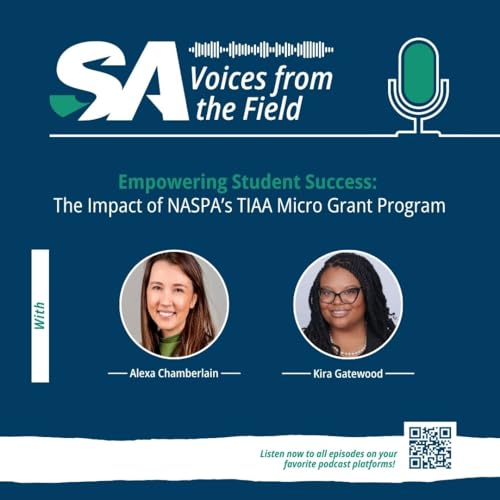
SA Voices From the Field cover art

SA Voices From the Field

SA Voices From the Field

Written by: Dr. Jill Creighton NASPA
Listen for free

About this listen

SA Voices from the Field shares the voices and stories from student affairs professionals from around the world. This podcast provides you with practical advice to help you be the best student affairs practitioner you can be, no matter where you are in your career.2024 Careers Economics Personal Success
Episodes
  • Empowering Student Success: The Impact of NASPA's TIAA Micro Grant Program
    Apr 26 2026
    If you're seeking powerful examples of student affairs' impact and actionable ideas to support today's college students, the latest episode of SA Voices from the Field is a must-listen. Host Dr. Jill Creighton welcomes Alexa Wesley Chamberlain (Director of Research and Strategy at NASPA) and Dr. Kira Gatewood (AVP of Student Life and Dean of Students at University of Houston Downtown) for a conversation focused on the NASPA-TIAA Micro Grant Program and its transformative effects on campus communities. TIAA Micro Grant Program: Fueling Emergency Aid Initiatives Led by Alexa Wesley Chamberlain, the TIAA Micro Grant Program provides $10,000 grants directly to campuses as emergency aid for students in crisis. Alexa Wesley Chamberlain explains how this initiative, rooted in NASPA's longstanding research on emergency aid, addresses basic needs like housing, food, childcare, and sudden financial emergencies. By supporting five institutions (selected from over 350 applicants), NASPA and TIAA aim to spotlight interventions that boost student persistence and success. University of Houston Downtown: Serving Parenting Students A highlight of the episode is Dr. Kira Gatewood's detailed look at how UHD is using its grant to support pregnant and parenting students—an often-overlooked group facing unique challenges. With over 70% of UHD's students being first-generation and many juggling caregiving responsibilities, the grant has enabled direct financial support and, maybe even more importantly, fostered a sense of community. Through stories of resilience and solidarity, Dr. Kira Gatewood shows how the micro grant helped students navigate grief, celebrate achievements, and feel truly seen by their institution. Bridging Policy, Research, and Impact Throughout the conversation, Dr. Jill Creighton, Alexa Wesley Chamberlain, and Dr. Kira Gatewood emphasize the importance of connecting research to daily practice, sharing stories and data that advocate for the normalization of basic needs support in higher education. They call for student affairs professionals to apply for future grant cycles and, above all, to keep listening to students' evolving needs. Why Listen? This episode is a rich source of inspiration and practical advice for anyone working in higher education. Whether you're exploring emergency aid options, want to build inclusive student support networks, or are searching for a reminder of why student affairs matters, don't miss this candid, hopeful discussion. 🎧 Listen now to learn how emergency aid is shaping student success and discover strategies to bring back to your own campus! TRANSCRIPT Dr. Jill Creighton [00:00:01]: Welcome to Student Affairs Voices from the Field, the podcast where we share your student affairs stories from fresh perspectives to seasoned experts brought to you by NASPA. We curate free and accessible professional development for higher education professionals wherever you happen to be. This is season 14 continuing our conversation on the value of Student Affairs. I'm Dr. Jill Creighton. Sheher hers your essay Voices from the Field host today on SA Voices. I'm pleased to welcome two guests, one from NASPA and one who's a campus based professional. Our NASPA professional today is Alexa Wesley Chamberlain, who's the Director of Research and strategy at NASPA. Dr. Jill Creighton [00:00:37]: In her role, she leads NASPA's research portfolio, manages grant funded research initiatives, and prior to joining naspa, she focused on federal post secondary education policy and institutional finance strategies through internships at the Lumina foundation, the Institute for Women's Policy Research and the US Department of Education. Alexa holds a Master's Degree in Public Policy and a Bachelor's degree in Government and Politics from the University of Maryland, College Park. Our second guest is Dr. Kira Gatewood, who self identifies as the educational architect. Dr. Gatewood is a dynamic force in higher education, serving as a masterful educational architect with unique talent for analyzing complex institutional challenges. She designs and implements creative, practical solutions that foster student success and organizational excellence. Her academic foundation, a Bachelor of Arts in Theater from Columbia College Chicago, an MEd from Loyola University Chicago and an EDD from Arizona State University, fuels her innovative approach. Dr. Jill Creighton [00:01:29]: At asu, she engineered the Landmark Endowed Gatewood NPHC Scholarship for Excellence and architected the Sankofa Early Start program, achieving a 94% persistence rate. Today, as the AVP of Student Life and Dean of Students at the University of Houston Downtown, she oversees a comprehensive portfolio and architects the Holistic Student Experience. Her division includes Student Leadership and Involvement, Veterans Services, Sports and Fitness, the Dean of Students, Office Counseling Services and Student Health Services. She strategically...
    Show More Show Less
    49 mins
  • Flexible Work in Student Affairs: What Success Looks Like Now & Next
    Apr 19 2026
    In the latest episode of NASPA's Student Affairs Voices from the Field podcast, the conversation dives deep into one of higher education's most timely topics: What does a successful flexible work environment look like in student affairs today and in the future? This episode, recorded live at the 2026 NASPA Annual Conference in Kansas City, captures a chorus of perspectives from student affairs professionals across the country and around the globe, each sharing insights on how flexibility is shaping the present—and the promise—of our profession. A key theme that echoes throughout the episode is the shift from the traditional 9-to-5 on-campus model to one that centers both staff well-being and student needs. Alan Thompson highlights this shift, noting that "the typical nine-to-five...is no longer going to work with the way the world is shifting around us" 00:00:50. Flexibility now takes many forms, from remote and hybrid work, to alternative scheduling, to using digital tools like chatbots for student support outside normal hours, as mentioned by Enoke J. Agyei. Supporting staff as whole people is another recurring message. Kerry Greenstein underscores the importance of supervisors who "are understanding and able to support their teams," allowing staff to do what they need to be their best selves for students 00:02:11. The theme of trust and autonomy surfaces in Mishka Murad's comments on letting employees choose their work settings and hours to find individual productivity and balance, so long as the work gets done. Many contributors advocate for meeting students where they are—digitally, asynchronously, and outside the office walls. Dan Volchek and Diana Sims Harris both suggest that student affairs professionals must adapt to students' diverse schedules and preferences, ranging from in-person to online interactions. At the same time, contributors recognize the challenge of designing flexible policies that remain inclusive, equitable, and responsive to both staff and student needs. From practical solutions like cross-training backups and honoring comp time, to broader reflections on rethinking institutional culture, the episode brims with wisdom for every level of the field. Whether you're a new grad or a seasoned dean, this conversation is a must-listen. It's packed with concrete ideas and heartfelt stories about finding work-life integration in student affairs. Tune in to SA Voices from the Field and explore how flexibility is not only redefining our work, but also sustaining our passion for serving students—today and into the future. TRANSCRIPT Dr. Jill Creighton [00:00:01]: Welcome to Student Affairs Voices from the Field, the podcast where we share your student affairs stories from fresh perspectives to seasoned experts brought to you by naspa. We curate free and accessible professional development for higher education professionals wherever you happen to be. This is season 14 continuing our conversation on the value of Student Affairs. I'm Dr. Jill Creighton. Sheher hers your SA Voices from the Field Host welcome back to another episode of SA Voices from the Field Today is our third episode that was recorded live and in person at the Kansas City, Missouri 2026 annual conference. We asked you about the third focus area for the conference, which was about workforce trends and the future of the profession. The question posed was what does a successful flexible work environment look like in student affairs today and in the future? Here's what you told us. Dr. Alan Thompson [00:00:50]: Alan Thompson at the Evergreen State College, Olympia, Washington Director of Academic and Career Advising Having a flexible work environment is so important to the professionals who work in student affairs today as well as the future. The typical nine to five, five day or six day work week that we were once accustomed to in years gone by is no longer going to work with the the way that the world is shifting around us, it is important that we as professionals have a work life balance and oftentimes that means that having a flexible work schedule, working different hours throughout the day or even various days of the week, being able to work remotely two or three days a week, is very, very successful in creating an environment in which student affairs employ, want to work and are available to work given the many complexities that we have outside of the typical work environment. Kerry Greenstein Kerry Greenstein, Sweet Briar College I'm the Dean of Student Life. A successful work environment to me looks like supervisors who are understanding and able to support their teams, allowing them to come late, take time, really do what they need to do to be there best selves so that when they are present and helping the students that they serve that they are really at their best and able to serve them as best as possible. Hi everyone, my name is Gada Endick [00:03:08]: Enoke J. Agyieu. I am a second year graduate student...
    Show More Show Less
    1 hr and 7 mins
  • Data, Tech, and the Future of Student Affairs Impact
    Apr 12 2026
    Season 14, Episode 8 of NASPA's Student Affairs Voices from the Field podcast brings together a powerful chorus of perspectives from student affairs professionals, leaders, and educators, all answering a central, urgent question: How can student affairs use data and technology to better serve the profession? This episode is a must-listen for anyone committed to the future of higher education, offering both inspiration and practical insight for advancing our field. A tapestry of voices emerges, revealing several clear themes. First, the call for intentional and strategic use of data rings loud and clear throughout. Alan Thompson identifies the importance of keeping up with evolving technology to positively impact the student experience and emphasizes the critical nature of knowing who our students are and what support they need. Others, like Gada Endick, advocate using data not just for compliance or recordkeeping, but to proactively search for gaps in student belonging and to build more intentional communities. Second, embracing technology and artificial intelligence as tools for both efficiency and connection is a recurring thread. Dylan Dermeyer, among others, highlights how AI can free professionals from routine tasks, affording more quality time with students. This shift allows practitioners to focus on building meaningful relationships—the heart of student affairs work. Romando Nash encourages leveraging AI so staff can spend less time on paperwork, and more time face-to-face with students. Another consistent theme is the necessity of collaboration and data sharing. Several contributors emphasize that data must not remain siloed. Brett Peterson Bruner voices the need to share information across campus, advocating for collective wisdom and integrated decision-making: when student affairs, academic, and institutional researchers join forces, the whole campus community benefits. The importance of professional development and training is spotlighted as well. Michael Allensworth and Antonia McFarland argue that data and technology skills should be woven into graduate preparatory programs and ongoing staff training to ensure everyone in the profession can grow, adapt, and thrive. Finally, the episode calls for a human-centered approach to data. Mishka Murad reminds us that behind every number is a student story, and Dr. Rolanda Horn advocates using data as storytelling—a tool to highlight successes, identify gaps, and advocate for the value of our work. For those seeking guidance, inspiration, or a pulse on where student affairs is headed in a rapidly changing world, this episode delivers. Tune in to hear your colleagues grapple with the challenges and opportunities ahead, sharing strategies that can help us all lead with data, technology, and most of all, heart. Ready to dive deeper? Listen now to Student Affairs Voices from the Field, Season 14, Episode 8! TRANSCRIPT Dr. Jill Creighton [00:00:01]: Welcome to Student Affairs Voices from the Field, the podcast where we share your student affairs stories from fresh perspectives to seasoned experts brought to you by NASPA. We curate free and accessible professional development for higher education professionals wherever you happen to be. This is season 14 continuing our conversation on the value of Student Affairs. I'm Dr. Jill Creighton. Sheher hers your SA voices from the Field host. Thank you for coming back for our next episode of Essay Voices from the Field. Today we're going to be featuring your responses to our second question that we recorded live and in person at the 2026 annual conference in Kansas City, Missouri. Our second question was about the focus area of data technology and return on investment in higher education and student affairs. We asked you how can student affairs use data and technology to better serve the student affairs profession? Here's what you told us. Dr. Alan Thompson [00:00:38]: Alan Thompson at the Evergreen State College, Olympia, Washington Director of Academic and Career Advising the use of data and technology in student affairs student life is so imperative. The way that technology is shifting and growing and changing today, student affairs needs to stay abreast and stay par with the various systems that can have a positive impact on students experiences and so the use of data knowing who our students are, what services that the institution is lacking to support our students, but making sure that we are using that data is critical to the success of the profession. Cary Greenstein Cary Greenstein, Sweet Briar College I'm the Dean of Student Life. I would make sure that student life and student affairs staff are led to be senior Student affairs or senior cabinet members at any institution so that they could really have the authority to lead and run everything from CARE teams to student success and all the other things that are really needed to help improve student success. And so really it's about how we set the ...
    Show More Show Less
    55 mins
No reviews yet