Season's Savings | ₹5/mo for 3 months

₹199/month after first 3 months. Renews automatically. Terms apply.
STRAT cover art

STRAT

STRAT

Written by: Mutual Broadcasting System LLC
Listen for free

About this listen
STRAT – Strategic Risk Assessment Talk, is a forum with a preparedness mindset. Mitigating risks, creating systems of prevention and recovery to deal with potential threats, and understanding the objectives of a Business Continuity Plan. This is the podcast for leaders who are committed to being prepared. The program is hosted by retired Marine Corps intelligence officer and strategic risk assessment professional Hal Kempfer and investment banker Mark Mansfield.Copyright 2026 Mutual Broadcasting System LLC Economics Management Management & Leadership Political Science Politics & Government World
Episodes
  • STRAT | Guest: Dr. John P Sullivan | Cartel Drone Wars and the US Border
    Nov 11 2026

    Retired Marine Intelligence Officer LtCol. Hal Kempfer welcomes Dr. John Sullivan to STRAT for a timely discussion of cartel drones, autonomous warfare, and security along the United States border. Drawing on decades of experience in policing, counterterrorism, and intelligence, Sullivan explores how Mexican cartels could adapt battlefield innovations from Ukraine and what those developments mean for homeland security. The conversation examines weaponized drones, emerging artificial intelligence capabilities, and questions surrounding government efforts to counter these threats. Kempfer and Sullivan also discuss the role of intelligence fusion centers in connecting information, strengthening coordination, and supporting threat assessment. From transnational organized crime to evolving autonomous systems, this episode considers how security professionals can better understand and prepare for an increasingly complex and rapidly changing global threat environment.

    Takeaways:

    • Examining cartel drones and their implications for border security.
    • Exploring Ukraine’s relevance to emerging cartel warfare tactics.
    • Assessing barriers to weaponized drone use inside the United States.
    • Discussing federal efforts to counter cartel drone threats.
    • Considering artificial intelligence’s role in future autonomous weapons.
    • Understanding intelligence fusion centers and their security mission.
    • Connecting transnational organized crime with evolving technological threats.
    • Exploring Sullivan’s security research and Arizona State University work.

    #STRATPodcast #HalKempfer #MutualBroadcastingSystem #StrategicRiskAnalysis #JohnSullivan #CartelDrones #DroneWarfare #BorderSecurity #HomelandSecurity #AutonomousWeapons #ArtificialIntelligence #MexicanCartels #CounterDrone #IntelligenceFusion #FusionCenters #TransnationalCrime #SecurityPolicy #ThreatAssessment #UkraineLessons #EmergingThreats

    Show More Show Less
    38 mins
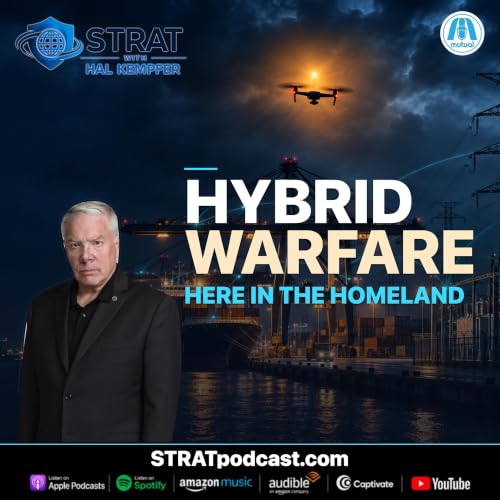
  • STRAT | 02 NOV 2026 | Hybrid Warfare Here in the Homeland
    Nov 3 2026

    What would hybrid warfare look like on American soil? Retired Marine intelligence officer LtCol. Hal Kempfer examines how foreign adversaries could use covert sabotage, cyberattacks, and drones to disrupt daily life while obscuring who is responsible. He explores how Iran and Russia could recruit local operatives online, where Hezbollah fits into the threat picture, and how cyber operations linked to China could compound disruptions. Kempfer walks through scenarios involving power grids, water systems, ports, airports, and public events, showing how localized incidents could ripple through national supply chains. He also revisits Fortress America, the push for military installations to operate independently for 90 days and considers what lessons civilian communities can draw about preparing for outages, recognizing warning signs, and acting before a crisis unfolds.

    Takeaways:

    • Gray zone tactics make it harder to identify attackers.
    • Online recruitment can give foreign intelligence services local reach.
    • Kempfer examines Hezbollah’s potential role in Iranian retaliation.
    • Drones could disrupt ports, airports, and public gatherings.
    • Power and water outages could ripple through supply chains.
    • Cyberattacks could amplify the effects of physical sabotage.
    • Fortress America targets 90 days of military base self-sufficiency.
    • Early warnings matter when there’s still time to prepare.

    #STRATPodcast #HalKempfer #MutualBroadcastingSystem #StrategicRiskAnalysis #HybridWarfare #GrayZoneWarfare #HomelandSecurity #FortressAmerica #MilitaryReadiness #EmergencyPreparedness #CriticalInfrastructure #InfrastructureResilience #SupplyChainSecurity #Cyberattacks #CovertSabotage #DroneThreats #OnlineRecruitment #Iran #Russia #Hezbollah

    Show More Show Less
    27 mins
  • STRAT | 29 OCT 2026 | Military Preparing for Catastrophic Events Here at Home
    Oct 30 2026

    What happens when the power grid fails and supply lines stop? On this episode of STRAT, retired Marine Intelligence Officer LtCol. Hal Kempfer examines military preparations for catastrophic disruptions at home and the growing emphasis on civilian readiness abroad. He explores the FORTRESS initiative outlined for U.S. bases, including independent energy, water, fuel, communications, and essential supplies. From microgrids and battery storage to emergency stockpiles, Kempfer connects military resilience with practical household planning. The discussion also covers preparedness efforts across Europe and Japan, where emergency kits help families weather disasters, cyberattacks, and infrastructure failures. Learn why water, medicine, evacuation routes, and regularly refreshed supplies deserve attention, and how sensible preparation can strengthen resilience without panic when everyday systems suddenly become unavailable during a major emergency.

    Takeaways:

    • FORTRESS targets 90 days of essential military base operations.
    • Microgrids and batteries support energy independence during infrastructure failures.
    • Independent water, fuel, and communications strengthen military resilience.
    • European and Japanese preparedness efforts emphasize household emergency supplies.
    • Preparedness addresses disasters, cyberattacks, conflict, and supply disruptions.
    • Water and medicine deserve special attention in emergency planning.
    • Build stockpiles gradually and refresh supplies every six months.
    • Pair emergency supplies with a clear evacuation plan.

    #STRATPodcast #HalKempfer #MutualBroadcastingSystem #StrategicRiskAnalysis #MilitaryPreparedness #FORTRESSInitiative #EmergencyPreparedness #MilitaryResilience #NationalSecurity #InfrastructureResilience #EnergyIndependence #Microgrids #SupplyChainResilience #CyberThreats #DisasterPreparedness #HouseholdPreparedness #EmergencySupplies #EvacuationPlanning #CivilianReadiness #StrategicStockpiles

    Show More Show Less
    22 mins
adbl_web_anon_alc_button_suppression_t1
No reviews yet