Episodes

  • New Therapy Wipes Out Deadly Childhood Brain Tumours in Mice | Science Made Simple
    Nov 19 2026
    Discover how UCSF scientists engineered B-SYNC CAR-T immune cells that stay switched off until they reach the brain, completely clearing diffuse midline glioma in every mouse tested. Learn how the brain-sensing switch works, why the cells kept patrolling for more than 70 days, and why human trials could begin as early as April 2027. Keywords: brain tumour, CAR-T, B-SYNC, immune cells, UCSF, diffuse midline glioma, DMG, Hideho Okada, Wendell Lim, Science Translational Medicine, childhood cancer, clinical trial, science, medicine, discovery, research

    Become a supporter of this podcast: https://www.spreaker.com/podcast/science-made-simple--6610397/support.
    Show More Show Less
    1 min
  • Blue Whales Are Coming Back From Near Extinction | Science Made Simple
    Nov 19 2026
    Discover how Antarctic blue whales — the largest animals ever to live on Earth — are slowly returning from near extinction. Learn how a new assessment led by Zoe Rand at the University of Washington found their numbers grew from just 418 in 1973 to about 4,018 in 2024, why whaling cut them by 99.8 percent, and why full recovery will still take generations. Keywords: blue whale, Antarctic, whale recovery, whaling, Zoe Rand, University of Washington, Endangered Species Research, conservation, Southern Ocean, largest animal, critically endangered, population, science, biology, ocean

    Become a supporter of this podcast: https://www.spreaker.com/podcast/science-made-simple--6610397/support.
    Show More Show Less
    1 min
  • Space Dust Reveals Ancient Water Beyond Neptune | Science Made Simple
    Nov 19 2026
    Discover how 12 microscopic dust grains collected from Earth's stratosphere carry chemical traces of an ancient water reservoir in the Kuiper Belt beyond Neptune. Learn how NASA's Johnson Space Center and UCLA researchers, led by Lindsay Keller, traced the grains' origin from solar particle tracks, why the water was enriched in heavy oxygen isotopes oxygen-17 and oxygen-18, and what this primordial reservoir tells us about the early Solar System. Keywords: Kuiper Belt, space dust, ancient water, Neptune, NASA, UCLA, Lindsay Keller, Science Advances, oxygen isotopes, stratosphere, ER-2, interplanetary dust, primordial water, Solar System, discovery, research, science, astronomy

    Become a supporter of this podcast: https://www.spreaker.com/podcast/science-made-simple--6610397/support.
    Show More Show Less
    1 min
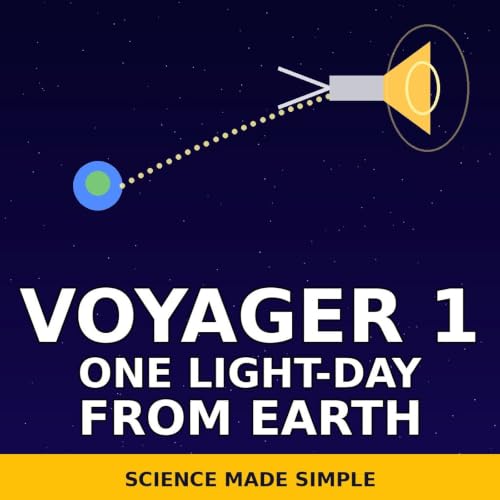
  • Voyager 1 Reaches One Light-Day From Earth | Science Made Simple
    Nov 18 2026
    Discover how NASA's Voyager 1 spacecraft became the first human-made object to reach one light-day from Earth on 18 November 2026. Learn what a light-day means — about 25.9 billion kilometres, or 173 astronomical units — why a radio signal now takes a full 24 hours to reach the probe and another day to return, how the spacecraft has travelled at about 61,100 kilometres per hour since its 1977 launch, and how it entered interstellar space in 2012. Keywords: Voyager 1, light-day, NASA, interstellar space, radio signal, deep space, spacecraft, astronomy, JPL, heliopause, distance, speed of light, 1977, exploration, milestone, probe, Earth, Sun, universe, science, discovery, space

    Become a supporter of this podcast: https://www.spreaker.com/podcast/science-made-simple--6610397/support.
    Show More Show Less
    1 min
  • Euclid Finds 15,000 Cosmic Magnifying Glasses | Science Made Simple
    Nov 18 2026
    Discover how ESA's Euclid space telescope found around 15,000 strong gravitational lenses — cosmic magnifying glasses — in its first major data release, DR1-Foundation, published 12 November 2026. Learn how a foreground galaxy's gravity bends a distant galaxy's light into arcs and rings, why fewer than 1,000 such lenses were known before Euclid, how the lenses let astronomers weigh galaxies including their unseen dark matter, and how machine learning plus thousands of Space Warps volunteers helped find them. Keywords: Euclid, gravitational lensing, dark matter, galaxies, ESA, DR1-Foundation, Space Warps, astronomy, cosmic web, discovery, research, science, telescope, universe, quasars, spectra, mapping, light, volunteers, machine learning

    Become a supporter of this podcast: https://www.spreaker.com/podcast/science-made-simple--6610397/support.
    Show More Show Less
    1 min
  • Leonid Meteor Shower Peaks Tonight | Science Made Simple
    Nov 18 2026
    Discover how the Leonid meteor shower peaks on the night of 17-18 November 2026. Learn about the debris of Comet 55P/Tempel-Tuttle, why Leonids are among the fastest meteors at about 158,000 miles per hour, how up to 15 meteors an hour can be seen under dark skies, and why the first-quarter Moon setting around midnight makes this year's peak a good one to watch. Keywords: Leonid, meteor shower, Tempel-Tuttle, comet, shooting stars, astronomy, night sky, November, Leo, meteors, space, science, stargazing, Moon, 1833, peak, observation, discovery, research

    Become a supporter of this podcast: https://www.spreaker.com/podcast/science-made-simple--6610397/support.
    Show More Show Less
    1 min
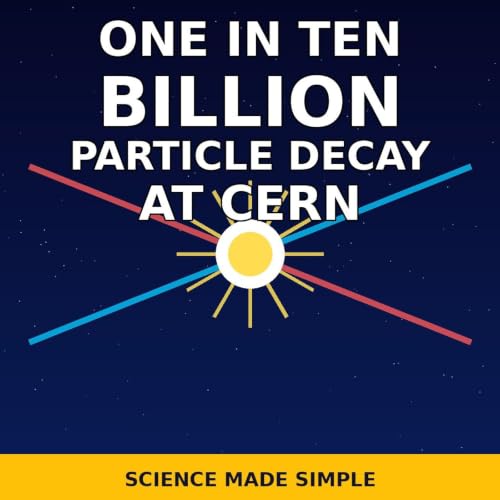
  • One-in-Ten-Billion Particle Decay Found at CERN | Science Made Simple
    Nov 17 2026
    Discover how CERN's LHCb experiment found the first evidence for one of the rarest particle decays ever hunted — a neutral B meson turning into two muons, a process the Standard Model predicts only once in about ten billion decays. After a search lasting more than 40 years, the result announced on 3 November 2026 reaches 3.2 sigma: evidence, not yet a discovery, and in full agreement with the Standard Model. Keywords: CERN, LHCb, particle physics, B meson, muon, Standard Model, rare decay, collider, Geneva, quantum, science, discovery, evidence, experiment, atom, energy, research.

    Become a supporter of this podcast: https://www.spreaker.com/podcast/science-made-simple--6610397/support.
    Show More Show Less
    1 min
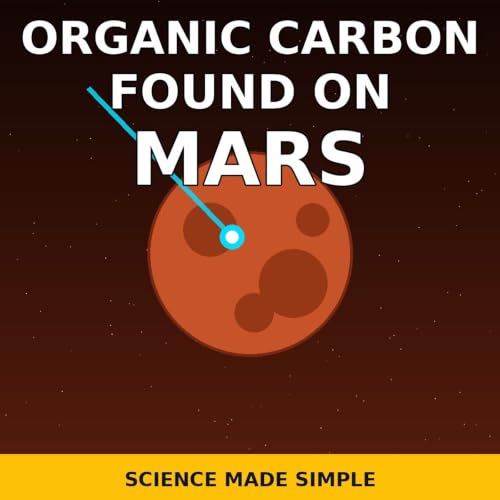
  • Organic Carbon Found in Ancient Mars Rocks | Science Made Simple
    Nov 17 2026
    Discover how NASA's Perseverance rover confirmed complex organic carbon in two ancient rocks in Mars' Bright Angel formation in Jezero crater. Learn about the SHERLOC laser instrument that found macromolecular carbon just microns below the surface — the shallowest detection of its kind on Mars — how the finding builds on NASA's September 2025 potential biosignature announcement, and why organic carbon is an ingredient for life, not proof of it. Keywords: organic carbon, Mars, Perseverance, NASA, Jezero crater, Bright Angel, SHERLOC, macromolecular carbon, Cheyava Falls, rover, ancient rocks, biosignature, life, space, geology, discovery, research, science, planet

    Become a supporter of this podcast: https://www.spreaker.com/podcast/science-made-simple--6610397/support.
    Show More Show Less
    1 min