Small College America cover art

Small College America

Small College America

Written by: Dean Hoke
Listen for free

About this listen

Small College America is a podcast series that presents critical discussions at the forefront by interviewing small college higher education leaders, policy experts, and innovators. The podcast will delve into the evolving role of small colleges, their economic impact, innovative strategies for sustainability, and how they can continue to provide a highly personalized educational experience. The series is co-hosted by Dean Hoke, Co-Founder of Edu Alliance Group and a Senior Fellow with the Sagamore Institute, and Kent Barnds, Executive Vice President for Strategy & Innovation and Vice President of Enrollment & Communication for Augustana College.@2025 Small College America Economics Management Management & Leadership
Episodes
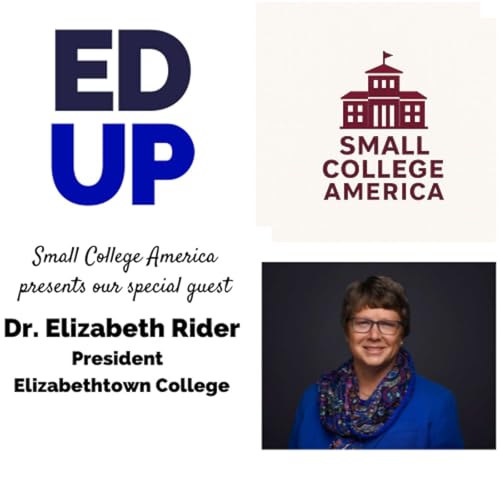
  • Small College America Elizabeth Rider - President Elizabethtown College
    Feb 17 2026

    Welcome to Small College America, a podcast dedicated to exploring the role and value of small colleges in higher education. I'm Dean Hoke, and I’m joined by my co-host, Kent Barnds.

    Kent Barnds: Our guest today is Elizabeth A. Rider, President of Elizabethtown College. Elizabeth brings more than 30 years of dedicated service to Elizabethtown, having served as faculty member, Provost, and Senior Vice President for Academic Affairs before becoming president in 2022.

    Since becoming President, she has championed enrollment growth, and under her leadership, the College has surpassed fundraising goals and reached a historic endowment milestone of over $100 million.

    She also serves as a member of the Board of Directors for the Association of Independent Colleges & Universities of Pennsylvania (AICUP), contributing to statewide efforts that advocate for independent higher education. Dr. Rider and I also share a personal connection — we’re both graduates of Gettysburg College — and I had the privilege earlier in my career of working at Elizabethtown College as well, so it’s especially meaningful for me to welcome her today. Betty, welcome to Small College America. We’re delighted to have you with us.

    Dean - Betty, you’ve spent much of your career at Elizabethtown — from faculty to provost to president. How has that long institutional perspective shaped your leadership, especially during such a disruptive period for higher education?

    Kent – Since becoming president, Etown has welcomed its largest incoming class in more than a decade and reached record applications. What changed — strategically or culturally — to drive that momentum, and how are you thinking about sustaining it in a competitive regional market?

    Dean – Elizabethtown recently launched a dual-enrollment partnership with Lancaster Catholic High School, creating earlier pathways for students to earn college credit. How do initiatives like this fit into your broader enrollment and access strategy — and what role do K–12 and community partnerships play in Etown’s long-term sustainability?

    Kent – Your draft Strategic Plan 2030 emphasizes integrating career-readiness across academic programs — including digital credentials and clearer pathways from classroom to career. How are you reimagining the student experience so graduates leave not only well-educated, but workforce-ready? Also, how do you communicate that value to prospective families?

    Dean – Under your leadership, Elizabethtown has surpassed fundraising goals and reached a historic endowment milestone. What practical lessons can other small colleges take from Etown’s approach to its fundraising success and building confidence among donors and trustees?

    Kent – Betty, looking three to five years out, what capabilities do you believe small colleges must strengthen now to remain resilient and relevant? And what encouragement would you offer presidents who may feel overwhelmed by the pace of change?
    Also Betty, If you had to name one leadership priority for the year ahead, what would it be?

    Dean: Betty, thank you for joining us today and for sharing such thoughtful insight into leading Elizabethtown College through a period of real momentum and change. We’re grateful for your perspective today.
    For those listening or viewing, if you'd like to learn more about Small College America, go to our web page at www.smallcollegeamerica.net, where you can find details on upcoming episodes, contact us, and suggest topics you’d like us to cover.

    This episode of Small College America is made possible with underwriting support from Edu Alliance Group — a higher education consulting firm that champions small colleges and the communities they serve.

    On behalf of our guest, President Elizabeth Rider, my co-host Kent Barnds, and I, thank you for joining us.

    Show More Show Less
    32 mins
  • Small College America Robert Kelchen
    Feb 10 2026

    Dean Hoke: Welcome to Small College America, a podcast dedicated to exploring the role and value of small colleges in the higher education landscape. I'm Dean Hoke, and I’m joined by my co-host, Kent Barnds.

    Kent Barnds: Robert Kelchen is a professor of higher education and head of the Department of Educational Leadership and Policy Studies at the University of Tennessee, Knoxville. His research interests include higher education finance, accountability policies, and student financial aid. Kelchen is the author of Higher Education Accountability and regularly publishes in top education journals. He has received the Robert P. Huff Golden Quill Award for excellence in financial aid research from the National Association of Student Financial Aid Administrators and has been recognized as one of the most influential faculty members in education by Education Week.

    He is also the data editor for Washington Monthly magazine’s annual college guide and rankings. Kelchen holds a bachelor’s degree in economics and finance from Truman State University, a master’s degree in economics from the University of Wisconsin-Madison, and a PhD in educational policy studies from the University of Wisconsin-Madison.

    Interview Questions (Estimated length: 27–30 minutes; six questions)

    Q1: About Robert’s Background

    Robert, before we dive into the data, could you briefly describe your work at the University of Tennessee—what you teach and research—and how that role shapes the way you think about institutional finance and risk—particularly for small, tuition-dependent colleges.

    Q2: Recent IPEDS Research
    Robert, you recently evaluated the newest IPEDS finance data (FY 2024) and dug into how often colleges lose money across sectors. You pointed out that the frequency of institutional financial losses is rising, especially among private nonprofit colleges. What does this trend tell you about the resilience of small colleges, and how should leaders interpret episodic versus persistent operating losses?

    Q3: Early Warning Signs
    In your work on financial stress indicators like operating losses, enrollment declines, and changes in endowment or state support, which combinations of metrics should small college leaders watch most closely as early warning signs?
    Q4 Washington Monthly & Public Accountability

    In addition to your academic work, you serve as the data editor for Washington Monthly’s college rankings, which emphasize outcomes and public value. How does that lens change the way you think about financial health and accountability—especially for small private colleges under pressure?
    Q5: Board – Finances – Professional Development
    What do you wish more boards of small private colleges understood about institutional finance—and where do boards most often misread or over-interpret the data in front of them?

    Follow-up - Robert, what responsibility does college leadership have to ensure that boards—and especially executive committees—have the financial literacy and ongoing professional development needed to govern effectively in this environment?

    Q6 The Next Five Years

    Looking ahead five years, do you expect the number of financially distressed small colleges to stabilize, increase, or accelerate, and why?

    Closing

    Dean: Robert, thank you for joining us today and giving your thoughtful perspective on the challenges and opportunities facing small colleges at this pivotal moment in higher education. Your work helps bring clarity to conversations that can otherwise feel overwhelming for campus leaders.

    For those listening or viewing, if you'd like to learn more about Small College America, go to our web page at www.smallcollegeamerica.net, where you can find details on upcoming episodes, contact us, and suggest topics you’d like us to cover.

    This episode of Small College America is made possible with underwriting support from Edu Alliance Group — a higher education consulting firm that champions small colleges and the communities they serve.

    On behalf of our guest, Robert Kelchen, my co-host Kent Barnds, and I, thank you for joining us.

    Show More Show Less
    25 mins
  • Small College America Jeff Selingo - Podcast Co-Host Future U
    Dec 16 2025

    Welcome to Small College America, a podcast dedicated to exploring the role and value of small colleges in the higher education landscape. I'm Dean Hoke, and I’m joined by my co-host, Kent Barnds.


    Kent Barnds: Joining us today is Jeff Selingo who has written about colleges and universities for more than 25 years and is a New York Times bestselling author of four books. His latest, New York Tines Best Seller Dream School: Finding the College That’s Right for You, draws on more than two years of research and a survey of some 3,000 parents to give families permission to think more broadly about what signals a “good” college and then the tools to discover their dream school.

    I’ll just note that my alma mater, Gettysburg College, my employer, Augustana College, and, my daughter’s college, Butler University are among those the 75 New Dream Schools, each identified as “hidden values.”

    He is also the author of Who Gets In & Why: A Year Inside College Admissions, named one of the New York Times’s 100 Notable Books of the Year in 2020.

    A regular contributor to The Atlantic, The New York Times, and The Wall Street Journal, Jeff is a special advisor to the president and professor of practice at Arizona State University. He writes the biweekly newsletter Next and co-hosts the podcast Future U. He lives near Washington, D.C., with his family.

    Jeff, as a father of two teenage daughters who will soon be navigating their own college search, you’re about to experience firsthand the very system you’ve spent decades analyzing! 


    Q1: Jeff, you’ve spent more than 25 years examining how higher education, the workforce, and student expectations are evolving. What trends have surprised you most recently, and how have they shaped your thinking in Dream School and your other current work?


    Q2: Your new book draws on a survey of 3,000 parents about what signals a ‘good’ college. How do parents today perceive small colleges differently from large publics or well-known brands, and what misperceptions should presidents address head-on?


    Q3: You’ve written extensively about admissions in Who Gets In & Why. Since that book came out in 2020, what changes have you seen, particularly in how small colleges can position themselves?


    Q4: Jeff, Gen Z, Gen Alpha, and their parents seem to be very focused on ROI. How can small colleges demonstrate lifetime value without over-promising?


    Q5: You’ve advised boards and presidents across the country. What blind spots do you see repeated most often at colleges, large or small? And what innovation patterns differentiate financially healthy institutions from those that are struggling?


    Q6: If you were advising a board tomorrow, what’s the first move you’d tell them to make? And looking ahead, is there one innovation or shift that could dramatically improve the prospects of small colleges if widely adopted?


    Closing Jeff, thank you for being with us today and for offering such thoughtful perspective on the challenges and opportunities facing small colleges at this pivotal moment in higher education

    For those listening or viewing, if you'd like to learn more about Small College America, go to our web page at www.smallcollegeamerica.net, where you can find details on upcoming episodes, contact us, and suggest topics you’d like us to cover.

    This episode of Small College America is made possible with underwriting support from Edu Alliance Group — a higher education consulting firm that champions small colleges and the communities they serve.

    On behalf of our guest, Jeff Selingo, my co-host Kent Barnds, and myself, thank you for joining us.

    Show More Show Less
    29 mins
No reviews yet