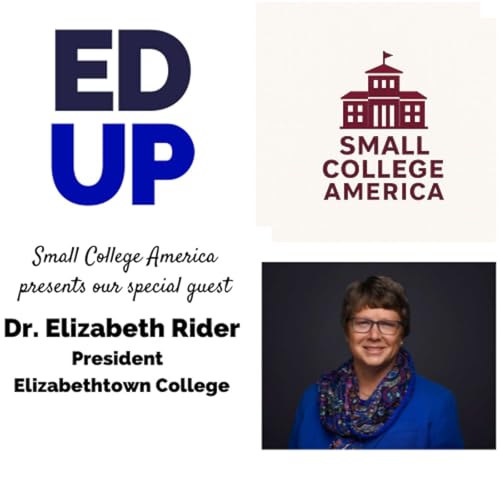
• Small College America Elizabeth Rider - President Elizabethtown College
    Feb 17 2026

    Welcome to Small College America, a podcast dedicated to exploring the role and value of small colleges in higher education. I'm Dean Hoke, and I’m joined by my co-host, Kent Barnds.

    Kent Barnds: Our guest today is Elizabeth A. Rider, President of Elizabethtown College. Elizabeth brings more than 30 years of dedicated service to Elizabethtown, having served as faculty member, Provost, and Senior Vice President for Academic Affairs before becoming president in 2022.

    Since becoming President, she has championed enrollment growth, and under her leadership, the College has surpassed fundraising goals and reached a historic endowment milestone of over $100 million.

    She also serves as a member of the Board of Directors for the Association of Independent Colleges & Universities of Pennsylvania (AICUP), contributing to statewide efforts that advocate for independent higher education. Dr. Rider and I also share a personal connection — we’re both graduates of Gettysburg College — and I had the privilege earlier in my career of working at Elizabethtown College as well, so it’s especially meaningful for me to welcome her today. Betty, welcome to Small College America. We’re delighted to have you with us.

    Dean - Betty, you’ve spent much of your career at Elizabethtown — from faculty to provost to president. How has that long institutional perspective shaped your leadership, especially during such a disruptive period for higher education?

    Kent – Since becoming president, Etown has welcomed its largest incoming class in more than a decade and reached record applications. What changed — strategically or culturally — to drive that momentum, and how are you thinking about sustaining it in a competitive regional market?

    Dean – Elizabethtown recently launched a dual-enrollment partnership with Lancaster Catholic High School, creating earlier pathways for students to earn college credit. How do initiatives like this fit into your broader enrollment and access strategy — and what role do K–12 and community partnerships play in Etown’s long-term sustainability?

    Kent – Your draft Strategic Plan 2030 emphasizes integrating career-readiness across academic programs — including digital credentials and clearer pathways from classroom to career. How are you reimagining the student experience so graduates leave not only well-educated, but workforce-ready? Also, how do you communicate that value to prospective families?

    Dean – Under your leadership, Elizabethtown has surpassed fundraising goals and reached a historic endowment milestone. What practical lessons can other small colleges take from Etown’s approach to its fundraising success and building confidence among donors and trustees?

    Kent – Betty, looking three to five years out, what capabilities do you believe small colleges must strengthen now to remain resilient and relevant? And what encouragement would you offer presidents who may feel overwhelmed by the pace of change?
    Also Betty, If you had to name one leadership priority for the year ahead, what would it be?

    Dean: Betty, thank you for joining us today and for sharing such thoughtful insight into leading Elizabethtown College through a period of real momentum and change. We’re grateful for your perspective today.
    For those listening or viewing, if you'd like to learn more about Small College America, go to our web page at www.smallcollegeamerica.net, where you can find details on upcoming episodes, contact us, and suggest topics you’d like us to cover.

    This episode of Small College America is made possible with underwriting support from Edu Alliance Group — a higher education consulting firm that champions small colleges and the communities they serve.

    On behalf of our guest, President Elizabeth Rider, my co-host Kent Barnds, and I, thank you for joining us.

    Show More Show Less
    32 mins
  • Small College America Robert Kelchen
    Feb 10 2026

    Dean Hoke: Welcome to Small College America, a podcast dedicated to exploring the role and value of small colleges in the higher education landscape. I'm Dean Hoke, and I’m joined by my co-host, Kent Barnds.

    Kent Barnds: Robert Kelchen is a professor of higher education and head of the Department of Educational Leadership and Policy Studies at the University of Tennessee, Knoxville. His research interests include higher education finance, accountability policies, and student financial aid. Kelchen is the author of Higher Education Accountability and regularly publishes in top education journals. He has received the Robert P. Huff Golden Quill Award for excellence in financial aid research from the National Association of Student Financial Aid Administrators and has been recognized as one of the most influential faculty members in education by Education Week.

    He is also the data editor for Washington Monthly magazine’s annual college guide and rankings. Kelchen holds a bachelor’s degree in economics and finance from Truman State University, a master’s degree in economics from the University of Wisconsin-Madison, and a PhD in educational policy studies from the University of Wisconsin-Madison.

    Interview Questions (Estimated length: 27–30 minutes; six questions)

    Q1: About Robert’s Background

    Robert, before we dive into the data, could you briefly describe your work at the University of Tennessee—what you teach and research—and how that role shapes the way you think about institutional finance and risk—particularly for small, tuition-dependent colleges.

    Q2: Recent IPEDS Research
    Robert, you recently evaluated the newest IPEDS finance data (FY 2024) and dug into how often colleges lose money across sectors. You pointed out that the frequency of institutional financial losses is rising, especially among private nonprofit colleges. What does this trend tell you about the resilience of small colleges, and how should leaders interpret episodic versus persistent operating losses?

    Q3: Early Warning Signs
    In your work on financial stress indicators like operating losses, enrollment declines, and changes in endowment or state support, which combinations of metrics should small college leaders watch most closely as early warning signs?
    Q4 Washington Monthly & Public Accountability

    In addition to your academic work, you serve as the data editor for Washington Monthly’s college rankings, which emphasize outcomes and public value. How does that lens change the way you think about financial health and accountability—especially for small private colleges under pressure?
    Q5: Board – Finances – Professional Development
    What do you wish more boards of small private colleges understood about institutional finance—and where do boards most often misread or over-interpret the data in front of them?

    Follow-up - Robert, what responsibility does college leadership have to ensure that boards—and especially executive committees—have the financial literacy and ongoing professional development needed to govern effectively in this environment?

    Q6 The Next Five Years

    Looking ahead five years, do you expect the number of financially distressed small colleges to stabilize, increase, or accelerate, and why?

    Closing

    Dean: Robert, thank you for joining us today and giving your thoughtful perspective on the challenges and opportunities facing small colleges at this pivotal moment in higher education. Your work helps bring clarity to conversations that can otherwise feel overwhelming for campus leaders.

    For those listening or viewing, if you'd like to learn more about Small College America, go to our web page at www.smallcollegeamerica.net, where you can find details on upcoming episodes, contact us, and suggest topics you’d like us to cover.

    This episode of Small College America is made possible with underwriting support from Edu Alliance Group — a higher education consulting firm that champions small colleges and the communities they serve.

    On behalf of our guest, Robert Kelchen, my co-host Kent Barnds, and I, thank you for joining us.

    Show More Show Less
    25 mins
  • Small College America Jeff Selingo - Podcast Co-Host Future U
    Dec 16 2025

    Welcome to Small College America, a podcast dedicated to exploring the role and value of small colleges in the higher education landscape. I'm Dean Hoke, and I’m joined by my co-host, Kent Barnds.


    Kent Barnds: Joining us today is Jeff Selingo who has written about colleges and universities for more than 25 years and is a New York Times bestselling author of four books. His latest, New York Tines Best Seller Dream School: Finding the College That’s Right for You, draws on more than two years of research and a survey of some 3,000 parents to give families permission to think more broadly about what signals a “good” college and then the tools to discover their dream school.

    I’ll just note that my alma mater, Gettysburg College, my employer, Augustana College, and, my daughter’s college, Butler University are among those the 75 New Dream Schools, each identified as “hidden values.”

    He is also the author of Who Gets In & Why: A Year Inside College Admissions, named one of the New York Times’s 100 Notable Books of the Year in 2020.

    A regular contributor to The Atlantic, The New York Times, and The Wall Street Journal, Jeff is a special advisor to the president and professor of practice at Arizona State University. He writes the biweekly newsletter Next and co-hosts the podcast Future U. He lives near Washington, D.C., with his family.

    Jeff, as a father of two teenage daughters who will soon be navigating their own college search, you’re about to experience firsthand the very system you’ve spent decades analyzing! 


    Q1: Jeff, you’ve spent more than 25 years examining how higher education, the workforce, and student expectations are evolving. What trends have surprised you most recently, and how have they shaped your thinking in Dream School and your other current work?


    Q2: Your new book draws on a survey of 3,000 parents about what signals a ‘good’ college. How do parents today perceive small colleges differently from large publics or well-known brands, and what misperceptions should presidents address head-on?


    Q3: You’ve written extensively about admissions in Who Gets In & Why. Since that book came out in 2020, what changes have you seen, particularly in how small colleges can position themselves?


    Q4: Jeff, Gen Z, Gen Alpha, and their parents seem to be very focused on ROI. How can small colleges demonstrate lifetime value without over-promising?


    Q5: You’ve advised boards and presidents across the country. What blind spots do you see repeated most often at colleges, large or small? And what innovation patterns differentiate financially healthy institutions from those that are struggling?


    Q6: If you were advising a board tomorrow, what’s the first move you’d tell them to make? And looking ahead, is there one innovation or shift that could dramatically improve the prospects of small colleges if widely adopted?


    Closing Jeff, thank you for being with us today and for offering such thoughtful perspective on the challenges and opportunities facing small colleges at this pivotal moment in higher education

    For those listening or viewing, if you'd like to learn more about Small College America, go to our web page at www.smallcollegeamerica.net, where you can find details on upcoming episodes, contact us, and suggest topics you’d like us to cover.

    This episode of Small College America is made possible with underwriting support from Edu Alliance Group — a higher education consulting firm that champions small colleges and the communities they serve.

    On behalf of our guest, Jeff Selingo, my co-host Kent Barnds, and myself, thank you for joining us.

    Show More Show Less
    29 mins
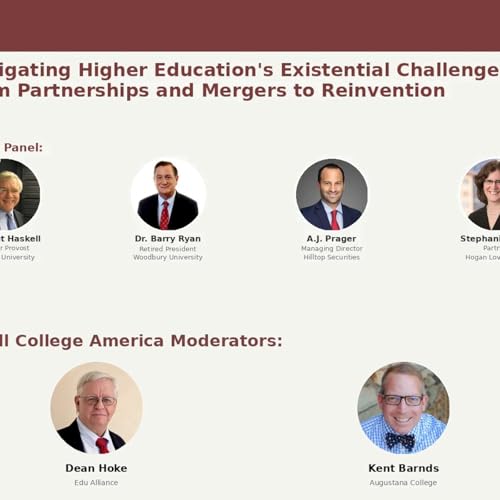
  • Small College America Webinar Navigating Higher Education's Existential Challenges
    Dec 9 2025

    Welcome everyone to this special edition of Small College America. On December 3rd we held a live webinar titled “Navigating Higher Education’s Existential Challenges: From Partnerships and Mergers to Reinvention,” brings together four seasoned leaders deeply involved in higher education strategy, governance, law, and finance. The issues of partnerships, mergers, closures and institutional reinvention are no longer abstract concepts, they’re real challenges shaping daily decision-making. To help us explore these topics we have four distinguished panelists with extensive experience across higher-education, strategy, finance, law, and governance.

    • Dr. Chet Haskell is an experienced higher education consultant focusing on existential challenges to smaller non-profit institutions and opportunities for collaboration. He is a former 2-time president and most recently a provost directly involved in three significant merger/acquisition or partnership agreements, including the Coalition for the Common Good partnership of Antioch and Otterbein Universities.

    • Dr. Barry Ryan is an experienced leader, and attorney who has served as president, and provost, for multiple universities. He helped guide several institutions through merger/acquisition, and accreditation. Most recently he led Woodbury University through its merger with the University of Redlands. He has served on university boards and as a Commissioner for WSCUC

    • A.J. Prager, Managing Director at Hilltop Securities Inc., investment banker focusing on higher education M&A, helping institutions manage the partnership process, such as finding a partner, financial analysis, due diligence and board management. Most recently, AJ served as engagement lead to Seattle University on its partnership with Cornish College of the Arts.

    • Stephanie Gold, is a Partner and Head of the Higher Education Practice at Hogan Lovells LLP, who has spent nearly three decades guiding colleges and universities through transformative transactions. She helps institutions to navigate the regulatory requirements and procedures related to such transactions, including accreditation approvals, state agency review, and the U.S. Department of Education process.

    Show More Show Less
    1 hr and 13 mins
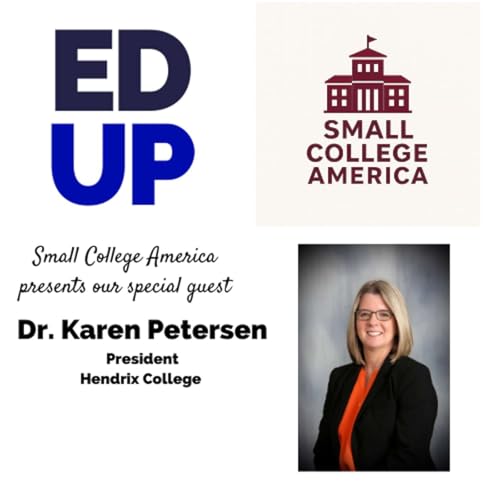
  • Small College America Karen Petersen - President Hendrix College
    Dec 2 2025

    Joining us today Dr. Karen Petersen is the 13th President of Hendrix College, taking office on June 1, 2023. A native of northwest Arkansas, she joined the Hendrix community from the University of Tulsa, where she served as Dean of the Henry Kendall College of Arts and Sciences and was a professor of political science.

    Before her time in Tulsa, Karen spent 16 years at her undergraduate alma mater, Middle Tennessee State University, rising through progressively senior leadership roles and ultimately serving as Dean of the College of Liberal Arts, the university’s largest academic unit. She earned both her master’s degree and Ph.D. in political science from Vanderbilt University.

    She and her husband, Joey Keasler, a northeast Arkansas native, are the parents of two children.

    Show More Show Less
    28 mins
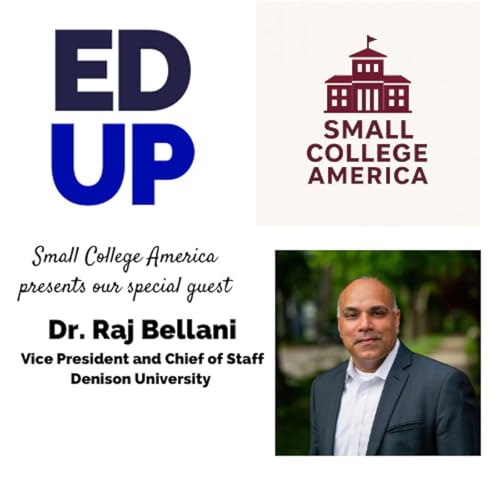
  • Small College America Raj Bellani - Vice President & Chief of Staff Denison University
    Nov 25 2025

    Today's guest is Dr. Raj Bellani, Vice President of External Affairs, Career Outcomes, and Chief of Staff at Denison University in Ohio.
    At Denison, Raj plays a key role in advancing the university’s strategic plan—strengthening its global engagement, enhancing faculty and staff mentoring, and promoting innovation and wellness across campus.


    Before arriving in Granville, Raj served as Dean of Experiential Learning and Career Planning at DePauw University’s Hubbard Center for Student Engagement, overseeing career services, service-learning programs, national fellowships, and alumni initiatives.

    Earlier in his career, he held senior leadership positions at the Rhode Island School of Design—including International Recruitment Director, Associate Provost, and Dean of Students—and served in a variety of administrative roles at Colgate University.

    Beyond campus, Raj contributes his expertise to several boards in the Columbus area, including the Greater Columbus Arts Council.
    He earned degrees from SUNY Geneseo, Western Illinois University, and the University of Pennsylvania.

    Show More Show Less
    25 mins
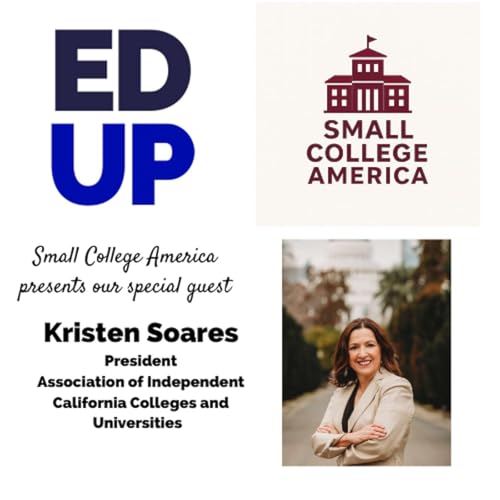
  • Small College America Kristen Soares - President of the Association of Independent California Colleges and Universities
    Nov 18 2025

    Kent Barnds: Welcome to Small College America, a podcast dedicated to exploring the role and value of small colleges in the higher education landscape. I'm Kent Barnds, and I’m joined by my co-host, Dean Hoke.


    Dean Hoke: Kristen Soares is the fourth president of the Association of Independent California Colleges and Universities (AICCU), representing more than 85 nonprofit institutions dedicated to the public good. As president, she works with leaders across the state to shape higher education policy and serves as the sector’s chief spokesperson. Under her leadership, AICCU partnered with the California Community Colleges Chancellor’s Office to implement the Associate Degree for Transfer pathway, expanding opportunities and improving access for transfer students.

    Soares plays a prominent role in statewide and national higher education leadership, serving as a member of the California Education Round Table, the Governor’s Council for Career Education, and the NAICU State Executives Council. She previously spent nearly 25 years at the University of Southern California (USC), where her career in higher education began with a federal Work-Study job, one she credits with landing her in the university’s senior administration and setting her on a lifelong path in higher-ed leadership. During her tenure, she led government and civic engagement efforts across California and Washington, D.C.

    Kristen earned her Bachelor of Science in Public Administration from USC. Kristen, we’re delighted to have you with us on Small College America.

    Kent - Q1: Kristen, for those who may not be familiar, could you start by telling us about the role of the Association of Independent California Colleges and Universities (AICCU) and how it supports its member institutions? What is AICCU’s top legislative priority this session?

    Dean – Q2: California has one of the most complex and influential higher education ecosystems in the country, with the University of California (UC) system, the California State University (CSU) system, and the independent sector each serving distinct missions. How does AICCU advocate for independent colleges within this landscape, and what opportunities or challenges arise in coordinating with state agencies and legislators?

    Kent – Q3: Many small colleges are rethinking their academic portfolios to meet changing student and workforce demands. What innovations or program models are you seeing that balance tradition with transformation—without losing institutional identity?

    Dean – Q4: With rising concerns about college affordability and ROI, how should small private colleges articulate their value proposition to skeptical families? What alternative business models or revenue streams show the most promise for achieving long-term financial sustainability?

    Kent – Q5: Higher education has faced increased political scrutiny nationwide. How do you advise independent college leaders to communicate their value and relevance to the public and policymakers in today’s polarized climate?

    Dean – Q6: Kristen, after you looked into your crystal ball, before meeting with the leaders of over 85 nonprofit institutions from AICCU, what's the most important piece or pieces of advice you'd offer them about the future?


    Closing


    Kent: Kristen, thank you for joining us and for sharing your insight into California’s independent higher education community and the issues shaping small colleges nationwide.


    For those listening or viewing, if you'd like to learn more about Small College America, go to our web page at www.smallcollegeamerica.net, where you can find details on upcoming episodes, contact us, and suggest topics you’d like us to cover.

    This episode of Small College America is made possible with underwriting support from Edu Alliance Group — a higher education consulting firm that champions small colleges and the communities they serve.


    On behalf of our guest, Kristen Soares, my co-host Dean Hoke, and myself, thank you for joining us.
    Show More Show Less
    31 mins
  • Small College America Dr. Michael Scarlett - Professor of Education Augustana College
    Nov 11 2025

    Welcome to Small College America, a podcast dedicated to exploring the role and value of small colleges in the higher education landscape. I'm Dean Hoke, and I’m joined by my co-host, Kent Barnds.


    Today, we’re joined by Michael H. Scarlett, Professor of Education at Augustana College. Michael supervises student teachers and teaches educational psychology and assessment, social studies methods, and educational technology. Before coming to Augustana, he spent four years on the faculty at Montana State University, Billings. He began his career teaching middle-school social studies—American history, world geography, humanities, and state history—and later taught secondary social studies in St. Paul Public Schools.

    Michael earned his B.A. from Macalester College in St. Paul and his M.A. and Ph.D. in Curriculum & Instruction (Social Studies Education) from the University of Minnesota–Twin Cities.

    Off campus, he’s a proud husband, dad of two, beagle wrangler, avid runner and kayaker, and former soccer player and youth coach with 15+ years on the pitch. I understand you have served as a history judge many times over the years, including as a National History Day judge at Bettendorf Middle School in Bettendorf, Iowa. :)


    Q1: Michael, tell us about the Augustana Education program. What does it offer, how many students are in the program, and what makes it distinct


    Q 2: What drew you into education—and how has your role at Augustana evolved?
    Follow-up: As a teacher, was there a moment that confirmed you’d chosen the right path?

    Q3: How would you describe today’s job market for new teachers, and where is the greatest teacher shortage?

    Quick follow-up, is there something school districts or private and charter schools can do to address these shortage?


    Q4: What are the biggest challenges education majors face as they prepare for the classroom, and what strategies or supports do you emphasize to help them thrive?


    Q5: A recent student wrote in a review that you made them feel they belonged in the program—especially after a rough start—and praised your respectful, nonjudgmental style. What practices do you recommend to support struggling students, whether a college professor or a middle school teacher?


    Q6: We like to end with the future. Looking 5–10 years ahead, what gives you the most hope that more high school students will choose teaching, especially through pathways at small colleges like Augustana?


    Michael, thank you for sharing your journey and your vision for teacher education at Augustana. Your commitment to making every student feel they belong in the classroom is exactly what education needs right now."

    For those listening or viewing, if you'd like to learn more about Small College America, go to our web page at www.smallcollegeamerica.net, where you can find details on upcoming episodes, contact us, and suggest topics you’d like us to cover.

    “This episode of Small College America is made possible with underwriting support from Edu Alliance Group — A higher education consulting firm that champions small colleges and the communities they serve.”

    On behalf of our guest, Michael Scarlett, my co-host Kent Barnds, and Dean Hoke, thank you for joining us.”

    Show More Show Less
    27 mins