• 35. Let's Talk about "Sage the Squirrel and the Winter Hedge"
    May 12 2025

    A discussion about 🎧 Sage the Squirrel and the Winter Hedge
    A fable about resilience, foresight, and smart inventory planning.

    🌰 Sage doesn’t just stash nuts—she builds a hedging strategy.
    • 20-40-40 inventory split: immediate use, buffer, and strategic reserve
    • Diversified caches = less risk, more resilience
    • Stress-tested for harsh winters and squirrel rivals

    🐿️ Learn how Sage outsmarts Just-in-Time chaos by planning for uncertainty.

    Show More Show Less
    12 mins
  • 34. Sage the Squirrel and the Winter Hedge
    May 12 2025

    Is your Supply Chain reactive?


    Most squirrels are reactive.


    They wait for hunger to strike. Then dash for the nearest nut.

    (It works. Until it doesn’t.)


    A surprise frost hit Chestnut Grove.

    Food vanished. Panic spread.


    Except for Sage. She wasn’t the fastest or flashiest.

    But she had something most didn’t: A strategy.


    Sage used a 20-40-40 inventory split:

    • 20%: Daily use (high accessibility, high risk)

    • 40%: Near-term buffer (mid-risk, mid-reach)

    • 40%: Strategic reserves (harder to get, but always there)


    And it worked.

    While others scrambled, Sage survived.

    And then she shared her stock with others.

    Because true resilience isn’t about hoarding—It’s about designing systems that hold up when everything breaks.


    This isn’t just a squirrel story. It’s a supply chain fable packed with real-world lessons.


    Diversify. Buffer. Stress-test.


    Winter is always coming.

    Show More Show Less
    12 mins
  • 33. Let's Talk about "OmniTech’s Crucible" - A Week of Supply Chain Drama
    May 9 2025

    What happens when a cutting-edge EV company faces a week-long supply chain crisis?


    OmniTech’s Crucible: A Supply Chain Fable ⚡🚗This is a discussion about the critical supply chain failures experienced by OmniTech Industries over the course of one week. The crisis exposed deep-seated issues across procurement, production, logistics, and quality assurance, stemming primarily from a lack of integration, real-time visibility, and proactive strategies. The leadership team, spearheaded by Chief Supply Chain Officer Sophia Ruiz, recognized that the failures were systemic rather than isolated and outlined a comprehensive plan for a "Supply Chain Reset" focusing on digital transformation, improved communication, cultural change, and strategic financial investment. The ultimate goal is to build a resilient, integrated, and future-proof supply chain capable of anticipating and mitigating disruptions.


    OmniTech Industries' week-long supply chain crisis serves as a stark reminder of the vulnerabilities inherent in complex global supply chains. The failures were not isolated incidents but rather symptoms of a deeper systemic issue rooted in a lack of integration, visibility, and proactive planning. The proposed "Supply Chain Reset," led by Sophia Ruiz and her team, offers a comprehensive roadmap for building a resilient, digitally-enabled, and culturally aligned supply chain capable of navigating future disruptions and positioning OmniTech for long-term success. The emphasis on technology, collaboration, and a forward-thinking mindset are critical takeaways for any organization seeking to build a robust supply chain.


    Show More Show Less
    18 mins
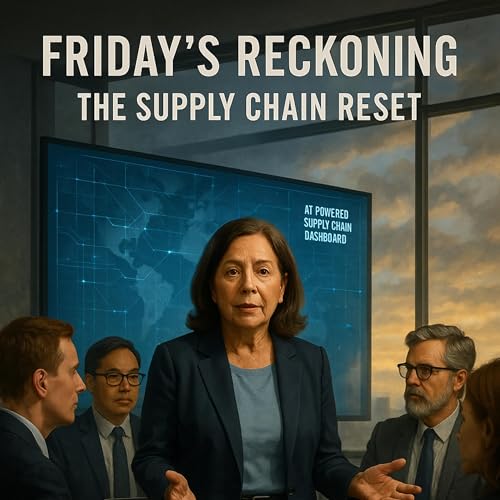
  • 32. Let's Talk about "Friday’s Reckoning – The Supply Chain Reset"
    May 9 2025

    "Friday’s Reckoning – The Supply Chain Reset," detailing OmniTech's disastrous week of supply chain failures and the subsequent strategic response led by Chief Supply Chain Officer, Sophia Ruiz. The core issue identified was not technical failure, but systemic breakdown due to siloed operations, poor communication, and a lack of integrated systems.

    The discussion is about Sophia Ruiz's four-part immediate reset plan and a comprehensive long-term strategy focused on building a "Supply Chain of the Future" through digital transformation, empowered teams, blockchain technology, and sustainability initiatives. The overarching theme is that supply chain resilience is achieved not through individual strength but through integration, visibility, and a collaborative culture.

    Show More Show Less
    17 mins
  • 31. Friday’s Reckoning: The Supply Chain Reset
    May 8 2025

    After a week of cascading crises—missing batteries, halted lines, blocked shipments, and QA failures—OmniTech’s leadership finally confronted the real problem: disconnection. At the heart of it, the issue wasn’t just supply chain disruption—it was siloed systems, delayed data, and fractured teamwork.


    Sophia Ruiz, Chief Supply Chain Officer, led a pivotal transformation session. No slides. No sugarcoating. Just truth and action.


    Her four-part recovery blueprint:

    🧠A digital nerve center with real-time AI-powered insights
    💬 Streamlined communication replacing outdated email chains
    🌱 Cultural change toward agility and integration
    📊 Smarter budgeting for lasting resilienceTakeaway:

    “Supply chains don’t fail in silos—they fail between them.”

    The future lies in connected systems, empowered teams, and a proactive culture.


    Show More Show Less
    6 mins
  • 30. Let's Talk about "Thursday’s Quality Quandary: When Trust Breaks"
    May 8 2025

    A discussion about “"Thursday’s Quality Quandary: When Trust Breaks"


    Thursday presented a significant crisis for OmniTech's Quality Assurance (QA) department, highlighting critical vulnerabilities in their current reactive approach. Under the leadership of VP of Quality Assurance, Liam Powell, the day revealed cascading failures in test equipment calibration, data integrity, supplier quality, and component reliability, culminating in potential safety risks. The events underscore the urgent need to transition from a traditional "end-of-the-line" inspection model to a proactive, predictive, and integrated QA strategy. Liam Powell is proposing a comprehensive plan leveraging AI, advanced testing tools, blockchain traceability, and enhanced team collaboration to build quality into every stage of the product lifecycle.

    Show More Show Less
    9 mins
  • 29. Thursday’s Quality Quandary: When Trust Breaks
    May 7 2025

    By Thursday, OmniTech’s crisis reached its final frontier—Quality Assurance. Liam Powell, VP of QA, faced a nightmare cascade: a miscalibrated test rig, corrupted certification data, supplier defects, and signs of metal fatigue. Trust in every recent QA decision evaporated.

    Instead of covering up the chaos, Liam led a full audit. Machines were recalibrated. Records recovered. Supplier reviews launched. And a new vision emerged: QA must be predictive, not reactive.


    His blueprint for next-gen quality:

    🤖 AI-powered predictive analytics & digital twins
    🧪 Self-calibrating tools & non-destructive testing
    🔗 Blockchain for full traceability
    💬 Real-time collaboration and AR-powered inspections


    Lesson:

    “Quality isn’t inspection—it’s anticipation.”
    It must start at sourcing and run all the way to shipment.


    Show More Show Less
    6 mins
  • 28. Let's Talk about “Wednesday’s Storm – Logistics on the Edge"
    May 7 2025

    A discussion about “Wednesday’s Storm – Logistics on the Edge"


    OmniTech's logistics operations faced significant disruption due to a major regional storm, highlighting critical vulnerabilities in transportation, tracking systems, and customs procedures. The crisis, which began with stranded inbound shipments, was exacerbated by a logistics system crash and a customs hold on essential parts. Carmen Mendoza, Head of Logistics, demonstrated effective crisis management by switching to air freight and navigating complex logistics challenges. However, the event underscored the need for proactive, "resilience by design" strategies rather than solely relying on reactive measures. Carmen's proposed "Logistics Playbook" outlines key areas for building a more robust and future-ready logistics system, emphasizing always-ready transportation backups, redundant tracking, fast-track customs, fuel cost control, and clear communication with finance and leadership.


    The original post can be found here.


    Show More Show Less
    8 mins