• Does putting a price on nature save or destroy it?
    Oct 14 2026

    Capitalism is relentless in putting a price on everything. So why does it so often fail to value the things we need most: clean air, a stable climate, healthy oceans, and the unpaid work of caregivers?

    This week, political theorist Alyssa Battistoni joins us to discuss her new book, Free Gifts: Capitalism and the Politics of Nature (Princeton University Press). Early economists marveled at nature’s “gratuitous gifts.” Today, economists try to price everything from a single whale to the entire planet. Alyssa argues that the long fight over whether to put a price on nature misses something more basic: most of nature isn’t priced at all, and it’s being destroyed anyway.

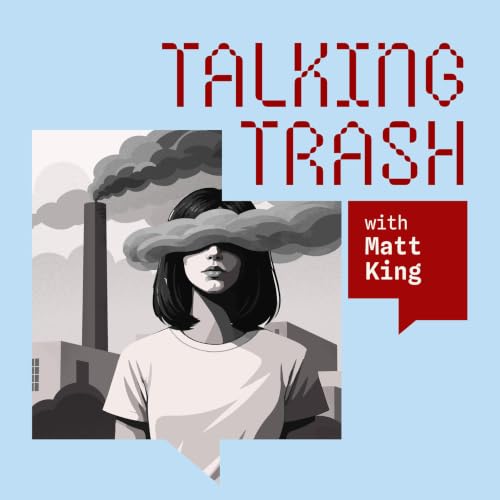
    Along the way, we cover a smoky chimney that inspired arguably the most important economic concept of the 20th century, a glass replica of Earth in the Arizona desert that ran short of air, and what Costa Rica figured out about protecting forests that carbon markets haven’t.

    🌐 Full episode page, transcript, and resources: talkingtrashpod.com

    📱 Follow us:

    Instagram: @_talkingtrashpod

    TikTok: @talkingtrashpod

    YouTube: @talkingtrashpod

    CREDITS:

    Host & Show Creator: Matt King

    Art Director: Frances Miller

    Show More Show Less
    28 mins
  • Tracing the hidden afterlives of Philadelphia's trash
    Sep 30 2026

    Philadelphia has been trying to solve its trash problem for decades. The city's answers have included hundreds of surveillance cameras mounted on telephone poles; 200-year-old sewers still catching what washes off the street; and, once, a ship sent out to sea with 14,000 tons of incinerator ash to find a country that would take it.

    The nonfiction film In Excess traces Philly's waste across time and space, above ground and below — through streets, sewers, a pumping station, a construction waste facility, and small rooms full of monitors and paperwork. The film is also built, to a remarkable degree, out of footage and sound other filmmakers would have thrown away.

    In this episode, we hear from director Melissa Langer; archival producer Caitlin Riggsbee, who tracked down forgotten VHS tapes in a Greenpeace basement; and the sound team of Jonathan Snipes and Christopher Fleeger, who recorded in the city's grittiest corners. Together they trace where a city's waste goes, who is paid to handle it, how a sewer grate became the film's musical theme, and why the film resists the conventions of the "environmental documentary."

    🌐 Full episode page, transcript, and resources: talkingtrashpod.com

    🎬 Watch In Excess and hear an extended cut of this conversation: videostoreage.com

    📱 Follow us:

    Instagram: @_talkingtrashpod

    TikTok: @talkingtrashpod

    YouTube: @talkingtrashpod

    CREDITS:

    Host & Show Creator: Matt King

    Art Director: Frances Miller

    Show More Show Less
    35 mins
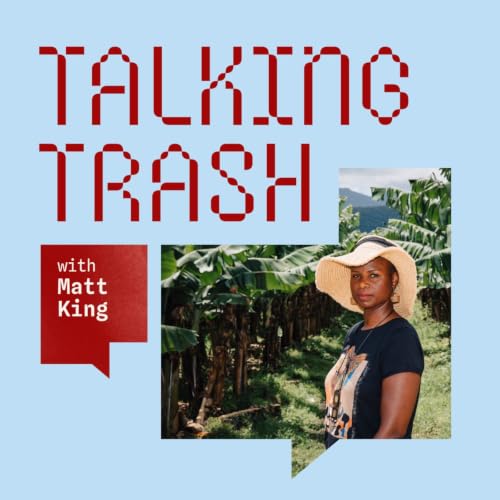
  • Exposing the French Caribbean's toxic banana farming scandal
    Sep 16 2026

    In 2018, Jessica Oublié left Paris and moved to her family’s home in Guadeloupe. Days later, she learned the island was contaminated by chlordecone — a pesticide used on banana plantations that will linger in the soil for an estimated 700 years. Today, roughly 90% of adults on the islands carry traces of the pesticide in their blood. The islands have among the highest prostate cancer rates in the world. And no one has been held accountable.

    Jessica spent the next few years conducting over 130 interviews, tracing how the chemical got there — from the factory floors of Virginia, where it was first manufactured and banned, to the banana fields of the Caribbean, where France kept authorizing its use for decades. The result is Toxic Tropics: A Horror Story of Environmental Injustice, a work of comics journalism that blends documentary investigation with illustration and photography. The English translation, by Irène Vázquez, is out now from Street Noise Books.

    In this episode, Jessica walks us through what it's like to live on poisoned land, why she chose the graphic novel form to tell this story, and what would happen to the price of a banana if it reflected the true ecological damage behind it.

    🎧 New episodes every other week.

    🌐 Full episode page, transcript, and resources: talkingtrashpod.com

    📱 Follow us:

    Instagram: @_talkingtrashpod

    TikTok: @talkingtrashpod

    YouTube: @talkingtrashpod

    CREDITS:

    Host & Show Creator: Matt King

    Art Director: Frances Miller

    Show More Show Less
    28 mins
  • The poet working nights in an Irish plastic factory
    Aug 26 2026

    Every night, while the rest of us sleep, plastic injection molding machines keep running — and somebody has to run them. For a decade, that somebody was Matthew Rice: a poet from Belfast working 12-hour night shifts in the factories that make the plastic parts inside almost everything you own.

    His new book, plastic: A Poem (Fitzcarraldo Editions / Soft Skull Press), compresses those years into a single shift, clock-in to clock-out — a night of urban legends, skull-and-crossbones warnings on bags of molding material, a hidden copy of Sir Gawain and the Green Knight, and the strange things that happen to the mind at 3 a.m.

    Matthew talks about the toll of working nights, the fumes nobody was protected from, why factory labor almost never appears in Irish poetry, the famous poet who became his first reader — and the moment at 30,000 feet when he realized he was sitting on his own handiwork.

    🎧 New episodes every other week.

    🌐 Full episode page, transcript, and resources: talkingtrashpod.com

    📱 Follow us:

    Instagram: @_talkingtrashpod

    TikTok: @talkingtrashpod

    YouTube: @talkingtrashpod

    CREDITS:

    Host & Show Creator: Matt King

    Art Director: Frances Miller

    Show More Show Less
    26 mins
  • How Argentinian workers took over an abandoned luxury hotel
    Aug 12 2026

    Some things our economy discards aren't waste objects or toxic substances. They're buildings. Businesses. And the people who ran them.

    In 2003, a group of laid-off workers broke a single padlock, slipped into an abandoned five-star hotel in Buenos Aires, and reopened it themselves — no owners, no bosses. They ran the 22-story Hotel Bauen as a worker cooperative for nearly two decades. Everyone rotated through every job, from the front desk to the trash tunnels beneath the lobby. Everyone was paid the same.

    Our guide to this story is ethnographer Dr. Katherine Sobering, who didn't just study the Bauen — she worked there, rotating through departments and drinking more yerba mate than any person should. Her book, The People's Hotel, calls it an "equality project": a deliberate, imperfect attempt to build a fairer workplace from the inside.

    The Bauen is one story, but its question is landing closer to home. As many American downtowns struggle, a generation of baby-boomer-owned small businesses — worth trillions — faces a change of ownership. This presents a rare opening: when the boss walks away, can the people who built the value, shift after shift, finally own it?

    TALKING TRASH is a new podcast about the hidden waste systems upstream from your bin.

    🎧 New episodes every other week.

    🌐 Full episode page, transcript, and resources: talkingtrashpod.com

    📱 Follow us:

    Instagram: @_talkingtrashpod

    TikTok: @talkingtrashpod

    YouTube: @talkingtrashpod

    CREDITS:

    Host & Show Creator: Matt King

    Art Director: Frances Miller

    Photography: Martin Barzilai

    https://martin-barzilai.com/

    Show More Show Less
    32 mins
  • Cleaning up the largest industrial disaster in US history
    Jul 29 2026

    In December 2008, three days before Christmas, a 60-foot wall collapsed at the Tennessee Valley Authority's Kingston Fossil Plant. Over a billion gallons of coal ash slurry — a hundred times the volume of the Exxon Valdez spill — surged into the Emory River and buried 300 acres of East Tennessee. It was, and remains, the largest industrial disaster in US history.

    And most Americans have never heard of it.

    For the first episode of TALKING TRASH, host and journalist Matt King digs into the Kingston disaster. He speaks with Jared Sullivan, author of Valley So Low — the definitive account of the disaster cleanup and legal fight that followed; Dr. Lisa East, an environmental sociologist at UT-Knoxville who taught about the disaster to students for over a decade; and Wes Bunch, a former Kingsport Times-News journalist who grew up in the Kingston area.

    Together they trace how coal ash — a substance the industry has both buried and rebranded — poisoned hundreds of workers, killed more than 60, and still isn't classified by the EPA as hazardous waste.

    TALKING TRASH is a new podcast about the hidden waste systems upstream from your bin.

    🎧 New episodes every other week.

    🌐 Full episode page, transcript, and resources: talkingtrashpod.com

    📱 Follow us:

    Instagram: @_talkingtrashpod

    TikTok: @talkingtrashpod

    YouTube: @talkingtrashpod

    CREDITS:

    Host & Show Creator: Matt King

    Art Director: Frances Miller

    Show More Show Less
    31 mins
  • Introducing the Talking Trash Podcast
    Jul 16 2026

    Exploring the hidden systems behind everything we throw away. Because the real waste crisis isn’t coming from your trash bin, but far upstream.

    Talking Trash is a new independent podcast from journalist Matt King that uses waste as a window into systems of power, money, race, and design. Each episode features a different author, filmmaker, scientist, or artist unearthing the biggest messes industry has left behind — and the people fighting back.

    New episodes every other week. No consumer guilt trips.

    FOLLOW US:

    Instagram: @_talkingtrashpod

    TikTok: @talkingtrashpod

    YouTube: @talkingtrashpod

    CREDITS:

    Host & Show Creator: Matt King

    Art Director: Frances Miller

    Show More Show Less
    3 mins