Episodes

  • Episode 231 – Healthcare Innovation Demands a Culture That Fears Inaction, Not Failure
    Oct 20 2026
    The Big Unlock · Dr. Richard Zane, Chief Medical Officer and Chief Innovation Officer, UCHealth

    In this episode, Dr. Richard Zane, Chief Medical Officer and Chief Innovation Officer at UCHealth, discusses how AI and emerging technologies can improve clinical decision-making, expand access to care, and enable scalable healthcare innovation.

    Dr. Zane emphasizes that successful innovation begins with problems identified by frontline teams, not technology looking for applications. He explains how AI’s strengths in pattern recognition and complex data analysis can support better decisions, while human judgment remains essential in clinical care. He shares an approach to partnering with technology companies, co-developing solutions, and designing for scale. He also discusses how technology can bring complex care closer to rural communities, supported by appropriate clinical safeguards.

    Dr. Zane advocates replacing traditional pilots with phased deployments, rapid iteration, and continuous improvement. His message to healthcare leaders is to prioritize patient needs, fear inaction rather than failure, and focus on technology that delivers meaningful value. Take a listen.

    Show More Show Less
    23 mins
  • Episode 228 – AI-Powered Health Discovery and the Path to Care
    Sep 29 2026
    The Big Unlock · Ann Bilyew, President, WebMD Ignite

    In this episode, Ann Bilyew, President at WebMD Ignite, explores how the rise of AI-generated health information is changing the way health systems connect consumers to care. As LLMs increasingly own the information layer, she argues that the opportunity for healthcare organizations is shifting from owning search and discovery to establishing credibility and owning the handoff from a patient’s question to the right care.

    Ann emphasizes the importance of complete, credible, and corroborated content, alongside personalized engagement that reflects each patient’s clinical circumstances, preferences, and needs. She also calls for reducing friction and breaking down organizational and technology silos across marketing, education, engagement, and care to create a more cohesive patient journey. Ann believes healthcare organizations must focus on creating the connection point between foundational AI models and the actual provision of care. Take a listen.

    Show More Show Less
    23 mins
  • Episode 229 – Agentic AI Can Expand Access to Primary Care
    Oct 6 2026
    The Big Unlock · Jean-Claude Saghbini, Chief Technology Officer and President of Technology Services, Lumeris

    In this episode, Jean-Claude Saghbini, Chief Technology Officer and President of Technology Services at Lumeris, explores how agentic AI can help address healthcare’s primary care access challenge. He argues that incremental efficiencies are not enough; AI must enable the existing clinical workforce to serve more patients and extend care between visits.

    Jean-Claude discusses Tom, Lumeris’ AI-powered primary care team member and operating system, which uses patient data to identify next actions and proactively engage patients. He emphasizes that deploying Agentic AI responsibly requires clear guidelines for what AI should do and guardrails for what it cannot do.

    Jean-Claude argues that AI models themselves will not create competitive advantage. Differentiation will come from data, domain knowledge, applications, and redesigned workflows. He advises healthcare technology leaders to move beyond the automation, pilot, and perfection traps and make focused enterprise AI investments. Take a listen.

    Show More Show Less
    21 mins
  • Episode 230 – AI Could Drive a Scope of Practice Change in Healthcare
    Oct 13 2026
    The Big Unlock · Hal Wolf, President and CEO, HIMSS

    In this episode, Hal Wolf, President and CEO of HIMSS, discusses how AI is changing healthcare’s approach to digital maturity, workforce transformation, and care delivery. He examines the persistent digital divide and explains that while emerging technologies initially favor organizations with greater resources, standardization and competition can eventually make them more accessible to underserved health systems. Hal also argues that digital maturity can no longer be measured by technology adoption alone. Health systems need the right people, processes, governance, and measurable improvements in access and quality.

    Hal sees AI and continuous data from emerging technologies such as wearables changing the scope of practice, enabling clinicians to focus their expertise where it matters most while AI supports monitoring, prediction, and decision-making. He also highlights the need to move beyond broad experimentation toward deeper AI integration, supported by strong governance and clearly defined use cases.

    Hal believes AI can help address workforce shortages and augment clinical decision-making, but human expertise remains essential. The opportunity ahead is to thoughtfully integrate AI into healthcare, continuously measure its impact, and ensure technology ultimately improves care. Take a listen.

    This episode is brought to you by the HIMSS AI in Healthcare Forum, happening in San Diego.

    Show More Show Less
    29 mins
  • Episode 226 – Healthcare AI Requires Workflow Transformation, Not Just Technology
    Sep 16 2026
    The Big Unlock · Roberta L. Schwartz, PhD, EVP, Houston Methodist Hospital and CIO, Houston Methodist

    In this episode, Roberta Schwartz, Executive Vice President at Houston Methodist Hospital and Chief Innovation Officer at Houston Methodist, explores how healthcare is moving from AI hype toward a more mature, outcomes-driven approach to innovation. She argues that as technology companies expand beyond traditional “swim lanes,” health systems must become more thoughtful about selecting platforms that can address multiple needs while avoiding fragmented solutions.

    Roberta emphasizes that technology alone does not create transformation. Successful AI adoption requires rethinking workflows, redesigning processes, and measuring whether technology improves care, strengthens the workforce, and reduces costs. She shares Houston Methodist’s approach of bringing operators and IT leaders together to evaluate innovation through both frontline impact and ROI.

    She also discusses agentic AI, virtual care, and centralized specialty services as ways to expand access and improve workforce efficiency. Her message to healthcare leaders is to remain optimistic but skeptical: define trials, measure outcomes, question assumptions, and ensure every technology investment delivers meaningful value. Take a listen.

    Show More Show Less
    23 mins
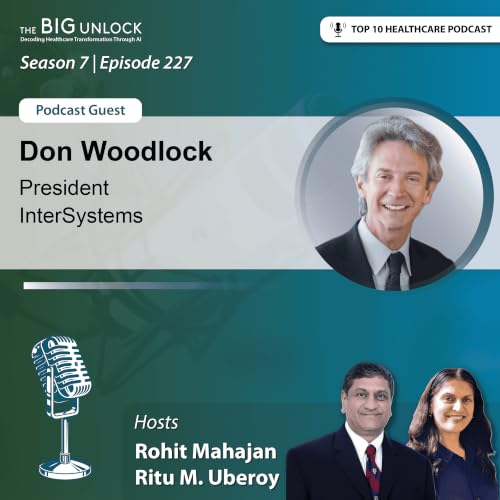
  • Episode 227 – AI-Native Means Rethinking the Workflow, Not Bolting on AI
    Sep 22 2026
    The Big Unlock · Don Woodlock, President, InterSystems

    In this episode, Don Woodlock, President of InterSystems, discusses what it takes to make AI work effectively in healthcare. He emphasizes that organizations need to look beyond models and focus equally on use cases, ROI, change management, data, and integration. AI needs to be connected to the right data, context, procedures, and skills to deliver value within an organization.

    Don emphasizes that healthcare remains a human endeavor. AI can summarize complex patient information and help clinicians consider additional possibilities, but it should support human decision-making rather than replace it. He sees agentic AI helping with administrative tasks, reducing burden, and improving access, with human oversight remaining essential.

    Don believes AI-native healthcare requires AI to be embedded directly into products and workflows. Rather than bolting AI onto existing software, the opportunity is to rethink how users interact with systems, allowing them to state what they want accomplished while the technology handles the underlying work. Take a listen.

    This guest appearance was facilitated through conversations initiated at HIMSS.

    Show More Show Less
    26 mins
  • Episode 225 – Moving Healthcare AI from Conversation to Execution
    Sep 8 2026
    The Big Unlock · Shailu Verma, Chief Executive Officer, Co-founder, Mila Health

    In this episode, Shailu Verma, CEO and Co-founder of Mila Health, explores how healthcare AI is moving beyond patient engagement and conversational tools toward AI agents that execute care coordination workflows. He explains that many critical tasks across the patient journey remain manual, creating an opportunity for AI to improve access, engagement, operational efficiency, and outcomes.

    Shailu emphasizes that scaling AI requires more than another point solution. AI must integrate seamlessly into existing clinical technology, remain configurable and governable, deliver consistent responses, and bring humans into the loop when needed. He sees LLMs becoming increasingly commoditized, making the last mile of execution, governance, and workflow integration critical differentiators.

    Shailu urges healthcare leaders to start with measurable problems where AI can demonstrate real ROI. His message is clear: move AI from conversation to execution, automate manual coordination, and focus on getting meaningful work done. Take a listen.

    Show More Show Less
    25 mins
  • Episode 224 – AI Can Augment Clinical Judgment Without Replacing It
    Sep 1 2026
    The Big Unlock · Dr. Ami Bhatt, Chief Medical Officer, WHOOP

    In this episode, Dr. Ami Bhatt, Chief Medical Officer at WHOOP and former Chair of the FDA Digital Health Advisory Committee, explores how healthcare can embrace AI without losing the clinical judgment, human connection, and context essential to patient care. She sees AI as a powerful source of compute that can surface knowledge, identify patterns, and help clinicians navigate growing volumes of health data, while clinical acumen remains central to decision-making.

    Dr. Bhatt emphasizes that digital health and Agentic AI must start with the patient, incorporate individual preferences, and establish clear guardrails for when human intervention is required. She also highlights wearables as an important bridge between community-based monitoring and clinical care.

    Dr. Bhatt highlights the need for post-deployment monitoring and real-world evidence as AI systems continuously evolve, and calls for closer collaboration among patients, clinicians, technology companies, and regulators. She urges healthcare leaders to prepare for constant technological change, develop stronger digital infrastructure, and focus innovation on unmet patient needs rather than technology for its own sake. Take a listen.

    This episode was recorded in July 2026. Dr. Bhatt is now Chief Medical Officer at WHOOP.

    Show More Show Less
    27 mins