• David Sanders: Why Getting Product/Service Costing Right Is the Key to Growing Performance and Value
    Jan 25 2026

    Have you Subscribed/Followed yet? Please do so I know I’m on the right track and adding value.

    Click here for further information and the eBook of resources:

    https://www.criticalfewactions.com.au/podcast/

    Do you really know what your products cost? Or, just what your system says they do?

    When your data tells you one thing, but your invoices say another, who do you trust?

    And what if the purpose behind your costing model is the reason you can’t see what’s really happening?

    If you’ve ever wondered why your numbers don’t match your experience, this episode is for you.

    In this conversation, John Downes speaks with Dave Sanders, CEO of Bestrane, about the truth behind product costing and how CEOs can use it to make better decisions and improve their Organisation Performance and Value.

    What You’ll Learn:

    == How to reveal hidden behaviours through your costing model

    == Why AI can’t replace good judgement in decision-making

    == How accurate costing improves business performance and value


    Highlights:

    00:00 Dave Sanders and The Journey into Product Costing

    02:38 Understanding Product Costing

    04:10 Case Study: Electronic Components and Software

    07:33 The Role of Invoices in Costing

    17:40 Challenges in Product and Service Costing

    21:52 Value-Based Pricing in Practice

    23:10 Challenges in Service Pricing

    25:26 Costing in Software Businesses

    34:29 AI's Impact on Costing and Decision Making

    38:20 Critical Actions for Founders and CEOs


    The #CriticalFewActions™ You Can Do Today

    When I work with successful business leaders to create their Strategic Plans and help them implement them, I often find that their product and service costing doesn’t tell the full story. Many assume they know their margins, until the data reveals how sales or customer behaviour drives unseen cost.


    The first Insight is about Purpose-Driven Costing.

    Many costing models exist to satisfy accountants rather than decision-makers.

    So, what can you do?

    • Define what decision each cost figure is meant to support.

    • Align every measure with your business purpose: service, efficiency, or value.


    The second Insight is about Revealing Hidden Behaviour.

    Linking costs to activity exposes how teams or branches use resources differently.

    So, what can you do?

    • Analyse behaviour patterns behind cost drivers.

    • Use costing to start conversations that improve performance, not assign blame.


    The third Insight is about Thinking Before You Automate.

    AI can model hundreds of scenarios, but leaders must still decide what matters.

    So, what can you do?

    • Use technology to test options but decide with intent.

    • Keep purpose and human judgement at the centre of every decision.


    Sponsor: The CEO Masterclass in Strategic Planning and Implementation

    Are you a business owner or CEO striving to elevate your business to new heights? But right now… you’re not hitting the targets or objectives your business needs to achieve. Or maybe you’ve hit a roadblock you can’t move past—a major challenge with no clear solution; and there’s no one in your world you can talk to about it.

    This isn’t another generic leadership course. It’s a highly focused, small-group programme where you’ll work alongside your peers, on your business, break through barriers, and implement real-world strategies; not just to solve the problems holding your business back, but to accelerate your growth faster than you thought possible.


    Find out more here:

    Show More Show Less
    40 mins
  • Ben Verney: How to Restructure a Business in Distress, Before It’s Too Late
    Jan 18 2026

    Please help me by hitting the Subscribe/Follow button.

    Click here for information and the eBook of resources:

    https://criticalfewactionspodcast.com.au/BenVerneyEpisodePage

    • How close is your organisation to a financial tipping point you haven’t yet recognised?
    • What would you do if your creditors or the tax office called tomorrow demanding payment?
    • Could your business survive a cash flow crisis next quarter?

    If you’re worried about your business cash flow or growing debt, this episode is for you.


    In this episode, John Downes speaks with restructuring expert Ben Verney, who helps organisations in distress navigate recovery through practical restructuring, Voluntary Administration, and turnaround strategies. Together they unpack what business restructuring really means, when to act, and how to protect jobs, reputation, and future value. For CEOs and founders, this conversation offers clarity, calm, and the confidence to make the right next move. It also helps you understand where you could significantly put yourself at personal and professional financial risk.


    What You’ll Learn:

    == How to recognise early warning signs of financial distress

    == The role of Voluntary Administration in saving businesses

    == Metrics every CEO should track to stay ahead of problems

    == How to manage emotional and legal pressures during crisis

    == Practical steps to protect your people and your company’s value


    Highlights

    00:00 Introduction to Ben Verney and His Expertise

    04:29 Defining Business Restructuring

    06:20 Case Study: Restructuring During COVID-19

    09:41 The Voluntary Administration Process

    17:42 Challenges and Considerations in Restructuring

    23:01 Alternative Solutions and Flexibility in Restructuring

    28:15 Emotional Challenges for Business Owners

    30:02 The Importance of Seeking Advice

    31:57 Key Metrics for Business Health

    34:15 Understanding Legal Liabilities

    38:07 Voluntary Administration Process

    39:56 Restructuring in Different Business Environments

    46:56 #CriticalFewActions™ for Business Owners and Senior Leaders


    The #CriticalFewActions™ You Can Do Today


    When I work with successful business leaders to create their Strategic Plans and help them implement them, I often see them wait too long before confronting distress signals. Most CEOs believe short-term fixes will solve cash flow pressure until it becomes a crisis. Restructuring, done early and professionally, is a way to preserve value and lead responsibly.


    Here are the 3 key insights:

    1 – Recognise distress early

    Too many businesses treat tax debt as cash flow.

    So, what can you do?


    • Review cash flow, payroll, and tax obligations monthly.
    • Engage advisers before problems compound.


    2 – Build a realistic recovery plan

    Delayed decisions destroy trust and options.

    So, what can you do?


    • Model multiple turnaround scenarios and discuss them with your board or peers.
    • Communicate early with creditors and your team to maintain confidence.


    3 – Lead through restructuring, not from fear

    Restructuring done right saves livelihoods.

    So, what can you do?


    • Treat restructuring as a leadership skill, not a failure.
    • Strengthen your reporting and diversify income now to future-proof your organisation.


    If you found this conversation valuable, please Subscribe / Follow, leave a comment, and share this episode with your peer business leaders. Your...

    Show More Show Less
    49 mins
  • Fiona Hansen: How to Put a Price on Your Brand Before Someone Else Does
    Dec 14 2025
    Please please click Subscribe/Follow so I can keep giving you valuable insights.Click here for further information and the eBook of resources:

    https://www.criticalfewactions.com.au/podcast/

    Please let me know if I’m on the right track with the podcast. It means the world to me to know I’m adding value.

    • Do you know what your business is really worth, beyond what’s on paper?

    • Are your brand, customers, and systems working as valuable assets? Or are they being overlooked?

    • When it comes time to sell, will you be negotiating from strength or surprise?


    If you’re thinking of an exit and you’ve never valued your intellectual property or brand, this episode is for you.

    In this episode, Strategic Mentor, John Downes explores what underpins a solid strategic plan and implementation of that plan as he speaks with valuation expert Fiona Hansen about how CEOs can uncover the real worth of their intangible asset: brand, customers, and systems. Fiona explains how these unseen drivers of value can make or break a negotiation and why smart CEOs treat IP valuation as an ongoing discipline, not a last-minute exercise.

    What You’ll Learn:

    == Why systems, customer bases, and brand are often undervalued assets.

    == The core valuation methods every CEO should understand.

    == How to calculate customer lifetime value and reduce valuation risk.

    == Why your brand can never be worth more than your business.

    == The critical steps to prepare your business for exit.

    Highlights

    00:00 Why Valuing Intellectual Property Matters

    01:09 Case Study – How a Mobile Betting Company Valued Its IP

    05:04 The Three Core Valuation Methods Explained

    12:34 How to Value a Customer Base

    15:21 Brand Value and the Louis Vuitton Example

    21:46 Market Valuation vs Traditional Techniques

    27:30 Preparing Your Business for Exit

    32:56 The #CriticalFewActions™ for Senior Leaders

    The #CriticalFewActions™ You Can Do Today:

    When I work with successful business leaders as a Strategic Mentor, exploring what underpins a solid strategic plan and implementation of that plan, I often find they’re focused on profit and revenue but overlook the assets that create them. Most CEOs underestimate how much systems, customer data, and brand equity contribute to overall enterprise value. Here are the three key insights I took from the conversation:

    1 – Systems as Assets.

    The first insight is about valuing your systems.

    Problem: Many treat systems as cost centres, not core value drivers.

    So, what can you do?

    • Identify the systems that enable sales and efficiency.
    • Estimate how much revenue depends on each—this defines your asset value.


    2 – Customer Value

    The second insight is about customer bases.

    Problem: CEOs see databases, not long-term revenue streams.

    So, what can you do?

    • Measure churn and retention over several years.
    • Segment customers to calculate lifetime value (CLV).


    3 – Brand and Profit

    The third insight is about brand.

    Problem: Awareness alone doesn’t equal brand value. It must link to profit.

    So, what can you do?

    • Identify how your brand supports pricing power or loyalty.
    • Use industry royalty benchmarks to quantify brand worth.


    If you found this conversation valuable, please Subscribe / Follow, leave a...

    Show More Show Less
    34 mins
  • Rachel Delaney: From Startup to Sale-The Hidden Legal Traps That Can Derail A Business Exit
    Dec 7 2025

    Subscribe/Follow and click here for further information and the eBook of resources:

    https://criticalfewactionspodcast.com.au/RachelDelaneyPodcastUpdate1

    Please let me know if I’m on the right track with the podcast. It means the world to me to know I’m adding value.

    Are you protecting your business, or leaving value exposed every day?

    Could a single contract clause undo years of hard work?

    Would investors discover something you never knew you didn’t own?

    If you want to protect value and avoid costly legal surprises, this episode is for you.


    John Downes speaks with Rachel Delaney, Founder and Fractional General Counsel at Resident Legal. Rachel shows how early legal action saves money, builds confidence, and makes a business exit-ready.


    What You’ll Learn:

    == Why early legal involvement creates confidence, not cost

    == How to lock down your intellectual property before investors ask

    == Ways to empower teams through Contract Playbooks

    == The rise of wage-compliance risk and how to avoid it

    == Why exit readiness starts with strong legal foundations


    Highlights

    00:00 Rachel’s legal journey and career path

    02:17 Why startups need early legal support

    04:13 Case study: IP issues that cost founders

    06:37 Legal essentials every startup should know

    08:07 How Contract Playbooks protect and empower

    10:49 Understanding wage theft and compliance risks

    14:01 Legal challenges during growth and major deals

    16:51 Fractional legal counsel for scaling businesses

    23:55 How to prepare for exits and mergers

    38:40 #CriticalFewActions™ for Senior Leaders


    The #CriticalFewActions™ You Can Do Today


    When I work with successful business leaders, I often see them delay legal steps until problems become urgent. Waiting too long is always costly.

    The first Insight is about locking down intellectual property early.

    If you don’t own it, you can’t sell it.

    • Audit all IP ownership with founders and contractors.

    • Include written IP assignment clauses before work begins.

    The second Insight is about being contract-ready.

    Teams lose deals—or accept risk—without a playbook.

    • Build a Contract Playbook listing red flags and escalation rules.

    • Train staff to use it and call for help early.

    The third Insight is about preparing for exit long before sale.

    Messy records erode confidence and reduce value.

    • Treat legal housekeeping as part of value creation.

    • Build your data room now so due diligence confirms success.

    If you found this conversation valuable, please Subscribe / Follow, leave a comment, and share this episode with your peer business leaders. Your support helps us reach more CEOs who want to improve their organisation performance and value.


    Stay in the loop with show updates and exclusive content: https://www.criticalfewactions.com.au/podcast/


    Sponsor: The CEO Masterclass in Strategic Planning and Implementation

    Are you a business owner or CEO striving to elevate your business to new heights? But right now… you’re not hitting the targets or objectives your business needs to achieve. Or maybe you’ve hit a roadblock you can’t move past, a major challenge with no clear solution, and there’s no one in your world you can talk to about it.


    This isn’t another generic...

    Show More Show Less
    41 mins
  • Marie Felsbourg: From Trauma to Triumph. How Marie Felsbourg built Astral Consulting in Information Management
    Nov 30 2025

    Subscribe/Follow and click here for further information and the eBook of resources:

    https://www.criticalfewactions.com.au/podcast/

    Please let me know if I’m on the right track with the podcast. It means the world to me to know I’m adding value.

    => Can you really separate your life from your business?

    => What if your hardest experiences became the foundation for your greatest success?

    => Are the patterns in your organisation helping it grow? Or, are they holding it back?

    If you’ve ever faced setbacks that shaped how you lead today, this episode is for you.

    In this episode, John Downes speaks with Marie Felsbourg, founder of Astral Consulting, a specialist in information management and governance. Marie built her business from personal challenge and resilience, helping Australia’s largest corporates and government agencies prepare for the AI era with systems that ensure compliance, trust and performance. Her story shows how discipline, self-awareness and people development can turn adversity into long-term growth.

    What You’ll Learn:

    == How to turn personal hardship into leadership strength

    == Why developing people from the bottom up drives business resilience

    == How information patterns define your organisation’s success

    == Practical ways to prepare your business for the AI future

    == The importance of discipline and accountability in growth

    Highlights

    00:00 Meet the Founder: Marie Felsbourg

    00:43 The Fascination with Patterns

    03:07 The Birth of Astral Consulting

    06:03 Challenges and Growth

    06:32 Information Management and AI

    09:09 Building a Business from the Ground Up

    15:38 Navigating Personal and Professional Life

    25:10 Intern Programs and Global Opportunities

    30:27 The Unexpected Benefits of COVID-19

    31:26 Navigating the CEO Masterclass

    32:14 The Importance of Perspective and Resilience

    35:43 The Role of Information Governance

    37:45 Innovating Business Models with Managed Services

    44:20 Leveraging Positive Psychology for Team Development

    51:52 Advice for Young Professionals and CEOs

    55:23 #CriticalFewActions™ for Senior Leaders


    The #CriticalFewActions™ You Can Do Today

    When I work with successful business leaders, I often see that many struggle to connect the personal lessons from their own lives to how they lead their organisations. Marie’s story reminds us that resilience, focus and discipline are as vital in business as in life.


    Here are the three key insights I took from the conversation:

    Insight 1 – Turning personal challenges into business strength

    Many founders separate personal and business growth, yet they often inform each other.

    So, what can you do?

    • Reflect on how your life experiences shape your leadership decisions.

    • Build systems and habits that keep you focused when life throws its next curve ball.


    Insight 2 – Developing people from the bottom up

    Growth stalls when leaders don’t invest in the next generation of talent and processes.

    So, what can you do?

    • Create structured development pathways for your team—from interns to leaders.

    • Build repeatable processes so knowledge is retained and scaled, not lost in handover.


    Insight 3 – Understanding patterns in information management

    Most leaders don’t see the repeating patterns in their operations until they become bottlenecks.

    So, what can you do?

    • Map the critical information flows in your organisation and ask where data gets lost or duplicated.

    • Use those patterns to...

    Show More Show Less
    56 mins
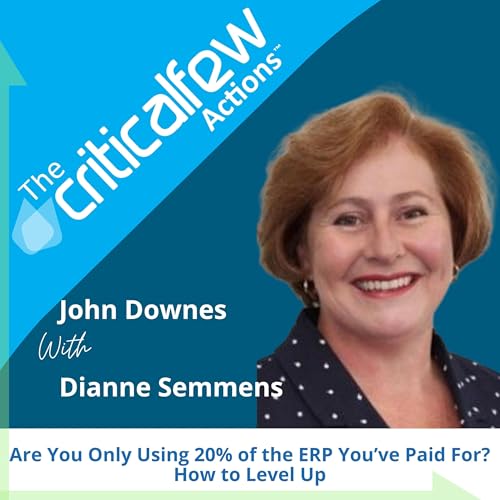
  • Dianne Semmens: Are You Only Using 20% of the ERP You’ve Paid For? How to Level Up
    Nov 23 2025

    Subscribe/Follow and click here for further information and the eBook of resources:

    https://criticalfewactionspodcast.com.au/DianneSemmens4EpisodePage

    Please let me know if I’m on the right track with the podcast. It means the world to me to know I’m adding value.

    • Are you only using 20% of the ERP you’ve paid for?
    • Could Phase 2 of ERP adoption be where the real value lies?
    • What if the tools you already own could save time and margin?

    If you’ve implemented ERP but stopped after the basics, this episode is for you.

    Many mid-sized businesses install ERP systems, survive go-live, then hit pause. The system runs, but the value stalls. In this episode of the #CriticalFewActions™ podcast, John Downes speaks with Dianne Semmens, CEO of Acacia Consulting Services. Dianne explains how most organisations miss out on mobile functionality, automation, and AI-driven decision support already included in their ERP licence. CEOs will learn how to unlock this “second wave” of ERP and avoid leaving value on the table.

    What You’ll Learn:

    == Why most businesses plateau after ERP go-live

    == How mobile ERP apps streamline expenses, time-tracking and approvals

    == Simple workflow automations that cut rework and protect margins

    == How AI is already embedded in ERP and what to switch on today

    == Why post-implementation reviews matter to capture new functionality

    Highlights

    00:00 Why most CEOs underuse ERP

    02:00 Five next-level ERP functions

    03:00 Mobile apps for expenses and pay-on-glass

    05:30 Automations that boost service and reduce margin loss

    07:30 Business alerts and stock management

    09:00 MRP and manufacturing planning

    10:30 AI integration into ERP

    13:00 Natural language queries in ERP

    17:30 Efficiency vs headcount: creating capacity

    19:00 Post-implementation reviews and missed opportunities

    21:00 #CriticalFewActions™ for Senior Leaders

    The #CriticalFewActions™ You Can Do Today

    When I work with successful business leaders, I often see ERP value stall after go-live. The basics work, but advanced capability sits idle. So think about these three insights I took from the episode:

    The first Insight is about mobile ERP apps. Many businesses miss them. The problem: wasted time on manual forms.

    So, what can you do?

    • Check if your ERP has a mobile app tailored to your versions
    • Pilot simple functions like expenses, timesheets, or pay-on-glass sign-off.


    The second Insight is about workflow automations. Manual processes eat time and margin.

    So, what can you do?

    • Start with small wins like automated order confirmations.
    • Review ERP workflows already available but not yet enabled.


    The third Insight is about AI-driven ERP decision support. Many teams still export to spreadsheets while AI sits unused.

    So, what can you do?

    • Ask your ERP provider what AI tools are embedded.
    • Enable natural language query features to answer questions without coding.


    If you found this conversation valuable, please hit the Subscribe / Follow button, leave a comment, and share this episode with your peer business leaders. Your support helps us reach more CEOs who want to improve organisation performance and value.

    Stay in the loop with show updates and exclusive content:

    Show More Show Less
    22 mins
  • Leanne Simpson: Crisis Leadership. How CEOs Can Lead When Everything Goes Wrong
    Nov 16 2025

    Could I ask you a favour? Please let me know you are getting value by clicking Subscribe/Follow here, and I’ll continue to work my butt off to produce the best content I can for you. It means the world to me.

    • What would you do if your board said: fix it or shut it down?

    • How do you lead when floods, fires, and storms hit all at once?

    • Can you act decisively when you don’t have the data, time, or resources?


    If you’ve ever wondered how to lead when survival is at stake, this episode is for you.

    In this conversation, Leanne Simpson shares lessons from turning around the Royal Flying Doctor Service during a cash flow crisis and leading through cascading disasters in regional Australia. CEOs of mid-sized businesses will discover practical tools to act fast, manage resistance, and keep their organisations alive when everything goes wrong.

    What You’ll Learn:

    == Why CEOs must spot creeping crises early before options disappear

    == How to overcome resistance with evidence and clear communication

    == How to prioritise survival and delegate effectively in cascading crises

    == Why you must give teams permission to stop non-essential work

    == Practical crisis leadership tools you can apply in your organisation today

    Highlights

    00:00 Leanne's Journey into Crisis Leadership

    03:01 Defining Crisis Leadership for Medium Businesses

    04:27 Handling Significant Uncontrolled Calamities

    08:25 Case Study: Royal Flying Doctor Service

    17:11 Leadership Challenges and Organizational Change

    24:14 Case Study: Fire, Flood, Mud slide, Supercell in the Bowen Region

    28:03 Critical Functions and Prioritization

    28:23 Effective Communication in Crisis

    29:50 Delegation and Performance Management

    33:08 Adapting Organizational Structures

    35:53 Building Leadership Muscle for Crisis

    43:30 Environmental Scanning and Risk Management

    45:51 Top Crisis Management Gotchas

    50:36 Critical Actions for Crisis Leadership

    The #CriticalFewActions™ You Can Do Today:

    Real crises come with no time, little data, and scarce resources. But you still must decide. And you must act.

    Insight 1 – Spot creeping crises early

    The first Insight is about recognising creeping crises. These build slowly until they threaten survival.

    So, what can you do?

    • Don’t wait for perfect information — act on early signals.
    • Map cash flow, regulation, workforce, and customer demand together.

    Insight 2 – Overcome resistance fast

    The second Insight is about breaking through resistance to urgent change.

    So, what can you do?

    • Use data to prove benefits to each stakeholder group.
    • Communicate early and set timelines for change.


    Insight 3 – Lead through cascading crises

    The third Insight is about prioritising when multiple crises strike.

    So, what can you do?

    • Put survival and critical functions first, stop non-essentials.
    • Delegate decisively, even with imperfect resources.

    If you found this conversation valuable, please share it with your peer business leaders to help improve organisation performance and value.

    Sponsor: The CEO Masterclass in Strategic Planning and Implementation

    Are you a business owner or CEO striving to elevate your business to new heights? But right now… you’re not hitting the targets or objectives your business needs to achieve. Or maybe you’ve hit a roadblock you can’t move past—a major challenge with no clear solution—and there’s no one in your world you can talk to about it.

    This isn’t another generic leadership course. It’s a highly focused, small-group programme where...

    Show More Show Less
    49 mins
  • Kate Goss: Turning Research into Revenue. The Innovator’s Roadmap From Idea to Market in 12 Months
    Nov 2 2025
    Subscribe/Follow and click here for further information and the eBook of resources:

    https://www.criticalfewactions.com.au/podcast/

    Please let me know if I’m on the right track with the podcast. It means the world to me to know I’m adding value.

    Have you ever had a brilliant idea that never made it past the whiteboard?

    Are you struggling to get from prototype to your first paying customer?

    Or wondering how to fund innovation without losing control of your business?

    If you have an idea on paper but no paying customer yet, this episode is for you.

    In this episode, John Downes talks with serial innovator Kate Goss, Founder of The Velo Group, about how to turn research and innovation into paying customers within 12 months. Drawing on her four start-ups and four exits, Kate shares how to clarify the real problem, involve early customers, and protect your IP as you scale.

    What You’ll Learn:

    == How to identify and validate the real customer problem before you build

    == Why an MVP mindset accelerates innovation

    == How to protect your IP and data in the age of AI

    == How to involve early users as collaborators, not critics

    == Why speed to market often beats perfection

    Highlights

    00:00 Kate’s Journey from Finance to Technology

    03:13 The Challenges of Commercialising Innovation

    06:45 Case Study: KnowMio and AI Innovation

    13:39 Navigating Funding and Commercialisation Milestones

    13:53 The Impact of IP and Governance in AI

    28:20 Collaborative Innovation in Research Institutions

    28:58 The Importance of IP and Longevity in Innovation

    30:12 Sustainability and ESG in Innovation

    30:32 Data and Technology in Agriculture

    33:39 Performance Metrics in Innovation

    36:07 The Role of AI in Accelerating Innovation

    41:32 Challenges in Commercialising Innovation

    51:16 #CriticalFewActions™ for Senior Leaders


    The #CriticalFewActions™ You Can Do Today:

    When I work with successful business leaders, I often see great ideas stall because leaders try to make them perfect before testing them in the market. Innovation isn’t about the smartest concept; it’s about solving the right problem and validating value quickly.


    Here are the three key insights I took from the conversation:
    1. Clarify the real problem before building the solution.

    Too many founders rush into design before validating demand.

    So, what can you do?

    = Start every innovation discussion with one sentence: What problem are we solving?

    = Engage potential customers early to test that the problem truly matters before you build anything.


    1. Build your MVP and involve early customers.

    “It’s not your first idea that wins. It’s often the second or third iteration that becomes the cracker,” says Kate.

    So, what can you do?

    = Define your minimum viable product; what must work, not what could work.

    = Get your first users involved as collaborators, not critics.


    1. Pricing, IP, and protecting your innovation as you scale.

    Every business, large or small, has IP worth protecting.

    So, what can you do?

    = Review who owns your code, content, and data before sharing them with third parties or AI platforms.

    = Build governance and clear policies early to protect your intellectual property and customer trust.


    If you found this conversation valuable, please Subscribe / Follow, leave a comment, and share this episode with your peer business leaders. Your support helps us reach more CEOs who want to improve organisation performance and value.


    Stay in the loop with show updates and exclusive content:

    Show More Show Less
    48 mins