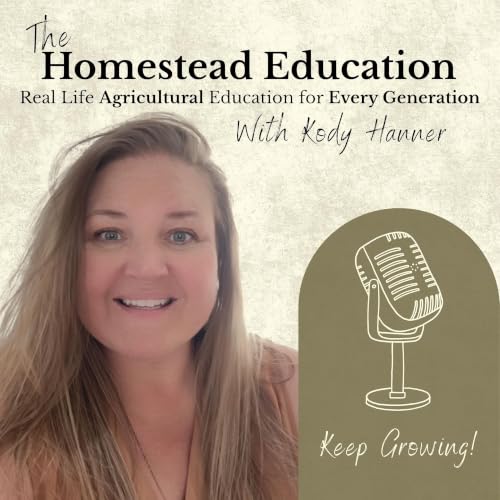
The Homestead Education Podcast cover art

The Homestead Education Podcast

The Homestead Education Podcast

Written by: Kody Hanner
Listen for free

Everyone deserves an agricultural education — to understand food, land, and responsibility at a scale that fits real life.

Hosted by Kody Hanner, agricultural educator, homeschool mom of six, and lifelong rural advocate, The Homestead Education Podcast explores how accessible, small-scale agricultural education can build capable people, strengthen families, and create resilient local food systems.

Drawing from generations of rural knowledge, educated in animal science, and years of teaching families outside traditional systems, Kody breaks down complex food and education topics into practical, usable skills for homes, classrooms, and communities.

Each week, you’ll hear honest conversations about food systems, small-scale agriculture, homeschooling, and real-world education — designed for families, educators, and anyone who believes we shouldn’t outsource our lives.

Whether you live on acreage, in town, or somewhere in between, this podcast will help you understand where your food comes from, why it matters, and how practical agricultural knowledge can create meaningful change.

Copyright 2026 All rights reserved.
Episodes
  • Episode 187: How to Preserve Heirloom Seeds and Grow a Resilient Garden
    Oct 13 2026

    Seed saving is about far more than collecting a few seeds at the end of the gardening season. It is a practical way to preserve heirloom varieties, strengthen your garden, and keep more control over your family’s food supply.

    In this episode, I’m joined by Christopher and Maggie Snow of Autumn Prairie Pumpkins to discuss seed saving, heirloom pumpkins, hand pollination, pest-resistant squash varieties, and the small suburban garden that grew into a micro farm and seed business.

    Christopher and Maggie explain the difference between heirloom and F1 hybrid seeds—and why seeds collected from a hybrid plant may not produce the same variety the following year. We also walk through their seed-saving process, including covering unopened blossoms, hand-pollinating flowers, preventing unwanted cross-pollination, and labeling the seeds they intend to preserve.

    We also talk about:

    • Why heirloom seeds matter for food security and resilience

    • How to begin seed saving in your own garden

    • The difference between heirloom and F1 hybrid varieties

    • How squash and pumpkins cross-pollinate

    • Using blossom bags and hand pollination to keep seeds true

    • Choosing squash varieties adapted to local pests and conditions

    • Squash vine borers, cucumber beetles, and natural pest-management methods

    • Growing vertically in a small suburban backyard

    • Preserving unusual culinary pumpkins and their agricultural history

    • Turning a passion for gardening into a small farm business

    You do not need acres of land, generations of gardening knowledge, or a naturally green thumb to begin growing food and saving seeds. Sometimes it starts with one stubborn pumpkin plant—and a willingness to learn why it survived when the others did not.

    Learn more about Christopher and Maggie, shop their heirloom seeds, and find their pumpkin cookbook at AutumnPrairiePumpkins.com.

    Use code HOMESTEAD10 for 10% off your order.

    Episode Links

    • The Pumpkin Bakery Book: https://link.amazon/B0coHS4gw
    • Ten Tomatoes that Changed the World: https://link.amazon/B0cuEn6db
    • Guns, Germs, & Steel: https://link.amazon/B02DY7mdr

    Kody's Links

    • Homestead Education Curriculum – http://thehomesteadeducation.com/homesteadeducationcurriculum
    • Homestead Family Reading List – https://www.thehomesteadeducation.com/homestead-summer-reading-list/
    • ESA Funding: https://www.thehomesteadeducation.com/funding/
    • Instagram – https://instagram.com/homestead_education
    • Facebook – https://facebook.com/thehomesteadeducation
    • Raising Self-Sufficient Kids Book – https://www.thehomesteadeducation.com/product/raising-self-sufficient-children/
    Show More Show Less
    57 mins
  • Episode 186: How to Prepare for Rising Gas Prices & Food Shortages
    Sep 22 2026
    What happens when rising gas prices don't just hurt at the pump—but begin affecting the cost and availability of nearly everything else? In this episode of The Homestead Education Podcast, I'm joined by my husband, Ron Hanner, to talk about what higher fuel costs can mean for truckers, farmers, food prices, local businesses, and the supply chain—and, more importantly, what ordinary families can actually do about it. This isn't about preparing for the end of the world. It's about preparing for the unprecedented. A job loss. A power outage. A winter storm. A supply-chain disruption. Rapidly rising gas prices. Or simply discovering that the groceries your family buys every week suddenly cost far more than they did a year ago. Ron and I talk through the ripple effect that fuel prices can have across agriculture and transportation, including the pressure on independent truck drivers and the importance of the trucks that move food, fuel, medical supplies, manufacturing materials, and countless everyday necessities. We also discuss why even a short disruption can expose just how dependent modern communities are on products arriving exactly when they're needed. But most of this episode is about what you can do before you're scrambling. In This Episode: How rising gas prices can increase the cost of food and other necessitiesWhy independent truck drivers are especially vulnerable to major fuel-price increasesWhat a transportation or supply-chain disruption could mean for everyday familiesWhy preparedness doesn't have to mean extreme preppingSimple ways to store drinking waterHow to secure a dependable protein sourceBuying beef, pork, eggs, and milk directly from local farmersSplitting bulk meat purchases with friends or family to lower the upfront costStretching meat across multiple mealsStocking inexpensive staples like potatoes and other root vegetablesPreserving grocery-store produce when your garden doesn't produce enoughSmall-batch canning, freezing, fermenting, and refrigerator picklingWhy you don't need to preserve hundreds of pounds of food at onceHow buying in bulk can make higher-quality food more affordableGetting multiple foods from one ingredient—like turning raw milk into drinking milk, yogurt, cream, butter, or cheeseReducing food waste by creating a more circular household or homestead food systemWhy supporting your local farmer before a crisis matters so much One of the biggest misconceptions about preparedness is that you need a huge pantry, acres of land, or thousands of dollars to get started. You don't. Start with one thing. Buy an extra staple when it's inexpensive. Find someone locally who sells eggs. Split a bulk beef purchase with another family. Learn how to preserve one food your family already eats. Store a little water. Cook an extra portion and put it away. The goal isn't fear. The goal is creating enough margin in your life that the unexpected doesn't immediately become an emergency. We also talk about one of the most important pieces of preparedness that can't be stored on a pantry shelf: relationships. A functioning local food system exists only when local farmers have enough customers to keep producing food. Waiting until grocery shelves are empty to find your local farmer is too late. Supporting those producers consistently helps ensure that farms, ranches, dairies, and small food businesses are still there when your community needs them. And because this is our family, the conversation naturally includes cows getting ready to calve, a chicken tractor that we accidentally built too large to get off the porch, kids who name animals destined for the freezer, plans for a multigenerational family homestead—and Ron abruptly leaving the podcast when his fire department pager goes off. Real life doesn't stop because you're recording a podcast. Neither does the unexpected. The best time to prepare for it is before you need to. Resources Mentioned Visit The Homestead Education for resources on food production, agriculture, preservation, homesteading, and teaching the next generation practical skills. If you have a question you'd like us to answer in a future episode, reach out at hello@thehomesteadeducation.com. And until next week—keep growing. Episode Links Hanner Homestead: https://www.hannerhomestead.comHanner Homestead Facebook: https://www.facebook.com/thehannerhomesteadRedmond's Real Salt: https://glnk.io/oq72y/homestead-educationEpisode 148: Homesteading on a Budget: Practical Tips to Grow Self-Sufficiency with Less Money: https://www.thehomesteadeducation.com/episode-148-homesteading-on-a-budget-practical-tips-to-grow-self-sufficiency-with-less-money/Episode 119: Are you sustainably prepared?: https://www.thehomesteadeducation.com/episode-119-are-you-sustainably-prepared/ Kody's Links Homestead Education Curriculum – http://thehomesteadeducation.com/homesteadeducationcurriculumHomestead Family Reading List – https://www.thehomesteadeducation.com/...
    Show More Show Less
    49 mins
  • Episode 185: How I Actually Get It All Done on a Homestead
    Sep 15 2026

    In this episode, I’m answering one of the questions I get asked all the time: How do I get it all done?

    Between running a homestead, raising livestock, homeschooling, managing multiple businesses, traveling, running a co-op, and keeping up with a very full household, the real answer is—I don’t do it all.

    I’m sharing what actually helps me keep things moving: delegating, building systems, choosing priorities, managing the mental load, using tools that work with my brain, knowing when to hire help, and accepting that sometimes “good enough” really is good enough.

    I also share plenty of real-life homestead chaos along the way—from new piglets and heritage hogs to chicken disasters, ducks, harvest season, and the reality of trying to prepare for winter while running a business.

    If you’ve ever felt like you’re working constantly but somehow still falling behind, this episode is for you.

    Episode Links

    • Autumn of the Homestead Activity Book: https://www.thehomesteadeducation.com/product/seasons-on-the-homestead-autumn-educational-activity-book/
    • Hanner Homestead: info@hannerhomestead.com
    • 80/20 Rule Book: https://amzn.to/4AeMfTl
    • The Gut Health Product That Changed My Life: https://shareplex.us/share/8qE7_VL

    Kody’s Link

    • Homestead Education Curriculum – http://thehomesteadeducation.com/homesteadeducationcurriculum
    • Homestead Family Reading List – https://www.thehomesteadeducation.com/homestead-summer-reading-list/
    • ESA Funding: https://www.thehomesteadeducation.com/funding/
    • Instagram – https://instagram.com/homestead_education
    • Facebook – https://facebook.com/thehomesteadeducation
    • Raising Self-Sufficient Kids Book – https://www.thehomesteadeducation.com/product/raising-self-sufficient-children/
    Show More Show Less
    1 hr and 23 mins
adbl_web_anon_alc_button_suppression_t1
No reviews yet