• C.S. Lewis' Nightmares
    May 26 2026

    Dr. Luke Mills joins me to talk about his article "His Dark Materials," as well as C.S. Lewis' nightmare imagery across his fiction. Among other things, we discuss:

    • [2:08] – Welcome & guest introduction: Dr. Luke Mills, Associate Professor of English at Wingate University
    • [2:57] – Dr. Mills's article: "His Dark Materials: C.S. Lewis's Nightmares as Inspiration"
    • [4:10] – What drew Mills to the topic: Lewis's dreams of lions and the writing of Narnia
    • [5:09] – Lewis's diary (All My Road Before Me) and the wolf-and-sheep nightmare (April 27, 1923)
    • [6:13] – Reading of the wolf-and-sheep nightmare
    • [7:07] – Lewis as an author of both heavenly beauty and horror
    • [7:41] – The Unman in Perelandra and Lewis's vivid portrayal of evil
    • [8:39] – How common were nightmares for Lewis? Insects, specters, and a lifelong pattern
    • [10:29] – Lewis near death: vivid dreams and beautiful visions
    • [11:38] – Etymology of "dream" and "nightmare" (Old English roots)
    • [12:07] – Did Lewis think his dreams were spiritually significant?
    • [12:46] – The Dark Tower and J.W. Dunne's Experiment with Time: precognitive dreams
    • [15:21] – Lewis, Tolkien, and their shared interest in time and dreams
    • [16:29] – Lewis's belief in precognitive dreams and his complicated relationship with Dunne's theories
    • [17:22] – The Dark Tower: the chronoscope and alternate timelines
    • [20:01] – Dreams as portals to other realities; Lewis's strong belief in the supernatural
    • [22:07] – Lewis's imaginative receptivity; running toward and away from something
    • [24:09] – Preface to Paradise Lost, letting the "leash slip," and Lewis's portrayal of evil
    • [26:13] – Other nightmare imagery in Lewis: The Last Battle, Perelandra, That Hideous Strength
    • [27:31] – Ransom's strange dream in Perelandra; the Unman as absurdist horror
    • [30:17] – Lewis and the word "un-man": dreams about his dead father and Perelandra's antagonist
    • [32:24] – Lewis's horror of corpses; childhood trauma of seeing his mother's body
    • [34:10] – Zombie squirrels and a digression to Grove City College
    • [37:11] – Are Lewis's nightmares demonic? Dreams of lions before Narnia
    • [38:24] – Lewis, modernism, surrealism, and the via negativa
    • [40:21] – Till We Have Faces: modernist technique and divinely sent nightmares
    • [43:03] – Aslan as terrifying: the scratch in The Horse and His Boy
    • [46:09] – Mark in the Objective Room at N.I.C.E.: nightmarish images turning him toward the good
    • [47:12] – Closing thoughts; terror and the uncanny as paths toward the good
    • [50:07] – Where to follow Dr. Mills; current research on Lewis's library at UNC (including Lewis's marginalia)

    As always, if you want to get in touch, email me at inklingsvarietyhour@gmail.com

    Rate the show if you like it and haven't rated it yet.

    Show More Show Less
    51 mins
  • Monster Relics?! (Pipkin Book Promo)
    May 21 2026

    Chris talks a bit about his first scholarly book, Monster Relics in Medieval English Literature, and what it has to do with Jimmy Stewart sneaking a Yeti finger past customs.

    You can find it here. Be sure to enter the promo code "RELICS20" to get it for $40 rather than $50 before August 20.

    A new full episode will appear Tuesday!

    Show More Show Less
    9 mins
  • The Magician's Nephew: Biblical and Literary Origins
    May 12 2026

    Dr. Leslie Baynes returns to the podcast to talk about biblical and literary allusions in (and origins of) The Magician's Nephew! If you haven't already, check out her book, Between Interpretation and Imagination: C.S. Lewis and the Bible.

    Among other things, we discuss:

    1:37 — Introductions Chris introduces Dr. Leslie Baynes — NT scholar, author on CS Lewis and the Bible.

    3:30 — Stars, Singing & Job 38 Discussion of how Aslan's creation song echoes Job 38 ("the morning stars sang together"). Lewis loved this verse even as a teenage atheist.

    6:07 — Hebrew Poetic Parallelism Leslie explains Hebrew poetic parallelism and the connection between "stars" and "sons of God" in Job. How this idea — that stars are divine beings — was widespread in the ancient world.

    9:09 — Stars as Minor Gods in Narnia & Tolkien Voyage of the Dawn Treader's Ramandu as a retired star; comparison to Tolkien's Ainur singing creation into existence in the Silmarillion.

    11:58 — E. Nesbit as a Source for Lewis Lewis openly based the Chronicles on E. Nesbit's children's books. The frame story of The Magician's Nephew (sick mother, absent father, magical adventure, happy resolution) follows Nesbit's formula exactly.

    18:04 — The Wood Between the Worlds & Charn These sections feel less biblical; Charn likely drawn from Nesbit's The Amulet (children traveling through time to an ancient Near Eastern setting). The Wood Between the Worlds echoes Lewis's Mere Christianity hallway metaphor.

    23:03 — Jadis/White Witch & Lilith Luke Mills found a passage in the medieval kabbalistic Alphabet of Ben Sira linking Lilith to a golden bell — possible indirect influence on Lewis's Witch origin story.

    26:08 — Narnia's Creation vs. Genesis Aslan creates stars first — Lewis "correcting" the light-before-sun problem in Genesis 1. Frank and Helen as Adam & Eve; their children marrying nymphs and dryads resolves the "who did Cain marry?" puzzle.

    31:22 — The Garden of the Hesperides The western garden in The Magician's Nephew blends the Garden of Eden with the Greek Garden of the Hesperides (Atlas's daughters, golden apples, a guardian dragon/serpent). Lewis changed the apples to silver — possibly echoing Yeats's "silver apples of the moon."

    34:45 — Milton's Comus & Watchful Dragons Lewis adored Comus as a teenager. His famous "past watchful dragons" metaphor connects to the guardian dragon of the Hesperides (who keeps people away from the apples), inverting the Eden serpent (who tempts people toward the fruit).

    39:48 — Joy, West, and the Last Battle The western garden = "Joy" (sehnsucht) for Lewis. In The Last Battle, the characters run west, then turn east to their final home — fulfilling joy rather than endlessly pursuing it. Same arc as The Pilgrim's Regress.

    42:25 — Lewis as a "Magpie" Creator Lewis freely borrowed from everything — Nesbit, Milton, Job, the Hesperides — without apology. Discussion of his view (in Mere Christianity) that true originality comes from surrender to God, not self-invention.

    45:43 — Pagan vs. Christian — A False Split Lewis (like Justin Martyr) believed all truth is God's truth. Anything good in "pagan" sources can be integrated into a Christian worldview — rejecting the idea that they must be kept entirely separate.

    Show More Show Less
    48 mins
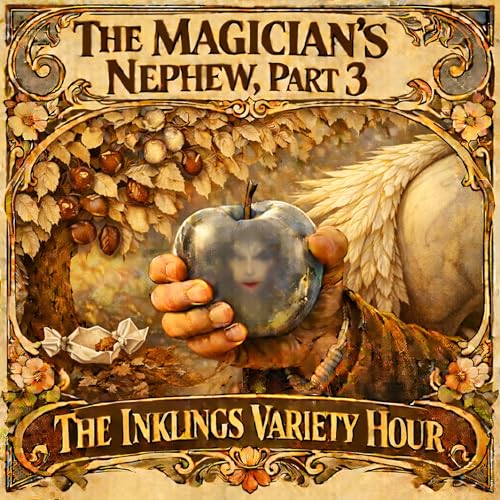
  • The Magician's Nephew, Part 3: Plot Holes, Planted Trees, and Plato
    Apr 28 2026

    Jonathan Geltner and Luke Mills rejoin me to finish talking about The Magician's Nephew.

    Meanwhile, Narnian troubadour Matt Wheeler joins us to share "Awake, Awake!"--the first of his seven songs from Narnia!

    More details to come, but here's a quick summary of what we discuss:

    Introduction & Reading 0:00 — Opening dramatic reading from The Magician's Nephew (Digory before Aslan)

    Host & Guest Introductions 2:12 — Pipkin introduces Dr. Luke Mills and Jonathan Gelter; Jonathan's MFA program plug and novel update

    Story Recap 3:39 — Summary of the book up to the current chapters (Charn, Jadis, Narnia's creation, lamppost origin)

    Is Narnia "Fallen"? 6:34 — Discussion of Digory's guilt, the nature of Narnia's corruption, and parallels to Paradise Lost and Eden

    Digory's Culpability 10:37 — Was Digory truly at fault? The enchanted bell, Aslan's judgment, and Jonathan's "defense counsel" argument

    The Comic Sections: Animals & Uncle Andrew 15:40 — Critiquing Lewis's humor; Barfield's observation about Lewis's "undergraduate" comedy; Tolkien comparisons

    The Cabby as First King of Narnia 20:21 — Why a working-class Cockney? Anti-urban sentiment in Lewis, WWI's influence, rural vs. city themes, and comparison to Sam Gamgee

    Lewis, Tolkien & Shared Mythological Ideas 26:53 — Overlapping motifs (singing creation, protective trees, the rings); did Lewis borrow from Tolkien?

    The Winged Horse & the Garden of Hesperides 27:56 — Aslan's tears scene; the walled garden and its inscription; parallels to Galadriel and the One Ring

    Trees in Mythology & Religion 29:14 — Sacred trees across world cultures: Norse, Celtic, Greek, Irish paradise mythology, apples, and forests

    Musical Guest: Matt Wheeler 36:19 — Original song inspired by Aslan's creation of Narnia; discussion of the source passage

    Jadis Eats the Apple & the White Salt Image 46:05 — Jadis's "white as salt" description; what it conveys about her character and the apple's dark gift

    Character of Jadis / The White Witch 53:32 — Her name (French "jadis" = "once upon a time"), Lilith parallels, satanic motivation, and the "dem fine woman" ending

    Allegory, Plot Holes & Medieval Parallels 56:49 — Lewis's inconsistent allegory, Dante vs. Bunyan, and how medieval authors simply didn't care about plot consistency

    The Ending: Digory's Mother, Uncle Andrew, and Redemption 1:01:27 — The apple healing his mother, Aslan's beatific vision, Uncle Andrew's comic/bittersweet conclusion, and the wardrobe's origin

    Platonic Themes & the Wood Between the Worlds 1:06:41 — Aslan's Platonism, the multiverse question, ontological status of the secondary worlds, and the reference to Plato in The Last Battle

    Netflix Adaptation Discussion 1:12:53 — Concerns about Greta Gerwig's adaptation; what changes would actually be welcome; Polly & Digory's relationship

    Closing Remarks & What's Next 1:18:03 — Wrap-up, acknowledgments, upcoming Silver Trumpet episode

    Show More Show Less
    1 hr and 22 mins
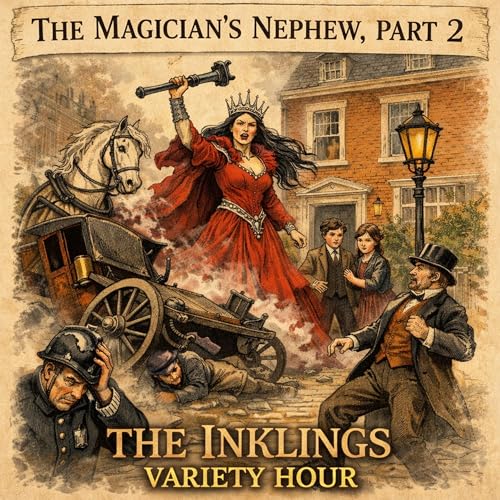
  • The Magician's Nephew, Part 2: "A Dem Fine Woman, Sir!"
    Apr 7 2026

    Chris welcomes back friend of the show Eric Geddes to talk about the second part of The Magician's Nephew.

    Among other things, we discuss the following:

    • Uncle Andrew's adult silliness
    • Jadis, Hempress of Colney 'Atch!
    • Why the Wood Between the Worlds affects Jadis the way it does
    • Digory v. Edmund and Eustace
    • Uncle Andrew and Renaissance Magic
    • The Cabby's Hymn
    • The Songs of Aslan
    • Mixing of Mythologies
    • Witches v. Hags in Narnia

    Enjoy! I'll be back in two weeks to talk about The Magician's Nephew, Part 3, with Jonathan Geltner and Luke Mills!

    Show More Show Less
    1 hr and 7 mins
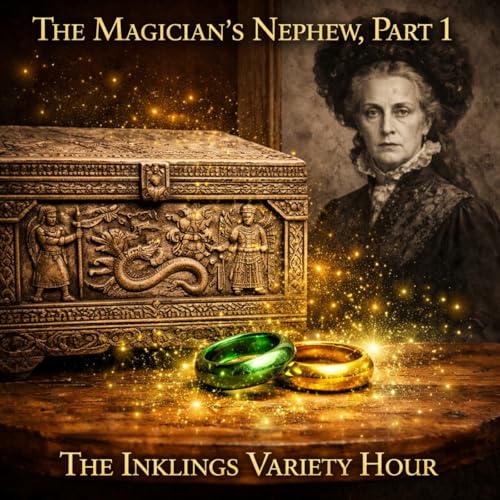
  • The Magician's Nephew, Part 1: Of Rings and Ringing
    Mar 17 2026

    Happy Sixth Season of The Inklings Variety Hour!

    Would you like a present to mark the occasion? One of these fine rings, perhaps?

    No, not the green ones. No, I don't care if it's St. Patrick's Day. You. Can't. Have. The. Green. Ones.

    But have a yellow ring. No, seriously, go for it. Why are you hesitating?

    But that's preposterous. They won't make you disappear. What do you think this is, The Hobbit?

    Why does it always come back to rings? I say none of this on today's episode, but perhaps it's that the Inklings knew that rings bind you to someone else. Or something else.

    In this case, the Wood Between the Worlds? Or Faerie? Or to your evil and intimidating uncle who is a mad magician-scientist with a furnished room that you don't know about and a dead fairy godmother named Mrs. Lefay?

    What's up with the strange parallels in this book, anyway? You've got children in England exploring inside because it's rainy. You've got Uncle Andrew and Jadis making essentially the same speeches. You've also got the wood between the worlds and the crawlspace between houses, as well as the troubling ways in which Digory resembles his uncle--both of whom, by the way, end up technically responsible for sending children to another world when they're old men. But what kind of an old man who sends children into peril will Digory grow up to be? The sort who thinks rules don't apply to him, or the sort who makes endless inside jokes with himself about Plato? Character matters.

    To talk about some of these riddles, or at least allude to them as we talk about things that are probably more interesting, I have Dr. Luke Mills. Join us on a whirlwind tour through Edwardian England, tunnels behind houses, Guinea Pig paradises that maybe aren't good for humans, and desolate worlds with very strange women among very strange waxworks that definitely aren't good for humans. (Seriously, though, what are the waxworks?)

    This may be your last chance to travel to Charn before Netflix ruins it forever with Pink Floyd or the 1950s or whatever-the-[deplorable word] a Barbie auteur wants to put in there.

    Among other things, Luke and Chris talk about the figure of Lilith--and why this account of Jadis' origin may not differ so much from that given in The Lion, the Witch, and the Wardrobe. We also discuss ways to tell whether or not that special someone in your life may not, in fact, be evil.

    Let's dive in! Or wonder, till it drives you mad, what would have followed...etc., etc.

    Show More Show Less
    1 hr and 12 mins
  • Tolkien's Father Christmas Letters (Rebroadcast)
    Dec 25 2025

    Enjoy this gently used Christmas gift from Ghost of Inklings Variety Hours Past!

    I think this may be from 2020.

    It's an Inklings Variety Hour Jovial Christmas Extravaganza! Featuring:

    A Discussion of J.R.R. Tolkien's Letters from Father Christmas!

    Chris Pipkin and his children, Davey and Virginia!

    Anika Smith! (First half of show)

    Meagan Logsdon! (Second half of show)

    A cringeworthy impersonation of an old British person by Chris Pipkin!

    Bits of music by Steeleye Span and Maddy Prior (The Boar's Head Carol), and Martin Romberg (A Elbereth Gilthoniel), (as well as Virginia Pipkin).

    Pipkins' Christmas site promoted: 12tide.com

    Thanks for listening to us this year! As always, if you enjoy this podcast, recommend it to a friend and give us a review on iTunes. And please do feel more than free to drop us a line at InklingsVarietyHour@gmail.com. We'd love to hear from you! Merry Christmas.

    Show More Show Less
    1 hr and 28 mins
  • Twelve Tide (Pipkin Book) (Rebroadcast)
    Dec 23 2025

    O.G. Host Anika Smith rejoins the podcast to interview Chris and his beautiful and omnicompetent wife, Glencora, about their new Christmas resource book, Twelve Tide.

    Part of what we're trying to do with this book is make Christmas less a single-morning present binge preceded by anxiety and followed by anticlimax--and more a season of twelve days of giving, feasting, and learning to celebrate better.

    Want an idea of what's in the book? Check out our website, 12tide.com. It is likely that if you order now, you will not receive the book before Christmas, but you can find all of the content on our website and order the book (if you like) in time for subsequent days of Christmas (the season lasts until January 6, after all).

    We are all Niatirbians now (and Lewis was dismayed by godless Christmas cards). We want to reconcile sacred and "secular" aspects of Christmas and equip people with some old ways to celebrate this season.

    Music from this episode includes:

    • George Winston's "The Holly and the Ivy"
    • Bing Crosby's "It's Beginning to Look a Lot Like Christmas"
    • Loreena McKennitt's "The Holly and the Ivy"
    • Choir of Christchurch's "Hark! The Herald Angels Sing"
    • Loreena McKennitt's "Gloucestershire Wassail"
    • The Chieftains' "Boar's Head Carol"
    • Maddy Prior's "Coventry Carol"
    • Medieval Baebes' "Adam Lay Ybounden"
    • Maddy Prior's "Wassail!"

    Also, if you're interested in the Twelve Tide Spotify list Anika suggested on the show, here it is.

    Stay tuned...I'm done with grading and I'm turning my attention to an Inklings Christmas Carol. Won't be easy to finish in time, but I'll do my level best. If you are interested in reading a part for it, feel free to email me at inklingsvarietyhour@gmail.com

    God bless and keep you this Advent Season. See you at Christmas!

    Show More Show Less
    57 mins