• Reflecting on Nikole Hannah-Jones and the Choice for Integration
    Oct 14 2026
    Ten years ago, Nikole Hannah-Jones wrote a powerful essay about choosing a predominantly Black, low-income public school for her daughter, Najya. That piece helped inspire a generation of parents to think differently about school choice, including many of us at Integrated Schools. Now, a decade later, Hannah-Jones has returned to that decision, this time through the eyes of her 16-year-old daughter, who has some very different feelings about the education she received.Her new essay, In Fighting for Every Black Child, Did I Betray My Own?, has sparked a national conversation about school segregation, parenting, privilege, and the tension between doing what's best for our own children and doing what's right for all children.To help us wrestle with these questions, we're joined by two mothers with different experiences and perspectives. Marian Dingle, a longtime educator and Black mother of two adult children, reflects on the choices she made for her own kids and the importance of protecting their identities and humanity. Jenny Devenny, a White mother in Brooklyn and leader of Integrated Schools' NYC chapter, shares why Hannah-Jones's experience has strengthened, rather than shaken, her commitment to integration.Together, we explore what makes a school "good," the limits of school ratings and test scores, the role of parents in advocating for their children, and the ways race shapes the risks and opportunities families encounter. We also consider what it means to stay engaged when a school isn't perfect, how we define success for our children, and why the responsibility for integration cannot continue to fall disproportionately on Black families.Hannah-Jones's reflections are a reminder that one family's choices cannot undo generations of systemic inequity. But that doesn't mean our choices don't matter.At the heart of this conversation is a question we return to often at Integrated Schools: How wide can we draw the circle of children we consider "our kids"?We are deeply grateful to Nikole Hannah-Jones and Najya for sharing their experiences so honestly, and to Marian and Jenny for helping us sit with the complexity, discomfort, and possibility of this work.LINKSIn Fighting for Every Black Child, Did I Betray My Own? — Nikole Hannah-Jones, The New York Times Magazine (2026)Choosing a School for My Daughter in a Segregated City — Nikole Hannah-Jones, The New York Times Magazine (2016)An Argument — This American Life, featuring conversations with Nikole Hannah-Jones and Najya (2026)The Problem We All Live With, Part One — This American Life (2015)The Problem We All Live With, Part Two — This American Life (2015)What Nikole Hannah-Jones's Essay Means for White Families — Jenny Devenny, Integrated Schools (2026)Extensive Data Shows Punishing Reach of Racism for Black Boys - The New York Times (2018)ABOUT OUR GUESTSMarian Dingle is a longtime elementary school educator, mother of two adult children, and advocate for educational justice. Drawing on her experience as a Black mother, teacher, and daughter of an educator, she brings a perspective on the importance of academic opportunity, belonging, and protecting children's humanity.Jenny Devenny is a White mother of two in Brooklyn, New York, and leader of the NYC chapter of Integrated Schools. A social worker by training, she is also the author of Race Cars, a children's book about White privilege. Her children attend a predominantly Black and Brown, Title I public school in their neighborhood.Send us a voice memo: speakpipe.com/integratedschoolsCheck out our Bookshop.org storefront to support local bookstores, and send a portion of the proceeds back to us.Join our Patreon to support this work, and connect with us and other listeners to discuss these issues even further.Subscribe to our YouTube Channel for video versions of our episodes.Let us know what you think of this episode, suggest future topics, or share your story with us – IntegratedSchools on Facebook, @integratedschools on Instagram and TikTok, or email us podcast@integratedschools.org.The Integrated Schools Podcast was created by Courtney Mykytyn and Andrew Lefkowits.dThis episode was produced by Andrew Lefkowits and Val Brown. It was edited, and mixed by Andrew Lefkowits.Music by Kevin Casey.Advertising Inquiries: https://redcircle.com/brandsPrivacy & Opt-Out: https://redcircle.com/privacy
    Show More Show Less
    1 hr and 8 mins
  • Season 13 Kick Off: Dreaming of the Future
    Sep 30 2026

    We are back! Welcome to Season 13 of The Integrated Schools Podcast. It’s been almost eight years and over 170 episodes, but as we kick off this new season, we are reflecting on where we find ourselves—as a country, as an organization, and in our own lives. Val is navigating life with a college freshman (who earned a 100% on his first African American Studies test!) and a high school senior, while Andrew is stepping into the classroom for the first time as a high school audio engineering and musical theater teacher. These real-world transitions ground us in the ongoing, messy work of wrestling with parenting, privilege, and public education.

    In this kickoff episode, we take a hard look at the state of public education right now. With federal rollbacks on civil rights enforcement, decreasing oversight, and expanding voucher and privatization schemes, the national landscape feels tricky and daunting. Yet, even in this moment, we find local reasons for hope. Across the country—from Denver and Winston-Salem to Charlotte-Mecklenburg, Montgomery County, and beyond—school districts are undergoing boundary redraws and student assignment reviews that explicitly aim to reduce socioeconomic segregation. These local efforts remind us that when the ground is shifting, there is an opportunity to build toward real change if we show up and demand it.

    As we look ahead to Season 13, we are focused on tilling the soil for future systemic change and radicalizing our hope. Guided by Dr. Loretta Ross's reminder to "hold our link in the chain," we are preparing to dream together about what public education could look like on the other side of this moment. Throughout the season, we'll be bringing in a diverse range of voices—including Afrofuturists, Indigenous thinkers, youth, and caregivers of students with special needs—to imagine a truly just, multiracial education system beyond simply rebuilding what was.

    How are you holding your link in the chain during this political moment, and what does your dream for a truly integrated, multiracial public education system look like?

    LINKS
    • Share your thoughts, local stories, or feedback via voice memo at speakpipe.com/integratedschools or email podcast@integratedschools.org
    • Support the show and access monthly happy hours, show notes, and discussion guides on Patreon
    • Explore or connect with an Integrated Schools Local Chapter
    • Listen to the Season 12 finale: Val’s reflection on parenting transitions and letting go
    Join the Movement

    Support is a verb! Help keep these unsponsored, nuanced conversations going by joining our Patreon community, starting a podcast listening group in your neighborhood, or sharing this episode with a friend.

    The Integrated Schools Podcast was created by Courtney Mykytyn and Andrew Lefkowits.

    This episode was produced by Andrew Lefkowits and Val Brown.

    It was edited and mixed by Andrew Lefkowits.

    Music by Kevin Casey.


    Advertising Inquiries: https://redcircle.com/brands

    Privacy & Opt-Out: https://redcircle.com/privacy
    Show More Show Less
    35 mins
  • Reflections on Season 12
    Jun 3 2026
    As we wrap up another school year, we're taking a moment to reflect on the conversations, challenges, and lessons that shaped Season 12.This year, we explored what it means to build belonging, strengthen community, advocate for public education, and stay connected through uncertainty. Along the way, we learned from educators, organizers, authors, students, parents, and community members who reminded us that while the challenges facing our schools are real, none of us are facing them alone.We also hear from listeners navigating school closures, parent organizing, and the everyday joys of integrated schools. Their stories remind us that community is built not only through big moments, but through the choices we make to show up for one another again and again.In This EpisodeBelonging mattersOne of the biggest themes we kept returning to this season was belonging. From conversations about disability justice to discussions about third spaces and community care, we explored what it looks like to create schools and communities where everyone feels seen, valued, and connected.The power of conversation and communityThis season reinforced something we deeply believe: meaningful change happens in relationship with one another. We reflected on lessons from guests like Dr. Loretta Ross, who reminded us that none of us are responsible for fixing everything alone. The work becomes sustainable when it's rooted in community.Public education under pressureThroughout the season, we examined some of the challenges facing public education today, including:School closures and spatial injusticeThe resurgence of "massive resistance" to educational equityImmigration enforcement's impact on students and familiesThe ongoing struggle for educational justice across generationsLearning from historyAgain and again, our guests reminded us that today's struggles are connected to longer histories of organizing, resistance, and collective action. From the Lemon Grove desegregation case to reflections on Thurgood Marshall's legacy, we explored how history can help guide us through the present moment.Listener ReflectionsWe also heard from listeners who shared:The grief and organizing that can emerge when a neighborhood school closesThe importance of family voice and participation in public schoolsMoments of joy that remind us why integrated schools matterA Few Things We're Carrying ForwardBelonging is foundational to healthy schools and communities.Public education is strongest when families, educators, and communities work together.History can offer both perspective and possibility.Community sustains us through uncertainty.There is real joy to be found in learning, growing, and building alongside people whose experiences differ from our own.Looking AheadAs we prepare for another season—and as our own families navigate major transitions—we're thinking about what comes next.What conversations are you having in your community? What challenges are showing up in your schools? What stories should we be telling together?Send us a voice memo: speakpipe.com/integratedschoolsThank you for listening, learning, and staying in community with us throughout Season 12. We're grateful to all of our guests, our listeners, and everyone committed to creating public schools that serve all of our children.Check out our Bookshop.org storefront to support local bookstores, and send a portion of the proceeds back to us.Join our Patreon to support this work, and connect with us and other listeners to discuss these issues even further.Subscribe to our YouTube Channel for video versions of our episodes.Let us know what you think of this episode, suggest future topics, or share your story with us – IntegratedSchools on Facebook, @integratedschools on Instagram and TikTok, or email us podcast@integratedschools.org.The Integrated Schools Podcast was created by Courtney Mykytyn and Andrew Lefkowits.dThis episode was produced by Andrew Lefkowits and Val Brown. It was edited, and mixed by Andrew Lefkowits.Music by Kevin Casey. Advertising Inquiries: https://redcircle.com/brandsPrivacy & Opt-Out: https://redcircle.com/privacy
    Show More Show Less
    32 mins
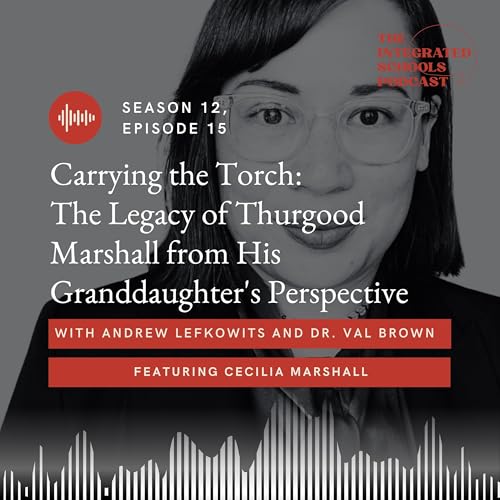
  • Carrying the Torch: The Legacy of Thurgood Marshall from His Granddaughter's Perspective
    May 17 2026
    On the 72nd anniversary of Brown v. Board of Education, Andrew and Dr. Val sit down with Cecilia Marshall — granddaughter of Supreme Court Justice Thurgood Marshall and founder of the newly launched Thurgood Marshall Foundation. Together, they reflect on what it means to carry forward a legacy rooted not in individual heroism, but in collective courage, sacrifice, and community responsibility.Ms. Marshall shares intimate stories of knowing Thurgood Marshall simply as “Grandpa,” and how, only later in life, she came to understand the magnitude of his work and the sacrifices made by the families behind Brown v. Board. The conversation explores the importance of telling these histories honestly — especially to children — and why public schools remain one of our most important democratic institutions.From the bravery of the 200+ plaintiffs across the five Brown cases, to present-day debates around diversity, public education, and belonging, this episode asks what it means to build bridges in a deeply polarized moment — and what responsibilities we each carry in shaping a more just future for all children.In honor of the 72nd anniversary of Brown v. Board of Education, Integrated Schools is launching the 1954 Campaign.We are asking you to give:$19.54$195.40$1,954or any amount meaningful to youHalf of the proceeds will support the Thurgood Marshall Foundation and its work preserving and sharing this history with future generations.LINKS:The Thurgood Marshall FoundationIntegrated Schools 1954 Campaign - Please donate today!Justice Marshall's Liberty Medal Acceptance SpeechRecovering Untold Stories: An Enduring Legacy of the Brown v. Board of Education DecisionBecoming Thurgood: America's Social Architect - PBS Documentary about Thurgood MarshallBrown v Board @ Sixty Five: The Stories We Tell Ourselves (our 5 part series on the Brown decision)Ep 18 – Rucker Johnson and the Grandchildren of Desegregation (BvB@65)Ep 19 – Segrenomics, Black Teachers, and Noliwe Rooks (BvB@65)Ep20 – Amanda Lewis on Desegregation Without Integration (BvB@65Ep 21 – Beyond Black and White with David Hinojosa (BvB@65)Ep 22 – I Hope They Hear It In Our Voices (BvB@65)S7E3 – Generational Work: Stefan Lallinger on IntegrationNAACP Legal Defense FundSend us a voice memo: speakpipe.com/integratedschoolsCheck out our Bookshop.org storefront to support local bookstores, and send a portion of the proceeds back to us.Join our Patreon to support this work, and connect with us and other listeners to discuss these issues even further.Subscribe to our YouTube Channel for video versions of our episodes.Let us know what you think of this episode, suggest future topics, or share your story with us – IntegratedSchools on Facebook, @integratedschools on Instagram and TikTok, or email us podcast@integratedschools.org.The Integrated Schools Podcast was created by Courtney Mykytyn and Andrew Lefkowits.dThis episode was produced by Andrew Lefkowits and Val Brown. It was edited, and mixed by Andrew Lefkowits.Music by Kevin Casey. The Brown v Board PlaintiffsThe bundle of five cases commonly referred to as Brown v. Board actually contained more than 200 plaintiffs. Below are their names and their associated cases.Belton v. Gebhart (Bulah v. Gebhart)Delaware State Court, Wilmington, DelawareEthel BeltonSarah BulahJoseph CrumplerJohn W. DavisEmma FountainBarbara Byrd HenryCharles HillLois May JohnsonMary JohnsonWillie RobinsonJohn ShortHarlan TrotterBolling v. SharpeU.S. District Court, Washington, D.C.Mrs. Sarah BollingSpottswood Thomas BollingWanamaker Von BollingWilliam BriscoeSarah Louise BriscoeJames C. JenningsAdrienne JenningsBarbara JenningsConsolidated Parent Group, Inc.Briggs et al v. Elliott et al.U.S. District Court, Eastern Division, Charleston, South CarolinaJames BennettOnetha BennettHarry BriggsRobert GeorgiaAnnie GibsonGilbert H. HenrySusan LawsonFrederick OliverMary OliverMose OliverBennie ParsonEdward RaginHazel RaginWilliam RaginLee RichardsonLucrisher RichardsonRebecca RichburgHenry ScottWilliam StukesGabriel TindalDavis v. County School Board of Prince Edward CountyU.S. District Court, Richmond, VirginiaHal Edward Allen (father)Hal Verner Allen (son)Margaret G. Allen (grandmother)James Henry C. Allen (grandson)Margaret G. Allen (mother)Herman Alexander Allen (son)Florence Gertrude Allen (daughter)Thomas H. Allen (father)Herman Wesley Allen (son)Thelma Leola Allen (daughter)Ellen Banks (guardian)John Banks, Jr. (guardee)Frankie Louise BerkeleyEddie Bigger (father)Virginia Bigger (daughter)Katie H. BiggerLeonard R. Bland (father)Floyd M. Bland (son)Reginald W. Bland (son)Clara S. Booker (mother)Blanche A. Booker (daughter)Ronald O.F. Booker (son)Joseph E. Booker (father)Loretta Booker (daughter)Carrie Brown James Brown (father)Phillip J. Brown (son)Nelson Carey (father)Mary Lizzie Carey (daughter)Anna Bell Carey (daughter)John DavisRosa Bell DavisIsaiah Dennis (father)Adline Dennis (...
    Show More Show Less
    55 mins
  • REVISIT: Calling In with Loretta Ross
    May 6 2026

    We're revisiting our conversation with Dr. Loretta Ross because her book, Calling In: How to Start Making Change with Those You’d Rather Cancel, is the Integrated Schools book club pick for this month. You can register for one of our amazing, free book club sessions here.

    We’re joined by MacArthur “Genius” and legendary activist Dr. Loretta Ross for a conversation that left us grounded, challenged, and deeply moved. From her early work in reproductive justice and anti-violence movements, to her current mission disrupting “call-out culture,” Dr. Ross offers us a path forward rooted in grace, accountability, and radical love.

    We explore what it means to “call in” rather than call out—especially in an era where public shaming feels ever-present and social media rewards outrage. Dr. Ross shares her personal story of trauma, healing, and transformation, and helps us understand how real change happens not through perfection or purity, but through connection and curiosity.

    Together we unpack the power of holding ourselves and others accountable without dehumanizing. We talk parenting, public schools, and what it means to stay in the struggle without breaking our link in the “chain of freedom.”

    Whether you’re navigating tricky conversations in your school community or trying to show up better in the fight for justice, this episode is for you.

    LINKS:
    • Register for book club!
    • Calling In: How to Start Making Change with Those You’d Rather Cancel – Dr. Ross’s new book
    • What If Instead of Calling People Out, We Called Them In? – NY Times Article about Dr. Ross’s work
    • What Is A Good Parent? Blog post by NY Chapter member, Meredith Winfrey
    • Mothers of Massive Resistance: White Women and the Politics of White Supremacy – Dr. Elizabeth McRae
    • Ep 11 – White Women and the Politics of White Supremacy – Dr. McRae’s 1st time on our show
    • S5E14 – White Supremacy and Black Educational Excellence – Dr. McRae’s 2nd time on our show

    Send us a voice memo: speakpipe.com/integratedschools

    Check out our Bookshop.org storefront to support local bookstores, and send a portion of the proceeds back to us.

    Join our Patreon to support this work, and connect with us and other listeners to discuss these issues even further.

    Subscribe to our YouTube Channel for video versions of our episodes.

    Let us know what you think of this episode, suggest future topics, or share your story with us – IntegratedSchools on Facebook, @integratedschools on Instagram and TikTok, or email us podcast@integratedschools.org.

    The Integrated Schools Podcast was created by Courtney Mykytyn and Andrew Lefkowits.d

    This episode was produced by Andrew Lefkowits and Val Brown. It was edited, and mixed by Andrew Lefkowits.

    Music by Kevin Casey.


    Advertising Inquiries: https://redcircle.com/brands

    Privacy & Opt-Out: https://redcircle.com/privacy
    Show More Show Less
    1 hr and 12 mins
  • REVISIT: Finding Hope in Solidarity with Heather McGhee
    Apr 22 2026

    We’re going back to the archives today to revisit a conversation with Heather McGhee. In February of 2021, Heather McGhee’s book, The Sum of Us came out. With a focus on the ways in which racism harms everyone, and the potential good that can come from cross-racial coalitions, the book was exciting to us. When we realized that Integrated Schools was featured prominently in the chapter about education, we were blown away.

    The book is based around three main concepts. The first is the “zero-sum lie of racial hierarchy”, or the idea that progress for people of color necessarily has to come at White folks’ expense. The second is the idea of the “drained pool,” the disinvestment by White people in public goods simply because they have to share them with people of color. And finally, the “solidarity dividend,” the idea of gains that we can unlock, but only when we come together across lines of difference.

    This last idea, the most hopeful, inspired Ms. McGhee to go back on the road and make a podcast documenting examples of the Solidarity Dividend in action. She joins us to discuss the podcast, what it means to be a good ally, the power of relationships in sustaining movements, and what role the Integrated Schools community should play in participating in the current, cross-racial movement for public education.

    LINKS

    • Ms. McGhee’s first appearance on our show
    • The Sum of Us Podcast
    • The Sum of Us Book
    • James Haslem from HEAL Together
    • Ms. McGhee and Victor Ray’s Op-Ed in the NYT
    • California Calls – organizing in California
    • Ms. McGhee’s mother – Dr. Gail Christopher
    • Truth, Racial Healing, and Transformation

    ACTION STEPS

    • Listen to The Sum of Us Podcast
    • Read The Sum of Us Book
    • Get involved locally – find organizations that align with your values, and just show up!
    • Take opportunities to share space with folks – school pick up/ drop off is a great place to start
    • Share stories off cross racial solidarity with others. Stories from The Sum of Us, from our podcast, or from your own life.

    Use these links or start at our Bookshop.org storefront to support local bookstores, and send a portion of the proceeds back to us.

    Join our Patreon to support this work, and connect with us and other listeners to discuss these issues even further.

    Let us know what you think of this episode, suggest future topics, or share your story with us – @integratedschls on twitter, IntegratedSchools on Facebook, or email us podcast@integratedschools.org.

    The Integrated Schools Podcast was created by Courtney Mykytyn and Andrew Lefkowits.

    This episode was produced by Andrew Lefkowits and Val Brown. It was edited, and mixed by Andrew Lefkowits.

    Music by Kevin Casey.


    Advertising Inquiries: https://redcircle.com/brands

    Privacy & Opt-Out: https://redcircle.com/privacy
    Show More Show Less
    1 hr and 1 min
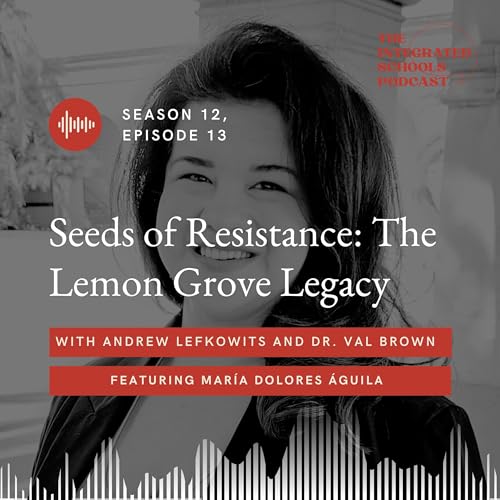
  • Seeds of Resistance: The Lemon Grove Legacy
    Apr 8 2026
    We're joined by YA author, María Dolores Águila to uncover the largely untold story of the 1931 Lemon Grove Incident—the first successful school desegregation case in California, led by Mexican and Mexican American families.Through her book A Sea of Lemon Trees, Maria invites us into the world of 12-year-old Roberto Alvarez, a child asked to carry the weight of his community’s fight for educational justice.Together, we explore what it looks like when communities organize, when young people lead, and when stories become a form of power.We can’t be what we don’t see.Maria shares how her work is rooted in creating “social capital” for young readers—especially those who have not seen themselves reflected in books or history. When our kids see communities like theirs organizing and winning, it expands what feels possible.The Lemon Grove case unfolded during a time of anti-Mexican sentiment and mass deportations. The parallels to today are hard to ignore. What we don’t know about our history can make the present feel confusing—but these stories remind us: we’ve been here before. While Roberto Alvarez was the named plaintiff, this was never a story about one hero. It was about a community—families organizing, neighbors supporting, people taking risks together. Every role mattered.Resistance is real—and it costs something.This wasn’t a clean or easy victory. Families faced threats, pressure, and even deportation. Telling the full story—including the hard parts—matters, especially for our kids. Through a 12-year-old’s perspective, the absurdity of segregation becomes clear. Kids often see injustice plainly—before we, as adults, complicate it.We keep coming back to this:All of our kids are watching.They’re watching how we talk about history.They’re watching how we respond to injustice.They’re watching whether we stay—or walk away.What might shift if we saw ourselves not as individuals navigating systems, but as part of a community shaping them—together?LINKS:A Sea of Lemon Trees: The Corrido of Roberto AlvarezBarrio Rising: The Protest that Built Chicano ParkMenudo Sunday: A Spanglish Counting BookThe Lemon Grove Incident Mexican RepatriationS11E10 – Micro Activism: Making a Difference One Step at a Time Send us a voice memo: speakpipe.com/integratedschoolsCheck out our Bookshop.org storefront to support local bookstores, and send a portion of the proceeds back to us.Join our Patreon to support this work, and connect with us and other listeners to discuss these issues even further.Subscribe to our YouTube Channel for video versions of our episodes.Let us know what you think of this episode, suggest future topics, or share your story with us – IntegratedSchools on Facebook, @integratedschools on Instagram and TikTok, or email us podcast@integratedschools.org.The Integrated Schools Podcast was created by Courtney Mykytyn and Andrew Lefkowits.This episode was produced by Andrew Lefkowits and Val Brown. It was edited, and mixed by Andrew Lefkowits.Music by Kevin Casey. Advertising Inquiries: https://redcircle.com/brandsPrivacy & Opt-Out: https://redcircle.com/privacy
    Show More Show Less
    50 mins
  • Spatial Injustice: School Closures as a Form of Educational Redlining
    Mar 25 2026
    What happens when we stop thinking about schools as buildings—and start seeing them as the ecosystems that hold our communities together?In this episode, we sit with Dr. Mara Tieken to explore school closures not as isolated decisions, but as part of a broader pattern of spatial injustice—where resources, opportunities, and care are unevenly distributed based on where we live.Together, we wrestle with a hard truth: school closures are often framed as inevitable… but what if they’re actually the result of choices—policies, priorities, and patterns of disinvestment—that we can question?We grapple with several key ideas:Schools are more than buildings—they are social, cultural, and economic anchors in our communitiesClosures disproportionately impact Black, Brown, and low-income communitiesThe most common justifications (cost savings, academic improvement, “efficiency”) often don’t hold up under scrutinyWhat gets labeled as a “failing school” is often a school that has been failed—by policy, funding, and systemic neglectSchool closures don’t just disrupt students—they create lasting grief, loss, and disconnection across generationsThis conversation also reminds us that we are not powerless. Across the country, communities are:Organizing and building multiracial, cross-class coalitionsQuestioning the data and narratives used to justify closuresRunning for school board, advocating for policy change, and showing up for each other’s schools—not just our ownWe are left wondering, what would it look like to treat every school as our school? Not just when it’s under threat—but all the time.Because if public schools are foundational to our democracy, then caring for them can’t be an individual act. It has to be collective.LINKS:Dr. Tieken's Hechinger Report Op-Ed - Shuttering public schools is a strategy that rarely saves much money and often leads to test score declinesAnd from The Washington Monthly - Don't Fall for the School Closure TemptationRural Schools Open - Dr. Tieken's guide to fighting school closures and doing it well, when needed. Dr. Eve L Ewing - Ghosts in the SchoolyardAnd Dr. Ewing on our show - S11E12: Schools and Race: Eve Ewing on the Construction of American Racism Send us a voice memo: speakpipe.com/integratedschoolsCheck out our Bookshop.org storefront to support local bookstores, and send a portion of the proceeds back to us.Join our Patreon to support this work, and connect with us and other listeners to discuss these issues even further.Subscribe to our YouTube Channel for video versions of our episodes.Let us know what you think of this episode, suggest future topics, or share your story with us – IntegratedSchools on Facebook, @integratedschools on Instagram and TikTok, or email us podcast@integratedschools.org.The Integrated Schools Podcast was created by Courtney Mykytyn and Andrew Lefkowits.This episode was produced by Andrew Lefkowits and Val Brown. It was edited, and mixed by Andrew Lefkowits.Music by Kevin Casey.Advertising Inquiries: https://redcircle.com/brandsPrivacy & Opt-Out: https://redcircle.com/privacy
    Show More Show Less
    1 hr and 1 min