• Tehran’s Terminal Hour: Inside the New Uprising
    Jan 2 2026

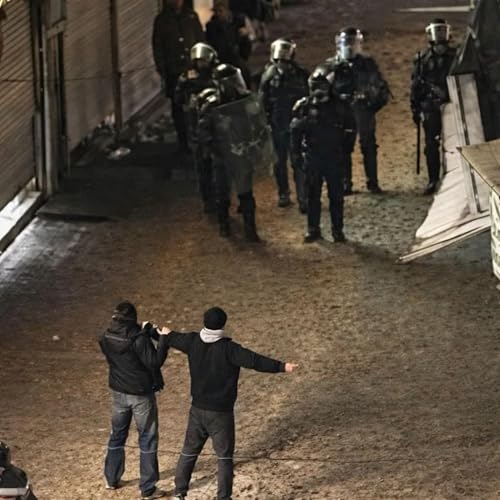
    The Islamic Republic stands on the precipice. It is January 2026, and the streets of Iran are burning not with reformist zeal, but with revolutionary fury. In this special Deep Dive episode of The Levant Files, we deconstruct the "perfect storm" that has shattered the regime’s grip on power.


    We begin with the catalyst: a catastrophic economic collapse that saw the Rial plummet to 1.45 million against the dollar. We explain why the powerful Bazaar merchants—historically the regime’s financial backbone—have locked their doors in a strike that signals a total loss of faith in the system. From the aisles of empty grocery stores to the burning government buildings in Lordegan, we trace how economic hopelessness has mutated into a singular political demand: the end of the theocracy.


    Our analysis exposes the regime’s schizophrenic "dual-track" survival strategy: the hollow conciliatory rhetoric of President Pezeshkian pitted against the brutal, live-fire crackdown orchestrated by a newly emboldened IRGC. We also explore the unprecedented calls for a transition government led by Crown Prince Reza Pahlavi and the groundbreaking legal battle in Argentina using universal jurisdiction to hunt down Iranian officials abroad.


    Is this the final chapter for the revolution of 1979? Join us as we strip away the noise and reveal the mechanics of a nation at its breaking point.


    Tune in now to The Levant Files for the essential briefing on the crisis reshaping the Middle East.


    Photo: Iran International

    Show More Show Less
    32 mins
  • The Somali Paradox. How a Nation of One People Became a State of Many Fragments
    Dec 30 2025

    Somalia presents one of the most haunting paradoxes in modern political history. As explored in this Deep Dive, few nations possess such a theoretically strong foundation for unity: a universal language, a shared religion in Sunni Islam, and a deep-seated pastoral heritage where the camel defines both value and law. Yet, this cultural homogeneity has failed to translate into political stability. Instead, the modern history of Somalia traces a tragic arc from the fervent "Pan-Somali" nationalism of the 1960s to the total disintegration of the state in 1991.


    This episode dissects the roots of this fracture, beginning with the "colonial convenience" that carved the Somali people into British, Italian, and French territories. We examine how the 1960 unification was doomed by administrative incompatibility and the dominance of the Italian-influenced South over the British-influenced North. The narrative moves through the authoritarian era of Siad Barre, whose contradictory attempt to ban the clan system while manipulating it for power—coupled with the disastrous Ogaden War—bankrupted the nation and destroyed its social fabric.


    The analysis culminates in the post-1991 reality, highlighting the stark divergence between regions. While the south descended into a vacuum filled by warlords, Al-Shabaab, and piracy, the breakaway region of Somaliland utilized traditional councils of elders (Guurti) to build a stable, functioning democracy. Ultimately, this summary reveals a story of incredible human resilience—sustained by a massive diaspora economy—while posing a critical question for the 21st century: Can a centralized western-style government ever succeed in a society where the primary unit of trust remains the clan?

    Show More Show Less
    41 mins
  • The People Who Refused to Vanish: The Enduring Identity of the Talysh
    Nov 14 2025

    Imagine a people, an entire ethnos, with a population of over 77,000 officially disappearing in just 33 years, reduced on paper to a mere 85 individuals. This isn't a dystopian novel; it's the modern history of the Talysh people, an ancient Iranian ethnos whose homeland is split between Azerbaijan and Iran along the southwestern coast of the Caspian Sea. Their story is one of staggering resilience against a backdrop of state-sponsored manipulation and forced assimilation. How does a culture survive when its very existence is denied in official records?In this episode of The Levant Files Deep Dive, we unravel this extraordinary story of endurance. We trace the Talysh identity back to antiquity, exploring their potential links to the legendary Cadusii people mentioned in classical texts, a connection that lives on in their collective memory and language. We’ll uncover how their unique language, rich with ancient echoes, preserves this history in its very sounds and place names, acting as a living archive of their past.Then, we journey into the heart of their culture—the sacred ironwood forests, the spiritual beliefs that blend folk Islam with pre-Islamic figures like the Black Shepherd, and the intricate material culture of their world-renowned carpets. These are the anchors that have helped them weather the storm. But we also confront the darkest chapter: the systematic Soviet policies designed to erase them from the map through language suppression, brutal deportations, and the statistical sleight-of-hand that nearly wiped them from history.Finally, we’ll see how in the 21st century, the Talysh have forged a new sanctuary in the digital world, creating a vibrant online ethnosphere to reclaim their heritage and connect a scattered people. Join us as we explore how a nation can be erased from a census but not from history, and how an identity rooted in mountains and myths found a new way to endure in the modern age.

    Photo: The flag of Talysh-Mughan Autonomous Republic (Talysh: Tolışə pərçəm) was adopted on August 7, 1993 as the state flag of the unrecognized Talysh-Mughan Autonomous Republic.[

    Show More Show Less
    12 mins
  • Sudan. From Black Pharaohs to Warlord Gold
    Nov 3 2025

    Welcome to The Deep Dive, a podcast from The Levant Files.


    When the world’s headlines turn to Sudan, the story is often reduced to a simple, brutal equation: two generals, Abdel Fattah al-Burhan of the official army and Mohamed Hamdan Dagalo, or ‘Hemeti’, of the paramilitary RSF, locked in a devastating struggle for power. But this framing, while convenient, misses almost everything that truly matters. The roots of today’s war are not shallow; they run deep through centuries of history, shaped by powerful empires, colonial manipulation, and a uniquely dangerous political economy.


    In this episode, we connect the dots from an ancient past, when Sudanese pharaohs ruled Egypt, to the modern catastrophe. We explore how the British colonial strategy of ‘divide and rule’ cemented deep-seated tensions between the country’s center and its vast peripheries. We trace the post-independence cycle of military coups that entrenched the army’s power, and the desperate ‘coup-proofing’ strategy of former dictator Omar al-Bashir, who deliberately created rival security forces to protect his own rule.


    Crucially, we uncover the story of how the loss of oil revenue with South Sudan's secession gave birth to a parallel warlord economy. This new system, built on the country's vast gold reserves, transformed Hemeti’s militias from a brutal counter-insurgency force into an independent military and economic empire. The current war is the inevitable collision of these two forces—the old state and the new shadow state—in a fight not just for political control, but for the very resources that sustain them. Join us as we unravel the complex history that made Sudan’s war almost inevitable.


    Some academic works used for the needs of this podcast:


    Berridge, Willow, Justin Lynch, Raga Makawi, and Alex de Waal. Sudan’s Unfinished Democracy: The Promise and Betrayal of a People’s Revolution. New York: Oxford University Press, 2022.


    Cockett, Richard. Sudan: The Failure and Division of an African State. New Haven: Yale University Press, 2016.


    Federal Research Division. Sudan: A Country Study. Washington, D.C.: Library of Congress, 2015.


    Holt, P. M., and M. W. Daly. A History of the Sudan: From the Coming of Islam to the Present Day. 6th ed. London: Routledge, 2011.


    Johnson, Douglas H. The Root Causes of Sudan’s Civil Wars: Old Wars and New Wars. Expanded 3rd ed. Woodbridge, Suffolk: James Currey, 2016.


    Jok, Jok Madut. Sudan: Race, Religion and Violence. Oxford: Oneworld Publications, 2007.


    Photo: Gemini AI

    Show More Show Less
    13 mins
  • A Victory Betrayed, A Revolution Squandered: Why the Greek Resistance Ultimately Failed
    Oct 28 2025

    In late 1944, Greece stood at a crossroads. The Nazi occupiers were gone, leaving behind a power vacuum dominated by the colossal Communist-led resistance, EAM-ELAS. With three-quarters of a million members and a powerful army, they seemed poised for victory. Yet, within a year, their movement was politically shattered and militarily defeated, setting the stage for a brutal civil war. How could such a dominant force be so completely vanquished?

    This is the central question explored in today's debate, revealing two powerful and conflicting narratives. Was this a story of geopolitical betrayal? Evidence points to the secret "Percentages Agreement" where Churchill and Stalin placed Greece firmly in the Western sphere, effectively sacrificing the Greek communists on the altar of Great Power politics. This was brutally enforced by Britain, first through political manipulation and then with tanks and aircraft during the bloody "Dekemvriana" in Athens. From this perspective, the resistance was an outmatched pawn on a global chessboard.

    Or was it a tragedy of internal failure? This argument holds the KKE leadership accountable for a series of catastrophic errors. Paralyzed by caution and adherence to Moscow's line, they delayed forming their own alternative government—unlike the successful Tito in Yugoslavia—and made fatal concessions by joining a unity government without securing real power. They agreed to a disarmament process that left their enemies armed while neutralizing their own forces. This strategic indecisiveness, it is argued, handed their powerful external and internal foes the very tools needed to orchestrate their destruction. Understanding this pivotal moment requires grappling with both the crushing weight of foreign intervention and the critical, squandered opportunities of the resistance itself.

    Source: Nikolaos Stelya, Sintrofoi: Yunanistan’da Komünizm Rüyası: Yunanistan Komünist Partisi (KKE) Tarihi (1918-1949) (Comrades: The Dream of Communism in Greece: History of the Communist Party of Greece (KKE) (1918-1949)) (Istanbul: Kalkedon Yayınları, 2025).

    Show More Show Less
    24 mins
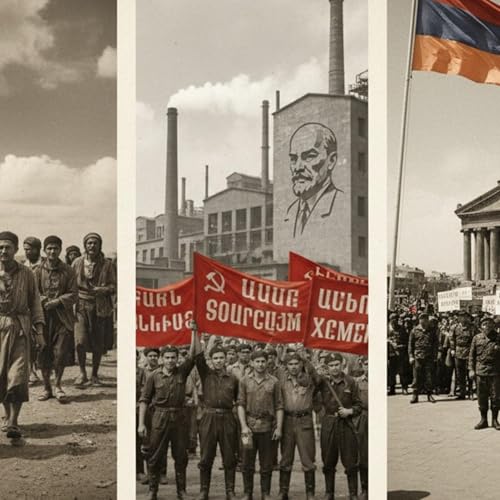
  • Armenia: Forged in Fire. A Deep Dive into a Century of Survival
    Aug 30 2025

    Welcome to the last episode of the first season of The Levant Files' Deep Dive Podcast Section, where we move beyond the headlines and into the heart of history. What if the story of a nation wasn't just a collection of dates and dry facts, but a living, breathing narrative shaped by constant struggle, unimaginable loss, and an unbreakable spirit?

    Today, we embark on a journey into the tumultuous and profoundly moving history of modern Armenia. We're setting aside ancient chronicles to focus on the pivotal 20th and 21st centuries—a period that forged the nation's contemporary identity. This isn't a simple timeline; it's a story of survival against all odds. We will navigate from the tragic dawn of the Armenian Genocide, a foundational trauma that echoes to this day, through the complex decades of Soviet rule where national identity simmered just beneath the surface.

    We'll witness the fleeting, hard-won moments of independence, the devastating conflicts over Nagorno-Karabakh, and the relentless geopolitical pressures of being at a crossroads of empires. It's a tale of how a people, repeatedly caught between larger powers, have fought to preserve their culture, their faith, and their right to self-determination.

    Our mission is to unpack this intricate history, exploring the key moments, the external pressures, and the internal will that have defined Armenia's path. As we begin, consider this: How does a small nation, defined so heavily by its tragic past and its challenging geography, secure a stable future in the 21st century? Join us as we deep dive into the story of modern Armenia.

    Show More Show Less
    17 mins
  • Forging a Nation: The Turbulent Birth of Modern Azerbaijan
    Aug 9 2025

    Welcome to a new episode of The Levant Files

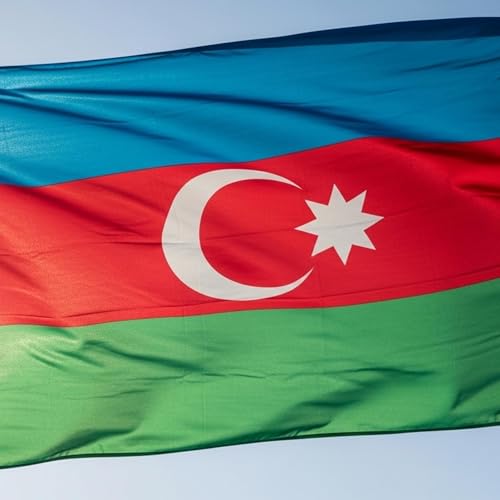
    Imagine a place that, just over a century ago, was little more than a geographical name on a map. Fast forward through a century of imperial collapse, world wars, revolution, and brutal conflict, and it emerges as a modern nation-state. What forces drive such a breakneck transformation? And what legacy does that turbulent journey leave for a country navigating the complexities of the 21st century?

    This week, in our new podcast episode, we delve into the fascinating and often turbulent history of modern Azerbaijan. We'll trace its path from a collection of people under the Russian Empire—where local Muslims faced systemic discrimination—to the surprisingly rapid formation of a national identity in the early 1900s. We explore the brief, doomed dream of its first independence, crushed by the Soviet Red Army, and the 70 years that followed, where Moscow both institutionalized the "Azerbaijani" ethnic category while simultaneously attempting to erase inconvenient histories.

    Join us as we unpack the chaos of the Soviet collapse, the explosion of the Nagorno-Karabakh conflict that came to define an era, and the political turmoil that paved the way for a second, hard-won independence. We'll examine how the legacies of Soviet-era corruption, immense oil wealth, and unresolved conflict continue to shape the nation today. Ultimately, this is a story that asks a profound question: What does it take to forge a stable, unified identity when the very definition of your people has been contested, constructed, and in constant flux for generations?


    Selected Sources:

    Bolukbasi, Suha. Azerbaijan: A Political History. United Kingdom: Bloomsbury Publishing, 2013.

    Transcaucasia, Nationalism, and Social Change. USA: University of Michigan Press, 1996.

    Zeynaloglu, Jahangir. A Concise History of Azerbaijan: From Azerbaijani Turkic Dynasties of the Middle Ages to the First Turkic Republic. N.p.: Independently Published, 2020.

    Show More Show Less
    23 mins