• 92. How to Really Use AI in Your GTM Team
    Feb 19 2026

    In this episode we discuss: How to really use AI in your GTM team. We are joined by Donna McCurley, Creator of the AI Sales Operating System™ (AiSOS).

    Love The Operations Room? Please support us by rating and reviewing it here.

    We chat about the following with Donna McCurley:

    1. Who should actually “own” AI inside your GTM function — and what happens if nobody does?
    2. What does real AI governance look like in practice — beyond policies and buzzwords?
    3. Are AI agents creating hidden shadow systems inside your organisation?
    4. Why are most AI rollouts in sales failing to drive measurable revenue impact?
    5. How do you move from AI experimentation to a true AI sales operating system?

    References
    1. https://www.linkedin.com/in/donnamccurley/

    Biography

    Donna McCurley is the creator of the **AI Sales Operating System™ (AiSOS)** and a go-to advisor for SaaS revenue teams who want to turn AI from “extra noise” into a real growth engine. She leads Global Sales Enablement teams and has helped 100s of sellers cut out busywork, triple their pipeline coverage, and adopt AI workflows that actually stick.

    With a background that spans classroom teaching, Fortune 500 enablement leadership, and consulting with companies like McAfee and HPe, Donna has built a reputation for stripping away complexity and focusing on what truly drives revenue. Her work blends proven sales methodologies with practical AI deployment—think Microsoft Copilot, ChatGPT, Gong, and SalesLoft stitched together into one coherent system sellers can actually use.

    At her core, Donna is obsessed with solving a simple but critical problem: too many sales teams are drowning in admin work, bloated tech stacks, and outdated playbooks. Through AiSOS, she’s building a future where sellers spend less time clicking around and more time closing deals.

    To learn more about Beth and Brandon or to find out about sponsorship opportunities click here.

    Summary07:05 – Turning Copilot into a Revenue Engine07:15 – AI Governance in Practice07:18 – Avoiding “Shadow AI” Systems09:27 – Change Management & Behaviour Shift13:19 – The Biggest Mistakes in AI Rollout14:16 – Enablement Over Experimentation22:00 – The Role of RevOps as AI Overseer38:00 – Moving from AI Tools to an AI Operating System

    This podcast uses the following third-party services for analysis:

    Podcorn - https://podcorn.com/privacy
    Show More Show Less
    47 mins
  • 91. AI in The Future of Work
    Feb 12 2026

    In this episode we discuss: AI in the future of work. We are joined by Agata Nowicka, Managing Partner of the AI Visionaries Accelerator.

    Love The Operations Room? Please support us by rating and reviewing it here.

    We chat about the following with Agata Nowicka:

    1. Are high-growth founders underestimating the role of distribution from day one?
    2. At Series B and beyond, is your monetisation model actually aligned with value delivery?
    3. Could your onboarding and sales process be quietly eroding the value you promise?
    4. Will AI fluency soon become a non-negotiable capability in your workforce?
    5. Are you building an AI-first company — or just layering AI onto old plumbing?

    References
    1. https://www.linkedin.com/in/agata-nowicka/
    2. https://femalefoundry.substack.com/
    3. https://www.aivisionaries.co/
    4. https://www.femaleinnovationindex.com/

    Biography

    Agata Nowicka is the Managing Partner at AI Visionaries—an AI accelerator launched with Google to scale Europe’s most innovative AI and deeptech startups. With 12 years of experience as an angel, VC investor and founder of two tech businesses in the U.S., Hong Kong, and the UK (one exit), she is also the author of the Female Innovation Index—the largest analysis of female-led innovation and funding in Europe. Agata holds an MBA from Wharton and INSEAD and is an advisor to startups and accelerators including Techstars, the University of Cambridge Founders Accelerator, and Village Capital.

    To learn more about Beth and Brandon or to find out about sponsorship opportunities click here.

    Summary

    39:04 – Introduction & Founder Focus Shift

    42:04 – Monetisation Beyond Revenue

    45:04 – Sales & Onboarding as Value Proof

    48:04 – AI Fluency as a Workforce Standard

    51:04 – Moving to an AI-First Model

    54:05 – Business Complexity & “Plumbing”

    48:20 – Resilience in High-Growth Environments

    49:49 – Leadership in an AI Era

    57:05 – The Future Belongs to Visionary Founders


    This podcast uses the following third-party services for analysis:

    Podcorn - https://podcorn.com/privacy
    Show More Show Less
    59 mins
  • 90. What is The CEO's Job?
    Feb 5 2026

    In this episode we discuss: What is the CEO’s job? We are joined by Keith Wallington, Chairperson and Investor in B2B SaaS businesses

    Love The Operations Room? Please support us by rating and reviewing it here.

    We chat about the following with Keith Wallington:

    1. What actually changes in an operating model as a company scales – and what shouldn’t change, even under pressure?
    2. How do you design an organisation that moves fast without creating chaos or decision fatigue?
    3. When does adding structure genuinely unlock performance, and when does it quietly slow teams down?
    4. How can operators tell the difference between a scaling problem and a leadership problem?
    5. What questions should COOs be asking before a Series B or major growth phase to avoid painful rework later?

    References
    1. https://www.linkedin.com/in/keithwallington/

    Biography

    Focussed on Series A and Growth stage B2B SaaS businesses that deliver vital, core services to their customers.

    Keith has led strategy and execution in technology businesses since the 1990’s, driving growth in Europe, the USA and Africa: His experience in driving online business models spans Retail Banking, Telecommunications, Online Live Broadcasting and Software as a Service (SaaS): He has led strategy and execution initiatives at businesses including Microsoft, Standard Bank, Omnicom/TBWA, MTN Group and Mimecast.

    From 2008 – 2014 Keith spent 6 years driving growth at Mimecast, best in class and global leader in SaaS based email security, archiving and continuity: Here he assumed a number of C Level roles, including COO, spanning most of the business from Marketing to Customer Experience to Technical Operations as he championed scalable, efficient growth during this phase of hyper growth (from $6m to over $110m Annual Recurring Revenue) and global expansion from the UK base.

    After preparing Mimecast for IPO Keith refocused his attention to support businesses on their growth journey. Keith invests in and assumes board roles with post Series A businesses. He engages directly and also collaborates with Venture Capital and Private Equity teams to co-invest and add depth to portfolio company boards.

    To learn more about Beth and Brandon or to find out about sponsorship opportunities click here.

    Summary

    05:30 – Why operating models break during growth

    12:45 – The tension between speed and structure

    19:30 – Horizontal vs vertical operating models

    26:00 – Decision-making at scale

    30:00 – What scaling exposes about leadership teams

    38:30 – Preparing for Series B (before it’s too late)

    47:00 – Operating principles that actually stick

    55:30 – Signals your operating model needs a reset


    This podcast uses the following third-party services for analysis:

    Podcorn - https://podcorn.com/privacy
    Show More Show Less
    1 hr and 7 mins
  • 89. The Economics of VC Funds
    Jan 29 2026

    In this episode we discuss: The economics of VC funds. We are joined by Edward Barrow, Co-Founder & CEO @ Cloud Capital.

    Love The Operations Room? Please support us by rating and reviewing it here.

    We chat about the following with Edward Barrow:

    1. Why do so many fast-growing companies only realise cloud spend is a problem once it’s already out of control?
    2. What actually breaks when finance and engineering don’t share a common language around cloud costs?
    3. Is “visibility” into cloud spend enough, or does it create a false sense of control?
    4. How should operators think about financial risk when infrastructure spend is variable by design?
    5. What does good cloud cost governance look like without slowing teams down?

    References
    1. https://www.linkedin.com/in/ebarrow/
    2. https://www.cloudcapital.co/

    Biography

    Ed has spent his career helping high-growth tech companies align strategy with execution — first in marketing tech, and now in cloud finance.

    After co-founding Idio, an AI-driven platform used by global B2B brands, he led the business through rapid growth, M&A, and a successful exit to Episerver (now Optimizely). Post-acquisition, he helped shape global product and M&A strategy across multiple acquisitions and 400% growth.

    Today, Ed is the co-founder and CEO of Cloud Capital, where he helps finance and engineering leaders forecast and optimize cloud spend — without taking on financial risk. The platform gives finance teams clarity and control while enabling engineering to move fast without waste. Ed and his team are building the cloud finance layer for the next generation of tech companies — turning cloud spend into a strategic advantage, not a liability.

    To learn more about Beth and Brandon or to find out about sponsorship opportunities click here.

    Summary

    00:00–04:10 – Setting the scene: operator fatigue, reality after the “honeymoon phase,” and why this conversation matters now

    06:05 – Ed Barrow’s background: from AI startup founder to cloud finance problem-solver

    09:30 – The real problem with cloud spend: why “usage-based pricing” breaks traditional finance models

    13:45 – Finance vs engineering: how misaligned incentives create hidden waste

    18:20 – Why visibility alone doesn’t change behaviour (and what actually does)

    22:50 – The risk operators don’t see: cloud spend as an uncapped financial liability

    27:40 – Forecasting cloud costs without slowing teams down

    32:10 – What good cloud governance looks like in high-growth companies

    36:30 – Turning cloud spend into a strategic advantage, not just a cost-control exercise


    This podcast uses the following third-party services for analysis:

    Podcorn - https://podcorn.com/privacy
    Show More Show Less
    1 hr and 2 mins
  • 88. Discovering Your Strengths
    Jan 22 2026

    In this episode we discuss: Discovering Your Strengths and Living The Life That You Want. We are joined by Alicia Diamond, COO and Transformation Leader.

    Love The Operations Room? Please support us by rating and reviewing it here.

    We chat about the following with Alicia Diamond:

    1. What happens when you stop waiting for “perfect clarity” and start sharing half-formed ideas with your team?
    2. How much operational value is lost because your best thinking happens outside formal meetings?
    3. Are your leadership decisions driven by energy and context — or by calendar availability?
    4. What if the real bottleneck in your organisation isn’t process, but permission to think out loud?
    5. How do you create space for strategic thinking when the operational noise never really stops?

    References
    1. https://www.linkedin.com/in/alicia-diamond/
    2. https://aliciadiamond.substack.com/
    3. https://www.aliciadiamond.com

    Biography

    Alicia has been the right-hand, “figure it out” partner to 5 CEOs as a 2x COO and 2x Chief of Staff. She's helped visionary CEOs across diverse industries to get their most transformative ideas unstuck and into action. Highlights include launching the Long-Term Stock Exchange and proving the bottom-line impact for listed clients and founding/managing the Chinese factory behind a portfolio of direct-to-consumer brands.

    She sharpened her operational prowess under the scrutiny of top-tier investors including a16z, Founders Fund, Collaborative Fund, Obvious Ventures while working in the Lean Startup methodology, at Eric Ries' startup stock exchange.

    Recently, Alicia expanded from working in tech into partnering with SMB owners. She helps visionary owners achieve their growth goals through scalable technology, best-in-class operating practices, and people-first leadership.

    To learn more about Beth and Brandon or to find out about sponsorship opportunities click here.

    Summary

    05:45 — The power of unplanned conversations

    06:55 — Why half-formed ideas are a leadership superpower

    08:30 — Meetings vs momentum

    11:00 — Energy as an operational constraint

    14:15 — The danger of over-polished thinking

    18:00 — Creating environments where ideas can be safely unfinished

    22:10 — Leadership presence over process

    26:30 — Rethinking how and when strategy happens

    30:45 — What operators can do differently tomorrow


    This podcast uses the following third-party services for analysis:

    Podcorn - https://podcorn.com/privacy
    Show More Show Less
    52 mins
  • 87. The COO's Guide to The Jigsaw Puzzle Company
    Jan 15 2026

    In this episode we discuss: The COO's Guide to The Jigsaw Puzzle Company. We are joined by Cameron Herold, he is the founder of the COO Alliance and author of the Second in Command.

    We chat about the following:

    1. How can a COO use the “jigsaw puzzle” metaphor to bring clarity and alignment to a fast-growing company?
    2. What should a new COO actually do in their first 30, 60, and 90 days to build trust and avoid missteps?
    3. How do COOs become the “leash, not the choke collar”, supporting visionary CEOs without slowing them down?
    4. What simple systems can COOs introduce early on that create long-term impact without overwhelming the business?
    5. How do you determine whether you’re truly operating as a COO… or actually a VP of Ops or GM in disguise?

    References:

    Cameron Herold

    COO Alliance

    YouTube Channel

    Biography:

    Founder of the COO Alliance & Invest In Your Leaders Course

    Author of Vivid Vision & The Second In Command

    Meet Cameron Herold, the mastermind behind the exponential growth of hundreds of companies. As the founder of the COO Alliance and the Invest In Your Leaders course, Cameron is a dynamic consultant who has coached some of the biggest names in business, including Sprint Telecom and a monarchy in the Middle East. Known as the "CEO Whisperer", Cameron has a reputation for guiding his clients to double their profits and revenue in just three years or less.

    Cameron's entrepreneurial journey began at a young age, and by 35, he had helped build his first two $100 million dollar companies. But his greatest achievement came as the COO of 1-800-GOT-JUNK?, where he engineered the company's spectacular growth from $2 million to $106 million in revenue and from 14 to 3,100 employees - all in just six years.

    Cameron is not just a successful business leader, but also a captivating speaker. The current publisher of Forbes magazine, Rich Karlgaard, stated "Cameron Herold is the best speaker I've ever heard...he hits grand slams”.

    When he's not on stage, Cameron continues to teach through his Second In Command podcast and his bestselling books, including Vivid Vision, Meetings Suck, Free PR, Double Double, and The Miracle Morning for Entrepreneurs.

    Cameron is a top-rated international speaker and has been paid to speak in 26 countries and on all 7 continents, including Antarctica in early 2022. He is also the top-rated lecturer at EO/MIT's Entrepreneurial Masters Program and a powerful and effective speaker at CEO and COO leadership events worldwide.

    Summary:

    00:03:35 – The COO as a jigsaw puzzle builder

    00:11:29 – How to use AI as a COO (and where it goes wrong)

    00:11:52 – Advice for the first 90 days

    00:14:26 – Why early relationship-building matters

    00:15:20 – “Be the leash, not the choke collar”

    00:16:20 – How to say “no” without shutting people down

    00:28:00 – What’s missing in EOS & how COOs fill the gap

    00:32:42 – Pick satellite projects, not messy ones

    00:33:16 – Avoid big disruptive changes early

    00:36:00 – Are you really a COO… or something else?

    00:59:23 – Final takeaway


    This podcast uses the following third-party services for analysis:

    Podcorn -...
    Show More Show Less
    1 hr and 1 min
  • 86. Season 2 Wrap Up
    Nov 13 2025

    It’s been a whirlwind of a season!

    In this special wrap-up episode, Bethany and Brandon look back on the last ten weeks of The Operations Room — the highlights, lessons, and chaos that shaped Season 2 — and share a sneak peek of what’s coming in Season 3.

    We reflect on:

    • What it really feels like to step into a CEO role (and why it’s lonelier than expected).
    • The intensity of leading through change — and learning to switch off when the buck stops with you.
    • The balance between growth, leadership, and staying human.
    • The power (and pain) of performance reviews done right.
    • Why our next season will dive deep into AI, leadership, and rethinking operational strategy.

    Plus, we reveal our guest line-up for Season 3 — including returning favourites like Keith Wallington and Cameron Herold, and new voices exploring AI, sales, and the future of strategy.

    Love The Operations Room? Please support us by rating and reviewing it here.

    You can also share your guest suggestions — one slot left for next season!

    Summary

    00:00 – Welcome and season recap

    02:00 – Bethany’s first 90 days as CEO

    07:30 – The reality of responsibility and loneliness at the top

    11:50 – Brandon’s reflections on scaling a high-growth team

    15:40 – Lessons from performance and salary reviews

    20:00 – What’s coming next: AI, leadership, and puzzles vs OKRs

    26:00 – Behind the scenes: planning the next season

    28:00 – Our Substack

    To learn more about Beth and Brandon or to find out about sponsorship opportunities click here.


    This podcast uses the following third-party services for analysis:

    Podcorn - https://podcorn.com/privacy
    Show More Show Less
    32 mins
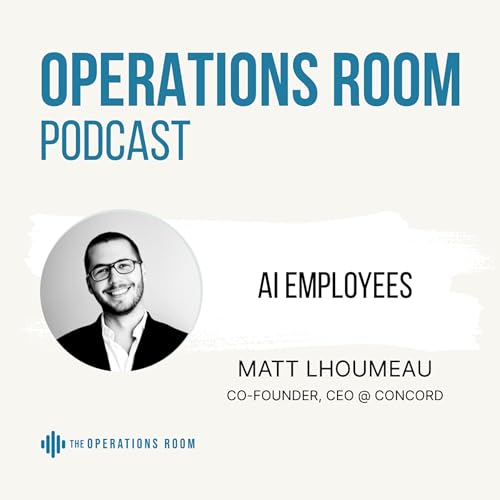
  • 85. AI Employees
    Nov 6 2025

    In this episode we discuss: AI employees. We are joined by Matt Lhoumeau, Cofounder & CEO at Concord

    Love The Operations Room? Please support us by rating and reviewing it here.

    We chat about the following with Matt Lhoumeau:

    1. How do you balance the need for structure with the chaos of fast-growing operations?
    2. What happens when marketing becomes a true conversation rather than a one-way message?
    3. Why are standards and expectations so critical to building trust in a growing team?
    4. How can leaders create clarity without stifling creativity?
    5. What’s the real difference between being busy and being effective?

    References
    • https://www.linkedin.com/in/mattlhoumeau/
    • https://www.concord.app/
    • https://eu1.hubs.ly/H0lMWln0

    Biography

    Matt Lhoumeau is the CEO and co-founder of Concord, the leading provider of AI-powered Agreement Intelligence solutions. With over a decade of experience transforming how businesses manage contracts, Matt helps operations leaders unlock strategic value from their agreements and turn contracts from cost centers into profit drivers.

    To learn more about Beth and Brandon or to find out about sponsorship opportunities click here.

    Summary

    04:05 – AI tools and operational leadership.

    08:05 – The power of systems thinking in AI bots

    12:01 – Using AI to challenge you

    15:16 – AI-first mantra

    19:40 – Legal department AI substitutes

    22:36 – Being a systems owner

    24:30 – ChatGPT as a therapist

    27:37 – Using AI to evolve and be durable

    31:34 – How tools and frameworks are used over time.

    34:58 – The balance between AI and human intervention

    35:19 – Evolving with AI

    37:05 – The right inputs


    This podcast uses the following third-party services for analysis:

    Podcorn - https://podcorn.com/privacy
    Show More Show Less
    40 mins