Season's Savings | ₹5/mo for 3 months

₹199/month after first 3 months. Renews automatically. Terms apply.
The Power Compass cover art

The Power Compass

The Power Compass

Written by: Dr Steve Vinay Gunther & Dr Paul Donovan
Listen for free

About this listen
Weilding authority can be exhilarating; it can also become a Danger Zone where honest feedback vanishes and sensibility gives way to excess—a risk for every manager, parent, or leader. Hosted by Drs. Paul Donovan and Steve Vinay Gunther, The Power Compass is your ‘Driver’s Ed’ for the responsibile use of influence. Master the Art of Power by balancing strength with heart. Outsmart the traps of the Power Paradox, build your 11-source Power Battery, and map your unique Powerprint. Shift from ‘power-over' to generative ‘power-with’, and learn to lead with wisdom in the Power Zone.Steve Vinay Gunther Economics Management Management & Leadership Self-Help Social Sciences Success
Episodes
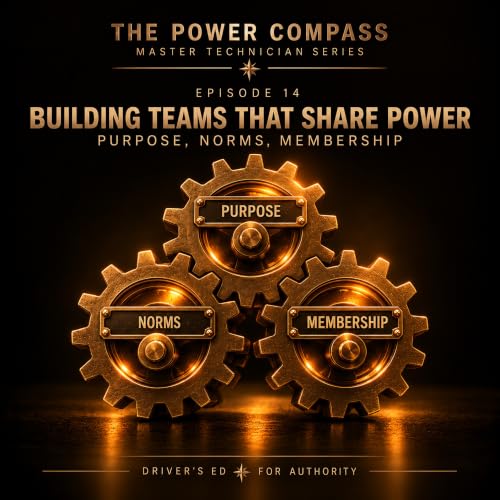
  • #14 Building Teams That Share Power
    Oct 31 2026
    • Why executive teams are often “over-challenged individually, under-challenged collectively” • Purpose: defining what only this team, not any individual, should be doing • Norms: the single most predictive factor of team effectiveness in real research • Membership: the surprising number of teams that can't agree who's actually on them • Decision-making: why divergence must come before convergence • Learning: why teams need to pause and reflect on themselves, not just their work • Why the best use of a manager's power is often to step out of the centre Drs. Vinay and Paul argue that most executive teams are “over-challenged individually and under-challenged collectively” — talented people who never truly function as a team. They outline five foundations for a team that shares power well: a clearly defined shared purpose distinct from individual work, agreed norms for how members will engage (the single most predictive factor of team effectiveness in one major study), clear membership boundaries, a shared process for decision-making (divergence before convergence), and regular team-level learning and reflection. Real stories — a mystery attendee at an executive meeting, organisations removing layers of management entirely — illustrate why the best use of a manager's power is often to step out of the centre and let the team's mission lead.
    Show More Show Less
    36 mins
  • #15 Why Good People Avoid Power | Ethical Leadership and Responsibility
    Nov 7 2026
    • Why ethical people often hesitate to take on power, leaving a dangerous vacuum • The “dirty hands effect” — why no leadership decision stays perfectly clean • Reluctant leaders in history: President Garfield and Desmond Tutu • What the Stanford Prison Experiment reveals about who's drawn to power • Narcissism, confidence, and why organisations often reward the wrong traits • Resume virtues vs. eulogy virtues — the deeper motivation for leading well • Robert Greenleaf’s servant leadership as the healthiest reason to take power Vinay and Paul examine why so many good, grounded people avoid positions of power, leaving a vacuum that's often filled by the overconfident or narcissistic instead. They unpack the “dirty hands effect” — the impossibility of leading without some decisions looking wrong from someone's vantage point — through stories of reluctant leaders like President Garfield and Desmond Tutu, and revisit the Stanford Prison Experiment to show how the mere framing of an opportunity attracts more aggressive personalities. They close with a case for “eulogy virtues” over “resume virtues,” and Robert Greenleaf's concept of servant leadership, as the healthiest motivation for accepting power's burden.
    Show More Show Less
    46 mins
  • #5 What Your Sense of Self Really Teaches Us About Personal Power
    Nov 3 2026
    • Julie Diamond's Diamond Power framework and its three domains of personal power • Capable self: building confidence without over inflating it • Aware self: understanding what triggers your thoughts and reactions • Purposeful self: finding resilience through a bigger sense of meaning • Viktor Frankl's insights on meaning under extreme adversity • Simple NLP techniques for shifting your emotional state • Why introverts can hold just as much personal power as extroverts Building on the "power battery" idea, Drs. Vinay and Paul unpack Julie Diamond's three-part model of personal power: capable self (confidence you can make an impact), aware self (understanding what triggers your thoughts and feelings, and directing your focus), and purposeful self (a sense of larger meaning that lets you recover from setbacks). Drawing on Viktor Frankl, NLP state-change techniques, and their own coaching practices, they make the case that personal power isn't about bravado — it's a quiet, buildable foundation that makes people less likely to misuse the power they're given elsewhere.
    Show More Show Less
    38 mins
adbl_web_anon_alc_button_suppression_t1
No reviews yet