The Rule O’Flaw Podcast cover art

The Rule O’Flaw Podcast

The Rule O’Flaw Podcast

Written by: Shivesh Kuksal
Listen for free

About this listen

Cutting Through Legal Farce, One Judgment at a Time!

Rule O’Flaw examines the cognitive and psychological mechanisms underlying institutionalised corruption in judicial systems.

We expose systemic corruption that undermines the rule of law through rigorous academic research, sharp analysis, and evidence-based critique.

Our work bridges cognitive psychology and legal theory to reveal how institutional biases, government circumvention of checks and balances, and socioeconomic inequality distort justice systems.

Copyright 2025. All rights reserved.
Political Science Politics & Government
Episodes
  • Why We Started Rule O’Flaw: Fighting Institutional Corruption Through Cognitive Science and Forensics
    Jan 4 2026
    The Flaws in Contemporary Legal Systems and Our Vision for Reform

    In this 37‑minute conversation, Shivesh and Peter share key insights from their journey as judicial reform activists and explain how cognitive science exposes systemic corruption in contemporary judicial systems.

    The discussion offers a radical, empirically grounded critique of how contemporary legal institutions structurally incentivise corruption, procedural predation, and professional bad faith, particularly in criminal prosecution and civil regulation. Framing public interest litigation as a form of systemic “audit” rather than conventional client‑centred advocacy, Shivesh treats each case as an experiment to expose and document the behavioural regularities of courts, regulators, and government lawyers under conditions of sustained contestation.

    Drawing on cognitive psychology and institutional economics of corruption (including Johann Lambsdorff’s work on “benevolent entrepreneurs” and the “invisible boot” of the market), the discussion explores how shame, conflict‑of‑interest engineering, and technological leverage can be deployed to discipline powerful actors who exploit plea bargaining, civil procedure, and judicial immunity to manufacture convenient rather than truthful outcomes.

    The discussion’s most striking features are its fusion of personal experience with a rigorously theorised account of systemic corruption, its provocative advocacy of algorithmic adjudication and biometric monitoring of judges, and its unapologetic rejection of professional civility norms as complicity in what is characterised as an ongoing fraud on the court. Chapters

    00:00: The Entrepreneur’s Philosophical Inquiry

    02:16: The Call for Algorithmic Justice

    04:40: The Commoditisation of Law and the Incompatibility of the Profession

    06:39: The Perversion of Procedure and the Need for Human Idealism

    09:21: Judicial Discretion, Immunity, and Accountability

    26:40: Auditing the System: Combating Institutional Corruption

    Show More Show Less
    38 mins
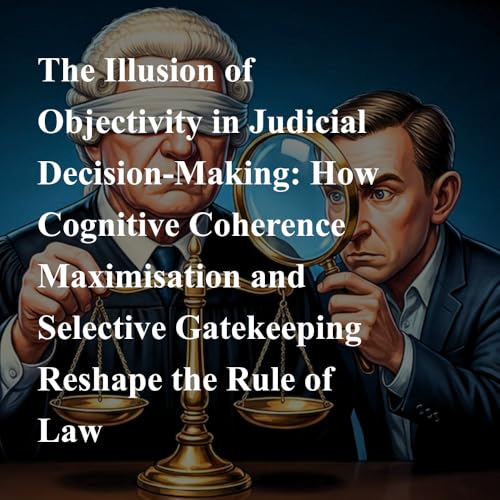
  • The Illusion of Objectivity in Judicial Decision-Making: How Cognitive Coherence Maximisation and Selective Gatekeeping Reshape the Rule of Law
    Jan 1 2026

    The conventional view of judicial decision-making presents judges as neutral arbiters who mechanically apply legal rules to factual scenarios. This analysis challenges that paradigm by examining the psychological mechanisms through which judges navigate complex and ambiguous legal materials. Drawing on cognitive science research, the video argues that judicial reasoning often operates through unconscious cognitive restructuring rather than through passive legal discovery.

    The framework begins with basic inference-building processes, in which judges construct interpretations by connecting established legal materials to new conclusions through mediating principles. In straightforward cases, these inferences typically converge coherently on a single outcome. In genuinely complex cases, however—where competing legal arguments point in contradictory directions—judges initially experience what researchers term a “dilemma set”: a cognitively conflicted state marked by profound ambiguity and contradiction.

    The analysis shows that judges resolve this cognitive dissonance through three primary forms of unconscious restructuring: gatekeeping (selectively including or excluding arguments and facts), bolstering (reinterpreting evidence to maximise narrative coherence), and rule selection (choosing among competing interpretive principles). Through these processes, judges oscillate between competing mental models, much like viewing the Necker cube optical illusion, until one model achieves sufficient coherence to feel compelling and decisive.

    Crucially, judges remain largely unaware of these cognitive transformations, instead experiencing an intuitive certainty that they are simply discovering objective legal meaning. This gap between experience and process produces what the research terms the “illusion of objectivity”: judges genuinely feel constrained by law precisely because their unconscious minds have already restructured the legal materials into a coherent framework. Judicial opinions, therefore, function as polished snapshots of this final coherent model, rather than faithful records of the messy decision-making process itself.

    This psychological perspective illuminates a fundamental tension between legal formalism and realism, suggesting that judges can simultaneously experience authentic constraint while actively constructing legal meaning. The implications are significant: if unconscious coherence-maximisation shapes judicial reasoning even among trained legal professionals striving for objectivity, similar cognitive mechanisms are likely to influence how systemic bias and corruption become embedded within ostensibly neutral legal institutions, operating below the threshold of conscious awareness while systematically advantaging particular interests and perspectives.

    Chapters

    00:00 The Complexity of Judicial Decision-Making

    00:50 Understanding Inferences

    02:03 The Role of Backing in Inferences

    03:03 Navigating Hard Cases

    04:25 The Dilemma Set Explained

    05:02 Case Study: Ratzlaff v. United States

    07:13 From Dilemma to Coherence

    08:49 The Mechanics of Cognitive Restructuring

    10:21 The Oscillation Phenomenon

    11:54 Cognitive Tools in Decision-Making

    15:12 The Illusion of Objectivity

    17:10 The Hunch Behind Judicial Decisions

    18:08 From Internal Process to Written Opinion

    20:01 Legal Formalism vs Legal Realism

    Show More Show Less
    22 mins
  • The Gavel and the Brain: Deconstructing the Myth of Mechanical Jurisprudence
    Dec 30 2025

    This episode examines the psychological foundations of judicial decision-making by analysing its cognitive processes, revealing important implications for systemic corruption and the rule of law. The central thesis challenges the myth of “mechanical jurisprudence,” the belief that judges function as dispassionate logic machines. It shows that legal reasoning operates through a human “coherence engine” that seeks stable, internally consistent interpretations rather than formal logical derivations.

    The analysis presents empirical evidence of judicial susceptibility to cognitive biases, most notably a landmark anchoring study where federal judges exposed to an irrelevant $75,000 jurisdictional figure awarded $350,000 less in damages, a 30% reduction compared with control groups. This finding shows how the mind’s constraint satisfaction process can be systematically manipulated, turning cognitive vulnerabilities into exploitable attack surfaces for corruption.

    The episode moves beyond individual bias to examine structural vulnerabilities, identifying judicial discretion as the key mechanism that enables both unintentional cognitive drift and deliberate manipulation. Bribes do not crudely purchase outcomes but act as targeted perturbations to the coherence-seeking process, nudging the interpretive network toward predetermined equilibria while preserving the appearance of legal rationality. These psychological mechanisms have been weaponised into doctrines of cognitive warfare, enabling scalable exploitation of human decision-making architecture.

    While existing institutional safeguards, such as reason-giving requirements, recusal rules, and whistleblower protections, provide partial mitigation, there is overwhelming evidence that they are insufficient to address systemic manipulation. The analysis concludes with concrete recommendations for strengthening judicial decision environments through anchor hygiene protocols, precommitment mechanisms, hindsight guards, and adversarial symmetry controls.

    The work reframes the fundamental question of judicial legitimacy. Instead of denying human cognitive limitations, institutional design should anticipate and channel them toward justice rather than the gravitational pull of power and influence. The episode demonstrates that the coherence-seeking mind is not a flaw but an inevitability that, properly constrained through structural reform, can serve the rule of law rather than undermine it.

    Chapters

    00:00 Introduction: Dismantling the Myth of Mechanical Jurisprudence

    00:48 The Mind as a Coherence Engine: Constraint Satisfaction, Not Linear Logic

    03:29 From Cognitive Architecture to Cognitive Glitches: Judicial Biases Are Human Biases

    05:20 Discretion as the Attack Surface: From Latent Bias to Deliberate Manipulation

    06:25 Institutional Patches: Adequate Mitigations or Partial Firebreaks?

    Show More Show Less
    8 mins
No reviews yet