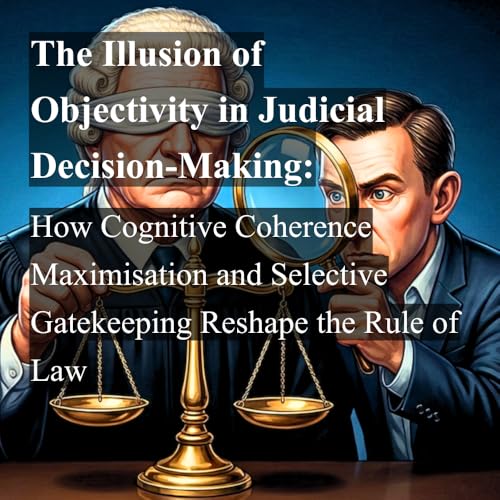
The conventional view of judicial decision-making presents judges as neutral arbiters who mechanically apply legal rules to factual scenarios. This analysis challenges that paradigm by examining the psychological mechanisms through which judges navigate complex and ambiguous legal materials. Drawing on cognitive science research, the video argues that judicial reasoning often operates through unconscious cognitive restructuring rather than through passive legal discovery.
The framework begins with basic inference-building processes, in which judges construct interpretations by connecting established legal materials to new conclusions through mediating principles. In straightforward cases, these inferences typically converge coherently on a single outcome. In genuinely complex cases, however—where competing legal arguments point in contradictory directions—judges initially experience what researchers term a “dilemma set”: a cognitively conflicted state marked by profound ambiguity and contradiction.
The analysis shows that judges resolve this cognitive dissonance through three primary forms of unconscious restructuring: gatekeeping (selectively including or excluding arguments and facts), bolstering (reinterpreting evidence to maximise narrative coherence), and rule selection (choosing among competing interpretive principles). Through these processes, judges oscillate between competing mental models, much like viewing the Necker cube optical illusion, until one model achieves sufficient coherence to feel compelling and decisive.
Crucially, judges remain largely unaware of these cognitive transformations, instead experiencing an intuitive certainty that they are simply discovering objective legal meaning. This gap between experience and process produces what the research terms the “illusion of objectivity”: judges genuinely feel constrained by law precisely because their unconscious minds have already restructured the legal materials into a coherent framework. Judicial opinions, therefore, function as polished snapshots of this final coherent model, rather than faithful records of the messy decision-making process itself.
This psychological perspective illuminates a fundamental tension between legal formalism and realism, suggesting that judges can simultaneously experience authentic constraint while actively constructing legal meaning. The implications are significant: if unconscious coherence-maximisation shapes judicial reasoning even among trained legal professionals striving for objectivity, similar cognitive mechanisms are likely to influence how systemic bias and corruption become embedded within ostensibly neutral legal institutions, operating below the threshold of conscious awareness while systematically advantaging particular interests and perspectives.
Chapters 00:00 The Complexity of Judicial Decision-Making
00:50 Understanding Inferences
02:03 The Role of Backing in Inferences
03:03 Navigating Hard Cases
04:25 The Dilemma Set Explained
05:02 Case Study: Ratzlaff v. United States
07:13 From Dilemma to Coherence
08:49 The Mechanics of Cognitive Restructuring
10:21 The Oscillation Phenomenon
11:54 Cognitive Tools in Decision-Making
15:12 The Illusion of Objectivity
17:10 The Hunch Behind Judicial Decisions
18:08 From Internal Process to Written Opinion
20:01 Legal Formalism vs Legal Realism


 38 mins
 22 mins
 8 mins
 Dec 30 20258 mins