Season's Savings | ₹5/mo for 3 months

₹199/month after first 3 months. Renews automatically. Terms apply.
The Tie-In cover art

The Tie-In

The Tie-In

Written by: Zena Harris and Mark Rabin
Listen for free

About this listen
Behind the scenes, sustainability in action. Entrepreneurs Zena Harris and Mark Rabin talk shop with filmmakers, event producers, and entertainment professionals from around the world in a quest to amplify the voices of people who are innovating, leveraging their influence, connecting ideas, and inspiring crews to make the entertainment we love more sustainable.Copyright 2026 Zena Harris and Mark Rabin Art Economics Leadership Management & Leadership
Episodes
  • Holiday Encore: AI Energy Use, Data Center Carbon & the Emissions Nobody Is Counting | Kanika Sharma
    Nov 24 2026

    A single AI query uses four to five times the energy of a regular search. Data centers consumed 415 terawatt-hours of electricity in 2024 — and that number is projected to more than double by 2030. But the carbon story most people aren't talking about isn't the electricity. It's the equipment.

    Kanika Arora Sharma, Principal of Sustainability at Introba, led the research report Hidden Emissions of the Cloud, examining the embodied carbon of data center cooling systems over a 60-year life cycle. She breaks down what a data center physically is, why the mechanical and electrical equipment inside it dominates its carbon footprint over time, what happened when her team asked manufacturers for their carbon data, and what the entertainment industry's studio and streaming infrastructure has to do with all of it.

    If you work in film, TV, or production and use cloud tools, AI workflows, or streaming platforms, this episode connects directly to your industry.

    🔗 Read the report: https://www.introba.com/news/hidden-emissions-cloud

    💼 Connect with Kanika: https://www.linkedin.com/in/arorakanika/

    🌐 Introba: https://www.introba.com

    Connect with your hosts:

    💼 Zena Harris: https://www.linkedin.com/in/zenaharris/

    💼 Mark Rabin: https://www.linkedin.com/in/rabinmark/

    👉 SUBSCRIBE for more sustainability and clean energy content from inside the entertainment industry.

    #DataCenter #AIEnergy #EmbodiedCarbon #DataCenterSustainability #AICarbon #CleanTech #GreenTech #Sustainability #DataCenterCooling #ImmersionCooling #CarbonFootprint #Scope3 #NetZero #ClimateAction #SustainableEntertainment #FilmIndustry #StreamingSustainability #GreenProduction #TheTieIn #EnergyTransition #AIEnvironmentalImpact #CloudComputing #BuildingDecarbonization #WholeLifeCarbon #MEP

    Show More Show Less
    38 mins
  • Planet in Mind: Closing the Sustainability Education Gap for Indie Filmmakers, Micro-Dramas & Building a Sustainable Studio in LA | Tauna Carson & Jim Stoddard
    Nov 17 2026

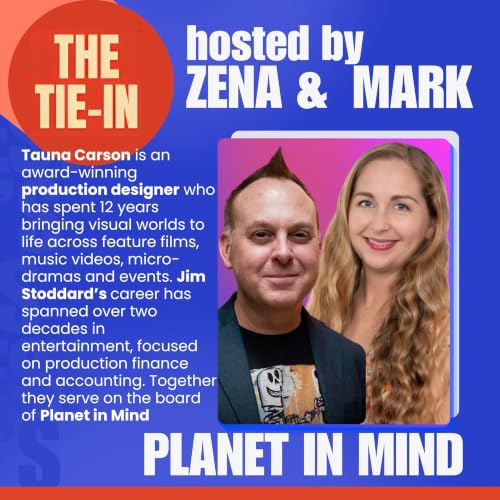
    This week on The Tie-In, Zena and Mark sit down with Tauna Carson and Jim Stoddard of Planet in Mind, a nonprofit bringing sustainability education and funding to the entertainment industry, starting with independent filmmakers.

    Tauna, an award-winning production designer, shares how Planet in Mind began with a dream to build a sustainable studio in Los Angeles: farm-to-table crew meals, a plastic-free environment, a prop house, and a maker’s workshop. While researching how to fund it, the team discovered resources like the Green Production Guide and realized that information wasn’t reaching the smaller productions shooting every day in LA. That’s where education became the focus.

    Jim, a line producer with 25 years across TV, film, commercials, music videos, and verticals, shares why he builds a sustainability line into every budget he creates. He explains how he plans for batteries and hydration stations from the start, and why batteries are now cheaper to run than generators as fuel costs rise.

    We also get into:

    bringing sustainability into film school classrooms earlier

    food donation, local rentals, and prop reuse

    how state incentives can reward sustainable productions

    how micro-dramas and vertical filmmaking are changing framing and set dressing

    what AI continuity means for production design

    Perfect for independent filmmakers, line producers, production designers, film students, and anyone looking for practical ways to make sustainable production part of everyday filmmaking.

    Topics: sustainable film production, indie filmmaking, green production education, sustainable studio, production design, line producing, production budgets, battery power, micro-dramas, vertical filmmaking, film school sustainability, prop reuse, food donation, fiscal sponsorship, Planet in Mind.

    🌱 Connect with @Planet in Mind:

    🎬 https://www.youtube.com/@planet_in_mind

    🌐 https://planetinmind.earth

    📸 Instagram: @planet_in_mind

    💼 LinkedIn: https://www.linkedin.com/company/planet-in-mind/

    👤 Facebook: https://www.facebook.com/533316533187923

    🎵 TikTok: @planetinmind0

    Connect with Tauna:

    🌐 Dynamite Pro Style: https://www.dynamiteprostyle.com

    Connect with Jim

    💼 LinkedIn: https://www.linkedin.com/in/jim-stoddard-producer/

    🎙️ Connect with your hosts:

    💼 Zena Harris on LinkedIn: https://www.linkedin.com/in/zenaharris/

    💼 Mark Rabin on LinkedIn: https://www.linkedin.com/in/rabinmark/

    Show More Show Less
    41 mins
  • Solar Shade Microgrids at Burning Man: Modular Road-Case Batteries, a Container Kitchen & Circular Water Systems | Marcus De Paula, Bao Chicka Wow Wow
    Nov 10 2026

    This week on The Tie-In, Mark is back in Black Rock City for our third From the Field episode at Burning Man. He visits Bao Chicka Wow Wow, a 110-person food camp, with Marcus De Paula, the camp’s co-lead and lead of infrastructure for power and water.

    Marcus walks through the modular solar shade microgrid he designed, now in its third year. It has 108 residential solar panels, about 50 kW, bridged between 20-foot shipping containers. The canopy goes up with no tools, using aluminum speed rail and stage lighting clamps adapted from his background in stage touring production. On a full sun day, it produces about 150 kWh, enough to power the camp’s full kitchen, eight chest freezers, a 500-pound-a-day ice machine, an e-bike charging station, and a large electric art car.

    The system stores 150 kWh of batteries in rolling road cases built to fit a standard truck pack. It is broken into 15 kWh cubes that a few campers can move by hand, so it can be split apart for smaller events in San Francisco off-season. Marcus also shows the custom power dashboard he vibe coded on Home Assistant, with predictive modeling to plan battery use through the night.

    On the water side, Marcus covers the camp’s circular water system. Ice machine runoff and clarified shower water feed the evaporative coolers. Filtration runs from 100 microns down to 0.01 microns, followed by UV sanitation. RFID wristbands manage shower water, and a dashboard at the bathhouse door tracks gallons per camper.

    Mark also shares highlights from across the playa, including Solar Punks’ 1.1 MW solar array with 5 MWh of storage.

    Perfect for festival and event producers, camp leads, production electricians, stage touring crews, sustainability coordinators, and anyone curious how modular solar and water systems work in extreme conditions.

    Topics: Burning Man solar, modular microgrid, solar shade structure, shipping container solar, road case battery storage, portable power, festival power systems, off-grid kitchen, evaporative cooling, gray water reuse, water filtration, energy dashboards, stage touring production, clean energy events.

    🌱 Connect with Marcus:

    📸 Instagram: @marcusv_depaula

    🎙️ Connect with your hosts:

    💼 Zena Harris on LinkedIn: https://www.linkedin.com/in/zenaharris/

    💼 Mark Rabin on LinkedIn: https://www.linkedin.com/in/rabinmark/

    👉 SUBSCRIBE for more sustainability and clean energy content from inside the entertainment industry.

    Show More Show Less
    38 mins
adbl_web_anon_alc_button_suppression_t1
No reviews yet