Season's Savings | ₹5/mo for 3 months

₹199/month after first 3 months. Renews automatically. Terms apply.
WTF Bach cover art

WTF Bach

WTF Bach

Written by: Evan Shinners
Listen for free

About this listen
J.S. Bach explained: Music analysis, Baroque history, counterpoint and performance practice. A classical music podcast for listeners who want to understand what they're hearing. Weekly history, Well-Tempered Clavier, Brandenburg Concertos, St. Matthew Passion, The Art of Fugue, Cello Suites, and more. Classical music education for all levels!

wtfbach.substack.comEvan Shinners
Music
Episodes
  • 154: The Trinity Seen In A Prelude
    Nov 10 2026

    The opening piece in Clavier-Übung III! A massive prelude with three parts. The three ideas are a representation of the trinity. Here is God the Father at the opening, full organ, dotted rhythms, pedals, lots of ornaments:

    Later, God the Son, a Gentle Lamb, a literal echo on a different keyboard, yet the music proceeds directly from the Father:

    The Holy Ghost, related to the Father and Son by the relative minor, is a fugue in three voices. Bach may have had this image in mind: “And suddenly there came a sound from heaven as of a rushing mighty wind, and it filled all the house where they were sitting. And there appeared unto them cloven tongues like as of fire, and it sat upon each of them.” (Acts 2: 2-3)

    Write That Fugue!

    We discuss the general contents of Clavier-Übung III: 27 pieces, (3x3x3) consisting of a Kyrie-Gloria Mass, hymns on the Catechism, the notorious ‘four duets,’ all framed by the giant pillars of the so-called ‘St. Anne’ prelude and fugue. We touch briefly on the notion of numerology in Bach.

    (SPOILER ALERT just in case you want to go in fresh!) The pieces of the Clavier-Übung III, listed with their BWV numbers (the confusing arrangement of which is also discussed in the episode.) Titles in RED are Organo Pleno pieces, ‘full’ organ— not quite ‘all the stops’ but something like that. Titles in BLUE are Manualiter pieces, for the hands alone. Titles in black therefore, are generally ‘à 2 Clav. et Pedal’ — with each hand on a separate keyboard. The variety is extraordinary!

    We Rely Exclusively on Paid Subscriptions! Help WTF Bach endure:Join at WTFBach.comYou can also make a one-time donation here:https://www.paypal.me/wtfbachhttps://venmo.com/wtfbach

    A new Telegram group is slowly forming! Singing through chorales and doing other cool Bachian things. Join here: https://t.me/+86a_lET5XKdmYTk0

    Spotify Listeners: New AI software has unjustly removed episodes. They are deaf to appeals. Stick it to the robot by listening on the Substack app.Thank you for your support!

    Selected Bibliography:

    Leaver, Robin A. “Bach’s Clavierübung III: Some Historical and Theological Considerations.” The Organ Yearbook 6 (1975): 17–32.

    Melamed, Daniel R. “Rethinking Bach Codes.” In Rethinking Bach, edited by Bettina Varwig, 227–50. Oxford: Oxford University Press, 2021.

    Schweitzer, Albert. J. S. Bach. Vol. 1. Translated by Ernest Newman. London: A. & C. Black, 1911.

    Schmieder, Wolfgang, ed. Bach-Werke-Verzeichnis: Thematisch-systematisches Verzeichnis der musikalischen Werke von Johann Sebastian Bach. Leipzig: Breitkopf & Härtel, 1950.


    Get full access to W.T.F. Bach? at wtfbach.substack.com/subscribe
    Show More Show Less
    1 hr
  • 153: Clavier-Übung III! A New Series.
    Nov 3 2026
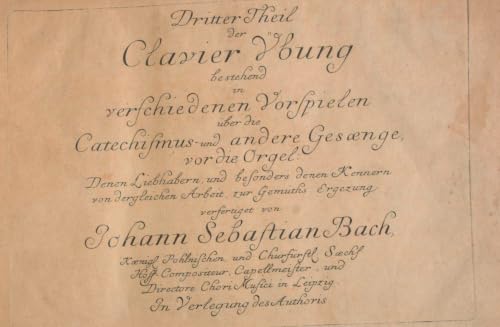
    Welcome to a new series on Bach’s first and most comprehensive published collection of organ music, the so-called, ‘Organ Mass,’ more accurately known as, Clavier-Übung III. Got Bach?The title page reads: Third Part of the Keyboard Practiceconsisting of various preludes on the Catechism and other hymns for the organ. For music-lovers and particularly for connoisseurs of such work, for the recreation of the spirit, prepared by Johann Sebastian Bach, Royal Polish and Electoral Saxon Court Composer, Capellmeister and Director of the chorusmusicus, Leipzig. Published by the Author.This is a group of 27 pieces for organ, some with pedal, many without. It was published in 1739. There are many ways to approach this giant work. The history of the engraving itself is a fascinating detective story. In this episode, I don’t even begin to speak of the music, but rather focus on the origins of liturgical organ music, and Bach’s precedents in his personal library for creating his own model. We also discuss what it means for Bach to have published something during his lifetime, what kinds of works he published, and why. (P.S. I said Pliny the Elder. I meant the Younger. Kudos to you if you caught that!)Keyboard Practice, Third Part!We Rely Exclusively on Paid Subscriptions! Help WTF Bach endure:Join at WTFBach.comYou can also make a one-time donation here:https://www.paypal.me/wtfbachhttps://venmo.com/wtfbachA new Telegram group is slowly forming! Singing through chorales and doing other cool Bachian things. Join here: https://t.me/+86a_lET5XKdmYTk0Spotify Listeners: New AI software has unjustly removed episodes. They are deaf to appeals. Stick it to the robot by listening on the Substack app.Thank you for your support!Bibliography: (Yes, I’m going to start adding bibliographies to some of these episodes, especially the ‘history-heavy’ ones. My goal is to establish WTF Bach as a legitimate scholarly resource, or at least a good place for other scholars to begin.)Primary SourcesBach, Johann Sebastian. Clavier-Übung III. Leipzig, 1739.Bach, Johann Sebastian. Bach: Orgelwerke, Bd. 4: Dritter Teil der Clavier-Übung. Edited by Manfred Tessmer and Christoph Wolff. Kassel: Bärenreiter, BA 5264.Caeremoniale episcoporum. Rome, 1600.Caeremoniale Parisiense. Paris, 1662.Codex Faenza. Faenza, Biblioteca Comunale, MS 117. c. 1420.Frescobaldi, Girolamo. Fiori musicali. Venice, 1635.Grigny, Nicolas de. Premier livre d’orgue. Paris, 1699.Heinichen, Johann David. Der General-Bass in der Composition. Dresden, 1728.Kuhnau, Johann. Neuer Clavier-Übung. Part 1. Leipzig, 1689; Part 2. Leipzig, 1692.Pliny the Younger. Epistulae 10.96–97. To Trajan, c. 112 CE.Robertsbridge Codex. British Library, London, Add. MS 28550.Scheidt, Samuel. Tabulatura nova. Hamburg, 1624.Secondary SourcesButler, Gregory G. J. S. Bach’s Clavier-Übung III: The Making of a Print, with a Companion Study of the Canonic Variations on “Vom Himmel hoch,” BWV 769. Durham, NC: Duke University Press, 1990.Ferguson, Everett. “Congregational Singing in the Early Church.” 2004, 144–59.Herl, Joseph. Worship Wars in Early Lutheranism: Choir, Congregation, and Three Centuries of Conflict. Oxford: Oxford University Press, 2008.Leaver, Robin A. Luther’s Liturgical Music: Principles and Implications. Grand Rapids: Eerdmans, 2007.More, Mother Thomas. “The Practice of Alternatim: Organ-playing and Polyphony in the Fifteenth and Sixteenth Centuries, with Special Reference to the Choir of Notre-Dame de Paris.” The Journal of Ecclesiastical History 18, no. 1 (1967): 15–32.Ponsford, David. French Organ Music in the Reign of Louis XIV. Cambridge: Cambridge University Press, 2011.Stauffer, George B. J. S. Bach: The Organ Works. Oxford: Oxford University Press, 2024.Stauffer, George B., ed. Clavier-Übung III. Vol. 8 of The Complete Organ Works of J. S. Bach. Colfax, NC: Wayne Leupold Editions, 2010.Van Wye, Benjamin. “Ritual Use of the Organ in France.” Journal of the American Musicological Society 33, no. 2 (1980): 287–325.Williams, Peter. The Organ Music of J. S. Bach. 2nd ed. Cambridge: Cambridge University Press, 2003.Yearsley, David. Bach and the Meanings of Counterpoint. Cambridge: Cambridge University Press, 2002. Get full access to W.T.F. Bach? at wtfbach.substack.com/subscribe
    Show More Show Less
    45 mins
  • 152: Bach’s Obituary (1754)
    Oct 27 2026

    One of the most important documents we posses about J.S. Bach— indeed the first biographical writing— is his obituary, written by his son, C.P.E., and his student, Agricola.

    Also referred to as the ‘Nekrolog,’ the obituary appeared in Mizler’s (yes, the Society of Musical Sciences gentleman) publication, Musikalische Bibliothek, in its very last installment.

    In this brief portrait of the greatest composer, we are struck by the renown of his family tree, the unanimous admiration of all those who heard Bach, but ultimately by the humility of his spirit despite his towering achievements.

    Write That Fugue!

    The obituary is also important because it contains Bach’s ‘first list of works.’ The five cantata cycles and five passions mentioned in the list are addressed in this article on Bach’s missing works:

    We Rely Exclusively on Paid Subscriptions! Help WTF Bach endure:Join at WTFBach.comYou can also make a one-time donation here:https://www.paypal.me/wtfbachhttps://venmo.com/wtfbach

    A new Telegram group is slowly forming! Singing through chorales and doing other cool Bachian things. Join here: https://t.me/+86a_lET5XKdmYTk0

    Spotify Listeners: New AI software has unjustly removed episodes. They are deaf to appeals. Stick it to the robot by listening on the Substack app.Thank you for your support!


    Get full access to W.T.F. Bach? at wtfbach.substack.com/subscribe
    Show More Show Less
    38 mins
adbl_web_anon_alc_button_suppression_t1
No reviews yet