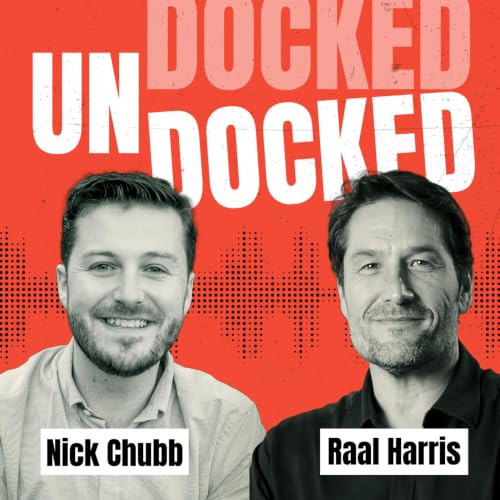
UnDocked: The Maritime Transformation Show cover art

UnDocked: The Maritime Transformation Show

UnDocked: The Maritime Transformation Show

Written by: Raal Harris and Nick Chubb
Listen for free

Undocked is a weekly podcast where Nick Chubb and Raal Harris explore what’s changing in maritime and technology. Through candid conversations and guest interviews, the show unpacks emerging trends, overlooked stories, and strategic insights, offering a fresh, unfiltered perspective on the evolving future of one of the world’s oldest industries.2026 Raal Harris and Nick Chubb
Episodes
  • What You Missed at Shipping UK and Demystifying AI in Maritime 2026
    Oct 9 2026

    Two maritime conferences, one city, and two perspectives on shipping's future. Nick reports from Shipping UK, where geopolitics, resilience and digital investment dominated. Raal brings insights from Demystifying AI in Maritime, exploring trust, governance and seafarer wellbeing. Together, they examine the decisions maritime leaders can no longer afford to postpone.

    CHAPTERS

    • 00:00 Two conferences, one city: What you missed
    • 01:12 Shipping UK: Geopolitics and national security
    • 09:51 Resilience, decarbonisation and the true cost of shipping
    • 14:01 Digital ROI: Measuring the return on technology investment
    • 23:05 Demystifying AI in Maritime: From potential to practical application
    • 27:47 The verification tax and AI's trust problem
    • 30:24 Real-world AI applications and emerging risks
    • 40:37 AI in the boardroom: Investment, accountability and people
    • 50:31 Seafarers, shadow AI and the STEER project
    • 55:14 AI bias and the importance of critical thinking

    Nick and Raal compare notes from Shipping UK, hosted by the UK Chamber of Shipping, and Demystifying AI in Maritime, organised by Intent Communications. From national security to artificial intelligence, both events raised difficult questions about how shipping prepares for an increasingly uncertain future.

    At Shipping UK, geopolitical risk dominated the conversation. A sobering keynote from Major General Paul Maynard highlighted the growing importance of commercial shipping to national security and the possibility that the UK may need to draw upon maritime expertise in a future conflict. But after decades of limited government investment in commercial maritime capabilities, is the industry equipped to respond?

    The discussion turns to resilience and an uncomfortable economic reality: shipping may need to become more expensive. Building redundancy into supply chains, preparing for disruption and funding decarbonisation all require investment.

    On a more practical note, Nick shares insights from his panel on digital return on investment. New benchmarking data reveals a significant jump in spending on AI and automation, while conventional IT budgets are being squeezed.

    Across London, Raal attended Demystifying AI in Maritime, where the conversation has matured from excitement about AI's capabilities to more fundamental questions of trust and accountability.

    Raal shares practical examples, including AI-powered food waste monitoring on cruise ships, alongside emerging threats from fraudulent certification, cyberattacks and information overload. A discussion with ABS also challenges the assumption that giving AI more context necessarily produces better answers.

    The conversation then moves into the boardroom. How should directors evaluate AI investments when the technology is evolving faster than conventional governance processes? Finally, attention turns to seafarers, who are already adopting AI tools regardless of whether their employers have formal strategies in place.

    EPISODE PARTNER

    This episode is sponsored by GTT Marine.

    Every integration RFP in shipping asks for a single source of truth. Almost no fleet actually wants one in practice.

    Why? Because, as one operator told the team at Thetius, the moment you force everything into one platform, you risk sacrificing best-in-class functionality.

    The great integration, the new Thetius and GTT Marine report, makes the case for something more achievable.

    A consistent view across the systems your teams already trust. Recommended reading for anyone running an integration RFP.

    Download it here.

    Show More Show Less
    1 hr
  • Shipping’s Unicorn CTO Problem, LLMs vs. Browsers, and the Broken Interoperability Window
    Oct 1 2026

    Nick and Raal explore how LLM-native apps could reshape maritime workflows, why shipping companies are struggling to define the modern CTO role, and what CCTV, digital identity and maritime single windows reveal about interoperability.

    CHAPTERS

    • 03:40 MCPs, LLMs and the future of maritime transactions
    • 14:52 When maritime standards meet the wider technology ecosystem
    • 18:30 Shipping’s “unicorn” CTO problem
    • 25:44 AI-powered CCTV arrives on board
    • 30:15 Surveillance, privacy and the social contract
    • 36:53 The Hawthorne effect and monitoring crew behaviour
    • 39:29 Why the Maritime Single Window still isn’t truly interoperable
    • 49:11 AI agents, digital identity and converging workflows
    • 52:14 Why all of this lands on the CTO’s desk
    • 57:02 Strategic choices, resilience and avoiding technology drift

    The episode opens with Nick testing Princess Cruises’ new ChatGPT integration and asking what happens when the browser stops being the default interface to digital services.

    That leads into shipping’s search for increasingly improbable technology leaders: CTOs expected to understand cloud infrastructure, cyber security, AI, data, vendors, transformation and the operational realities of ships. Nick and Raal consider whether companies need deep maritime experience, deep technology expertise, or teams deliberately designed to combine both.

    The discussion then moves on board, where AI-enabled CCTV promises better safety analysis, automated evidence and reduced administrative workload while raising difficult questions around privacy, crew acceptance and surveillance.

    Finally, they examine the Maritime Single Window, seafarer identity and certification as examples of a wider interoperability problem. Digital systems may be individually compliant yet still fail to work together.

    Tickets are still available for the Digital Ship Summit in Athens. Join maritime IT leaders for practical discussion around the technology choices shaping the fleet.

    EPISODE PARTNER

    This episode is sponsored by Insight.

    Most organisations invest in preventing a cyber incident. Fewer can say, with confidence, how they'd keep operating on the day one happens.

    Insight and SmartSea build resilience so an incident is a disruption, not a shutdown — connecting technology, people and operational workflows so critical decisions can still be made even when a single system is compromised.

    Because resilience isn't only about stopping attacks. It's about keeping the business moving when one gets through.

    Future-proof your digital defences with Insight.

    Show More Show Less
    1 hr and 3 mins
  • Shipping’s 2050 Fuel Forecast, Helium Supply Shortages, and 54,000 Sea Miles for One Sausage Roll
    Sep 24 2026

    This week, Nick and Raal examine how geopolitical disruption is exposing hidden dependencies across shipping: from helium shortages and future-fuel investment choices to soaring freight markets and cyber risk. They also trace the global supply chain behind a Greggs sausage roll, revealing how deeply everyday life depends on maritime trade.

    CHAPTERS

    • 01:03 Helium shortages and an unexpected shipping dependency
    • 03:35 Qatar, Hormuz and the global helium supply chain
    • 08:40 Shipping’s difficult alternative-fuel investment choices
    • 15:20 What the newbuild engine mix says about 2050
    • 19:00 Ammonia safety and the long road to fuel adoption
    • 24:25 Could alternative fuels reshape tramp shipping?
    • 40:19 The sea miles behind sausage rolls

    Nick opens with one of shipping’s less obvious supply-chain vulnerabilities: helium. Its role in MRI scanners, semiconductor production and aerospace makes disruption to Qatari supply more consequential than the commodity’s profile might suggest.

    Raal then turns to study published by the Global Centre for Maritime Decarbonisation (GCMD) and Boston Consulting Group on shipping’s fuel transition and the decisions being embedded in today’s newbuild orderbook. The pair discuss the economics of conventional fuels, LNG, methanol, ammonia and onboard carbon capture, and why carbon pricing, hydrogen costs, bunkering availability and safety requirements make a 25-year investment decision exceptionally difficult.

    That uncertainty raises a bigger operational question. If future fuels are available only along selected corridors and port networks, could shipping become less flexible? Nick considers whether tighter dependence on known bunkering locations could constrain tramp operations and encourage more fixed trading patterns, while Raal points to combination carriers as an example of how the industry can extract more efficiency from established routes.

    Nick brings that global system down to the scale of a single Greggs sausage roll, tracing ingredients and inputs across Canada, Brazil, Indonesia, Vietnam, China, India, Morocco, Ukraine and the US.

    The episode closes with a more immediate operational concern: a cluster of reported cyber incidents involving tankers and gas carriers. With allegations involving cargo-monitoring and control systems rather than only conventional IT or navigation, Nick and Raal discuss why cyber resilience is increasingly a safety and fleet-management issue, not simply an information-security problem.

    EPISODER PARTNER

    This episode is sponsored by Insight.

    Fleet IT shouldn't mean a constant cycle of hardware refreshes, scattered support contracts, and capital tied up in kit that's hard to maintain.

    It's the same discipline behind Insight's day-in-the-life device management on the Aroya refit — every one of 650-plus onboard devices tracked, maintained and accounted for across its lifecycle, on schedule and within budget.

    Insight's Ship-to-Shore IT Asset Management brings that same model fleet-wide, modernising onboard technology without upfront capital spend — shifting fleet IT from a lump CapEx cost to a predictable service.

    It's a smarter way to run fleet IT — freeing your teams to focus on operations, not infrastructure.

    Simplify your fleet IT with Insight.

    Show More Show Less
    55 mins
adbl_web_anon_alc_button_suppression_t1
No reviews yet