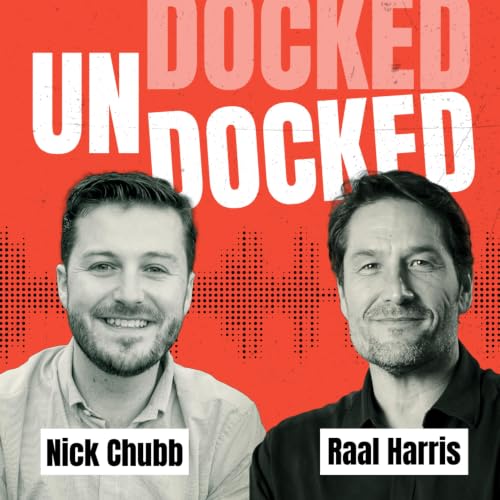
UnDocked: The Maritime Transformation Show cover art

UnDocked: The Maritime Transformation Show

UnDocked: The Maritime Transformation Show

Written by: Raal Harris and Nick Chubb
Listen for free

Undocked is a weekly podcast where Nick Chubb and Raal Harris explore what’s changing in maritime and technology. Through candid conversations and guest interviews, the show unpacks emerging trends, overlooked stories, and strategic insights, offering a fresh, unfiltered perspective on the evolving future of one of the world’s oldest industries.2026 Raal Harris and Nick Chubb
Episodes
  • Leaving Cargill to Start SeaThrew Marine: Eman Abdalla on How Shipping Can Become More Responsible
    Oct 15 2026

    Eman Abdalla joins Nick Chubb and Raal Harris to discuss building SeaThrew Marine, why ownership matters for safety and seafarer welfare, and what meaningful maritime transformation demands. The conversation spans operational accountability, career reinvention, decarbonisation, collaboration, incentives, technology, and the challenge of turning ambition into everyday practice at sea.

    CHAPTERS

    • 03:31 Why ownership changes accountability
    • 07:46 Commercial viability and seafarer safety
    • 09:30 Using technology to reduce risk
    • 11:58 Courage, culture, and difficult decisions
    • 16:03 Why transformation fails at adoption
    • 18:51 Transforming operations at Cargill
    • 23:26 Turning operations into a P&L enabler
    • 29:59 Leaving the corporate identity behind
    • 33:12 Designing a career with intention
    • 41:03 Decarbonisation beyond future fuels
    • 47:55 Fixing incentives across the value chain
    • 51:50 What effective collaboration requires
    • 56:18 What comes next for SeaThrew Marine

    Eman Abdalla joins Nick and Raal to explain why founding SeaThrew Marine was the culmination of a career spanning chartering, operations, logistics, governance and strategy, and why her original ambition was not simply to advise shipowners, but to own and operate vessels herself.

    In Emans’s view, influence only goes so far. Charterers, managers and operators can set standards and shape behaviour, but ultimate responsibility for safety, seafarer welfare and investment decisions still rests elsewhere. Her aim is to build a business where commercial performance and operational accountability sit in the same place.

    The conversation moves into the practical meaning of transformation. Eman argues that technology should do more than optimise fuel consumption: drones, better data, AI and redesigned processes should also reduce risk for seafarers and improve the quality of everyday decisions.

    She also reflects on her time at Cargill, including the work of repositioning operations from a perceived cost centre into a function that protects and enables P&L. That required trust, stronger communication, talent development and a clear link between organisational values and daily decision-making.

    The discussion then turns to career identity and Eman’s decision to leave the security and visibility of a major corporate role. She describes the vulnerability of separating her own professional identity from a large company name, alongside the freedom to pursue board work, entrepreneurship and problems where she believes she can have a direct impact.

    Finally, the conversation examines shipping’s decarbonisation challenge. Eman argues that uncertainty over future fuels cannot become an excuse for ignoring operational efficiency today. Better voyage planning, port coordination, contractual incentives and data sharing could cut avoidable emissions now, but only if owners, charterers, ports, cargo interests and operators stop optimising their individual piece of the system in isolation.

    EPISODE PARTNER

    Compliance in maritime is too often treated as a constraint. Done properly, it's the foundation for better operational performance.

    The real barrier isn't the regulation — it's fragmented data and inconsistent standards, which make compliance manual, slow and reactive. Standardise the data and strengthen the governance, and compliance starts improving data quality and reducing inefficiency across the fleet, instead of just sitting on top of it.

    Compliance isn't the anchor holding the fleet back. It's the keel that keeps it stable — and lets you move faster with more confidence.

    Build compliance into every workflow with Insight.

    Show More Show Less
    59 mins
  • What You Missed at Shipping UK and Demystifying AI in Maritime 2026
    Oct 9 2026

    Two maritime conferences, one city, and two perspectives on shipping's future. Nick reports from Shipping UK, where geopolitics, resilience and digital investment dominated. Raal brings insights from Demystifying AI in Maritime, exploring trust, governance and seafarer wellbeing. Together, they examine the decisions maritime leaders can no longer afford to postpone.

    CHAPTERS

    • 00:00 Two conferences, one city: What you missed
    • 01:12 Shipping UK: Geopolitics and national security
    • 09:51 Resilience, decarbonisation and the true cost of shipping
    • 14:01 Digital ROI: Measuring the return on technology investment
    • 23:05 Demystifying AI in Maritime: From potential to practical application
    • 27:47 The verification tax and AI's trust problem
    • 30:24 Real-world AI applications and emerging risks
    • 40:37 AI in the boardroom: Investment, accountability and people
    • 50:31 Seafarers, shadow AI and the STEER project
    • 55:14 AI bias and the importance of critical thinking

    Nick and Raal compare notes from Shipping UK, hosted by the UK Chamber of Shipping, and Demystifying AI in Maritime, organised by Intent Communications. From national security to artificial intelligence, both events raised difficult questions about how shipping prepares for an increasingly uncertain future.

    At Shipping UK, geopolitical risk dominated the conversation. A sobering keynote from Major General Paul Maynard highlighted the growing importance of commercial shipping to national security and the possibility that the UK may need to draw upon maritime expertise in a future conflict. But after decades of limited government investment in commercial maritime capabilities, is the industry equipped to respond?

    The discussion turns to resilience and an uncomfortable economic reality: shipping may need to become more expensive. Building redundancy into supply chains, preparing for disruption and funding decarbonisation all require investment.

    On a more practical note, Nick shares insights from his panel on digital return on investment. New benchmarking data reveals a significant jump in spending on AI and automation, while conventional IT budgets are being squeezed.

    Across London, Raal attended Demystifying AI in Maritime, where the conversation has matured from excitement about AI's capabilities to more fundamental questions of trust and accountability.

    Raal shares practical examples, including AI-powered food waste monitoring on cruise ships, alongside emerging threats from fraudulent certification, cyberattacks and information overload. A discussion with ABS also challenges the assumption that giving AI more context necessarily produces better answers.

    The conversation then moves into the boardroom. How should directors evaluate AI investments when the technology is evolving faster than conventional governance processes? Finally, attention turns to seafarers, who are already adopting AI tools regardless of whether their employers have formal strategies in place.

    EPISODE PARTNER

    This episode is sponsored by GTT Marine.

    Every integration RFP in shipping asks for a single source of truth. Almost no fleet actually wants one in practice.

    Why? Because, as one operator told the team at Thetius, the moment you force everything into one platform, you risk sacrificing best-in-class functionality.

    The great integration, the new Thetius and GTT Marine report, makes the case for something more achievable.

    A consistent view across the systems your teams already trust. Recommended reading for anyone running an integration RFP.

    Download it here.

    Show More Show Less
    1 hr
  • Shipping’s Unicorn CTO Problem, LLMs vs. Browsers, and the Broken Interoperability Window
    Oct 1 2026

    Nick and Raal explore how LLM-native apps could reshape maritime workflows, why shipping companies are struggling to define the modern CTO role, and what CCTV, digital identity and maritime single windows reveal about interoperability.

    CHAPTERS

    • 03:40 MCPs, LLMs and the future of maritime transactions
    • 14:52 When maritime standards meet the wider technology ecosystem
    • 18:30 Shipping’s “unicorn” CTO problem
    • 25:44 AI-powered CCTV arrives on board
    • 30:15 Surveillance, privacy and the social contract
    • 36:53 The Hawthorne effect and monitoring crew behaviour
    • 39:29 Why the Maritime Single Window still isn’t truly interoperable
    • 49:11 AI agents, digital identity and converging workflows
    • 52:14 Why all of this lands on the CTO’s desk
    • 57:02 Strategic choices, resilience and avoiding technology drift

    The episode opens with Nick testing Princess Cruises’ new ChatGPT integration and asking what happens when the browser stops being the default interface to digital services.

    That leads into shipping’s search for increasingly improbable technology leaders: CTOs expected to understand cloud infrastructure, cyber security, AI, data, vendors, transformation and the operational realities of ships. Nick and Raal consider whether companies need deep maritime experience, deep technology expertise, or teams deliberately designed to combine both.

    The discussion then moves on board, where AI-enabled CCTV promises better safety analysis, automated evidence and reduced administrative workload while raising difficult questions around privacy, crew acceptance and surveillance.

    Finally, they examine the Maritime Single Window, seafarer identity and certification as examples of a wider interoperability problem. Digital systems may be individually compliant yet still fail to work together.

    Tickets are still available for the Digital Ship Summit in Athens. Join maritime IT leaders for practical discussion around the technology choices shaping the fleet.

    EPISODE PARTNER

    This episode is sponsored by Insight.

    Most organisations invest in preventing a cyber incident. Fewer can say, with confidence, how they'd keep operating on the day one happens.

    Insight and SmartSea build resilience so an incident is a disruption, not a shutdown — connecting technology, people and operational workflows so critical decisions can still be made even when a single system is compromised.

    Because resilience isn't only about stopping attacks. It's about keeping the business moving when one gets through.

    Future-proof your digital defences with Insight.

    Show More Show Less
    1 hr and 3 mins
adbl_web_anon_alc_button_suppression_t1
No reviews yet