Episodes

  • Three Books With Some Variation of the Word "Fly" in the Title
    Feb 21 2026

    1- Operation Overflight

    By: Francis Gary Powers and Curt Gentry
    Published: 1970
    384 Pages


    Briefly, what is this book about?

    An autobiographical account of Powers' experiences before, during, after and around his U-2 spy plane being shot down over the Soviet Union, including his 21 months of imprisonment in a Soviet prison and his long campaign to rehabilitate his reputation upon his return to the US.

    2- Flybot

    By: Dennis E. Taylor
    Published: 2025
    430 Pages


    Briefly, what is this book about?

    Another Taylor book where a few scrappy nerds get thrust into the middle of world altering events. In this case it's the emergence of an ASI (artificial superintelligence).

    3- Gun Runner

    By: Larry Correia and John D. Brown
    Published: 2025
    430 Pages


    Briefly, what is this book about?

    Set in a science fiction future, this is a classic tale of scoundrels with a heart of gold, who may seem like bad guys but once you peel away their gruff exterior. Though actually the story is somewhat reversed. You see the heart of gold right from the beginning, but because they are still scoundrels, some of the scoundrelly things they do end up being bad, and they have to undo the damage they've caused.

    The story mostly revolves around Jackson Rook, a mech pilot whose piloting implants were once subverted forcing him to cause tremendous harm. This has left him haunted and in search of redemption.

    Show More Show Less
    14 mins
  • HeartMath Solution - A Sugary Pseudoscience Soufflé
    Feb 18 2026

    Come for the unreplicatable science, stay for the promise of a planetary heart beating out peace for a thousand years.

    The HeartMath Solution: The Institute of HeartMath's Revolutionary Program for Engaging the Power of the Heart's Intelligence

    By: Doc Childre, Howard Martin, and Donna Beech
    Published: 1999
    304 Pages (But somehow this translates to only 2 hours 45 minutes on audio…)


    Briefly, what is this book about?

    The idea that the heart contains a separate brain, and true emotional health comes from aligning the heart's brain and its "intelligence", with the actual brain. Basically it's mindfulness, meditation, and cognitive behavioral therapy (CBT) wrapped in pseudoscience.

    What authorial biases should I be aware of?

    These guys are definitely trying to sell you on the HeartMath program. Also many of the studies they cite were conducted by their institute.

    Who should read this book?

    No one, unless perhaps for its (completely unintentional) value as a work of humor.

    Specific thoughts: You had me at "quantum nutrients"

    Show More Show Less
    9 mins
  • Rise and Fall of the Third Reich - A Series of Unfortunate Events
    Feb 10 2026

    A book full of potential comparisons to our own day for the motivated, and strangely removed from our own day if you're really going to be honest about it.

    The Rise and Fall of the Third Reich: A History of Nazi Germany

    By: William L. Shirer
    Published: 1960
    1250 Pages


    Briefly, what is this book about?

    A comprehensive history of Nazi Germany, from Hitler's birth to the Nuremberg trials. Written by someone who was there for a great deal of the most important period.

    What authorial biases should I be aware of?

    Shirer is a journalist, not a historian, but he did have access to the German state and party archives, plus some diaries, etc. that were captured at the end of the war. Plus he witnessed the rise of Hitler in the 30's. I love passages like this:

    No wonder that Hitler was in a confident mood when the Nazi Party Congress assembled in Nuremberg on September 4 [1934]. I watched him on the morning of the next day stride like a conquering emperor down the center aisle of the great flag-bedecked Luitpold Hall while the band blared forth "The Badenweiler March" and thirty thousand hands were raised in the Nazi salute.

    Who should read this book?

    It's clear that this isn't the most accurate book about this subject. Scholarship is always advancing and this was written more than 60 years ago. But it may be the most readable book on the subject. It flows very well. 1250 pages fly by. (Or rather the minutes fly by, I listened to it, but with a physical copy for reference and anchoring.) If you're at all interested in this period I think you'll really enjoy this book.

    What does the book have to say about the future?

    I think a lot of people are trying to draw comparisons between the rise of Hitler and the Trump phenomenon. Other people see echoes of fascism in the ubiquity of woke-ism. I don't think history is going to repeat. And I'm not even sure it's going to rhyme this time around. People are still too aware of the dangers of populist demagoguery for someone to come to power in the same way Hitler did. Which is not to say there's nothing to be gleaned from this book, but I suspect that by the time things start lining up, in some bizarre fashion, it will be too late.

    Specific thoughts: Pivot points

    Show More Show Less
    12 mins
  • Radical Markets - I Mean Really Radical
    Feb 5 2026

    Policy proposals from the White Queen. (It's a Lewis Carroll reference. No, I'm not talking about the Mad Hatter or the Red Queen. It's from "Through the Looking Glass".)

    Radical Markets: Uprooting Capitalism and Democracy for a Just Society

    By: Eric A. Posner and Eric Glen Weyl
    Published: 2019
    384 Pages


    Briefly, what is this book about?

    A series of radical proposals for restructuring property, voting, immigration, investing, and employment. All of the proposals seek to solve the problem of "monopolized or missing markets" in ways that seem pretty strange. One has to wonder if there's a good reason those markets didn't exist in the first place.

    What authorial biases should I be aware of?

    Posner has his finger in all sorts of things, and has defended everything from post-9/11 government surveillance to increasing foreign aid. I guess the throughline is a belief in technocratic solutions?

    Weyl is an economist working for Microsoft who helped popularize the idea of quadratic voting, and had a political awakening while reading Ayn Rand. This feels more like his book than Posner's but perhaps I'm imagining that.

    Who should read this book?

    I read this as part of an ACX/SSC book club. Most of the people didn't like it. They felt that it was too radical. (Though you can't say we weren't warned, it's right there in the title.) But if you want to see what mechanisms Georgist economists come up with when they're completely unrestrained, this might be the book for you.

    What does the book have to say about the future?

    Hayek is famous for noting that the big advantage of markets is that they are giant distributed systems for discovering prices and allocating resources effectively. They're obviously not perfect, and socialists have long dreamt of having a centrally planned economy that would be fairer and work better. Posner and Weyl imagine a future where computing power and machine learning could take over some of the work currently being done by markets, and thereby improve the outcomes.

    Specific thoughts: "Six impossible things before breakfast"

    Show More Show Less
    10 mins
  • Gemini Goes Insane — How Should I Update? [Essay]
    Feb 3 2026

    One part documentation of a strange AI hallucination. One part panic about whether I'll be put out of business by AI.

    Show More Show Less
    26 mins
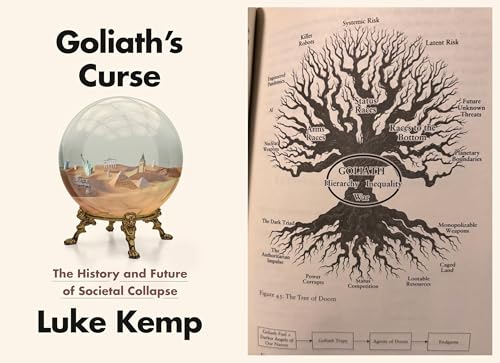
  • Goliath's Curse (and the Agents of Doom!)
    Jan 30 2026

    Using the Stone of Democracy to Slay the Goliath of Inequality

    Goliath's Curse: The History and Future of Societal Collapse

    By: Luke Kemp
    Published: 2025
    592 Pages


    Briefly, what is this book about?

    By most accounts, civilization, which is to say the large Hobbesian state, is a good thing. Kemp doesn't necessarily agree. In his account, states are lumbering, tyrannical, extractive Goliaths, cursed to grow bigger, more oppressive and more brittle until they are eventually brought down by a "stone" that hits in just the right place.

    Civilization forms out of dominance hierarchies, and these hierarchies generally only move in one direction, towards greater inequality, greater extraction, and more self-interested decisions. This leads to ever increasing fragility and eventual collapse. Collapse might actually be a better place for the masses of people, though it's often quite bloody to get there.

    Though if that's how it played out in the past, Kemp doesn't think it will necessarily play out that way going forward. If (when?) civilization collapses this time, it will be far more apocalyptic.

    What authorial biases should I be aware of?

    Kemp is associated with the Centre for the Study of Existential Risk at Cambridge. I was recommended this book by the sagacious Florian U. Jehn of the excellent Existential Crunch blog. Jehn knows his stuff which gives me the confidence to safely locate Kemp as an important scholar in the genre of collapse research, with an interesting, albeit populist/anti-elite take on the subject.

    Who should read this book?

    Kemp draws heavily on the ideas of James C. Scott (Seeing Like a State and Against the Grain) and writes in opposition to the ideas of Steven Pinker (in particular The Better Angels of Our Nature). If you find yourself similarly situated, you'll enjoy this book.

    It's also a great book for anyone who can't get enough discussion of existential risk. And really given the stakes we should be considering as many viewpoints as possible.

    What does the book have to say about the future?

    As you might imagine, Kemp's vision of the future is pretty bleak. He is not a techno-optimist, rather he sees in technology the emergence of a new Goliath, a new arena of dominance and extraction. He has a certain amount of hope, but it all revolves around using democracy to disrupt the ratcheting up of inequality and elite power, which seems like a tall order.

    Specific thoughts: Past, present, and future collapse

    Show More Show Less
    20 mins
  • Knowing Our Limits - Epistemology Without Bayes
    Jan 28 2026

    I was promised useful stories to assist me in a quest for justified belief. Instead I got a lesson in the limits of expertise. Unfortunately it was the author's expertise that was limited.

    Knowing Our Limits

    By: Nathan Ballantyne
    Published: 2019
    344 Pages


    Briefly, what is this book about?

    Regulative epistemology as opposed to descriptive epistemology. Put more simply, this is about how to find truth, as opposed to how to define truth. Though because the author recommends having very high standards, you may come away from the book thinking that there is no truth. That is not Ballantyne's intent, but most of his guidance revolves around less confidence rather than more confidence.

    There is some good stuff about tolerance, and the utility of doubt. And while I take issue with some of what he says on the subject of expertise, he covers the subject exhaustively and thought-provokingly.

    What authorial biases should I be aware of?

    Ballantyne isn't just interested in epistemology. He doesn't dabble in it. He is epistemology, or rather an epistemologist. Accordingly, even though it's apparent that he's trying really, really hard to not make the book overly academic, it's still pretty academic. For example:

    If an undefeated defeater for believing p were included in the evidence I don't have, then I (probably) would have heard of it by now. But I have not heard of it and the "silence" gives me reason to think that the unpossessed defeater is probably defeated.

    He's a big fan of the word defeater, and various constructions involving the word. In the course of a few pages he uses the term "defeater-defeater" seventeen times.

    Who should read this book?

    Epistemological collapse is the major crisis of our time, so on some level it's probably useful to read everything you can get your hands on. (Which was my big reason for reading it.) But, as much as I crap on Yudkowsky's Rationality: From AI to Zombies I'd probably read his chapters on Bayes' Theorem before reading this.

    I heard about the book on Jesse Singal's substack. He was much more bullish on it. So you might read that if you're interested or on the fence.

    Specific thoughts: Lots of epistemic tools, Ballantyne really only covers one

    Show More Show Less
    10 mins
  • A YA Series, a First Contact Novel, and a Startup Book Walk Into a Bar—Pursued by Wolves
    Jan 17 2026
    1. The Westmark Trilogy by: Lloyd Alexander

    2. RoadKill by: Dennis E. Taylor

    3. Slicing Pie Handbook: Perfectly Fair Equity Splits for Bootstrapped Startups by: Mike Moyer

    4. Fables for Young Wolves by: Thomas O. Bethlehem

    Show More Show Less
    12 mins