Episodes

  • Mick Liubinskas: Give people something they can say yes to
    Jul 7 2026

    In 2017, Mick Liubinskas got one line from an old basketball mate: "maybe it's time you got in the game." He'd just moved to the US, read the IPCC reports for the first time, and had three kids under seven. But he couldn't unsee it, so he got in the game.

    Nine years on, Mick leads Climate Salad - a community of 800 Australian climate tech founders and operators that he deliberately chose to keep lean when it could have grown. He knows the funding volatility, the long hardware timelines, the challenge of selling Australian innovation to Australians who'd sooner trust the same thing from a US startup. But when three founders in the same week told him their sales cycles were getting shorter, he almost cried.

    What this conversation gets into is the tension in climate tech right now: how do you hold genuine conviction about an existential problem while speaking a language that CFOs, customers and markets can actually act on? And what happens when you finally make peace with what kind of builder you actually are instead of the one you assumed you were supposed to be?

    Kate sits down with Mick to talk about why he walked away from a tech career to work on climate, what he learned from building and deliberately shrinking a community, the one leading indicator that tells him the tide is turning, and what he changed his mind about.

    Show More Show Less
    1 hr and 7 mins
  • Phoebe Pincus: You never forget your first yes.
    Jun 30 2026

    Most of us remember what it's like to want to be in a room we're not allowed into.

    For Phoebe Pincus, that room was startups. Before she became CEO of Startmate, she was writing heartfelt cover letters to startups who never wrote back, wanting in with no warm intro and no way through the door. And so when someone said yes, she never forgot what that felt like and it's shaped everything she's built since.

    Today Phoebe leads Startmate, the community-driven seed fund that has touched over 10,000 founders, operators and investors across the ANZ ecosystem. She's also the co-founder of Cheeky Run Club, an amateur running podcast that hit a million downloads in two years by doing one thing: making people feel like they belonged as runners.

    In this episode, she talks about what it actually takes to build a community people genuinely belong to, not just show up to. What she looks for in the founders most likely to succeed and the trap that even the best fall into. Why making it easier to build products is quietly creating a generation of founders who've stopped talking to customers. And why everything that looks like a threat to the startup ecosystem - hacker houses, closing accelerators, VCs going earlier - looks to Phoebe like good news.

    In a world drowning in bad news, Phoebe looks at the same facts as everyone else and chooses to see opportunity. We love it.

    Show More Show Less
    1 hr and 4 mins
  • Nick Rudder: Tax. But not as you know it.
    Jun 23 2026

    When Nick Rudder's co-founder left and went back to Australia, Nick was alone in the US. His wife was pregnant with twins. Their health insurance wouldn't cover the pregnancy. He had almost no budget and no product. He could have gone home. He didn't.

    Sphere - now backed by a16z - builds international tax compliance for the fastest-growing software companies in the world. Most of their customers have never had a compliance platform before. They're moving too fast to have built one, which means Nick isn't up against a competitor. He's becoming the function they don't yet have.

    How you get from "everything is on fire" to "a16z writes the check" is the episode. The 60 discovery calls before a line of code. The Figma prototype he sold until a customer told him to grow up. The AI he built to reason over trade law while the old guard said it couldn't be done.

    Kate sits down with Nick to talk about what it takes to rebuild from nothing and what the fastest corner of the market actually demands right now.

    Show More Show Less
    1 hr and 9 mins
  • Didier Elzinga: What survives AI
    Jun 16 2026

    There are people who think about culture. And then there's Didier Elzinga.

    Fifteen years running CultureAmp. 7,000 organisations. A front-row seat to how culture forms and fractures - the writedowns, the departures, the hard conversations that don't make it into announcements. During this episode, Didier draws on Buddhist philosophy, Buckminster Fuller, spiral dynamics, Brené Brown and more. Not as decorations but as working tools for a CEO who has spent two decades in the room when things go wrong and when they go right. He knows the difference between organisations that are succeeding and ones that are performing success.

    That's the vantage point he brings to AI. Not the model specs or the market positioning. The human question: what happens to culture, identity, and the way we work together when the tools change this fast? Who holds the values of an organisation when part of its team isn't human? And does context - the real context, the stuff that lives in a company's bones - survive the remaking?

    He also has a question he's been considering that has nothing to do with AI. The one every founder eventually faces, usually alone. When your identity and your company have been the same thing for twenty years - who are you when that changes?

    Kate sits down with Didier to go there. On culture, on AI, on what a leader owes the people who follow them. And on what, exactly, is worth protecting.

    Show More Show Less
    1 hr and 7 mins
  • Katelyn Lesse and Angela Jiang: Not the Anthropic you're expecting
    Jun 9 2026

    If you're here for commentary on the Pope, Trump, or the geopolitics of frontier AI - this isn't that episode. If you're here for the unfiltered view from the people actually building Claude - stay.

    This one is for the builders, the tinkerers, and the curious. Two of the people behind Claude - not here for governments, the press, or the Vatican. Instead, here to zero in on what they're seeing, and how you can get more from AI, however you're using it.

    Katelyn Lesse runs engineering for Anthropic's Claude Developer Platform. Angela Jiang runs product. They're the people closest to what builders are actually doing with the technology and are exactly the kind of spark people they'll tell you every team needs.

    What they're seeing: teams that transform overnight because one person in them is genuinely obsessed. Founders who move with the model instead of against it. A shift from "content is king" to "context is king" that most people haven't caught up to yet. And a clean slate advantage - available to anyone willing to look at an old problem as if it's never been solved before.

    Show More Show Less
    1 hr and 3 mins
  • Charlie Gearside: What to do with $1.6 billion
    Jun 2 2026

    Earlier this year, Eucalyptus sold for $1.6 billion - one of the biggest exits in Australian startup history. Charlie Gearside co-founded it.

    A year on, he's spending his time on YouTube and on Build Australia, the nonpartisan movement he launched last month to make space for a more ambitious version of this country. He talks publicly about property investing, the universities, and a culture that calls earnest people try-hards. None of it is comfortable, and none of it is what most people do after an exit.

    He's also the first to admit that none of this pays off quickly. The work is to shift what Australians think is acceptable to want. A project that’s measured in decades, not quarters.

    Kate sits down with Charlie to talk about untangling your identity from a company you built. The brutal question he had to ask himself before leaving Eucalyptus. Why he won't go into politics. Why he thinks the most risky thing right now might be doing nothing. And the one topic he's still too nervous to make a video about.

    Show More Show Less
    1 hr and 4 mins
  • Mason Yates What gives you the most energy?
    May 26 2026

    After 77 episodes and eight years at Blackbird, Mason Yates is signing off as host of Wild Hearts. This is his final episode - just eight minutes, no fanfare and true to how he hosted: generous with the floor, light on his own voice.

    Mason started Wild Hearts in 2020. Lockdown. Sourdough. Tiger King. Across the six seasons since, Mason has sat down with founders building mind control for cows, sending toaster-sized satellites into orbit, and chasing a million-qubit quantum computer. Holding the mic through the 2021 supernova, the 2022 correction, the survivor years, and the deep tech wave defining this moment.

    There's one question he's asked nearly every founder along the way: what gives you the most energy? In this episode he walks back through the answers that have stayed with him - Melanie Perkins, Tim Doyle, Tom Kelly, Flavia Tata Nardini - and shares three lessons from 77 episodes on the craft of interviewing.

    And then he hands the show over to Kate Glazebrook.

    If you've been listening since 2020, this one's a love letter to the archive you helped build. If you're new, it's the perfect doorway in.

    Thank you, Mason. From all of us.

    Show More Show Less
    8 mins
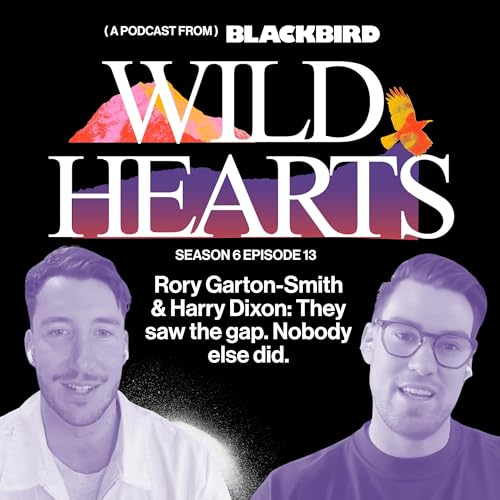
  • Rory Garton-Smith & Harry Dixon: They saw the gap. Nobody else did.
    May 19 2026

    When Apple's iOS privacy changes hit, most people saw a headache. Rory Garton-Smith and Harry Dixon saw something else: millions of brands suddenly unable to reach customers, and no good solution in sight. So they built one.

    Checkmate connects consumers with personalised offers at the exact moment of intent, replacing spray-and-pray marketing with something precise enough that household brands are now paying attention. Eight-figure ARR. 260 million users. Revenue up 6,000% in six months.

    But the more interesting thing is what they've learned along the way. Because when you sit inside the shopping journeys of hundreds of millions of people, patterns emerge. Shopping windows. Platform preferences. How intent signals behave. What converts and what doesn't - and exactly why. That data is now the foundation of an AI marketing platform that goes well beyond savings.

    In this conversation with Mason Yates, Rory and Harry talk about how they found the gap, how they solved the chicken-and-egg problem between brands and consumers, and where the intelligence they've built is taking them next.

    Show More Show Less
    55 mins