

Season's Savings | ₹5/mo for 3 months
₹199/month after first 3 months. Renews automatically. Terms apply.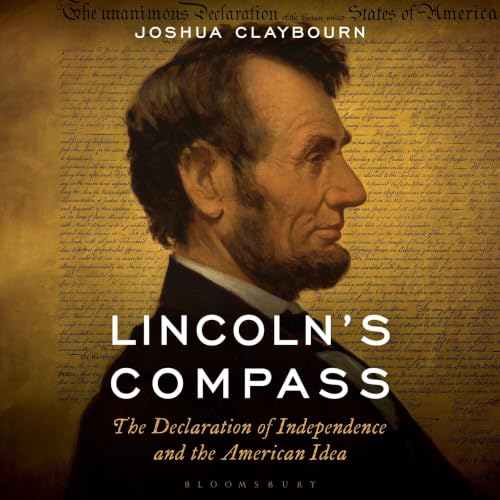
Lincoln's Compass
The Declaration of Independence and the American Idea
Failed to add items
Sorry, we are unable to add the item because your shopping basket is already at capacity.
Add to cart failed.
Please try again later
Add to wishlist failed.
Please try again later
Remove from wishlist failed.
Please try again later
Follow podcast failed
Unfollow podcast failed
₹0.00 for first 30 days
Season's Savings
₹5/month for first 3 months
Offer ends on 28 December, 2026.

Only ₹5/month for first 3 months.
Get 1 credit per month to use on any title of your choice.
Listen to anything from the Plus Catalogue—thousands of audiobooks, podcasts, and Audible Originals.
₹199/month after first 3 months. Cancel anytime. Renews automatically. Offer ends 28 December, 2026.
1 credit a month to use on any title to download and keep
Listen to anything from the Plus Catalogue—thousands of Audible Originals, podcasts and audiobooks
Download titles to your library and listen offline
₹199.00 per month after 30-day trial. Cancel anytime.

Lincoln's Compass
Narrated by:
Kenneth Medford
Buy Now for ₹497.01
-
Narrated by:
-
Kenneth Medford
-
Written by:
-
Joshua Claybourn
About this listen
Through speeches, debates, and wartime leadership, Lincoln invoked the Declaration of Independence to end slavery, heal a fractured Union, and redefine the nation’s purpose.
As we mark the 250th anniversary of the Declaration's immortal words, Joshua Claybourn reflects on their enduring power through the eyes of one of its greatest leaders. Drawing on Enlightenment philosophy, Judeo-Christian ethics, and the lived political culture of both the Revolutionary era and the antebellum frontier Claybourn traces how Lincoln came to view the Declaration’s assertion that “all men are created equal” as a timeless moral truth—what he called his “ancient faith.”
Through vivid storytelling and close readings of Lincoln’s most important speeches—from the Lyceum Address to the Peoria Speech—Claybourn reveals how Lincoln used the Declaration to confront the moral crisis of slavery and to redefine the meaning of American freedom. Rediscover the Declaration not as parchment under glass, but as a living challenge—a golden ideal still waiting to be fully realized. This book is a must-read for anyone who believes America’s founding ideals still matter—and must be reclaimed.©2026 Joshua Claybourn (P)2026 Bloomsbury Publishing PLC
adbl_web_anon_alc_button_suppression_t1
Critic Reviews
A lawyer and scholar from Indiana, Joshua Claybourn deeply understands Lincoln’s rural roots, legal mode of thinking, and moral clarity. With a vivid clarity, Claybourn illuminates the key to Lincoln’s thought: the equal human rights promised by the Declaration of Independence as the foundation of our nation. We could have a more just and enduring republic, if all Americans would read and reflect on Lincoln’s Compass.
A superb explanation of how Lincoln turned America into a creedal nation.
Lincoln was that rare species – a politician with a profound moral compass. Joshua Claybourn’s investigation takes us on a journey to find the sources and principles of that compass, and does so in an eloquent and highly personable fashion. We can all profit from reading the words of Lincoln; we can profit still more from understanding the moral roots of those words, and Claybourn’s Lincoln is the clearest set of guideposts on that journey.
In this sweeping, brilliant book, Joshua Claybourn reveals how the Declaration’s pronouncement of human equality was transformed by Lincoln into the lodestar for civil rights advocacy, from his own presidency to modern times. Lincoln’s Compass is an inspiring, essential contribution to our understanding of the American experiment.
One of the best ways to think about the Declaration of Independence is to watch Abraham Lincoln think about it -- and Joshua Claybourn has given us an unprecedented front-row seat. In this timely and lively book, Claybourn reveals how deeply Lincoln studied the Declaration (and how much our current understanding of this document depends on Lincoln's lawyerly work). Lincoln's Compass does not trace the president's full life. It does something better by zooming in on key moments, on how the sunlight feels in southern Indiana, on how Enlightenment ideas should matter to every American. This book shows why Lincoln, a writer so good at describing the metaphorical beauty of history -- its better angels, its mystic chords -- in the end relied most on a simple declarative phrase: All men are created equal.
No reviews yet