Season's Savings | ₹5/mo for 3 months

₹199/month after first 3 months. Renews automatically. Terms apply.
AI Accelerator Podcast cover art

AI Accelerator Podcast

AI Accelerator Podcast

Written by: Matt Zembruski
Listen for free

About this listen

The AI Accelerator Podcast is for business leaders, executives, entrepreneurs, and innovators who want to move beyond AI theory and into real-world results.


Hosted by Matt Zembruski, each episode features candid conversations with industry experts, technology leaders, founders, and AI practitioners who are transforming organizations through artificial intelligence.


From enterprise AI strategy and automation to leadership, innovation, and emerging technologies, we explore what works, what doesn't, and what leaders need to know to stay ahead.


If you're looking to turn AI into a competitive advantage, drive meaningful business outcomes, and prepare your organization for the future, this podcast is your roadmap.


New episodes every week.

© 2026 AI Accelerator Podcast
Economics Leadership Management & Leadership
Episodes
  • AI and Fractional Leadership: How Businesses Can Scale Smarter | Jessica Lee
    Nov 17 2026

    What happens when AI and fractional leadership work together? In this episode of the AI Accelerator Podcast, Matt Zembruski speaks with Jessica Lee, Founder and CEO of OptimizedExecs, about how businesses can combine experienced fractional leadership with AI to improve efficiency, strengthen operations, and scale with confidence.

    With nearly 20 years of experience across startups and global enterprises, Jessica shares why founders often become the bottleneck to growth, how fractional COOs help turn vision into execution, and why successful AI adoption requires a clear strategy, strong processes, and human oversight.

    In This Episode, Jessica Lee Discusses
    • What fractional leadership means and how a fractional COO supports growing businesses.
    • Why AI and fractional leadership complement each other.
    • How founders can step away from day-to-day bottlenecks and focus on strategic growth.
    • Common AI adoption mistakes, including tool-hopping and unstructured experimentation.
    • Why AI initiatives should align with business goals, people, and processes.
    • How EOS, OKRs, and KPIs can support stronger business execution.
    • Using data and performance dashboards to make better decisions.
    • Rethinking leadership roles and organizational structures as businesses grow.
    Chapters
    • 00:00 – Why AI Still Needs Human Oversight
    • 00:57 – Introducing Jessica Lee and OptimizedExecs
    • 02:05 – What a Fractional COO Does
    • 04:07 – Why Fractional Leadership Is Growing
    • 06:36 – How Fractional Leadership Scales With a Business
    • 07:59 – How AI Makes Fractional Leadership More Effective
    • 11:09 – Recognizing When a Founder Has Become the Bottleneck
    • 12:57 – Turning a CEO’s Vision Into an Operating Plan
    • 15:15 – What's Working and What's Not in AI Adoption
    • 17:17 – Building a Strategic Approach to AI and Governance
    • 19:31 – Combining EOS, OKRs, and KPIs
    • 21:18 – Leadership Advice for Growing Businesses
    • 24:00 – Rethinking Organizational Roles and Responsibilities
    • 24:35 – How to Connect With Jessica
    Key Learnings
    • AI works best with human guidance: Experienced leaders provide the judgment and oversight needed to make AI useful.
    • Start with the problem, not the technology: Identify business needs before choosing tools or solutions.
    • Founders need room to lead: Delegating operational decisions gives business owners more time to focus on vision and growth.
    • Adoption needs structure: Clear governance, training, and approved tools help prevent duplicated work and scattered efforts.
    • Measure what matters: Use meaningful business metrics and regular reviews to understand performance.
    • Rethink roles as you grow: Leadership transitions are opportunities to assess what the business needs next, rather than simply replacing people like for like.
    💬 Jessica Lee’s Key Insights
    • “You need a human on the front end and the back end when you're using AI.”
    • “I intentionally like to stay problem-focused and solution-agnostic.”
    • “The founder is the bottleneck.”
    • “We need to have some internal governance.”
    • “We have to be willing to stop and pause and consider it as an option.”
    About Jessica Lee

    Jessica Lee is the Founder and CEO of OptimizedExecs, a fractional leadership firm helping founder-led businesses scale through stronger leadership, operational clarity, and disciplined execution. With nearly 20 years of experience, she helps organizations build scalable systems, strengthen accountability, and turn strategy into measurable results.

    Follow Jessica Lee
    • Website: https://www.optimizedexecs.com
    • LinkedIn: https://www.linkedin.com/in/jlee-il/
    Follow Matt Zembruski
    • Website: https://leadingaiagility.com
    • LinkedIn: https://www.linkedin.com/in/mattzembruski/
    • Email: matt@leadingaiagility.com
    • Phone / Text / WhatsApp: +1 978-618-5778
    Show More Show Less
    25 mins
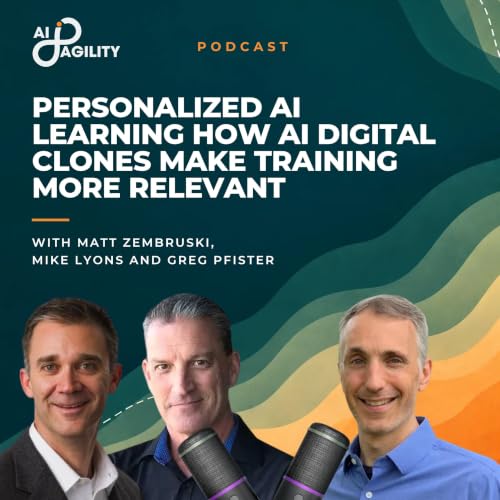
  • Personalized AI Learning: How AI Digital Clones Make Training More Relevant | Mike Lyons & Greg Pfister
    Nov 10 2026
    What if corporate training could move beyond generic videos, static quizzes, and one-size-fits-all content to deliver personalized coaching whenever a learner needs it? In this episode of the AI Accelerator Podcast, Matt Zembruski welcomes Mike Lyons, Founder and CPO, and Greg Pfister, Co-Founder of KaiRise, to explore how AI is changing learning and development. Mike and Greg share how they moved KaiRise from a self-paced agile training company into an AI-powered learning and development platform. They explain how they developed Ask Mike, Mike’s AI digital clone, and expanded the concept into Ask Me, a platform that allows trainers, consultants, instructors, and subject matter experts to create personalized AI experiences using their own knowledge and content. The conversation explores why the future of enterprise AI is not simply about adding chatbots. It is about delivering the right knowledge, feedback, and coaching in the context of each person's role, experience, and learning goals. In This Episode, Mike Lyons and Greg Pfister Discuss: How AI is transforming corporate training and learning and development.Why traditional online training often fails to keep learners engaged or help knowledge stick.The importance of connecting agile practices and professional roles to measurable business outcomes.How the pace and cost of change are accelerating with AI.Why organizations will increasingly need to manage teams that combine people and AI agents.The difference between using AI as a general search engine and applying it to specific business and learning contexts.How KaiRise developed Ask Mike to provide immediate, personalized feedback to learners.How Ask Me enables experts to create AI-powered digital clones using their own knowledge, content, and teaching style.How learner profiles and individual goals make AI coaching more relevant to real-world responsibilities.How personalized AI learning can support corporate L&D teams, independent instructors, consultants, and higher education.Why creating more training content is not enough if learners cannot retain or apply what they learn. Chapters 00:00 – The Problem with Traditional Corporate Training 01:02 – Introducing Mike Lyons, Greg Pfister, and KaiRise 02:01 – KaiRise’s Evolution into AI-Powered Learning and Development 04:20 – How Agile and Online Training Have Changed 05:03 – Measuring Value Through Business Outcomes 06:43 – AI, the Changing Pace of Work, and Managing Agents 08:36 – How KaiRise Supports AI-Powered Learning 10:08 – The Growing Gap in AI Adoption 11:26 – Moving Beyond Prompts to AI Embedded in Everyday Work 12:18 – Why People Want to Use AI Agents, Not Necessarily Build Them 13:47 – The Future of an Agent Marketplace 14:17 – Natural Language as the New Way to Work with Technology 15:44 – Why AI Must Understand What People Actually Need 16:14 – The Origin Story Behind Ask Mike and Ask Me 16:41 – Building Ask Mike: Personalized Feedback for Learners 18:01 – Using RAG to Ground AI in Specific Knowledge 19:00 – Bringing Contextual AI Interactions into the Learning Experience 20:01 – Expanding Ask Mike into the Ask Me Platform 21:49 – Why Better Learning Matters More Than More Content 22:19 – Personalized Learning Based on Individual Roles and Goals 24:38 – Creating Digital Coaches with Distinct Personalities 25:17 – Turning Learning Feedback into Practical Next Steps 26:02 – Who Benefits Most from Ask Me? 27:36 – Supporting Trainers, Consultants, and Higher Education 28:36 – Extending Expertise Beyond the Classroom 29:43 – How to Explore KaiRise and Its AI Tools 30:41 – Special Offer for AI Accelerator Podcast Listeners Key Learnings Personalization makes learning more useful. Training becomes more relevant when AI can connect course material to a learner’s role, experience, responsibilities, and goals.Feedback is essential to learning. Static quizzes and generic responses cannot provide the same level of coaching as context-aware interactions that explain what a learner did and how to improve.More content does not automatically mean more learning. Organizations need to focus on retention, understanding, and practical application rather than simply producing more videos and courses.AI needs the right knowledge base. Grounding responses in an organization's own content helps make feedback more specific and aligned with its learning objectives.AI can extend human expertise. Digital clones allow instructors, consultants, and subject matter experts to make their knowledge accessible beyond scheduled sessions.The cost of change is falling. As AI tools become more accessible, professionals and organizations need to adapt how they manage products, projects, teams, and workflows.Business value remains the priority. Agile practices and AI initiatives should ultimately contribute to outcomes such as revenue growth, cost reduction, and better performance. About Mike Lyons, Greg Pfister & ...
    Show More Show Less
    32 mins
  • AI Adoption Without Fear: Psychological Safety, Cloud Lessons, and Real Results in Healthcare | Jessica Kalinowski | AI Accelerator Podcast
    Nov 3 2026
    What does successful AI adoption actually look like inside an organization? For technology leader Jessica Kalinowski, the answer starts with people, not tools. With more than 15 years of experience leading engineering, DevOps, site reliability, and cloud transformations across e-commerce, financial services, and healthcare, Jessica shares how her teams have used automation and AI to improve reliability, accelerate delivery, and reduce operational friction. In this episode of the AI Accelerator Podcast, Jessica explains why organizations should approach AI adoption much like cloud transformation: with a clear strategy, appropriate guardrails, measurable outcomes, and a willingness to learn. She discusses how psychological safety helps teams embrace new technology, why mandating AI usage can backfire, and how involving engineers in decisions creates stronger adoption. Jessica also shares a practical healthcare example: rebuilding clinician onboarding in-house, consolidating fragmented systems, and using AI to help reduce onboarding time from approximately 30 days to as little as 24 hours in some cases. If you're a business leader looking to move beyond AI experimentation and achieve meaningful results, this conversation offers practical lessons on building trust, empowering teams, and making technology serve real business needs. In This Episode, Jessica Kalinowski Discusses How her career evolved from quality assurance and test automation to cloud, DevOps, site reliability engineering, and AI.Why automation should focus on removing work that does not create value.How her organization increased deployment frequency from once or twice a month to more than 120 times a month.Why psychological safety and transparency are essential for successful AI adoption.How to introduce AI tools through pilots, feedback, and practical use cases instead of mandates.Why AI usage statistics, such as the number of agents created, are not meaningful measures of business productivity.How AI-assisted document reviews can reduce repetitive operational work.How the team rebuilt clinician onboarding and reduced the process from approximately 30 days to as little as 24 hours in some cases.What cloud transformation can teach organizations about AI governance, security, and adoption.Why teams need measurable outcomes, appropriate guardrails, and a clear strategy before scaling AI. Chapters 00:00 – Introduction to Jessica Kalinowski 01:38 – From Quality Assurance to AI and Engineering Leadership 02:42 – Building a Culture of Automation and Reliability 04:47 – How the Team Increased Delivery Speed and Reliability 05:12 – Creating Shared Ownership of Security and Reliability 06:30 – Applying AI Beyond Engineering 07:16 – Psychological Safety and Incremental AI Adoption 08:44 – Transparency, Team Feedback, and AI Guardrails 09:58 – What AI Adoption Can Learn From Cloud Transformation 10:36 – Introducing AI Safely in a Healthcare Environment 11:20 – Starting With Practical Tools and Human Oversight 12:16 – Why Mandating AI Usage Can Backfire 13:30 – Rethinking AI Productivity Metrics 15:02 – Measuring Business Outcomes Instead of AI Activity 16:30 – Leadership, Trust, and Retaining Engineering Talent 17:55 – Building a Better Clinician Onboarding Experience 19:00 – Reducing Operational Complexity and Vendor Sprawl 20:00 – Using AI to Improve Onboarding Workflows 21:53 – Building and Launching an In-House Platform 23:26 – Moving Beyond One-Size-Fits-All Enterprise Tools 24:45 – Building, Iterating, and Owning Your Technology 27:46 – Testing and Rolling Out Changes in Stages 29:36 – Practical Advice for Business Leaders 30:25 – Creating an AI Strategy With Measurable Outcomes 31:24 – Final Thoughts on AI Adoption and Engineering Leadership Key Learnings Successful AI adoption starts with people. Technology alone does not create transformation. Teams need transparency, opportunities to provide feedback, and confidence that AI is being introduced to improve their work rather than simply monitor or replace them. Learn from cloud transformation. Organizations that moved to the cloud without planning for architecture, performance, cost, and operational change encountered challenges. AI adoption also requires preparation, governance, and a realistic understanding of how new tools affect existing workflows. Introduce AI incrementally. Start with practical use cases, pilot programs, and tools that solve recognizable problems. Let employees evaluate the results and help shape adoption before expanding across the organization. Measure outcomes, not AI activity. The number of AI agents created or how frequently employees use a tool does not necessarily indicate productivity. Track meaningful measures such as delivery speed, reliability, quality, cost, and the amount of work completed. Give teams a voice in the transformation. Engineers are more likely to embrace AI when they are involved in decisions, ...
    Show More Show Less
    32 mins
adbl_web_anon_alc_button_suppression_t1
No reviews yet