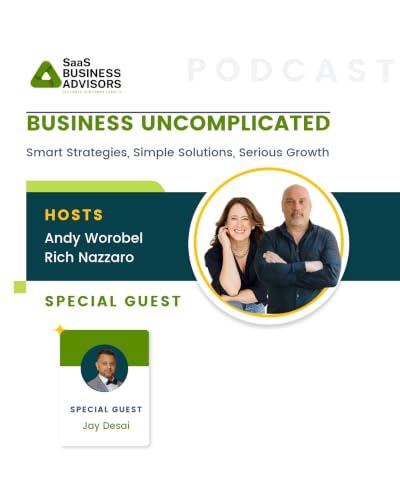
• Why AI Pilots Don't Scale (and What CIOs Must Do Now) with Jay Desai, Salesforce
    Nov 5 2026

    Everyone has an AI pilot. Almost nobody has AI at scale.

    Jay Desai of Salesforce is back on Business Uncomplicated, our first return guest. A year ago we were asking what AI even is. Now Jay leads technology for Salesforce's private equity and startup practice, and the questions have changed: does it make a measurable difference, what does it actually cost, and can the people keep up?

    Rich Nazzaro and Andy Worobel dig into tokenomics (yes, someone said $500K per engineer), why the CIO's job is shifting to guardrails and force multipliers, rapid innovation squads that pair two engineers with one business person, and why change management is always the last slide and the first cut. Jay explains small language models, multi-surface work across Claude, Slack and Salesforce, and AI tools that clear years of tech debt in weeks. Rich shares how a client vibe coded an entire new product and launched it in 90 days.

    In this episode:

    • Why AI pilots stall before they scale
    • Tokenomics: AI unit costs and real ROI
    • The CIO's new job: governance, guardrails and force multipliers
    • Rapid innovation squads and getting rid of the middle people
    • Change management, picking the right problem, and when AI is overkill
    • Small language models vs. large language models
    • Job displacement, humans in the loop, and training your people
    Chapters
    • (00:00:02) - Welcome back and musings on AI's rapid pace
    • (00:02:03) - From determinism to tokenomics and ROI
    • (00:03:40) - Jay's new role leading PE and startup tech practice
    • (00:09:04) - Democratization of IT and rise of frontier squads
    • (00:11:43) - Governance, guardrails, and the evolving CIO role
    • (00:14:58) - How Salesforce's tech stack is evolving with AI
    • (00:17:50) - Multi-surface UX and the Minority Report analogy
    • (00:19:35) - Change management and bringing teams along at different paces
    • (00:21:32) - Redesigning business processes versus bolting on AI
    • (00:24:41) - Picking the right problem for AI investment
    • (00:28:25) - Speed, microflows, and compressed decision-making
    • (00:30:27) - Decision overload and designing for human capacity
    • (00:34:00) - Human thought, job displacement, and AI's labor debate
    • (00:36:24) - Data limits, human-in-the-loop, and job displacement reality
    • (00:40:17) - Mid-market democratization and small business growth
    • (00:41:08) - Small language models vs large models and platform choice
    • (00:45:58) - Experimentation, benchmarking, and CIO decision-making at speed
    • (00:48:21) - Tackling tech debt with AI tools
    • (00:51:13) - Coopetition between models and defining the real problem
    • (00:58:09) - Vibe Fest case study: building a new product in 90 days
    • (01:02:37) - Breaking down silos and solving last-mile problems
    • (01:05:00) - Rich's rental car customer service nightmare story
    • (01:09:13) - Closing thoughts and investing in people alongside AI
    Show More Show Less
    1 hr and 12 mins
  • Nobody Draws the Roots: The Hidden Side of Every Transformation
    Oct 22 2026

    Why do most digital and AI transformations fail, even with the right technology?

    On this episode of Business Uncomplicated, Rich Nazzaro and Andy Worobel talk with Matt Evans, co-founder of Treeline Transformation. Matt spent 12 years at Salesforce helping its top 200 customers succeed without ever pitching a product. His main point: AI isn’t creating new problems. It’s exposing the ones companies have ignored for years.

    Matt runs a “draw a tree” exercise with executives, and almost no one draws the roots. Most transformations work the same way. Leaders change what they can see (strategy, tools, org structure, process) and ignore the roots: the culture, unwritten rules and behaviors that decide whether change sticks. Your organization is perfectly set up to get the results you’re getting now. To get different results from AI, you have to reorganize how work actually gets done.

    The conversation also covers how to move fast on AI without breaking what already works. Instead of 18-month overhauls, Matt makes the case for small experiments, embedded business and technology teams, and funding customer experiences instead of projects. That’s how you build lasting change while the roadmap keeps moving.

    In this episode:

    • Why AI is exposing old problems instead of creating new ones
    • Above-ground vs. below-ground strategy: structure and culture
    • Accountability = alignment + autonomy (and the pharma client with seven definitions of one transformation)
    • The CRO who asked three anti-agile questions, and the mindset shift that followed
    • How a telco cut proposal turnaround from three weeks to 24 hours in two months
    • “Insurgents with influence” and leadership debt
    • Funding experiences, not projects
    • Who should own AI: whoever owns the customer experience, not IT or HR
    • Matt’s hot take: is it time to get rid of the IT department?

    If you’re a CIO, CRO, RevOps or transformation leader trying to get real value from AI, this one’s for you.

    Connect with Matt Evans and Treeline Transformation:
    LinkedIn: https://www.linkedin.com/in/mdevans/
    Website: https://www.treelinetransformation.com/

    Chapters
    • (00:00:02) - Welcome and Introductions
    • (00:00:34) - Matt's Salesforce Background and the Famous Tagline Story
    • (00:03:17) - Founding Treeline Transformation
    • (00:06:23) - Common Problems: Business vs IT Friction
    • (00:08:25) - The Tree Analogy: Above Ground vs Roots
    • (00:12:55) - Accountability, Alignment, and Autonomy
    • (00:16:47) - Common Language and Alignment Breakdowns
    • (00:18:14) - Sabotage Exercise and Trust in Organizations
    • (00:19:54) - Who Brings Treeline In: Insurgents with Influence
    • (00:22:42) - Leadership Debt and Mindset Shifts
    • (00:24:07) - The Agile Transformation Story with the CRO
    • (00:27:03) - ROI vs Customer Experience as the Real Driver
    • (00:30:44) - Spectrum of Human Influence and Direct Experience
    • (00:33:49) - AI Governance, Speed, and Organizational Behavior
    • (00:39:03) - Provocative Idea: Getting Rid of the IT Department
    • (00:41:11) - Redefining CIOs and Redesigning Organizations
    • (00:44:55) - Has AI Changed the Methodology? Walks and Base Hits
    • (00:49:39) - Who Should Own AI and Customer Experience
    • (00:52:59) - Experience Ownership and Funding by Competitive Advantage
    • (00:57:14) - Closing Thoughts and How to Reach Treeline
    Show More Show Less
    1 hr and 1 min
  • Day 2 Operating Model: What Happens After Go-Live (And Why Transformations Fail)
    Oct 8 2026

    Everyone plans for go-live. Almost nobody plans for the day after.

    On this episode of Business Uncomplicated, Rich Nazzaro and Andy Worobel dig into Day Two: the day after go-live, when a digital transformation either starts paying off or quietly falls apart. Change management matters, but it isn't enough. Day Two is about building an operating model that changes how the business actually runs.

    Rich and Andy cover why process mapping should come before requirements, how to use UAT to test your operating plan (not just the system), and why "adoption" is the laziest metric in the world. Rich shares the Dell story where server deals were being "lost" to Apple, and why only 12% of organizations sustain transformation gains past three years (McKinsey). They also get into re-baselining the business case when scope gets cut, holding leaders accountable for results, bringing finance into the operating rhythm, and the one meeting every company should kill.

    If you're a CIO, CRO, RevOps or transformation leader running a Salesforce, CRM, CPQ or AI program, this one's for you.

    In this episode:

    • What "Day Two" means and why most programs ignore it
    • Why technology is just a business process in a system
    • Using UAT to test SOPs, dashboards and metrics
    • Leading vs. lagging indicators and why adoption isn't enough
    • Re-baselining your business case to protect ROI
    • Rapid fire: the meeting to kill, and whether rhythm or strategy fails first
    Chapters
    • (00:00:02) - Catching up and the pace of the year
    • (00:00:46) - Budget season and constant change
    • (00:02:39) - Introducing Day Two: the day after go live
    • (00:03:28) - Why change management alone isn't enough
    • (00:05:09) - Fragmented initiatives and missing process ownership
    • (00:06:27) - Process mapping and learning from Sapient-era discipline
    • (00:08:12) - Technology as a manifestation of business process
    • (00:09:03) - Client-centric process design and hidden variations
    • (00:10:30) - Planning for ownership before the project even starts
    • (00:12:02) - Measuring success beyond go-live and baseline data
    • (00:13:45) - Operationalizing work streams and overlooked dependencies
    • (00:15:29) - Consultants guide, clients decide
    • (00:16:38) - Using UAT to rehearse the future operating state
    • (00:19:58) - The Day Two to Day 60 problem
    • (00:21:37) - Building SOPs and leading vs lagging metrics
    • (00:24:39) - Adoption metrics and the real data behind behavior change
    • (00:27:11) - Quarterly reviews and real accountability
    • (00:34:20) - Why transformation gains fade after three years
    • (00:35:43) - Re-baselining business cases and confidence checks
    • (00:37:56) - AI, iterative design, and evolving systems
    • (00:42:03) - Finance partnership and bottom line vs top line thinking
    • (00:44:04) - Programs as part of a bigger continuum
    • (00:45:02) - Rapid fire: meetings, rhythm, and strategy
    • (00:51:10) - Closing thoughts on consultants and operationalizing change
    Show More Show Less
    54 mins
  • 90 Days: How Atlas Turned an AI Bet Into a Live Product
    Sep 24 2026

    Most companies try to bolt AI onto existing workflows like a software update. That is a recipe for failure.

    Chris Capriccio ("Cap"), CTO at Atlas, joins Rich Nazzaro and Andy Worobel to break down how his team built and launched AOR (Agent of Record) — a brand-new product line — in just 90 days, using Claude AI at the center of the build.

    Cap walks through the internal "VibeFest" — a Shark-Tank-style hackathon that got the whole leadership team competing to design the product — why Atlas chose Claude over ChatGPT and Gemini for legal research and coding, how AI spend is becoming its own line item next to Salesforce and Oracle, and why he believes IT is shifting from support function to the company's primary change agent. The conversation closes with Cap's unfiltered take on AI security, regulation, and where he actually gets his AI insights (hint: it's not a newsletter).

    If you're a CTO, CIO, or product leader trying to figure out how to move at AI speed without breaking your organization, this one's packed with tactical, real-world lessons. In this episode: How Atlas decided to build vs. buy vs. partner for a new product line Inside VibeFest: turning AI adoption into an 8-week internal competition Why Claude won the model bake-off for legal + technical work Treating AI tokens as a new cost-of-goods-sold line item Why the bottleneck in fast AI development has moved to sales and client success IT's new role as organizational change agent AI regulation, security, and what keeps a CTO up at night

    ️ Business Uncomplicated is hosted by Rich Nazzaro and Andy Worobel of SaaS Business Advisors, helping CIOs, CROs, and RevOps leaders cut through AI and GTM complexity.

    Chapters
    • (00:00:02) - Welcome and Guest Introduction
    • (00:00:43) - Chris's Background and Path to CTO
    • (00:03:24) - Introducing AOR: Agent of Record
    • (00:05:54) - Deciding to Build, Buy, or Partner with AI
    • (00:08:19) - Embracing AI as an Organization
    • (00:09:57) - Creating Vibe Fest and Company Buy-In
    • (00:11:56) - Vibe Fest Timeline and Rapid Launch
    • (00:13:55) - Shark Tank Competition and Team Energy
    • (00:16:22) - Change Management and Fast Decision Making
    • (00:18:31) - AI's Impact on Estimation and Bottlenecks
    • (00:20:00) - Cross-Team Empathy and Understanding Complexity
    • (00:23:05) - Navigating Partner and Technical Challenges
    • (00:25:12) - Prototyping Speed and Leadership Validation
    • (00:27:43) - Choosing Claude Over Other AI Models
    • (00:29:50) - AI Costs, Tokens, and Workforce Economics
    • (00:32:25) - Day Two Operations and Ongoing Iteration
    • (00:34:00) - Chaotic Development Cycles and Organizational Strain
    • (00:36:34) - IT as a Change Agent in the AI Era
    • (00:38:51) - AI Regulation, Security, and Data Protection
    • (00:41:31) - Rapid Fire: Excitement, Fears, and Info Sources
    • (00:45:35) - Closing Thoughts and Where to Find Chris
    Show More Show Less
    47 mins
  • Stop Doing This If You Want to Scale Your Business
    Sep 10 2026

    Every founder hits the same wall: the habits that got the business to $1M are the exact habits capping it at $1M.

    In this episode of Business Uncomplicated, hosts Rich Nazzaro and Andy Worobel sit down with Brooke Dukes — founder of Success by Design and author of Burn On Not Out — to unpack why so many SMB leaders burn out chasing growth instead of building toward it.

    Brooke spent 24+ years consulting for billion-dollar companies before walking away from corporate America to build her own path. She breaks down the founder's trap: how being the hub of every decision becomes the growth ceiling of your company, why self-care — not hustle — is the real success strategy, and the framework she uses to fix broken delegation: the difference between delegating a task and delegating authority.

    You'll also hear why reopening decisions you've already made is quietly costing SMBs thousands of dollars, how AI is already cutting payroll costs in half for lean teams, and the moment at the zoo that made Brooke rethink her entire definition of success and legacy.

    If you're a founder, CEO, or GTM leader who feels like the business has outgrown you, this one's the reset.

    Topics covered: founder burnout, the founder's trap, scaling past the $1M bottleneck, delegation architecture, the real cost of decision fatigue, self-care as a leadership strategy, AI for small business operations, and redefining success and legacy as an entrepreneur.

    Connect with Brooke:

    • Website: www.brookemdukes.com
    • Linkedin: https://www.linkedin.com/in/brookedukes/
    Chapters
    • (00:00:02) - Business Uncomplicated
    • (00:00:20) - Pushing the SMBs into the World
    • (00:02:39) - Top Executives on the Layoff
    • (00:05:57) - Burnout and How to Get Out of It
    • (00:13:54) - How to Get Out of the Founder's Trap
    • (00:16:48) - Decision Architecture: The Challenges
    • (00:20:56) - The 6 Basic Human Needs Framework
    • (00:28:32) - How to Coach Your Team Through the AI Revolution
    • (00:33:39) - How to Build the Trust Within Your Team
    • (00:39:22) - Why do you think people don't communicate?
    • (00:41:18) - What Advice Would You Give Yourself For Fun?
    • (00:45:44) - "He Complains About His Life"
    • (00:46:03) - What Do We Need to Teach to Keep People Engaged?
    • (00:48:17) - What's Your Company Doing?
    • (00:50:30) - A Day in the Life of Communications
    Show More Show Less
    53 mins
  • Unlocking Africa's Talent Pool: Remote Work, AI, and the Future of Global Outsourcing
    Aug 27 2026

    Gerard Holland, founder of Talent Match Africa, joins Business Uncomplicated to share his unconventional path from auditor to entrepreneur and explain why Africa's young, English-speaking, tech-savvy workforce is becoming the world's next great talent frontier. Gerard, Rich, and Andy dig into what makes African talent stand out, how AI is reshaping the outsourcing and consulting industries, why "AI-native" teams are outperforming traditional consultants, and what the explosive growth of Africa's population and infrastructure means for global business over the next decade.

    Connect with Gerard:

    • Linkedin: https://www.linkedin.com/in/gerardholland/
    • Website: https://talentmatchafrica.com/
    Chapters
    • (00:00:02) - Business Uncomplicated: Talent Wars
    • (00:00:38) - Your journey into the CFO role
    • (00:02:37) - The experience of university in Australia
    • (00:08:19) - The Secret to Connecting With People
    • (00:08:35) - TeTalent Match
    • (00:14:23) - What is the talent pool in Africa?
    • (00:18:01) - Employment Dynamics: The Need for AI in the Future
    • (00:20:54) - Outsource to Africa
    • (00:22:55) - How long do your average clients stay with you?
    • (00:26:36) - Outgoing consultants on the culture of the offshore team
    • (00:28:32) - AI and Competition for Your Resources
    • (00:31:20) - WSJD Live: The AI consulting challenge
    • (00:38:17) - What's The Future of Change Management?
    • (00:40:25) - Will IT Talent move to the continent?
    • (00:44:15) - Does AI affect the security of Africa?
    • (00:50:08) - Claude vs. Excel
    • (00:51:43) - What's something that stuck with you in the last 90 days?
    Show More Show Less
    53 mins
  • The Cost of Broken Communication: The Trust Tax
    Aug 13 2026

    Serial entrepreneur and organizational strategist Robin Sims-Allen joins Business Uncomplicated to break down a concept she calls the "trust tax" — the hidden cost companies pay when internal dysfunction, misalignment, and broken communication erode the trust that customers and employees place in them. Robin explains how she puts an actual dollar figure on wasted meetings, misdirected strategy, and cultural friction, and why nearly every corporate crisis — whether it's framed as a "transformation," a lawsuit, or a revenue slump — traces back to the same root cause.

    The conversation digs into why companies keep repeating the same mistakes even as they reorganize the org chart every few months, why layoffs so often eliminate institutional knowledge the business still needs, and how leaders can start acting like a startup again no matter how long they've been in business. Robin also offers a clear-eyed take on AI in the workplace — arguing it should be treated as a tool, not a replacement for people — and gives practical advice for both executives and middle managers on how to have honest, frequent conversations that surface the real problems instead of the rosy version.

    If you've ever sat through a meeting that "could've been an email," watched good people get laid off only to see their role reposted weeks later, or wondered why your company's strategy never seems to change even as everything else does, this episode names exactly what's going wrong — and what to do about it.

    Connect with Robin: https://www.linkedin.com/in/robinsimsallen/

    Chapters
    • (00:00:02) - Business Unlock: Robin Williams
    • (00:00:16) - Robin Williams on Why He's a Serial Entrepreneur
    • (00:02:13) - Why Do People Overcomplicate Their Trust Tax?
    • (00:03:56) - How to Bridge the Clients' Transformation Challenges
    • (00:05:32) - Root causes of business failures
    • (00:06:30) - Trust Tax
    • (00:15:21) - The Need to Start a Startup
    • (00:17:18) - What are the hallmarks of a startup culture?
    • (00:20:02) - In the Elevator With Ray Kurz
    • (00:21:37) - WSJDLive: Unpacking the Culture of an Organization
    • (00:25:21) - Layoffs and the Future of Talent
    • (00:27:46) - The Complacency of Executives
    • (00:29:17) - Raman: The Future of Workforce Intelligence
    • (00:35:24) - What Leaders Can Do to Make the Company Better
    • (00:39:43) - How Do You Coach Middle Managers?
    • (00:43:18) - Where Can People Find R. Sims Allen?
    • (00:44:34) - Democracy in the World
    Show More Show Less
    45 mins
  • IS YOUR AI STRATEGY FAILING THE HUMANITY TEST?
    Jul 30 2026

    Stop chasing growth with less. Workforce intelligence exposes why your current AI strategy might be hurting productivity. Most executives approach automation by trying to reduce human capital, but this often creates a cycle of diminishing returns. We examine the flawed logic behind using AI purely for cost-cutting and explain why that strategy rarely leads to genuine business scaling. If you are an operations leader struggling to connect your technical roadmap to real results, this discussion offers a necessary course correction.

    In this episode of Business Uncomplicated, OneDigital co-founder Mike Sullivan and Chief Product Officer Vinay Gidwaney explain how they built "Ben," a fully-deployed AI coworker, using a hire-train-promote framework — and why cutting jobs to boost AI efficiency backfires for company culture and long-term growth.

    They dig into the shift from human capital management to workforce intelligence, the difference between reducible and irreducible skills, how to measure AI adoption and ROI, and why leadership has to go first if AI transformation is going to work. If you're a founder, HR leader, or executive trying to figure out AI adoption in the workplace without losing your people, this conversation is a practical, people-first playbook for AI transformation.

    Get the book, Workforce Intelligence: The People-First Playbook for Leading Your Company Through AI Transformation: https://amzn.to/4x2uHaU

    Connect with the OneDigital Team:

    • https://www.linkedin.com/in/mikesullivanatdigital/
    • https://www.linkedin.com/in/gidwaney/

    Chapters
    • (00:00:02) - Business Uncomplicated: Workforce Intelligence
    • (00:00:38) - In the Elevator With OneDigital's Executives
    • (00:01:56) - In the Elevator With Mike Cope
    • (00:03:04) - On AI's Journey
    • (00:03:27) - Employee Experience: The New AI Jobs
    • (00:07:52) - How to Manage Human Talent and AI Talent
    • (00:16:07) - The Need for Human Talent
    • (00:19:37) - Top Executives: The Future of Jobs
    • (00:24:14) - Hiring an AI COO
    • (00:30:07) - WSJDLive: The Process of Promoting AI to Enterprise
    • (00:37:19) - In the Elevator With Ben Wilcox
    • (00:38:13) - How Age Affects The Future of Jobs
    • (00:45:31) - AI in Big Brother
    • (00:45:47) - What Will Digital Mean for Your Company?
    • (00:49:00) - The Future of AI Is Your Own
    • (00:54:01) - Employment Intelligence: The Future of Talent
    • (00:55:50) - Flagrant Violation
    Show More Show Less
    56 mins