• Episode 126: Evidence to Action: Live Panel at ICAM 2026
    May 30 2026
    From Evidence to Action: Incorporating Disability Inclusion in Medical Training and Practice (ICAM 2026) Session Description The ICAM Series | Recorded Live at the International Congress on Academic Medicine (ICAM) What does it take to move disability inclusion from research and policy into everyday medical training and practice? Recorded live at the International Congress on Academic Medicine (ICAM) in Ottawa, Canada, this special episode of the Docs With Disabilities Podcast brings together an extraordinary panel of physician leaders, educators, and advocates working to transform disability inclusion across undergraduate medical education, residency training, and clinical practice. Together, the panel explores how institutions can move beyond awareness and compliance toward meaningful, sustainable change. Drawing from scholarship, systems leadership, and lived experience, they discuss the realities of accommodation implementation, the importance of centralized and trusted systems, faculty training, universal design, and the role of culture in shaping whether disability inclusion succeeds or stalls. This conversation asks difficult—but necessary—questions: How do we create systems that are consistent and humane? How do we support learners and physicians across transitions and career stages? And how do we build medical environments where disability is expected, planned for, and valued? Rich with practical insight and grounded in real-world experience, this live ICAM session highlights a field at an important turning point—one where we increasingly have the evidence, the tools, and the responsibility to act. Whether you are a learner, educator, physician, administrator, or institutional leader, this episode offers concrete ideas and inspiration for advancing disability inclusion within your own environment. Keywords: UGME, PGME, Disability, Learner, Trainee, Medical Education, Policies, Processes, Ableism, Culture, ICAM, AFMC, Docs With Disabilities. Transcript: https://docs.google.com/document/d/18hNrBcylnDfSuT6hJB-RwFMpIBVzEPY21Qf4y0mU0WY/edit?usp=sharing Co-Moderators Lisa Meeks, PhD, MA Dr. Meeks is a Professor of Medical Education at the University of Illinois College of Medicine in Chicago, IL and holds an appt as an Associate Professor of Family Medicine at the University of Michigan School of Medicine in Ann Arbor, MI. She is the founder of the Docs with Disabilities Initiative and host of the DWDI Podcast. Lynn Ashdown, MD, MMEd Lynn Ashdown is a patient experience expert who advocates for patients to be included as stakeholders in all levels of healthcare. She has a medical degree, and was close to finishing her residency in family medicine when she began, and continues to navigate, a complex journey as a full-time patient. She has a masters degree in medical education, and presents, participates in research, and is a senior patient partner consulting with various organizations like the Association of Faculties of Medicine of Canada. She's involved in curriculum reform focusing on patient partnerships and is a disability educator within medicine. Lynn is a disability advocate, drawing from her experiences as a patient and person living with multiple disabilities. She's a board member of the Canadian Association of Physicians with Disabilities and is involved with policy and legislative changes to combat ableism and inequities for people living with disabilities. She co-authored Canada's first position statement on the importance of disability inclusion in medical education, and received the 2024 CMA Dr. Ashok Muzumdar Memorial Award for Physicians with Disabilities. Pam Liao, MD, MEd, FRCPC Dr. Liao is the Inaugural Interim Associate Dean Accessibility and Disability Health at the Toronto Metropolitan University School of Medicine. Here, she previously served as the Disability Health Lead and Special Advisor to the Dean at the Toronto Metropolitan University School of Medicine. In her work, she leads efforts to embed critical disability perspectives and anti-ableist practices into medical education. Drawing from her personal experience navigating medical training with a disability, she has dedicated her career to dismantling systemic barriers faced by individuals with disabilities in medicine. Her work includes groundbreaking research—such as the first analysis of accommodations policies in Canadian undergraduate medical programs—and advocacy efforts like the widely recognized "#docswithdisabilities" social media campaign, which brings attention to the underrepresentation of disabled individuals in healthcare and drives meaningful change. She advocated for the establishment of the Association of Faculties of Medicine of Canada (AFMC) Disability Inclusion Network and currently serves as its inaugural Co-Chair. Her advocacy earned her a place on the Board of Directors of the Canadian Association of Physicians with Disabilities, where she continues to serve. Dr. Liao earned her ...
    Show More Show Less
    48 mins
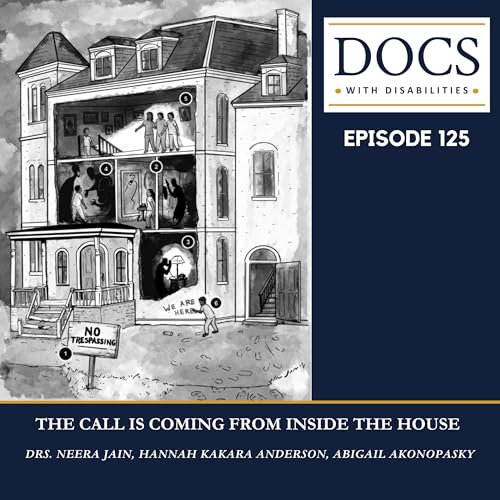
  • Episode 125: The Call is Coming From Inside the House
    May 25 2026
    Interviewees: Neera Jain, PhD — Senior Lecturer, Centre for Medical and Health Sciences Education, Waipapa Taumata Rau, The University of Auckland Hannah Kakara Anderson, PhD, MBA — Assistant Professor of Pediatrics, Children's Hospital of Philadelphia and the University of Pennsylvania Abigail (Abby) Konoposky, PhD— Director of Medical Education Research, Department of Psychiatry, Northwell Interviewer: Lisa Meeks, PhD, MA — Professor of Medical Education, The University of Illinois College of Medicine, Chicago; Host, the Docs With Disabilities Podcast Description: In this episode of Stories Behind the Science, we sit down with Drs. Hannah Kakar Anderson, Abby Konoposky, and Neera Jain to discuss a paper that confronts some of the most painful and persistent realities in medical education: The Call Is Coming from Inside the House. Together, they explore how racism and ableism intersect in the experiences of racially minoritized medical learners with disabilities—and why traditional conversations about diversity and inclusion often fail to capture these realities. Using disability critical race theory (DisCrit), narrative inquiry, and counter-storytelling, the authors illuminate what participants described as a haunted "house of medicine"—a space marked by exclusion, surveillance, distorted reflections of self, and support systems that too often become sources of harm rather than protection. Through powerful metaphors drawn from horror—No Trespassing, Hall of Mirrors, and The Call Coming from Inside the House—the conversation examines how institutional structures and well-intentioned actors alike can perpetuate systems that marginalize learners. But this episode is not simply about oppression. It is equally a conversation about resistance, agency, and survival. Grounded in Caitlin Seida's poem Hope Is Not a Bird, Emily, It's a Sewer Rat, the authors reflect on the fierce and complicated hope carried by learners who persist despite environments that were never designed with them in mind. Their stories are not one-dimensional accounts of struggle—they are acts of testimony, community building, and imagination for a different future. The discussion reviews: How racism and ableism operate as intertwined forces within medical education.Why horror became a powerful analytic metaphor for understanding participants' experiences. What it means to be simultaneously hyper-visible and invisible in training environments.How institutional actors may unintentionally reproduce harmful systems—and what it means to recognize "the call" within ourselves.Why the authors resisted easy solutions and instead invite educators to sit with discomfort before rushing to reform.How participants' stories function as "apocalyptic logs" and acts of "leaving evidence" for future learners and institutions. Dr. Anderson brings a clinician-educator's perspective and deep commitment to educational equity, reflecting on disability as both a personal and professional identity. Abby Konoposky offers a linguist's and educational psychologist's lens, unpacking agency, metaphor, and the power of story to challenge dominant narratives. Dr. Jain contributes expertise in ableism, disability studies, and anti-ableist practice, connecting participants' experiences to broader histories of disability rights and racial justice. Together, they invite listeners not only to understand these stories—but to reckon with what they reveal about medicine itself. This episode asks us to imagine what medicine might become if we listened more closely to the people who have long been navigating its haunted spaces—and if we allowed their stories to reshape the house itself. Transcript: https://docs.google.com/document/d/1dWbGNYB_pzptoEUDSKiS7bOr3DHEOGwqundz90i4fVk/edit?usp=sharing Bios: Hannah Kakara Anderson, PhD, MBA, is an Instructor of Pediatrics at the Children's Hospital of Philadelphia and the University of Pennsylvania. Her work focuses on educational equity in medical education, with particular attention to disability equity and the creation of learning environments that support diverse learners and the communities they serve. Drawing from both lived experience and scholarship, her work explores how medical education can better sustain learners with disabilities and advance justice in training environments. Abigail (Abby) Konoposky, PhD, supports medical education research in the Department of Psychiatry at Northwell Health. Trained in linguistics and educational psychology, her scholarship explores language, agency, and the ways stories shape educational experiences and systems. Her work is informed by both personal experience with disability and a commitment to understanding how narrative and structure interact in medical education. Neera Jain, PhD, MS is Senior Lecturer at the Centre for Medical and Health Sciences Education at Waipapa Taumata Rau, The University of Auckland, New Zealand. Her scholarship focuses on ...
    Show More Show Less
    1 hr and 3 mins
  • Episode 124: Mapping the Landscape of Technical Standards: A Nationwide Review of Medical Schools
    Nov 13 2025
    Interviewees: Carol Haywood, PhD, OTR/L — Assistant Professor, Medical Social Sciences, Northwestern University Feinberg School of Medicine Chris Moreland, MD, MPH — Professor of Internal Medicine; Division Chief for Hospital Medicine; Interim Associate Chair for Faculty Affairs and Development, Dell Medical School (Comments made in ASL and voiced through interpreters) Interviewer: Lisa Meeks, PhD, MA — Guest Editor, Academic Medicine Supplement on Disability Inclusion in Undergraduate Medical Education Description: In this episode of Stories Behind the Science, we sit down with Dr. Carol Haywood and Dr. Chris Moreland to explore a deceptively powerful document: the medical school technical standards. These quietly influential statements—often tucked deep in an admissions webpage—shape who feels welcome to apply, who gains access, and how institutions imagine the future of their profession. Haywood and Moreland, co-authors of a national analysis featured in the Academic Medicine supplement on Disability Inclusion in Undergraduate Medical Education, unpack what happens when ambiguous language, outdated assumptions, and vague expectations collide with real people making real decisions about their careers. Together, they dig into the nuances of functional vs. organic standards, the importance of clarity for applicants who lack insider knowledge, and the ripple effects of inequitable policies across a learner's entire training experience. What emerges is both sobering and hopeful: a field undergoing change, a growing recognition that words matter, and a roadmap for institutions ready to bring their values into alignment with their practices. The discussion reviews: How technical standards became a gatekeeper—and why revising a single sentence can shift an entire culture. Why students with disabilities read these documents differently—and why that matters for equity. How ambiguity in admissions can deter talented future physicians long before they step foot in a classroom. What schools can do now to create standards that prioritize competence, flexibility, and inclusion. Dr. Haywood brings a researcher's lens and an occupational therapist's creativity to the conversation, illuminating how functional expectations—not assumptions about bodies—should guide medical training. Dr. Moreland shares deeply personal reflections on navigating technical standards as a deaf physician, offering rare insight into how these documents land on applicants with lived experience. This episode invites the audience to imagine a medical education landscape where technical standards do what they should do—define competence, set expectations, and open doors—rather than unintentionally closing them. Bios: Carol Haywood, PhD, OTR/L, is Assistant Professor of Medical Social Sciences in the Determinants of Health Division and core faculty in the Center for Health Services and Outcomes Research at Northwestern University Feinberg School of Medicine in Chicago, IL. Building from her work as an occupational therapist in acute rehabilitation, she completed a PhD in occupational science at the University of Southern California and a postdoctoral fellowship in health services and outcomes research at Northwestern University. Using qualitative, mixed methods, and community-engaged research approaches, she studies disability in a variety of contexts, as well as health care access, coordination, and quality. She is driven by a vision of health care that facilitates equity for people with disabilities. Chris Moreland, MD MPH, is a professor of medicine, interim associate department chair for faculty affairs, and division chief for hospital medicine at Dell Medical School at UT Austin. He practices clinically as a hospitalist. As a career-long clinician educator, his teaching has been recognized regionally and nationally. His collaborative advocacy and research efforts describe the experiences of our healthcare workforce and learners with disabilities, as well as strategies to foster pathways to thriving clinicians. He has served as president and longtime board member for the Association of Medical Professionals with Hearing Losses; he holds current roles on the Docs with Disabilities Initiative advisory board, the AAMC Group on Diversity and Inclusion steering committee, and as a consultant with the National Deaf Center. Transcript: https://docs.google.com/document/d/18hUPguWf_jWeDC1fmOgSKSXPv4xGnkQIPUi3zhfH540/edit?usp=sharing Resources: Singer, Tracey; Madanguit, Lance MD; Fok, King T. MD, MSc; Stauffer, Catherine E. MD; Meeks, Lisa M. PhD, MA; Moreland, Christopher J. MD, MPH; Huang, Lynn MS; Case, Benjamin MPH; Lagu, Tara MD, MPH; Kannam, Allison MD; Haywood, Carol PhD, OTR/L. Mapping the Landscape of Technical Standards: A Nationwide Review of Medical Schools. Academic Medicine 100(10S):p S144-S151, October 2025. | DOI: 10.1097/ACM.0000000000006135 McKee, M.M., Gay, S., Ailey, S., Meeks, L.M. (2020). ...
    Show More Show Less
    42 mins
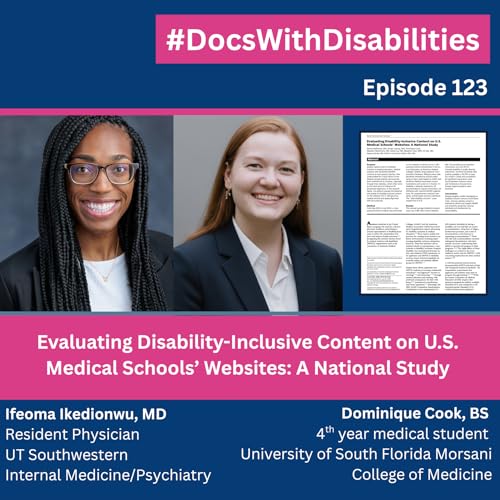
  • Episode 123: Evaluating Disability-Inclusive Content on U.S. Medical Schools' Websites: A National Study
    Oct 22 2025

    Episode 123: Evaluating Disability-Inclusive Content on U.S. Medical Schools' Websites—A National Study

    Interviewees:
    Ifeoma Ikedionwu, MD — Psychiatry and Internal Medicine Dual Intern, UT Southwestern
    Dominique Cook — Fourth-Year Medical Student, University of South Florida

    Interviewer:
    Lisa Meeks, PhD, MA — Guest Editor, Academic Medicine Supplement on Disability Inclusion in Undergraduate Medical Education

    Description:
    In this episode of Stories Behind the Science, Dr. Lisa Meeks sits down with Dr. Ifeoma Ikedionwu and Dominique Cook, co-authors of the first national study examining how medical school websites communicate disability inclusion. Their paper, Evaluating Disability-Inclusive Content on U.S. Medical Schools' Websites: A National Study, is part of the Academic Medicine supplement on Disability Inclusion in Undergraduate Medical Education.

    What do medical schools' digital front doors say about who belongs? The conversation explores how public-facing messages shape applicants' sense of access, belonging, and possibility—and why visibility is the first step toward equity. Ikedionwu and Cook share how their lived experiences as medical students with and without disabilities inspired a research project that merges advocacy, analysis, and systemic change.

    Together, they unpack the challenges of quantifying inclusivity, the nuance of intersecting identities, and the powerful role of student-led research in shaping institutional accountability. The episode underscores how every mission statement, technical standard, and accessibility page sends a message—and how aligning those messages with institutional values can create a more inclusive path for future physicians.

    Listeners will leave with actionable insights:

    • Audit your institution's website for clarity, tone, and accessibility.

    • Engage learners with lived experience in reviewing public materials.

    • Translate inclusion from policy into practice—and from practice into visibility.

    Because as Ikedionwu reminds us, "It's not enough to do the work—you have to share it, so others can find their way."

    Transcript: https://docs.google.com/document/d/1UmiXVs8wESM28eRYAM-d13IuJTV6VzR2khagExHF12A/edit?usp=sharing

    Resources:
    Article from Today's Talk:
    Ikedionwu I, Cook D, Kim N, Cotts J, Case B, Meeks LM. Evaluating Disability-Inclusive Content on U.S. Medical Schools' Websites: A National Study. Academic Medicine. 2025;100(10S):S60–S67. Read the full article here →

    Related Reading:
    Equal Access for Students with Disabilities: The Guide for Health Science and Professional Education (2nd Ed). Meeks LM, Jain NR, & Laird EP. Springer Publishing, 2020.

    🎧 The Docs With Disabilities Podcast: https://www.docswithdisabilities.org/docswithpodcast

    Key Words: Disability inclusion · Medical education · Admissions · Accessibility · Representation

    Show More Show Less
    44 mins
  • Episode 122: Clinical Accommodations in Undergraduate Medical Education
    Oct 17 2025
    Interviewees: Matthew Sullivan, PhD, Assistant Director of Disability Resources, Washington University School of Medicine in St. Louis Suchita "Suchi" Rastogi, PhD. MPH Candidate, University of Illinois Chicago; CEO, Disability in Medicine Mutual Mentorship Program Interviewer: Lisa Meeks, PhD, MA, Guest Editor, Academic Medicine Supplement on Disability Inclusion in Undergraduate Medical Education Description: In this episode of Stories Behind the Science, Dr. Lisa Meeks talks with Matt Sullivan (Washington University School of Medicine) and Suchita "Suchi" Rastogi (UIC; DM3P) about their paper, "Standardized Language for Clinical Accommodations in U.S. Undergraduate Medical Training: Results From a National Modified Delphi Consensus Study,"part of the Academic Medicine supplement on Disability Inclusion in UME. Their conversation explores how a grassroots idea—born from students' lived experiences and practitioners' urgent need for clarity—grew into the first national, evidence-based language guide for clinical accommodations. Together, they unpack how a modified Delphi process brought students, Disability Resource Professionals, and leaders together to build consensus around the precise language that transforms intention into implementation. The trio discuss how language and word choices can make the difference between support and confusion, and how transparent, shared language strengthens trust and access for all. Dr. Meeks, Sullivan, and Rastogi also reflect on the collaborative model that made this project possible—one that centers disabled voices, encourages vulnerability in leadership, and demonstrates how clarity in communication is the foundation of equity. Listeners will come away with practical takeaways for institutions and leaders: audit your accommodation templates, build structured partnerships between DRPs and Student Affairs, and engage students as co-creators in designing accessible clinical environments. Transcript: https://docs.google.com/document/d/1ooJ5TP8V8s4t35EECoWHNTta7qqwbKlx-Fgu_WIiPG4/edit?usp=sharing Bios: Matt Sullivan PhD Dr. Sullivan is the Assistant Director of Disability Resources, At Washington University in St. Louis, and serves as DR's liaison to WashU's School of Medicine, acting as the primary contact for SoM faculty/staff, students, and prospective students. In this role, Matt works closely with all parties to create an accessible and inclusive educational environment for disabled students pursuing their degrees within Health Sciences and Medicine. Dr. Sullivan is a research-oriented practitioner dedicated to promoting disability awareness and inclusion within the higher education environment. In his student affairs roles, Dr. Sullivan has experience providing leadership and direction for a variety of programs and services in the areas of disability, testing, tutoring, Supplemental Instruction, and academic coaching. Working in the field of disability services for more than a decade, Matt has dedicated his time and energy to the education and development of students, faculty, and staff surrounding the intersectionality of disability with race, culture, gender, and other prominent identity factors. Suchita "Suchi" Rastogi PhD Suchi is an MPH student at the University of Illinois Chicago and CEO of the Disability in Medicine Mutual Mentorship Program (DM3P). A former MD-PhD student at Stanford University, she advocates for accessible medical education and leads community-based efforts to promote disability inclusion and peer mentorship. As a South Asian disability activist, she values health equity and compassionately designed systems that serve all people with dignity. She believes everyone deserves respect, access to material resources, and psychosocial support. These values compel her to improve healthcare and public health infrastructure for disabled patients, increase disability representation in medicine, and shift attitudes towards persons with disability. To accomplish this, she 1) run a mentorship program (DM3P) for healthcare professionals with disability, 2) conducts disability health equity research, and 3) advocates for evidence-based policies that center accessibility. Key Words: Clinical accommodations · Disability inclusion · Medical students · Disability Resource Professionals ADA Resources: Article from Today's Talk: Dhanani Z, Rastogi S, Sullivan M, Betchkal R, Poullos P, Meeks LM. Standardized Language for Clinical Accommodations in U.S. Undergraduate Medical Training: Results From a National Modified Delphi Consensus Study.Academic Medicine. 2025;100(10S):S92–S97. DOI: 10.1097/ACM.0000000000006150 Read the full article here → Equal Access for Students with Disabilities: The Guide for Health Science and Professional Education (2nd Ed). Meeks LM, Jain NR, & Laird EP. Springer Publishing, 2020. Read here → The Docs With Disabilities Podcast: https://www.docswithdisabilities.org/docswithpodcast
    Show More Show Less
    58 mins
  • Episode 121: Promoting Disability Inclusion Through an Expanded Conceptual Framework of the Learning Environment
    Oct 9 2025

    Interviewee:
    Erick Hung, MD, Professor of Clinical Psychiatry and Associate Dean for Students, University of California San Francisco School of Medicine

    Interviewer:
    Lisa Meeks, PhD, MA, Guest Editor, Academic Medicine Supplement on Disability Inclusion in Undergraduate Medical Education

    Description:
    In this episode of Stories Behind the Science, Dr. Lisa Meeks talks with Dr. Erick Hung (UCSF) about his paper, "Promoting Disability Inclusion Through an Expanded Conceptual Framework of the Learning Environment," part of the Academic Medicine supplement on Disability Inclusion in UME.

    Their conversation explores how a single student story at UCSF sparked a full-scale rethinking of what it means to create an equitable learning environment. Dr. Hung walks us through the journey—from a campus task force to a conceptual framework that now guides systemic change nationwide. Together, they unpack the six domains of the learning environment, including a new and critical addition: the societal layer, which recognizes how broader cultural forces shape belonging, access, and success.

    The discussion touches on mentorship, student advocacy, technical standards reform, and what it means to move beyond compliance toward culture change. Dr. Hung also reflects on humility in leadership, the importance of systems thinking, and how conceptual frameworks become living roadmaps for equity.

    Listeners will come away with practical takeaways for schools and leaders—build peer networks, re-evaluate policies through an inclusion lens, and invite students into the co-creation of change.

    Transcript:
    https://docs.google.com/document/d/1aO6cvl-_b82AONsV7V4LmS1Y8r6sI8zVtWKzWPlHakw/edit?usp=sharing

    Bios:
    Erick Hung, MD is Professor of Clinical Psychiatry and Associate Dean for Students at UCSF School of Medicine. A UCSF graduate and psychiatrist by training, he has led major institutional efforts to foster student well-being, belonging, and disability inclusion. His scholarship and leadership focus on systems approaches to learner flourishing, inclusive learning environments, and advocacy for equitable policy reform in medical education.

    Key Words:
    Learning environment
    Disability inclusion
    Medical students
    Systems thinking
    Societal drivers
    Technical standards
    Belonging
    Well-being
    Institutional change

    Resources:


    Article from Today's Talk:
    Theall, Alexandra C.P.; Crandall, Joanne E., MD; Gamboa, Haley N., MS, MD; Chichioco, Michael; Hughes, Sarah E.; Gruppen, Larry, PhD; Hung, Erick, MD. Promoting Disability Inclusion Through an Expanded Conceptual Framework of the Learning Environment. Academic Medicine, 100(10S): S84-S91, October 2025. DOI: 10.1097/ACM.0000000000006148
    Read the full article here

    The Docs With Disabilities Podcast:
    https://www.docswithdisabilities.org/docswithpodcast

    Show More Show Less
    38 mins
  • Episode 120: The Intersection of Disability, Race, Ethnicity, and Financial Background on Food Insecurity Among Medical Students
    Oct 2 2025

    Interviewee:

    Bassel Shanab, BS is a fourth-year medical student at the Yale School of Medicine.

    Interviewer:

    Lisa Meeks, PhD, MA, Guest Editor, Academic Medicine Supplement on Disability Inclusion in UME.

    Description:

    This episode of Stories Behind the Science sits down with Bassel Shanab (Yale School of Medicine), co-first author of "The Intersection of Disability, Race, Ethnicity, and Financial Background on Food Insecurity Among Medical Students," part of the Academic Medicine supplement on Disability Inclusion in UME. We move beyond prevalence rates to the lived realities behind them—and why hunger so often hides in plain sight in elite training environments. Bassel shares the personal experiences that shaped his questions, the multi-institutional data that sharpened the answers, and the practical moves any school can make now: screen routinely, get cost-of-living estimates right, normalize help-seeking, and invest in evidence-based campus supports. Along the way, we talk flourishing (not just "fixing"), student-led research networks, and why transparency beats stigma every time. Whether you're a dean, DRP, faculty member, or student, this conversation offers a humane roadmap from surviving to thriving. Links to the open-access article, and related tools are in the show notes.

    Transcript:

    https://docs.google.com/document/d/184LJqvcAgHGmpHyOcaxOxRw4yetR7qrGPPin0HDX7i4/edit?usp=sharing

    Bios:

    Bassel Shanab, BS is a fourth-year medical student at the Yale School of Medicine. He holds a Bachelor of Arts in Biological Sciences and Global Health Studies from Northwestern University, graduating with distinction. His academic interests include medical education, cardiovascular health, social determinants of health, and health policy.

    Key Words:

    Food insecurity

    Medical students

    Disability

    Race and ethnicity

    Underrepresented in medicine (URiM)

    Low-income background

    Intersectionality

    Student well-being

    Academic performance

    Resources:

    Article from Today's Talk

    The Intersection of Disability, Race, Ethnicity, and Financial Background on Food Insecurity Among Medical Students

    Nguyen, Mytien MS; Shanab, Bassel M.; Khosla, Pavan; Boatright, Dowin MD, MBA, MHS; Chaudhry, Sarwat I. MD; Brandt, Eric J. MD, MHS; Hammad, Nour M. MS; Grob, Karri L. EdD, MA; Brinker, Morgan; Cannon, Caden; Cermack, Katherine; Fathali, Maha; Kincaid, John W.R. MS, MPhil; Ma, Yuxing Emily; Ohno, Yuu MS; Pradeep, Aishwarya; Quintero, Anitza MBA; Raja, Neelufar; Rooney, Brendan L.; Stogniy, Sasha; Smith, Kiara K.; Sun, George; Sunkara, Jahnavi; Tang, Belinda; Rubick, Gabriella VanAken MD; Wang, JiCi MD; Bhagwagar, Sanaea Z.; Luzum, Nathan; Liu, Frank MS; Francis, John S. MD, PhD; Meeks, Lisa M. PhD, MA; Leung, Cindy W. PhD. The Intersection of Disability, Race, Ethnicity, and Financial Background on Food Insecurity Among Medical Students. Academic Medicine 100(10S):p S113-S118, October 2025. | DOI: 10.1097/ACM.0000000000006156

    https://journals.lww.com/academicmedicine/fulltext/2025/10001/the_intersection_of_disability,_race,_ethnicity,.12.aspx


    The Docs With Disabilities Podcast

    https://www.docswithdisabilities.org/docswithpodcast


    Show More Show Less
    48 mins
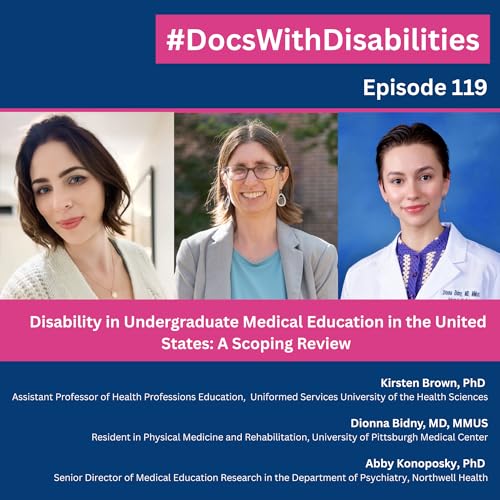
  • Episode 119: Disability in Undergraduate Medical Education in the United States: A Scoping Review
    Sep 27 2025
    Interviewees: Kirsten Brown, PhD Assistant Professor of Health Professions Education at the Uniformed Services University of the Health Sciences; as a short disclaimer, Kirsten's views do not represent the official policy or position of her employer. Dionna Bidny, MD, MMUS a first-year resident in Physical Medicine and Rehabilitation at the University of Pittsburgh Medical Center, currently completing her Transitional Year; and Abby Konoposky, PhD Senior Director of Medical Education Research in the Department of Psychiatry at Northwell Health. Interviewer: Lisa Meeks, PhD, MA, Guest Editor, Academic Medicine Supplement on Disability Inclusion in UME. Description: This episode of Stories Behind the Science brings you an intimate conversation with Dr. Kirsten Brown (Uniformed Services University of the Health Sciences), Dr. Dionna Bidny (University of Pittsburgh Medical Center), and Dr. Abby Konopasky (Northwell Health), co-authors of Disability in Undergraduate Medical Education in the United States: A Scoping Review, part of the Academic Medicine supplement on Disability Inclusion in Undergraduate Medical Education. Drawing from over 80 publications, their study traces how disability in medical education has too often been framed through deficit and legal models, while leaving intersectionality and the voices of disabled learners largely absent. Together, we explore why this framing matters, what the literature reveals about gaps and progress, and how a critical perspective can re-shape the field. Our guests share the personal and professional motivations behind this ambitious review, the surprises and challenges they encountered, and their hopes for how this work can serve as both roadmap and catalyst. Whether you are a researcher, faculty member, disability resource professional, or student, this episode offers insights into the state of the field and inspiration for charting new directions. Resources and links to the open-access article, Disability Resource Hub, and related tools are in the show notes. Transcript: https://docs.google.com/document/d/1iUYE0Q-2TA1flXiMU6rum1S3dO-obE5DoA9J0mFmHlE/edit?usp=sharing Bios: Kirsten Brown, PhD Dr. Kirsten Brown's research examines the intersection of disability, power, and social systems. Her work has appeared in the Journal of College Student Development, the Journal of Diversity in Higher Education, and Journal of Higher Education. She co-authored the book Disability in Higher Education: A Social Justice Approach. Dr. Brown prepared this chapter during non-work hours as an independent scholar and this publication did not receive funding from the federal government. The views expressed are solely those of the author and do not represent the official policy or position of the Uniformed Services University of the Health Sciences, the Henry M. Jackson Foundation for the Advancement of Military Medicine, the Department of Defense, or the U.S. Government. Abigail Konopasky, PhD Abigail Konopasky holds doctorates in educational psychology from George Mason University and in linguistics from Princeton University. She is currently an Associate Professor and Director of Medical Education Research and Scholarship in the Psychiatry Department at Northwell Health. She conducts critical qualitative and mixed methods research in health professions education, with a focus on equity, Black feminism, and critical disability studies using functional linguistic and narrative methods and theories of agency. She serves on the editorial boards of Teaching and Learning in Medicine, Perspectives on Medical Education, and Advances in Health Sciences Education. Dionna Bidny, MD, MMus Dionna is a first year resident at the University of Pittsburgh Medical Center in Physical Medicine and Rehabilitation (currently in her Transitional Year). She has a BS in biomedical engineering and an MMus in Musicology; she incorporated her interest in accessibility in arts, sports, and healthcare spaces through research during both degrees. In medical school, she continued to study and lecture in the space of disability justice and its intersections with art, identity, and healthcare experience, all while navigating chronic illness and pursuit of her own accommodation and access needs. In residency, she aims to continue her work in accessibility within arts and sports through community engagement and engineering innovation. Key Words: Disability in medical education Undergraduate medical education (UME) Disability inclusion Scoping review Academic Medicine supplement Deficit model vs. asset model Legal framing of disability Intersectionality in medicine Disabled learners' voices Critical perspectives in medical education Equity in medical training Accommodations in medical education Disability justice Ableism in medicine Representation in health professions Research roadmap Diversity and inclusion in medicine Disability studies in medical education Inclusive ...
    Show More Show Less
    44 mins