• John Fees: Rethinking the Risk of Paying for College
    Oct 20 2026

    What happens when paying for college becomes a six-figure financial risk, but families have almost no safety net when something goes wrong?

    In this episode of Entrepreneur Rx, host John Shufeldt sits down with John Fees, serial entrepreneur and Co-founder and CEO of GradGuard, to talk about entrepreneurship, higher education, insurance, and the financial risks families often do not think about until it is too late.

    Fees has spent his career at the intersection of education, financial services, and technology. He previously built and sold companies to Viacom and JPMorgan Chase before co-founding Next Generation Insurance Group and launching GradGuard, a company designed to reduce the financial risks associated with college life.

    A major focus of the conversation is tuition insurance. Once a university's refund period ends, a student who has to withdraw for a covered reason may otherwise lose tuition, housing, and other academic costs already paid. GradGuard was built to provide protection against certain unexpected events and now works with more than 700 colleges and universities. Its programs have served more than 2 million students across more than 1,900 institutions.

    John and John also step back from the product itself to ask bigger questions about how America pays for education. They discuss student debt, whether the current financing system creates the right incentives, the economics of medical education, and why the cost of becoming a physician or other highly trained professional can influence career decisions long after graduation.

    The conversation then moves into entrepreneurship and insurance innovation, including why Fees believes technology and AI will pressure traditional insurance intermediaries, where specialized insurance models can still create real value, and why entrepreneurs should focus on solving problems rather than fitting into an existing industry mold.

    They close with a fascinating discussion about pattern recognition. Experience can help founders and investors recognize opportunities, but it can also create blind spots. Fees shares how his own assumptions contributed to passing on Facebook early, sparking a broader conversation about challenging what experience tells you and deliberately looking for the counterargument.

    About John Fees: John Fees is a serial entrepreneur who builds technology-enabled ventures at the intersection of financial services and education. He previously sold Y2M and Members Connect to Viacom and JPMorgan Chase, respectively, and later co-founded Next Generation Insurance Group. He holds a BS in History from Arizona State University and an MBA from Harvard Business School.

    About GradGuard: GradGuard was created around a simple problem: families can spend tens of thousands of dollars on a semester of college, yet have little protection if an unexpected illness, injury, or other covered event forces a student to withdraw. Since 2009, GradGuard has built insurance programs specifically for the risks of college life, including tuition and renters insurance. Today, the company works with more than 700 colleges and universities and has helped protect more than 2 million students across more than 1,900 institutions.

    About Xcellerant Ventures: Xcellerant Ventures is a venture capital firm investing in innovative private companies across healthcare, technology, defense, and other emerging industries. Xcellerant offers multiple investment vehicles, including the Jetstream Venture Fund ($5,000 minimum interval fund) and select SPVs, while partnering with founders through capital, strategic guidance, and its broader network.

    About My Custom Wine: My Custom Wine lets you build a wine around your own taste. Tell Augustan, its AI sommelier, what you're craving, and it can blend, taste-test, and refine a custom wine from thousands of options before it is bottled with your own blend and label. Visit mycustomwine.com to build yours.

    Show More Show Less
    30 mins
  • Dr. Tyler Okland: Building Beyond Medicine
    Oct 13 2026
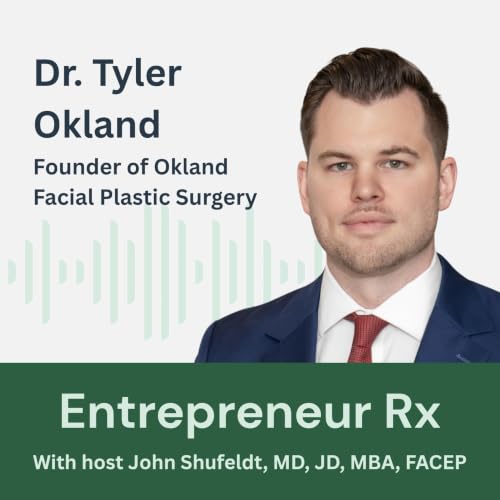
    What if becoming a doctor is only the beginning of what you’re capable of building? In this episode of Entrepreneur Rx, host John Shufeldt sits down with Dr. Tyler Okland, double board-certified facial plastic and reconstructive surgeon and founder of Okland Facial Plastic Surgery, to talk about medicine, entrepreneurship, failure, and why doctors may be better equipped to build businesses than they realize. While completing his five-year residency in Otolaryngology–Head and Neck Surgery at Stanford, Tyler co-founded Datadoor, a real estate data company that provided institutional-grade analytics to hedge funds and investors. Rather than trying to compete broadly, Tyler and his co-founder went incredibly deep on a narrow market, eventually becoming a trusted source for some of the largest institutional investors following the company they covered. That experience ultimately helped Tyler fund his next venture: his own facial plastic surgery practice. John and Tyler discuss why specialization can be such a powerful business strategy, the financial realities facing physicians today, and why developing interests outside of medicine can provide both additional opportunity and a hedge against burnout. They also get into what Tyler believes aspiring physician-entrepreneurs often miss. You do not necessarily need another degree before starting. You need to understand what you are uniquely good at, find a real audience, build distribution, and be willing to learn as you go. Tyler shares how writing and building an audience helped create the foundation for Datadoor and why even the best product can struggle if no one knows it exists. The conversation also explores Tyler’s relationship with failure. After struggling to get into college and requiring two attempts to enter medical school, he ultimately trained at Stanford and one of the country’s leading facial plastic surgery fellowships. He credits those early setbacks with teaching him how to ask better questions, focus on what truly mattered, and become far more intentional about how he approached his career. About Dr. Tyler Okland: Dr. Tyler Okland is a double board-certified facial plastic and reconstructive surgeon and founder of Okland Facial Plastic Surgery in Denver. He earned his medical degree from the University of Colorado, completed residency in Otolaryngology–Head and Neck Surgery at Stanford, and completed fellowship training in Facial Plastic and Reconstructive Surgery at Vanderbilt. He has authored more than 30 peer-reviewed publications and is also the co-founder of Datadoor and Tone Medical Aesthetics. About Okland Facial Plastic Surgery: Okland Facial Plastic Surgery is a Denver-based practice focused on rhinoplasty, deep plane facelift surgery, and comprehensive facial rejuvenation. The practice is built around specialization and direct surgeon access, with Dr. Okland personally involved throughout consultation, surgery, and postoperative care. Dr. Okland is also the founder of Operation Breathe, through which he donates surgical care to eligible women experiencing nasal deformity, impaired breathing, or both as a result of physical domestic violence. About Xcellerant Ventures: Xcellerant Ventures is a venture capital firm investing in innovative private companies across healthcare, technology, defense, and other emerging industries. Xcellerant offers multiple investment vehicles, including the Jetstream Venture Fund ($5,000 minimum) and selective SPVs, while partnering with founders through capital, strategic guidance, and its broader network. About Pitch Deck Analysis: For founders getting ready to raise, Pitch Deck Analysis reviews your deck like an investor would, with scoring, feedback, and recommendations on what to improve before you pitch. Use code EntrepreneurRx for a free Founder Pack with five free runs.
    Show More Show Less
    25 mins
  • ShadowGen: Making Voice Work Where Networks Don't
    Oct 6 2026

    What if voice communication could work anywhere a text message can get through?

    In this episode of Entrepreneur Rx, host John Shufeldt sits down with Julie Gerber, Founder & CEO of ShadowGen, and Chad Gerber, Founder & CTO, to talk about a new approach to voice communication built for the places conventional networks struggle most.

    ShadowGen is a national security technology company developing resilient voice communications for degraded, congested, and unreliable networks. Its technology reduces the bandwidth required for voice by more than 99%, opening potential applications across defense, public safety, telecommunications, tactical networks, satellite communications, and other mission-critical environments.

    The path to ShadowGen was anything but traditional. Julie began her career in global public health and disaster resilience, working with organizations including the World Health Organization before moving into music management, licensing, publishing, and technology. Chad built a career as a Gibson-endorsed artist and technologist, contributing to 10 gold and platinum records while also developing new tools for creative collaboration.

    Their worlds converged through Meloscene, a spatial computing platform built for live creative collaboration. When Julie saw how the underlying technology could address a problem she had encountered years earlier in disaster response, she asked a simple question: “Can we do that with voice?”

    That question changed the direction of what they were building.

    John, Julie, and Chad explore how ShadowGen could keep people connected when traditional communications fail, why ultra-low-bandwidth voice matters in national security and public safety, and how the technology could eventually support areas like translation, secure communications, and data analytics.

    They also get into what it is like to build a deep-tech company as a husband-and-wife team, how two radically different careers ended up converging around the same problem, and the moments that made them realize the technology could have applications far beyond music.

    About ShadowGen: ShadowGen delivers voice where conventional communications struggle. Its technology cuts the bandwidth required for voice communication by more than 99%, helping keep people connected when networks are degraded, congested, or unreliable. Built for national security and other mission-critical environments, ShadowGen is advancing resilient voice across defense, public safety, and telecommunications.

    About Xcellerant Ventures: Xcellerant Ventures is a venture capital firm investing in innovative private companies across healthcare, technology, defense, and other emerging industries. Xcellerant offers multiple investment vehicles, including the Jetstream Venture Fund ($5,000 minimum) and select SPVs, while partnering with founders through capital, strategic guidance, and its broader network.

    About Deal Titan: Deal Titan is an AI-powered platform that helps investors evaluate early-stage companies faster by turning pitch decks into structured diligence reports covering the market, team, financials, competition, and key risks. Use code EntrepreneurRx for a free solo membership, including 10 full analysis reports.

    Show More Show Less
    27 mins
  • Kristie D'Ambrosio-Correll: Building America's Next Great Luxury Car Brand
    Sep 29 2026

    What does it take to build a new American luxury car company from the ground up?

    In this episode of Entrepreneur Rx, host John Shufeldt sits down with Kristie D'Ambrosio-Correll, Co-Founder and CEO of Dacora, to talk about what it takes to challenge one of the most established industries in the world and create a modern luxury automotive house built around beauty, craftsmanship, technology, and experience.

    Kristie's relationship with cars started long before Dacora. She grew up working on cars with her father before studying Electrical Engineering and Computer Science at MIT, where she immersed herself in artificial intelligence at the MIT Computer Science and Artificial Intelligence Lab. She later became CTO of MIRROR, helping bring the product to market and leading the company through its $500 million acquisition by lululemon. That experience gave her a firsthand look at what can happen when beautiful design and technology are built to work together.

    Today, Kristie and her husband are applying those lessons to Dacora, with the ambition of creating America's next great luxury marque. John and Kristie discuss why American ultra-luxury may be ready for a resurgence, what the automotive industry can learn from Tesla's willingness to question everything, and how Dacora's coachbuilt model allows the company to focus on the elements it believes matter most to the customer while reducing complexity, cost, and time to market.

    They also explore Kristie's evolution as a founder and leader, from a career driven by achievement and perfectionism to one shaped more by courage, resilience, and a willingness to take risks. Kristie opens up about the difficult pregnancy and birth of her daughter, how that experience changed her relationship with control and success, and why she now believes growth comes from the experiences you accumulate rather than the titles or security you hold.

    About Kristie D'Ambrosio-Correll: Kristie D'Ambrosio-Correll is the Co-Founder and CEO of Dacora. Before founding Dacora, she served as CTO of MIRROR, helping lead the company through its $500 million acquisition by lululemon. She holds bachelor's and master's degrees in Electrical Engineering and Computer Science from MIT, where she studied AI at the MIT Computer Science and Artificial Intelligence Lab. Today, Kristie and her husband combine a lifelong passion for cars with deep experience in technology and consumer products to build Dacora, reimagining the automobile around experience, personalization, and human connection.

    About Dacora: Dacora is an American luxury automotive house creating a new vision for modern transportation centered on beauty, craftsmanship, personalization, and human connection. Its coachbuilt vehicles are individually commissioned, combining timeless design and exceptional materials with an AI-native architecture designed to quietly adapt to the people it serves. Since emerging from stealth, Dacora has built a reservation pipeline exceeding its planned first year of production and begun commissioning its first Founder Series vehicles.

    About Xcellerant Ventures: Xcellerant Ventures is a venture capital firm investing in innovative private companies across healthcare, technology, defense, and other emerging industries. Xcellerant offers multiple investment vehicles, including the Jetstream Venture Fund ($5,000 minimum) and SPVs, while partnering with founders through capital, strategic guidance, and its broader network.

    About My Custom Wine: My Custom Wine lets you build a wine around your own taste. Tell Augustan, its AI sommelier, what you're craving, and it can blend, taste-test, and refine a custom wine from thousands of options before it is bottled with your own blend and label. Visit My Custom Wine to build yours.

    Show More Show Less
    32 mins
  • Chris Franks: Closing the Gap Between Medical Research and Patients
    Sep 22 2026
    What happens to breakthrough medical ideas when the science works, but no one knows how to get them out of the lab and into the hands of patients? In this episode of Entrepreneur Rx, host John Shufeldt sits down with Chris Franks, five-time founder and CEO of Promptus, to explore one of healthcare innovation’s biggest gaps: why so much promising research never becomes a real-world product. Chris explains that the U.S. invests roughly $245 billion each year in healthcare research, yet only a small fraction of resulting technologies ever reach patients. Promptus was built to tackle that problem by identifying promising intellectual property from universities, hospitals, and physicians, then rapidly developing them toward commercialization. John and Chris dig into how Promptus evaluates thousands of technologies to find the rare opportunities that combine meaningful clinical need with a realistic regulatory, manufacturing, and commercialization pathway. They also discuss why great science alone is not enough, the challenges of working with technology transfer offices, and how Promptus aims to compress a development process that can traditionally take years into an 18-to-30-month path toward FDA submission. What makes the model especially compelling is the scale of the opportunity: thousands of technologies are already sitting inside universities and research institutions, and Promptus is building a repeatable system to identify the few with the strongest potential to become real products that can improve patient care. The conversation also goes into the founder journey. After nearly two decades of building companies, Chris shares why entrepreneurs need to get out of the office and talk to the people they are actually trying to serve, why medtech founders have to understand every stakeholder who can say “no,” and why building something valuable requires far more than having a clever idea. Chris also opens up about failure, the toll entrepreneurship can take, and one of the hardest lessons he learned along the way: you are not your company. He and John discuss separating identity from business outcomes, surviving difficult chapters, and why failure can ultimately make someone a better founder. About Chris Franks: Chris Franks is a five-time founder, CEO, and builder who has spent more than 15 years on the founder’s path. After selling his last company in 2023, he began rethinking what sustainable success looks like for founders and leaders. Today, Chris is CEO of Promptus, teaches management and leadership at the University of Colorado Denver, co-hosts the How To Founder podcast, and co-founded Denver Startup Week and the Denver Founders Network. He is also a six-time Ironman finisher. About Promptus: Promptus is a healthcare innovation platform built to close the gap between medical research and commercialization. Through its proprietary Expedited Innovation Platform, Promptus identifies high-potential IP from universities, hospitals, and physicians; acquires or licenses it directly; and develops each technology rapidly and leanly, with physicians involved from day one and a clear path toward FDA clearance in 18–30 months. Promptus is currently focused on next-generation biosensing technology designed to give people greater awareness and control over their health. About Xcellerant Ventures: Xcellerant Ventures is a venture capital firm investing in innovative private companies across healthcare, technology, defense, and other emerging industries. Xcellerant offers multiple investment vehicles, including the Jetstream Venture Fund ($5,000 minimum) and SPVs, while partnering with founders through capital, strategic guidance, and its broader network. About Pitch Deck Analysis: For founders getting ready to raise, Pitch Deck Analysis reviews your deck like an investor would, with scoring, feedback, and recommendations on what to improve before you pitch. Use code EntrepreneurRx for a free Founder Pack with five free runs.
    Show More Show Less
    23 mins
  • Jeffrey Fidelman: What Founders Get Wrong About Raising Capital
    Sep 15 2026
    Why do so many founders struggle to raise capital when the basic fundraising playbook is already known? In this episode of Entrepreneur Rx, host John Shufeldt sits down with Jeffrey Fidelman, Founder and Managing Partner of Fidelman & Company, to break down what actually works when raising capital, where founders go wrong, and why fundraising requires far more consistency and preparation than most entrepreneurs expect. Jeffrey shares how his experience in banking, venture capital, and working directly with early-stage companies exposed a major gap in the market: institutional fundraising is structured and systematic, while startup fundraising is often chaotic. That realization eventually led to Fidelman & Company’s Fundraise as a Service model, which gives founders and fund managers dedicated investor outreach infrastructure, data, and support without requiring them to build an internal investor relations team. Now, the firm is taking that methodology a step further with Fundex, a technology-enabled fundraising platform built from the CRM and investor database Fidelman & Company developed internally. Fundex is designed to make the firm’s investor intelligence and fundraising workflows more scalable and accessible to founders and fund managers managing the process themselves. Jeffrey even shares how he built the first version using AI-powered coding tools before bringing in developers to expand the platform. John and Jeffrey dig into some of the biggest mistakes founders make when pitching investors, from AI-generated decks they have not fully reviewed to unrealistic market assumptions, weak follow-up, and simply failing to ask for the investment. Jeffrey explains why founders should understand every number and claim in their deck, communicate consistently, personalize outreach, and treat fundraising like the full-time job it is. They also discuss how AI is raising the bar for early-stage companies, along with valuation, runway, how much capital founders should truly raise, and why Jeffrey generally prefers raising less capital more frequently over taking an unnecessarily large round. About Jeffrey Fidelman: Jeffrey Fidelman is the Founder and Managing Partner of Fidelman & Company, an investment bank founded in 2015 to support the fundraising and growth needs of early- to mid-stage companies and fund managers. His background spans Morgan Stanley, HSBC, early-stage venture investing, and work as an interim CFO and COO. A cum laude graduate of Harvard University, Jeffrey has helped companies navigate capital raises, acquisitions, business sales, and strategic growth initiatives. About Fidelman & Company: Fidelman & Company is a fully licensed investment bank with a team of approximately 40 people across the U.S. and Canada. Its Fundraise as a Service (FaaS) offering functions as outsourced investor relations, combining investor data, dedicated analysts, strategic support, and direct outreach on behalf of clients. The firm is also developing Fundex, a technology platform designed to bring its fundraising workflows, CRM, and investor intelligence to a broader group of founders and fund managers. About Xcellerant Ventures: Xcellerant Ventures is a venture capital firm investing in innovative private companies across healthcare, technology, defense, and other emerging industries. Xcellerant offers multiple investment vehicles, including the Jetstream Venture Fund ($5,000 minimum) and SPVs, while partnering with founders through capital, strategic guidance, and its broader network. About Pitch Deck Analysis: For founders getting ready to raise, Pitch Deck Analysis reviews your deck like an investor would, with scoring, feedback, and recommendations on what to improve before you pitch. Use code EntrepreneurRx for a free Founder Pack with five free runs.
    Show More Show Less
    22 mins
  • Casey Qadir: Building a Safer Standard for Surgery 
    Sep 8 2026

    What happens when a college student looks at a decades-old surgical tool and asks a simple question: why hasn’t anyone made this safer? 

    In this episode of Entrepreneur Rx, host John Shufeldt reconnects with Casey Qadir, Co-founder and CEO of Hubly Surgical, several years after her first appearance to talk about how far the company has come, from an undergraduate idea to FDA-cleared technology being used in hospitals across the country. 

    Casey started Hubly while studying neuroscience at Northwestern University after learning that emergency cranial access still relied on hand-crank drills without automatic stopping technology. Working with neurosurgeon Dr. Amit Ayer and CTO Tyler Panian, she co-developed the Hubly Auto-Stop Drill, designed to automatically stop after penetrating bone and help protect the brain beneath it. 

    John and Casey revisit one of their earliest meetings, when John put his hand beneath a demonstration skull and drilled through it to see whether Hubly’s technology would stop. It did, helping turn a pitch meeting into an investment. 

    Since then, Hubly has moved from early development to commercialization while expanding beyond cranial access. Casey shares how feedback from neurosurgeon customers led the company into spine surgery, resulting in FDA clearance for laminectomy and laminotomy procedures, and why clinician feedback continues to shape what comes next. 

    The conversation also gets into the realities of building a medical device company: raising the first million dollars during COVID, finding physician champions, selling into hospitals, challenging the status quo, and staying confident when investors insist that if an idea were really that obvious, someone else would have done it already. Casey also shares what she has learned about balancing conviction with humility. 

    About Casey Qadir: Casey Qadir is the Co-founder, CEO, and co-inventor behind Hubly Surgical. She started Hubly while studying neuroscience at Northwestern University and has since led the company from a classroom concept through two FDA clearances, nationwide commercialization, and use in thousands of patients across the United States. Casey holds a bachelor’s degree in neuroscience from Northwestern University and a master’s degree in computational mathematics from Johns Hopkins University. She was named to the Forbes 30 Under 30 Healthcare list for 2026 and serves as an entrepreneur-in-residence and advisory board member at Northwestern’s Farley Center for Entrepreneurship and Innovation. 

    About Hubly Surgical: Hubly Surgical is a medical device company committed to making surgery safe. Its flagship product, the single-use, cordless Hubly Auto-Stop Drill, combines automatic breakthrough detection, mechanical plunge prevention, and real-time force indication to give clinicians greater control during high-stakes procedures. Initially developed for cranial access in the Neuro ICU, the platform now has FDA-cleared applications in both cranial access and spinal decompression procedures, including laminectomy and laminotomy. Since its commercial launch in 2024, Hubly Drills have been used to save thousands of patient lives nationwide. 

    About Xcellerant Ventures: Xcellerant Ventures is a venture capital firm that invests in innovative companies across healthcare, technology, defense, and other emerging industries.  Xcellerant partners with founders to provide capital, strategic guidance, and support as they build and scale their companies.  Learn about their newest fund, Jetstream Venture Fund, and its $5,000 minimum.

    About Deal Titan: Deal Titan is an AI-powered platform that helps investors evaluate early-stage companies faster by turning pitch decks into structured diligence reports covering the market, team, financials, competition, and key risks. Use code EntrepreneurRx for a free solo membership, including 10 full analysis reports. 

    Show More Show Less
    25 mins
  • Daniel Oliver: The Science of Reversing Age-Related Disease
    Sep 1 2026
    What if we could reverse the damage caused by age-related disease instead of simply managing its symptoms? In this episode of Entrepreneur Rx, host John Shufeldt sits down with Daniel Oliver, CEO and Co-founder of Rejuvenate Bio, a Jetstream Venture Fund portfolio company, to explore the science behind age-related disease, the potential of gene therapy, and what it takes to turn groundbreaking research into treatments for both animal and human health. This success has lead to one of the leading crowdfunding equity campaigns.Rejuvenate Bio grew out of George Church’s lab at Harvard Medical School, where research into the biology of aging opened the door to a bigger question: instead of treating age-related diseases one at a time, could we target the underlying changes that drive them? Daniel explains the company’s work across heart failure, kidney failure, metabolic dysfunction, and epigenetic reprogramming. Daniel and John also dig into Rejuvenate Bio’s strategy of developing therapies for both companion animals and humans. Its most advanced program is targeting mitral valve disease in dogs, while its human program moves toward clinical development. Daniel explains why dogs can be a powerful model for age-related disease and how animal health may provide a faster path for translating aging science into real-world therapies. Beyond the science, Daniel shares his unconventional journey from mechanical engineering and aerospace to Harvard Business School, entrepreneurship, and biotech. He and John discuss why breakthrough ideas often emerge at the intersection of different disciplines, and they get candid about the pressure of startup life and why the “never sleep, always hustle” mentality can make founders worse leaders. About Daniel Oliver: Daniel Oliver is Co-founder and CEO of Rejuvenate Bio, a spinout of George Church’s Lab at Harvard Medical School focused on targeting the drivers of age-related disease through novel gene therapies. Prior to Rejuvenate Bio, Daniel was awarded a Blavatnik Fellowship, during which he co-founded Voxel8. Voxel8 was named one of the top innovations at CES and one of the 50 most innovative companies by MIT Technology Review. Daniel received his MBA from Harvard Business School and holds degrees in Mechanical Engineering and Business from the California Institute of Technology. About Rejuvenate Bio: Rejuvenate Bio is a George Church spinout with backing from Merck and leading VCs developing one-time gene therapies that target the root causes of age-related disease, beginning in companion animals and expanding to humans. The company was the first to demonstrate lifespan extension using epigenetic reprogramming and is advancing a breakthrough cardiovascular platform built around a single-dose therapy that restores youthful levels of a critical age-declining soluble protein. Preclinical data show reversal of heart damage and durable metabolic reset, positioning the program as a potential long-term alternative to chronic therapies such as GLP-1s. About Xcellerant Ventures: Xcellerant is a venture capital firm investing in innovative companies across healthcare, technology, defense, and other emerging industries.About Jetstream Venture Fund: Jetstream is an interval fund that provides investors access to venture opportunities across multiple stages, with a $5,000 minimum and no carried interest. Disclosure for Jetstream: Investors should carefully consider the investment objectives, risks, charges, and expenses of the Fund before investing. The prospectus contains this and other information about the Fund and can be obtained by emailing jetstream@sweaterfunds.com or by visiting www.jvf.vc. Please read the prospectus carefully before investing. About Pitch Deck Analysis: Pitch Deck Analysis reviews your deck like an investor would, with scoring, feedback, and recommendations on what to improve before you pitch. Use code EntrepreneurRx for a free Founder Pack with five free runs.
    Show More Show Less
    27 mins