• Your Child Isn't a "Picky Eater." Here's What's Really Going On at the Dinner Table with Lena Livinski
    Feb 26 2026

    In this Field Notes conversation, Dr. Rob Downey sits down with speech-language pathologist and holistic feeding specialist, Lena Livinsky to reframe "picky eating" as a whole-body, whole-family issue—less about willpower or "bad behavior," and more about safety, biology, skills, and environment.

    Lena shares how conventional feeding therapy often over-focuses on behavior, and how working through her own child's selective eating helped her connect the dots: when a child's nervous system is dysregulated or their gut and sensory systems are off, eating can feel threatening, not nourishing.

    She introduces her BLOOM Framework—rooted in connection—to help caregivers zoom out, identify the real bottleneck, and create steady, realistic shifts that help kids feel safe enough to explore food again.

    Learn more about Lene here: https://lenalivinsky.com/

    Key takeaways

    • Connection and nervous system regulation are the "root" of progress—kids can't "rest and digest" when they don't feel safe.

    • "Picky eating" is often better understood as selective eating with underlying drivers (discomfort, sensory load, stress, gut imbalance).

    • Lena's BLOOM Framework maps the core levers: Balanced health, Learned oral skills, Optimal microbiome, Open exploration, Mealtime boundaries.

    • You can do a lot at home before (or alongside) extensive testing: simplify gut disruptors, support circadian/light hygiene, and create low-pressure exposure to food.

    If something feels off (limited foods, gagging/choking, food pocketing), trust your gut and seek the right-fit, interdisciplinary support—small changes, started early or late, can still move the needle.

    If you have a child (or grandchild) in your life who struggles at the dinner table… this conversation might change how you see everything.

    Show More Show Less
    38 mins
  • What If You've Been Looking at Mental Health All Wrong? The 4 Pillars Approach to Lasting Happiness
    Feb 19 2026

    In this episode of Field Notes, Dr. Rob Downey sits down with integrative psychiatric provider Dr. Josh Waddell to unpack mental health through a functional medicine lens—moving beyond symptom labels and "chemical imbalance" shortcuts to ask what's actually driving anxiety, depression, and emotional instability in the first place.

    Dr. Waddell lays out a clear roadmap for understanding mental illness as a progression—from real-world triggers to cellular/mitochondrial disruption to downstream neurotransmitter changes—then introduces his practical "Four Pillars" framework (Body, Mind, Spirit, Environment) to help people pinpoint where their system is wobbling and what to address first.

    The conversation is equal parts compassionate and actionable, emphasizing that mental health struggles are not a character flaw, that healing is often about restoring stability in the right pillar(s), and that the best plan is the one that meets you where you are—sometimes including medication as a bridge so deeper root-cause work can actually stick.

    Learn more about Dr. Josh Waddell here: http://www.arukahwell.co

    5 Key Takeaways

    Mental health symptoms often follow a progression: triggers → mitochondrial/cellular dysfunction → neurotransmitter changes, so "root cause" usually sits upstream of brain chemicals.

    The Four Pillars (Body, Mind, Spirit, Environment) offer a simple way to identify what's most off—and why progress can stall when you're only focusing on one area.

    You can't out-supplement a toxic context: chronic stress, unhealthy relationships, burnout jobs, or constant distressing media exposure can keep the nervous system stuck.

    A timeline exercise (mapping life events, illnesses, stressors, and turning points) can reveal the earliest catalyst and clarify where to start.

    Supplements can help, but basics matter: food-first, third-party testing, avoid vague proprietary blends, and match herbs/supports to your symptom pattern—not trends.

    Show More Show Less
    39 mins
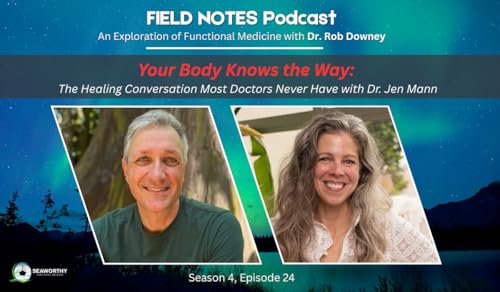
  • Your Body Knows the Way: The Healing Conversation Most Doctors Never Have
    Feb 11 2026

    In this episode of Field Notes, Dr. Rob Downey sits down with Dr. Jen Mann to talk about one of the most frustrating (and common) experiences in modern health care: the "mystery illness" — the symptoms that don't fit neatly into a diagnosis, and the exhaustion that comes from chasing answers. Instead of defaulting to more tests, more protocols, or another "perfect stack," Dr. Jen invites a different starting point: your body already has information — and learning to listen is part of the medicine.

    Together, they explore how healing can be both science and art… and how true recovery often begins when we shift from "fixing what's broken" to cultivating more aliveness. Along the way, Dr. Rob shares how many patients get stuck in the pressure to "figure it out," and why the relief sometimes comes not from finally getting a label — but from rebuilding trust in your own internal guidance, regulating your nervous system, and finding support that makes the journey feel human again.

    Learn more about Dr. Jen here: http://novawellnessmed.com

    Key Takeaways

    • Healing is both science and art. Tests and protocols can help, but they're most powerful when paired with presence, self-compassion, and deeper listening.
    • Mystery illness can be a doorway, not a life sentence. Reframing symptoms as signals (instead of personal failures) reduces suffering and opens curiosity and growth. You are the primary agent in your healing.
    • Doctors, supplements, AI, and tools can support you — but your relationship with your body is the foundation.
    • Rigid wellness routines can become another form of stress. Hustle culture can sneak into "health" and keep the nervous system stuck in fight-or-flight. Regulation + connection accelerate recovery.
    • Nervous system practices (done in ways you enjoy) and healing in community/partnership can fast-track progress and reduce overwhelm.
    Show More Show Less
    52 mins
  • Medicine at the Edge: What Extreme Wilderness Care Teaches Us About Burnout, Purpose, and Real Healing
    Feb 4 2026

    In this powerful episode of Field Notes—hosted by Nurse Practitioner Heather Moon—we're joined by Mary Ellen Doty, NP, a pioneer in wilderness medicine and founder of Wilderness Medical Staffing.

    Mary Ellen shares gripping stories from serving as the sole medical provider in some of the most remote and unforgiving environments on earth, including Bush Alaska, where medicine is practiced not by protocol alone—but with presence, creativity, and deep respect for the human story.

    Learn more about Mary Ellen here: https://maryellendoty.com/ Her journey reveals a stark contrast between relationship-centered care in extreme settings and the burnout-driven pace of modern corporate medicine, offering timely lessons on resilience, meaning, and what it truly takes to heal both patients and practitioners.

    Drawing from decades of experience and her upcoming book Medicine at 50 Below, this conversation is a moving reminder that when medicine slows down, humanity shows up—and everyone benefits.

    Key Takeaways:

    True healing requires presence and time, not rushed, transactional care

    Burnout in healthcare is driven more by loss of meaning than lack of money

    Rotational and boundary-based work models can restore balance for clinicians

    Harsh environments reveal the importance of community, adaptability, and systems thinking

    Practicing medicine with purpose benefits patients, providers, and entire communities

    This episode is a powerful reminder that the future of medicine isn't about doing more—it's about caring deeper.

    If you've ever felt burned out, disillusioned, or called to a more human way of healing, this conversation will stay with you.

    Show More Show Less
    31 mins
  • From Desperation to Breakthrough: A Mother's Journey That Redefined Whole-Body Healing with Dr. Chloe Weber
    Jan 29 2026

    In this powerful episode of Field Notes, Dr. Rob Downey sits down with Dr. Chloe Weber for a deeply human conversation at the intersection of functional medicine, Chinese medicine, and lived experience.

    Dr. Weber shares how her son's rare neurological condition became the catalyst for her life's work—pushing her beyond the limits of conventional care and into the ecosystem-based wisdom of Chinese herbal medicine, CBD, and spagyric extraction.

    Together, they explore why modern chronic illness demands a proactive, pattern-based approach to health, how ancient formulas can be intelligently adapted for today's world, and why women's hormonal health and neurological resilience deserve far more nuanced support than they currently receive.

    Learn more about Dr. Chloe Weber: http://radicalrootsherbs.com and http://Noxiherbs.com

    Key Takeaways:

    Chinese medicine treats the body as an ecosystem, not a collection of isolated parts—addressing root patterns, not just symptoms.

    Personal healing journeys often spark the most powerful innovations, as seen in Dr. Chloe Weber's work born from advocating for her son's neurological health.

    Herbal formulas and CBD can be deeply therapeutic when used intelligently and in ways that support underlying imbalances.

    Modern health challenges require updated ancient wisdom, blending time-tested Chinese medicine with today's science and realities.

    Women's hormonal health needs cycle-aware, dynamic support, not one-size-fits-all solutions.

    This episode is equal parts science, story, and soul—an inspiring reminder that true healing begins when we stop treating symptoms in isolation and start supporting the whole human system.

    Show More Show Less
    26 mins
  • Doing Everything 'Right' but Still Feel Off? This Gut Insight Changes Everything with Jacqui Meehan
    Jan 21 2026

    What if the missing link behind stubborn hormone issues, mood swings, fatigue, and digestive chaos isn't your hormones at all—but your gut? In this powerful Field Notes conversation, Dr. Rob Downey sits down with nutritionist and gut-health expert Jacqui Meehan to unpack the deeply personal story that led her from chronic illness to healing, and why the microbiome is the true cornerstone of vibrant health.

    Learn more about Jacqui here: https://www.jacquimeehannutrition.com/about

    Together, they explore the gut-brain-hormone connection, why so many people "do everything right" and still feel awful, and how simple, overlooked shifts in digestion, lifestyle, and nutrient absorption can unlock dramatic changes in energy, mood, and hormonal balance—especially for women. If you've ever felt dismissed, stuck, or frustrated by surface-level health advice, this episode may completely change how you understand your body—and where real healing begins.

    Key Takeaways:

    • Gut health is foundational—not secondary. The microbiome influences digestion, immunity, hormones, and mood. You cannot fully heal or optimize health without first stabilizing gut function.

    • You're not just what you eat—you're what you absorb. Many people eat well but still feel depleted because poor digestion and low stomach acid block nutrient assimilation. Fixing absorption often unlocks rapid improvements.

    • Stress directly disrupts digestion and hormones. Chronic stress shifts the nervous system into fight-or-flight, suppressing stomach acid, bile flow, and gut motility—setting the stage for inflammation and imbalance.

    • The gut and brain are in constant two-way communication. Through the vagus nerve and microbial metabolites, gut health shapes mood, stress resilience, and emotional regulation—sometimes even more than mindset alone.

    • Hormonal balance depends on the microbiome. Certain gut bacteria can recycle excess estrogen instead of eliminating it, contributing to estrogen dominance, PMS, PMDD, and PCOS—making gut repair essential for hormone health.
    Show More Show Less
    38 mins
  • The Hidden Reason Your Healing Stalls—Even When You're Doing Everything Right with Veronique Ory
    Jan 15 2026

    In this deeply moving episode of Field Notes, Dr. Rob Downey sits down with Veronique Ory to explore the powerful intersection of embodiment, trauma, and healing. Veronique shares how lived experiences—especially those shaped by early life, intergenerational trauma, and unexpressed emotion—are stored in the body, influencing our health, behavior, and sense of safety long after the original events have passed.

    Together, they unpack why healing isn't about "fixing" ourselves, but about creating enough safety to let go, soften old narratives, and reconnect with the body through compassion, curiosity, movement, and presence. Blending wisdom from yoga, somatic work, psychology, and functional medicine, this conversation offers a hopeful, grounded reminder that when we learn to listen to the body—and honor both pain and joy—profound personal and collective transformation becomes possible.

    Learn more about Veronique here: http://YogaWithVeronique.com

    Key takeaways:

    All experience is embodied. Emotions, stress, and trauma don't just live in our thoughts—they are stored in the nervous system, fascia, and tissues, shaping health patterns until they are consciously felt and released.

    Healing requires safety, not force. We often hold on to old wounds because they once protected us. True healing happens only when the body feels safe enough to let go, not when the mind tries to "fix" or override the process.

    Suppressed emotions create bigger reactions later. No emotion is inherently bad, but unexpressed feelings tend to surface as overwhelm, illness, or sudden emotional eruptions. Somatic practices allow emotions to move through the body in healthy ways.

    Forgiveness is about freedom, not approval. Letting go of old stories and grievances isn't about condoning what happened—it's about releasing the emotional charge so it no longer hijacks the body or dictates health outcomes.

    Small shifts can create paradigm-level change. Gentle, embodied actions—like changing daily habits, slowing down, choosing nourishing movement, or removing inflammatory inputs—can unlock profound transformations in health, agency, and self-trust.

    Show More Show Less
    58 mins
  • The Surprising Longevity Blueprint: Why You May Be Missing This Key Piece of The Formula with Dr. Avinish Reddy
    Jan 8 2026

    In this Field Notes conversation, Dr. Rob Downey sits down with Dr. Avinish Reddy to explore a powerful but often overlooked truth about longevity: social connection isn't a "nice to have" — it's a biological necessity.

    While modern health culture fixates on metrics like VO₂ max, glucose, sleep scores, and diet precision, Dr. Reddy explains how meaningful relationships directly shape stress physiology, immune function, metabolic health, and long-term vitality.

    Drawing from clinical data, neuroscience, and real-world patient outcomes, the episode reframes connection as a measurable driver of healthspan — one that lowers inflammation, stabilizes blood sugar, improves sleep, and reduces mortality risk.

    The message is simple but profound: optimizing health in isolation is incomplete. Longevity is built in relationship.

    Key Takeaways

    • Social connection is a core pillar of longevity, with isolation linked to up to a 50% increase in early mortality risk

    • Meaningful relationships lower stress hormones, improve sleep quality, and positively influence glucose and inflammation

    • Simple daily habits (calling loved ones, walking with friends, shared meals) outperform complex protocols when sustained long-term

    • Healthspan depends on integrating social connection with movement, nutrition, and purpose — not tracking metrics alone

    • The benefits of connection compound over decades, making midlife habits critical for long-term resilience and vitality

    Learn more about Dr. Reddy: https://www.elevatedmedical.com/

    Show More Show Less
    32 mins