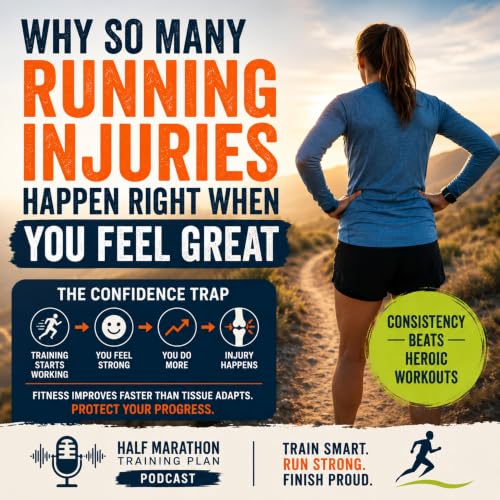
• Shin Splints That Won’t Go Away? Here’s What You’re Missing
    Apr 27 2026

    Do your shin splints keep coming back every time you start running again?

    You rest. The pain goes away. You feel good. Then you run… and it comes right back.

    If that cycle sounds familiar, you are not alone—and you are not doing anything wrong.

    In this episode, Coach Chris and Coach Maya break down why shin splints (medial tibial stress syndrome) keep returning, and why the common advice to “just rest until it feels better” doesn’t actually fix the problem.

    We cover:

    • 🔁 The “injury loop” that keeps runners stuck in recurring pain
    • 🦴 Why pain going away does NOT mean your tissue is healed
    • ⚠️ The biggest mistake runners make when returning to training
    • 🏃‍♂️ A simple, practical system to safely get back to running
    • ⚙️ How a small cadence adjustment can reduce stress on your shins

    🔗 Start Here: The Injury-Proof Running System
    Download our Free 14-Week Training Plan and get the step-by-step system we use with beginner runners:
    halfmarathontrainingplan.com/start

    📚 Related Reading:
    How to Avoid Shin Splints

    This has been a production of the Half Marathon Training Plan Podcast. Visit HalfMarathonTrainingPlan.com for more science-based training guidance.

    Show More Show Less
    16 mins
  • Heavy Legs While Running: Why It Happens (And How To Fix It)
    Apr 15 2026

    Why do your legs suddenly feel heavy during a run—even when your fitness is improving?

    This is one of the most frustrating and misunderstood experiences in running. One minute you feel smooth and in control… and the next, your legs feel like bricks.

    This episode is grounded in exercise physiology and real-world training principles.

    In this episode, Coach Chris and Coach Maya break down exactly why this happens—and how to fix it.

    We cover:

    • ⚡ How glycogen depletion impacts muscle force and perceived effort
    • 💧 Why electrolyte imbalance (especially sodium) disrupts muscle contraction
    • 🧠 The role of neuromuscular fatigue and the brain’s “central governor”
    • 🔧 A simple system to prevent heavy legs before, during, and after your runs

    🔗 Start Here: The Injury-Proof Half Marathon System
    Download our free 14-week training plan and learn how to structure your training, fueling, and recovery: halfmarathontrainingplan.com/start

    📚 Learn More:

    • How to Avoid Shin Splints
    • Fueling Long Runs
    • Electrolytes for Runners

    This has been a production of the Half Marathon Training Plan Podcast. Visit HalfMarathonTrainingPlan.com for more science-based training guidance.

    Show More Show Less
    17 mins
  • The Only Running Shoes Beginners Actually Need (And Why $250 Shoes Can Cause Injury)
    Mar 30 2026

    Do you really need $250 carbon-plated super shoes to run a half marathon?

    If you walk into a running store and feel completely overwhelmed by the "wall of neon," you are not alone. The running shoe industry wants you to think you are broken so they can sell you an expensive fix. But the truth is, the wrong "advanced" shoe can actually contribute to shin splints and knee pain.

    This episode is grounded in sports biomechanics research and real-world training data.

    In this episode, Coach Chris and Coach Maya cut through the marketing hype to tell you exactly what kind of shoes a beginner needs — and what you should completely ignore.

    We cover:

    • 👟 Why carbon-plated race shoes can increase injury risk for beginners.
    • 📉 The "Stability vs. Speed" debate (and why boring shoes win).
    • ⚙️ How increasing your cadence does more for your knees than any shoe.
    • 💰 The "2-Week / 20-Mile" break-in rule to protect your race day.

    🔗 Start Here: The Injury-Proof Half Marathon System
    Download our Free 14-Week Training Plan and get the exact gear checklist we recommend: halfmarathontrainingplan.com/start

    📍 The "Boring but Safe" Daily Trainers We Recommend:

    • Brooks Ghost
    • Saucony Ride

    Read our full guide to the best running shoes for half marathon beginners

    This has been a production of the Half Marathon Training Plan Podcast. Visit HalfMarathonTrainingPlan.com for more science-based training guidance.

    Show More Show Less
    20 mins
  • Why Treadmill Running Feels Easier (And How to Transition Outside Without Injury)
    Mar 16 2026

    Why does running outside feel so much harder than running on a treadmill?

    If you’ve ever felt strong indoors but struggled the moment you hit the pavement, you’re not imagining it. The difference isn’t mental — it’s physiological and biomechanical.

    In this episode, Coach Chris and Coach Maya explain exactly why treadmill running feels easier, what changes when you move outdoors, and how to transition safely without injury.

    We cover:

    • 🏃 Why treadmill running often feels easier (and the science behind it)
    • ⚙️ The biggest difference: posterior chain demand outdoors
    • 📉 How cadence and stride change when you leave the treadmill
    • ⏱️ The pacing mistake almost every runner makes outside
    • ⚠️ Why the first 2–3 weeks outdoors carry the highest injury risk
    • ✅ A simple, step-by-step plan to transition safely

    This episode is especially helpful if you're coming off a winter of treadmill training or preparing for an outdoor race.

    🔗 New to the podcast?
    Start here → The Injury-Proof Half Marathon System

    📚 Helpful Resources:

    • How to Avoid Shin Splints
    • Why Consistency Beats Motivation in Half Marathon Training

    📘 Want the full system step-by-step?
    It’s built directly into the Half Marathon Training Plan book (Kindle & Paperback).

    This has been a production of the Half Marathon Training Plan Podcast. Visit HalfMarathonTrainingPlan.com for more science-based training guidance.

    Show More Show Less
    11 mins
  • The Injury-Proof Half Marathon Blueprint (The Math Behind Staying Healthy)
    Feb 23 2026

    This is the episode that ties everything together.

    Most runners think injury is random. That shin splints just happen. That bonking is inevitable.

    It’s not.

    In this season-anchor episode, Coach Chris and Coach Maya consolidate the entire Half Marathon Training Plan system into one clear, practical framework designed to keep you healthy from Week 1 to race day.

    The 5-Layer Injury-Proof Blueprint:

    • 📉 Layer 1: The Load — Why training structure matters more than your shoes.
    • 💓 Layer 2: The Engine — How Zone 2 protects your tendons and aerobic base.
    • ⚙️ Layer 3: The Mechanics — Why cadence and comfort beat carbon plates.
    • Layer 4: The Chemistry — How fueling and magnesium reduce breakdown.
    • 🧠 Layer 5: The Mind — Why burnout is the most common “injury” in training.


    Build Your System:


    The Plan

    📘 The Half Marathon Training Plan Book


    The Gear & Tools

    ⌚ Garmin Forerunner 55

    👟 Daily Trainer (Brooks Ghost)

    🧦 Balega Running Socks


    The Recovery & Fuel

    💊 Magnesium Guide

    ⚡ Electrolytes


    The Mental Edge

    🎧 The Audio Companion


    Runner Tip: Don’t be a hero this week. Be a runner for the next 10 years.


    Visit HalfMarathonTrainingPlan.com for the full article library and training resources.

    Show More Show Less
    29 mins
  • The Only 5 Pieces of Running Gear That Actually Prevent Injury (And What’s a Waste of Money)
    Feb 16 2026

    Do you actually need carbon-plated shoes, recovery boots, and $300 gadgets to avoid injury?

    Or is most of it just smart marketing?

    In this episode, Coach Chris and Coach Maya break down the only five pieces of running gear that truly reduce injury risk — and explain why most expensive upgrades don’t fix the real problem.

    We cover:

    • 🏃 Why training load — not gear — is the #1 injury driver
    • 👟 Why daily trainers beat carbon shoes for base training
    • ⌚ How a basic GPS watch protects you from running too hard
    • 🧦 How blisters alter gait mechanics and increase injury risk
    • 🧂 Why electrolytes matter more than most runners realize
    • 🌀 Why 5 minutes of foam rolling beats expensive recovery gadgets

    This episode also introduces the concept of “mental gear” — because burnout is the most common injury in endurance training.

    📍 Featured Resources:

    • How to Avoid Shin Splints (Science-Based Guide)
    • Best Electrolytes for Runners
    • Best Magnesium for Runners

    🎧 Want coaching in your ear during tough miles?
    Our Audio Companion gives you guided long-run mental anchors and race-week focus tracks.
    👉 Get the Audio Companion ($9)

    📘 Want the full system?
    The Half Marathon Training Plan book includes built-in pacing, fueling, recovery, and injury-prevention strategy.
    👉 Get the Book (Kindle & Paperback)

    This has been a production of the Half Marathon Training Plan Podcast. Visit HalfMarathonTrainingPlan.com for more science-based training tools and resources.

    Show More Show Less
    15 mins
  • Fueling Long Runs: Why You Bonk (and How to Fix It with Gels, Timing & Gut Training)
    Feb 9 2026

    New to the podcast? Start here → ⁠The Injury-Proof Half Marathon System

    Have you ever felt great on a long run… until everything suddenly fell apart?

    Heavy legs. Brain fog. Emotional crash. Walking when you planned to run.

    That’s not a lack of fitness or mental toughness. It’s called bonking — and it’s a predictable, fixable fueling problem.

    In this episode, Coach Chris and Coach Maya break down the real physiology behind the bonk and explain exactly how to fuel long runs so it never happens again.

    We cover:

    • 🧠 What bonking actually is (acute glycogen depletion)
    • ⏱️ Why most runners wait too long to fuel
    • 🍌 How many carbs you really need per hour (and why body weight doesn’t matter)
    • 💧 Why water and electrolytes don’t prevent bonking
    • 🤢 The science of gut training (and how to avoid GI distress)
    • 🚀 Why glucose + fructose fuels absorb better than single-source carbs
    • 🏃‍♂️ How fueling strategy changes for runs under 60, 90, and 120+ minutes

    This episode also explains why long runs are not just about surviving the distance — they are practice for your fueling strategy.

    ⚡ Featured Resources & Links:

    • Best Energy Gels for Sensitive Stomachs (Our Top Picks)
    • Best Electrolytes for Runners (Science-Based Guide)
    • Best Magnesium for Runners (Sleep & Recovery)


    🎧 Need a Coach in Your Ear?
    Struggling mentally during your long run? Our Audio Companion includes a specific "Race Week Anchor" track to get you through the hardest miles.👉 Get the Audio Companion ($9)


    🏃‍♂️ Runner Tip of the Week:
    Never try something new on race day. Fuel during training first — your long runs are the lab, the race is the demonstration.

    📘 Want the full fueling framework built directly into a training plan? It’s all laid out step by step in the Half Marathon Training Plan book (Kindle & Paperback).

    This has been a production of the Half Marathon Training Plan Podcast. Visit us at HalfMarathonTrainingPlan.com for more in-depth articles, training tools, and gear recommendations.

    Show More Show Less
    12 mins
  • Nutrition & Injury Prevention: Fix Heavy Legs, Poor Sleep & Hidden Fueling Gaps
    Feb 2 2026

    Do your legs feel heavy even when your training plan looks right?

    By week five of half marathon training, many runners hit a wall—not from mileage, but from invisible fueling mistakes that quietly sabotage recovery and increase injury risk.

    In this episode, Coach Chris and Coach Maya break down the science behind nutrition and injury prevention, explaining why many overuse injuries don’t start in your shoes—they start in the kitchen.

    In this episode, we cover:

    • Why many running injuries are actually under-recovery injuries
    • The concept of Low Energy Availability (LEA) and how it suppresses tissue repair
    • Why magnesium is essential for ATP energy, muscle relaxation, and sleep
    • Why blood tests often miss magnesium deficiency in runners
    • How drinking only water during long runs can worsen fatigue and heavy legs
    • The role of sodium and electrolytes in neuromuscular function and endurance
    • How fueling mistakes elevate cortisol and increase stress fracture risk

    📌 Recommended Guides Mentioned in This Episode:

    • Best Magnesium for Runners (Forms & Brands)
    • Best Electrolytes for Runners
    • The Runner’s Recovery Supplement Guide

    Runner Tip of the Week:
    If your sleep quality declines as training volume increases, nutrition—not mileage—is the first variable to fix.

    Related Episodes:

    • How to Avoid Shin Splints Before They Start
    • Why Consistency Beats Motivation

    This episode is part of our science-based Half Marathon Training series.

    📘 Want the full framework? The Half Marathon Training Plan book is now available on Amazon (Kindle & Paperback)

    Show More Show Less
    14 mins