• Pitstop: Is Dialysis Nephrology’s Original Sin? A Dialogue Inspired by a Recent AJKD Publication
    Jan 23 2026

    Is dialysis nephrology’s greatest achievement or its original sin? In this Kidney Commute: Pit Stop episode, host Dr. Osama El Shamy, welcomes Dr. Andrew Cohen, to discuss a provocative question that challenges how the field of nephrology has evolved. Drawing from Dr. Cohen’s recent AJKD publication, the conversation explores key historical milestones, including early innovations, the 1972 Medicare amendment, and the rise of corporatized dialysis care. Together, they examine how these forces have shaped trainee perceptions, workforce recruitment, and the identity of nephrology today. The episode concludes with a forward-looking discussion on how the field can refocus priorities, embrace innovation, and chart a more balanced path beyond dialysis-centered care.

    AJKD Article: https://www.ajkd.org/article/S0272-6386(25)00711-5/abstract

    Show More Show Less
    40 mins
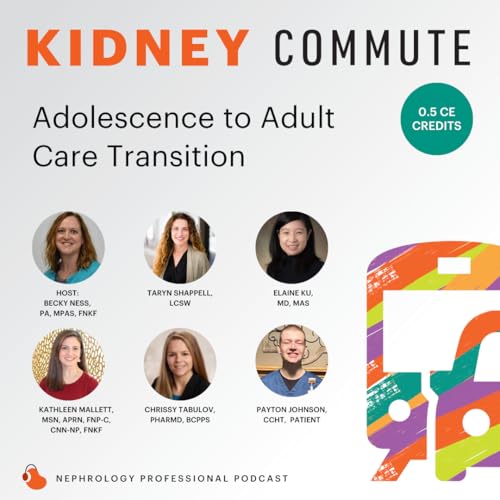
  • Adolescence to Adult Care Transition
    Jan 20 2026

    Navigating the transition from pediatric to adult kidney transplant care is one of the most pivotal and vulnerable periods for young patients. In this episode of the Kidney Commute, an interdisciplinary panel of nephrology, social work, nursing, pharmacy experts, and a kidney transplant recipient explore the medical, psychological, and social complexities that shape a successful transition. The discussion addresses readiness for independence, medication and insurance changes, adherence challenges, family dynamics, and coordinated handoffs between pediatric and adult teams. Through real-world insights and practical strategies, this episode highlights approaches to support continuity of care, protect graft survival, and empower young adults as they move into adult-centered transplant care.

    This episode is complemented by additional insights from a psychologist who was unable to join the discussion; related resources are available at this link.

    Show More Show Less
    32 mins
  • Pitstop: Uromodulin
    Dec 13 2025

    In this Kidney Commute: Pitstop episode, host Anna Gaddy, MD, FASN, FNKF, is joined by Kaice LaFavers, PhD, and Pranav Garimella, MBBS, MPH, to explore uromodulin. They discuss its role in infection defense, immune modulation, AKI and sepsis, genetic insights, and evolving methods to study its multiple forms. A concise, science driven look at why uromodulin matters in kidney health.

    Show More Show Less
    33 mins
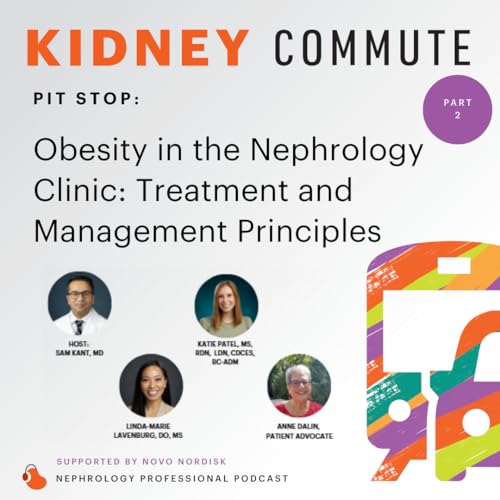
  • Pitstop: Part 2: Obesity in the Nephrology Clinic – Treatment and Management Principles
    Dec 1 2025

    Effective management of obesity in patients with CKD requires a holistic, interprofessional approach. In part 2 of this episode, the conversation continues with translating the evolving evidence into practical guidance for nephrology teams. Experts review the importance of a person-centered approach integrating lifestyle interventions, pharmacologic therapies, and surgical options with a focus on safety, efficacy, and kidney-related outcomes. The discussion emphasizes how members of the nephrology care team can collaborate to personalize treatment, address appetite and nutrition concerns, and help patients achieve meaningful weight loss without compromising kidney health. Tune in for actionable insights and strategies to translate emerging science into individualized, kidney-friendly, weight management strategies.

    Please be sure to visit the National Kidney Foundation's Obesity in the Nephrology Clinic page for additional information and access to an infographic designed to support clinical care for managing obesity in individuals living with CKD: https://www.kidney.org/professionals/tools/obesity-nephrology-clinic

    Supported by Novo Nordisk

    Show More Show Less
    31 mins
  • Pitstop: Part 1: Obesity in the Nephrology Clinic – Risks, Roles, and Real-World Strategies
    Dec 1 2025

    Obesity and chronic kidney disease (CKD) are deeply interconnected as each condition increases the risk and severity of the other. In part 1 of this episode, our interprofessional panel of experts explores the science behind this bidirectional relationship and the epidemiologic data underscoring their connection. Listeners will gain insight into the underlying pathophysiology, including the roles of inflammation, altered kidney hemodynamics, and lipotoxicity. Through practical discussion and dissection of the literature, this episode highlights the importance of recognizing obesity as both a cause and consequence of CKD, and the crucial role nephrology professionals play in interrupting this cycle early.

    Please be sure to visit the National Kidney Foundation's Obesity in the Nephrology Clinic page for additional information and access to an infographic designed to support clinical care for managing obesity in individuals living with CKD: https://www.kidney.org/professionals/tools/obesity-nephrology-clinic

    Supported by Novo Nordisk

    Show More Show Less
    25 mins
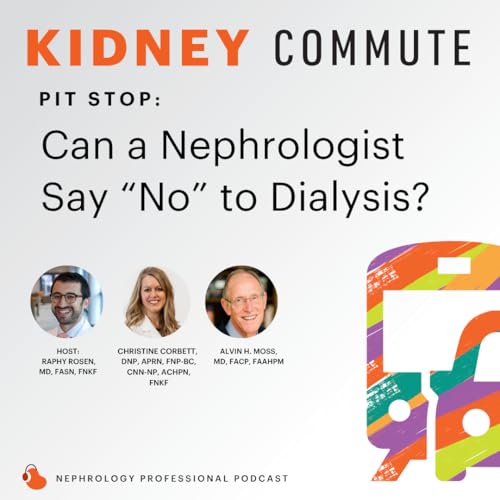
  • Pitstop: Can a Nephrologist Say "No" to Dialysis?
    Oct 13 2025

    When should dialysis be withheld at the end of life—and who makes that decision? Join host Raphy Rosen with experts Drs. Alvin Moss and Christine Corbett as they explore the ethical, clinical, and emotional challenges the nephrology team face when considering “no” to dialysis. Learn how shared decision-making, time-limited trials, and compassionate communication can help align care with patient values and improve end-of-life outcomes.

    Host: Raphy Rosen, MD, FASN, FNKF

    Panelists: Christine Corbett, DNP, APRN, FNP-BC, CNN-NP, ACHPN, FNKF and Alvin H. Moss, MD, FACP, FAAHPM

    Show More Show Less
    37 mins
  • Pitstop: Applying eGFR Trends to Clinical Practice when Treating Patients with IgAN
    Oct 2 2025

    In this episode, we explore the evolving role of surrogate endpoints in the management of IgA nephropathy (IgAN), with a particular focus on the significance of estimated glomerular filtration rate (eGFR). Of the completed Phase 3 trials in IgAN, one used time-weighted average eGFR, an area under the curve-based measure that reflects the average change in eGFR from baseline over a specified period, in this case, over the full 2-year study period. The other trial used total eGFR slope to describe the overall rate of change over 2 years. But what do these endpoints mean outside the setting of a clinical trial? Expert insights shed light on how proteinuria and eGFR trends can inform prognosis and guide treatment decisions in clinical practice over the long term. Listeners will gain a deeper understanding of how to interpret eGFR changes over time and apply this knowledge to optimize patient care. Designed for nephrology professionals, this episode offers practical, evidence-based perspectives on integrating these surrogate endpoints into the care of patients with IgAN.

    Supported by Calliditas Therapeutics

    Upon completion of the podcast, please take a moment to complete a brief survey: https://kidneyforms.tfaforms.net/4728109

    Show More Show Less
    31 mins
  • Benefits of Medical Nutrition Therapy (MNT)
    Sep 22 2025

    Chronic kidney disease (CKD) affects more than 35 million U.S. adults, yet only a small percentage see a dietitian before starting dialysis. In this episode of Kidney Commute, experts and a patient share how Medical Nutrition Therapy (MNT) can slow CKD progression, improve quality of life, and support patients in making sustainable dietary changes. Listeners will also gain practical insights on insurance coverage, referral pathways, and strategies to expand access to renal nutrition care.

    Show More Show Less
    43 mins