• 16 • The trauma-informed organisation
    Apr 16 2025

    Research studies have long established that workplace incivility, bullying and harassment is a traumatic experience for people affected by this unacceptable behaviour. It's self-evident that – at the extreme end of this continuum – any form of sexual harm is particularly traumatising.

    But to what extent does the way organisations respond to these kind of incidents actually exacerbate the harm caused to people who’ve already been traumatised by unacceptable workplace behaviour?

    'Trauma-informed' is a phrase that’s increasingly being used, but what does this mean in terms of practical steps that leaders, managers, Professional Standards Units, HR, lawyers and colleagues supporting one another need to take?

    In this episode, Tanya talks about Life at the Sharp End of training people and organisations to become trauma informed, and the practical steps that we can all take to support people around us when they are affected by unacceptable workplace behaviour.

    Would you like to know more?

    Visit priceperrott.com for this episode's show notes, and become a Price Perrott subscriber for exclusive access to additional insights and content

    Links
    • Follow Tanya Hallett on LinkedIn
    • Visit Tanya's website for Trauma Informed Practice Training
    Show More Show Less
    1 hr and 6 mins
  • 15 • Managing abrasive leadership behaviour
    Mar 18 2025

    A toxic culture is one result of workplace behaviour that includes incivility, bullying, harassment and a host of other unacceptable conduct. What action can leaders take to address this behaviour, other than following formal complaint processes and HR disciplinary investigations?

    Dr Laura Crawshaw is a researcher and practitioner who's spent her career looking into this behaviour, which she summarises with one simple word - “abrasive.”

    Are abrasive leaders just difficult people who need to be identified and removed from the workplace, or can they be persuaded to change their behaviour?

    Do they even understand what their behaviour is like and the harm it is causing to others?

    Dr Crawshaw is known as the “Boss Whisperer” coaching leaders in how to prevent - and address - the destructive impact of abrasive behaviour occurring in their organisations.

    If you’re a people leader who needs to deal with an abrasive individual that reports to you — or you’re someone working for an abrasive boss who just ‘rubs everyone up the wrong way’ —this episode provides important insights and practical techniques that’ll help you take action to intervene and turn the situation around.

    Would you like to know more?

    Visit priceperrott.com for this episode's show notes, and become a Price Perrott subscriber for exclusive access to additional insights and content.

    LINKS

    • Follow Dr Crawshaw on LinkedIn
    • Visit the Boss Whispering Institute's website
    • Read Dr Crawshaw’s latest book, “Grow your spine and manage abrasive leadership behavior”
    Show More Show Less
    45 mins
  • 14 • Active bystandership - how bystander behaviour changes workplace culture
    Feb 25 2025

    The role of bystanders in workplace incivility, bullying and harassment incidents is significant and their behaviour can influence the course of events.

    What do you do when you see something that’s just not right happening to someone nearby? Do you stand up and say something, or do you stand back and watch? What role does bystander behaviour play in establishing a workplace culture?

    Graham Goulden is a former police officer who’s combined his career experience in crime and violence prevention with his interest in the role bystanders play in changing the behaviour of others. Graham’s developed his own programme to help people understand how peer intervention can be used as a vital tool in preventing - or addressing - a toxic workplace culture.

    In this episode, we hear from Graham about his experience of Life at the Sharp End of creating positive cultural change through the behaviour of bystanders.

    Would you like to know more? Visit priceperrott.com for this episode's show notes, and become a Price Perrott subscriber for exclusive access to additional insights and content.

    LINKS • Connect with Graham Goulden on LinkedIn • Visit Graham’s website • Follow Graham on BlueSky • Buy Prof Phillip Zimbardo's book, "The Lucifer Effect" on Amazon [Affiliate link]

    Show More Show Less
    1 hr and 2 mins
  • 13 • Women in leadership - policing, professionalism and sexual harassment
    Jan 21 2025

    Charlotte Hails heads the Public Sector Vertical Strategy for Virgin Media O2 Business, working with customers in UK policing, the Home Office, Health and Local Government. She's an ambitious woman in leadership, who began her career in policing rising to become a Detective Chief Inspector leading people in counter-terrorism, safeguarding and public protection.

    But Charlotte’s experiences in policing also reflect the darker side of a workplace culture that women in uniformed services still find themselves having to deal with today. The last few years have highlighted problems of sexual harassment, bullying and misogyny towards women in emergency and armed services across the world.

    In this episode, Charlotte reflects on her own experiences in policing, the progress that UK policing is making and the contrast between positive and negative experiences in policing and her subsequent career in the private sector.

    Would you like to know more?

    Visit priceperrott.com for this episode's show notes, and become a Price Perrott subscriber for exclusive access to additional insights and content.

    LINKS

    • Charlotte's speech to the 2024 Women in Business Awards
    • Connect with Charlotte on LinkedIn
    Show More Show Less
    1 hr and 1 min
  • 12 • Bullying's impact on the human brain - harms caused and hopes for recovery
    Dec 17 2024

    Research studies have shown that bullying and harassment have serious medical consequences for people’s physical and psychological health and wellbeing.

    But what actually happens to the brain of people targeted by those who engage in this kind of unnecessary, unpleasant and unkind behaviour? Can people who’ve been targeted by bullies learn to recover their confidence and self-esteem, after suffering the harm caused by the behaviour they’ve been subjected to?

    Dr. Jennifer Fraser has applied her research mindset to investigate and understand the neuroscience behind bullying, and what it does to the human brain.

    Her book, “The Bullied Brain” explores the physical and emotional damage the brain of a bullying victim suffers, and looks into how the brain’s mechanisms for learning and recovery provide hope for the future.

    In this episode, you’ll hear about life at the sharp end of bullying neuroscience, as Jen Fraser discusses “The Bullied Brain” - and she gives a preview into her new book (due out later in 2025), “The Gaslit Brain”

    Would you like to know more?

    Visit priceperrott.com for this episode's show notes, and become a Price Perrott subscriber for exclusive access to additional insights and content.

    LINKS

    • Purchase The Bullied Brain on Amazon (affiliate link)
    • Dr. Jennifer Fraser’s website
    • Connect with Dr. Jennifer Fraser on LinkedIn
    • Read Jennifer Fraser's blog, The Bullied Brain in Psychology Today
    • Exercise your brain with BrainHQ training from Dr. Michael Merzenich
    Show More Show Less
    1 hr
  • 11 • Mental health stigma in emergency services
    Dec 10 2024

    Mark Bouchard has been in law enforcement since 2007 and has a Master’s degree in leadership, studying culture and mental health in policing. He’s the author of “Setting my sights on stigma: thoughts from an injured mind” - a candid and personal exploration of his own mental health journey and PTSD diagnosis.

    In this episode, Mark talks openly about some of the critical incidents he’s been involved in as a police officer, and the impact these can have on the mental health and wellbeing of front-line first-responders in the emergency services.

    We discuss leadership, and Mark gives practical examples of how leaders can create psychological safety and how we can all encourage and support people to be open about seeking support for their mental health.

    What is the role of leadership in setting the culture for a workplace, and what’s actually down to you - as an individual, and in your own teams - when it comes to creating culture, and supporting the people around you, when they need to talk about their mental health?

    This episode contains mentions of operational police call-outs, PTSD and suicide. If you think this episode might affect you in any way, you can find links to support resources in the show notes.

    Would you like to know more?

    Visit priceperrott.com for this episode's show notes, and become a Price Perrott subscriber for exclusive access to additional insights and content.

    LINKS

    • Mark Bouchard's website
    • Connect with Mark on LinkedIn
    • Police Mentors channel on YouTube

    REFERENCES

    • Ontario coroner’s inquiry report (2021) into police suicides
    • CIPSRT research publications into stressors and mental health in Canadian public services
    • Books from this podcast on Amazon (via affiliate links):
      • Mark Bouchard (2023) - Setting my sights on stigma : thoughts from an injured mind
      • Dr. Kevin Gilmartin (2021) - Emotional survival for law enforcement: A guide for officers and their families (revised edition)
      • Dave Grossman & Lauren Christensen (2008) - On combat: The psychology and physiology of Deadly Conflict in War and in Peace
    Show More Show Less
    1 hr and 6 mins
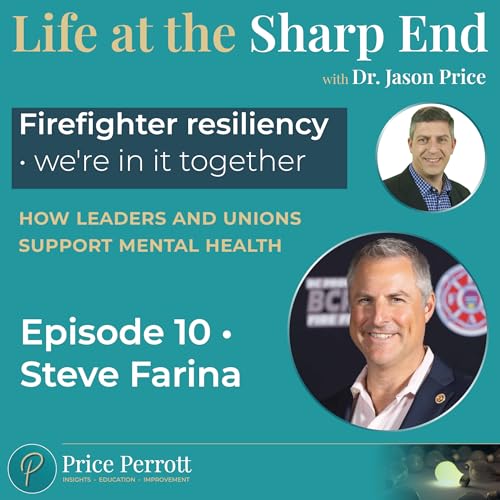
  • 10 • Firefighter resiliency - we're in it together
    Nov 26 2024

    The British Columbia Firefighter Resiliency Program is an innovative partnership that provides practical mental health support to Canadian firefighters.

    Steve Farina is Executive Vice President of the British Columbia Professional Firefighters Association and he’s played an instrumental role in the program and its success in supporting firefighter mental health.

    Steve’s extensive career, from volunteer and career firefighter to Captain, and a union executive, provides a fascinating perspective on the extent cultural changes he’s seen (and those still needed) in Fire and Rescue services.

    In this episode, Steve discusses what leaders in Fire and Rescue can do to create a respectful culture that mentors and supports their crews. He reflects on how leaders should be accountable for their behaviour; take ownership of their actions; and on the role that unions can play in working constructively with Fire Services to achieve common goals.

    The BC Firefighter Resiliency Program is one excellent example of how constructive engagement has produced a result that has, literally, saved lives.

    Would you like to know more?

    Visit priceperrott.com for this episode's show notes, and become a Price Perrott subscriber for exclusive access to additional insights and content.

    LINKS

      • Contact Steve by e-mail at mainlandnorth@bcpffa.org
      • Visit Steve’s LinkedIn page
      • The BC Professional Firefighters Association
      • The BC Firefighters Resiliency program
      • Blueprint - BCFFA’s partner in the Resiliency Program
      • Buy Extreme Ownership by Jocko Willink, the book referred to by Steve in this episode (affiliate link)
    Show More Show Less
    59 mins
  • 9 • Fire and Rescue service culture - how leaders shape the fire service family
    Nov 12 2024

    Chad Costa is Assistant Fire Chief at the City of Petaluma in California, USA. He has a passion for leadership, organisational change and improving culture in the fire service family, based on over twenty six years of experience in Fire and Rescue.

    As someone who’s lived life at the sharp end of Fire and Rescue culture, what can we learn from Chad about how developing leaders and supporting diversity in teams are key factors in tackling the cultural problems affecting many Fire and Rescue services across the world?

    In this episode you’ll hear about Chad’s own experiences of poor Fire and Rescue culture; how the probationary system reinforces outdated approaches and hinders cultural change; and how he’s taken positive steps with his organisation to encourage diversity of thought and leadership education.

    Chad talks about the importance of leaders living up to their promises, and his reflections that “we call people leaders - some people are just people in leadership positions.”

    If you’re part of the fire service family with a desire to make a positive difference in tackling incivility, bullying and harassment, this episode is packed with content that you can apply in your own situation.

    Would you like to know more?

    Visit priceperrott.com for this episode's show notes, and become a Price Perrott subscriber for exclusive access to additional insights and content.

    LINKS

    • Connect with Chad Costa on LinkedIn
    • Chad’s website, with links to Chad’s podcasts, videos, articles and other content
    • Watch a documentary about the heroes of California’s 2020 wildfires, featuring Chad.
    Show More Show Less
    59 mins