Episodes

  • 2 Thessalonians 2:13-3:5 · Luke 16:1-9 — Thursday, November 19, 2026
    Nov 19 2026

    A daily note from the team at OCABS.ORG, drawing on the published works of Fr. Paul Nadim Tarazi, with citations to his books and lectures.

    Readings: 2 Thessalonians 2:13-3:5; Luke 16:1-9.

    Paul tells the Thessalonians that God chose them "through sanctification of the Spirit and belief in the truth," calling them through the gospel so that they might obtain the glory of the Lord Jesus Christ. Fr. Paul reads this as more Pauline weaving into the eschatological vocabulary that Luke himself later draws on, since the verb for "obtaining" glory recurs only here and in a cognate verse of Luke's gospel, both tied to the coming judgment rather than any present possession of it.

    The letter insists that this gospel is not a free-floating oral tradition for anyone to reshape; Paul tells the church to "stand firm and hold to the traditions which you were taught by us, either by word of mouth or by letter," a phrase Fr. Paul calls a literary device meant to keep the readers pinned to the contents of the letter itself, not an invitation to invent a separate living tradition. The chapter's turn to comfort and "every good work and word" follows the same order: good behavior grounds the good word of teaching, and Paul's closing confidence that the Thessalonians "are doing and will do the things which we command" rests on God's own faithfulness to his plan rather than human achievement.

    Luke's parable of the dishonest manager uses the same vocabulary of stewardship, found in the phrase "turn in the account of your stewardship," that Paul applies elsewhere to his own apostolic commission, and Fr. Paul notes that outside Luke this triad of steward, found faithful, and praised appears only in Paul's description of himself as a steward awaiting God's judgment. The parable's own perspective is thoroughly Pauline: everything is to be judged from the standpoint of God's coming kingdom, holding together divine judgment and divine mercy as the key to what the dishonest manager does.

    The root pair of the day · שׁ-ק-ה šin–qof–he, שָׁקָה šaqah · س–ق–ي sīn–qāf–yāʾ, سَقَى saqā · cause to drink water; give to drink; water. The root pair of the day, as in the Triliteral Root of the Day: שָׁקָה (šaqah) and سَقَى (saqā), cause to drink water; give to drink; water. Hear every passage of the pair at ocabs.org. cf. The Consolation of Consonants

    Sources: Tarazi, The New Testament: An Introduction, vol. 2, Luke and Acts, “The Prodigal Son (11–32)”; Tarazi, Ephesians and 2 Thessalonians: A Commentary, p. 132; Tarazi, Ephesians and 2 Thessalonians: A Commentary, p. 135; Tarazi, The New Testament: An Introduction, vol. 2, Luke and Acts, “The Prodigal Son (11–32)”; Tarazi, Hebrews: A Commentary, p. 77.

    The note on ocabs.org

    Opening music: Taksim Arbi, Bichi Slama, oud (Tunis, Archives de la Parole, 1930s), public domain. Source: gallica.bnf.fr / BnF.

    The digital voice Fāṭima (فَاطِمَة) is named in honor of the learned women of al-Andalus, particularly Fāṭima bint Yaḥyā al-Maghāmī, Fāṭima al-Sharrāṭ, and Fāṭima bint al-Muthannā, whose legacies embody the Andalusian traditions of scriptural scholarship, jurisprudence, education, and wisdom.

    Show More Show Less
    6 mins
  • 2 Thessalonians 2:1-12 · Luke 15:1-10 — Wednesday, November 18, 2026
    Nov 18 2026

    A daily note from the team at OCABS.ORG, drawing on the published works of Fr. Paul Nadim Tarazi, with citations to his books and lectures.

    Readings: 2 Thessalonians 2:1-12; Luke 15:1-10.

    Fr. Paul reads 2 Thessalonians 2:1-12 as Paul's warning against being shaken by claims that "the day of Christ has already come." The lawless one, the "anti-god," will be revealed using the very vocabulary normally reserved for Christ -- power, signs, wonders, revealing, coming -- precisely because he is a counterfeit of the Lord, deceptively resembling him. Fr. Paul stresses that Satan can do only what God permits for the testing of humans, and that the responsibility for being deceived lies with those who refuse to love the truth and so choose falsehood over it.

    This counterfeit power is tied by Fr. Paul to the rulers of "this age," the imperial authority that crucified the Lord, which Satan lures into claiming a quasi-divine status; God alone remains the just judge who in his own time will expose the true face of each claimant and avenge the afflictions of the persecuted. Fr. Paul also notes that Paul forbids any teaching beyond his own letters, read aloud in the churches, so that no oral tradition or spurious letter can be used to unsettle believers about the day of the Lord.

    Turning to Luke 15:1-10, Fr. Paul treats the parables of the lost sheep and lost coin as two of three parallel stories in the chapter -- sheep, coin, and finally the lost son -- where the item has no value in itself but only in its role of being "lost and found." He points out that the key verb apollymi, destruction and loss, binds all three stories together, and that the call each time is to "rejoice with me," a joy the finder insists on sharing with friends and neighbors rather than keeping to himself, the very point on which, as he shows in the third parable, the older brother later fails.

    The root pair of the day · נ-ח-שׁ nun–ḥet–šin, נָחָשׁ naḥaš · ن–ح–س nūn–ḥāʾ–sīn, نَحِسَة naḥisa · serpent; hiss. The root pair of the day, as in the Triliteral Root of the Day: נָחָשׁ (naḥaš) and نَحِسَة (naḥisa), serpent; hiss. Hear every passage of the pair at ocabs.org. cf. The Consolation of Consonants

    Sources: Tarazi, 2 Corinthians: A Commentary, p. 104; Tarazi, 2 Corinthians: A Commentary, p. 103; Tarazi, Ephesians and 2 Thessalonians: A Commentary, p. 139; Tarazi, Galatians: A Commentary, p. 64; Tarazi, Ephesians and 2 Thessalonians: A Commentary, p. 131; Tarazi, Ephesians and 2 Thessalonians: A Commentary, p. 41; Tarazi, The Rise of Scripture, p. 340; Tarazi, The Rise of Scripture, p. 415; Tarazi, Ephesians and 2 Thessalonians: A Commentary, p. 124; Orthodox Audio Bible Commentary, Luke (vol. 42), part 2, at 1:01:31; Orthodox Audio Bible Commentary, Luke (vol. 42), part 2, at 1:03:48; Tarazi, The Rise of Scripture, p. 52.

    The note on ocabs.org

    Opening music: Taksim Arbi, Bichi Slama, oud (Tunis, Archives de la Parole, 1930s), public domain. Source: gallica.bnf.fr / BnF.

    The digital voice Fāṭima (فَاطِمَة) is named in honor of the learned women of al-Andalus, particularly Fāṭima bint Yaḥyā al-Maghāmī, Fāṭima al-Sharrāṭ, and Fāṭima bint al-Muthannā, whose legacies embody the Andalusian traditions of scriptural scholarship, jurisprudence, education, and wisdom.

    Show More Show Less
    6 mins
  • 2 Thessalonians 1:10-2:2 · Luke 14:25-35 — Tuesday, November 17, 2026
    Nov 17 2026

    A daily note from the team at OCABS.ORG, drawing on the published works of Fr. Paul Nadim Tarazi, with citations to his books and lectures.

    Readings: 2 Thessalonians 1:10-2:2; Luke 14:25-35.

    Paul tells the Thessalonians not to be shaken by any claim, oral or written, that the day of the Lord has already arrived, insisting that the only authoritative word is the one he himself put in writing: "not to be quickly shaken in mind or excited, either by spirit or by word, or by letter purporting to be from us." Fr. Paul reads this as the Apostle forbidding any appeal to a supposedly living oral tradition alongside or beyond the written gospel; the churches of Thessalonica, like those of Galatia and Corinth, know Paul's teaching only through his letters, so that any other spirit, word, or letter claiming his authority is itself the deception the text warns against. The same passage recurs across his commentaries as proof that scripture, once written, becomes the sole binding reference against which every later claim is tested.

    In 2 Thessalonians the rebellion and the lawless one are said to be already secretly working, and Fr. Paul connects the term for the "opposer" here to the same word used of those who trouble the Philippians, showing that in his reading the real adversary described in this letter works from inside the community, disguised, rather than as an outside enemy. He also notes that the goal of Christ being "glorified in his saints" and the fulfilling of "every desire of goodness and work of faith with power" are to be read together with the warning that follows, since the glorification is still ahead, contingent on holding to the one teaching already delivered, not already secured.

    The passages provided do not address the Lucan Gospel reading on carrying the cross, counting the cost, and salt losing its taste, so nothing from Fr. Paul on that text can be reported here.

    The root pair of the day · ע-ו-ד ʿayin–waw–dalet, עוֹד ʿod · ع–و–د ʿayn–wāw–dāl, عاد ʿād · a going round; return; go about. The pair ʿod and ʿād carries the sense of going round, return, and from it Hebrew yields ʿed, witness, and ʿedut, testimony, matching Greek marturion. In 2 Thessalonians 1:10 Paul writes that 'our testimony to you was believed,' the very marturion the note treats as the fixed written reference against which every later spirit, word, or letter claiming his authority must be tested. cf. The Consolation of Consonants

    Sources: Tarazi, Ephesians and 2 Thessalonians: A Commentary, p. 125; Tarazi, Philippians: A Commentary, p. 172; Tarazi, The Rise of Scripture, p. 340; Tarazi, The Rise of Scripture, p. 415; Tarazi, Ephesians and 2 Thessalonians: A Commentary, p. 41; Tarazi, The New Testament: An Introduction, vol. 2, Luke and Acts, “Discipleship and its Cost (25–33)”.

    The note on ocabs.org

    Opening music: Taksim Arbi, Bichi Slama, oud (Tunis, Archives de la Parole, 1930s), public domain. Source: gallica.bnf.fr / BnF.

    The digital voice Fāṭima (فَاطِمَة) is named in honor of the learned women of al-Andalus, particularly Fāṭima bint Yaḥyā al-Maghāmī, Fāṭima al-Sharrāṭ, and Fāṭima bint al-Muthannā, whose legacies embody the Andalusian traditions of scriptural scholarship, jurisprudence, education, and wisdom.

    Show More Show Less
    6 mins
  • 1 Peter 1:1-2:6 · 1 Peter 2:21-3:9 · 1 Peter 4:1-11 · John 21:15-25 · 1 Corinthians 4:9-16 · Matthew 9:9-13 · 2 Thessalonians 1:1-10 · Luke 14:12-15 — Monday, November 16, 2026
    Nov 16 2026

    A daily note from the team at OCABS.ORG, drawing on the published works of Fr. Paul Nadim Tarazi, with citations to his books and lectures.

    Readings: 1 Peter 1:1-2:6; 1 Peter 2:21-3:9; 1 Peter 4:1-11; John 21:15-25; 1 Corinthians 4:9-16; Matthew 9:9-13; 2 Thessalonians 1:1-10; Luke 14:12-15.

    Peter addresses "the chosen ones who are living as foreigners in the Dispersion," and Fr. Paul notes this opening parallels James, so that Peter stands as apostle to the Jews of the dispersion just as James stands as head of Judaism in the land. The letter is woven from the terminology of Romans: born anew to a living hope, an inheritance kept in heaven, guarded through faith for a salvation revealed at the end time. Fr. Paul stresses that faith and hope work together because trust is proven only by action over time, not by reciting a formula; the testing of faith like gold tried by fire shows whether the word has been obeyed.

    The ransom from "the futile ways inherited from your fathers" by the blood of a lamb without blemish, destined before the foundation of the world, is read by Fr. Paul as showing nothing in this plan is accidental; the message is manifested for the hearer's sake, as when the gospel reached Corinth or Macedonia because it was sent, not sought. He links holiness, "you shall be holy, for I am holy," to passing the time of exile, parikia, in fear, the same word used of Moses as paroikos in Midian and of believers as paroikoi who are no longer strangers but members of God's household. The newborn babies' longing for "pure spiritual milk" is tied to the same root as the Romans term logikos, meaning conformity to the gospel word, and the living stone rejected by men draws on Isaiah 28:16, the verse 1 Peter shares uniquely with Romans 9:33.

    In the second reading, Christ's silence under abuse, bearing sins in his body, and healing by his wounds come, in Fr. Paul's account, from Isaiah 53 and form the pattern for the whole household, wives, husbands, and the community, with Sarah's obedience to Abraham likened to Jerusalem's submission to God. The closing material presses the same point as Romans: the end is near, love covers sins, and each believer manages God's varied grace as a steward, whether speaking the oracles of God or serving by God's strength, so that God alone is glorified.

    The root pair of the day · ז-כ-ה zayin–kaf–he, זָכָה zakah · ز–ك–و zāy–kāf–wāw, زَكاة zakāt · be clear; clean; pure. The root pair of the day, as in the Triliteral Root of the Day: זָכָה (zakah) and زَكاة (zakāt), be clear; clean; pure. Hear every passage of the pair at ocabs.org. cf. The Consolation of Consonants

    Sources: Tarazi, The Pastorals: A Commentary, p. 109; Tarazi, The Rise of Scripture, p. 90; Tarazi, Romans: A Commentary, p. 230; Orthodox Audio Bible Commentary, 1 Peter (vol. 60), part 1, at 0:00; Tarazi, Decoding Genesis 1–11, p. 91; Tarazi, Decoding Genesis 1–11, p. 339; Orthodox Audio Bible Commentary, 1 Peter (vol. 60), part 1, at 0:00; Tarazi, The New Testament: An Introduction, vol. 3, Johannine Writings, p. 283.

    The note on ocabs.org

    Opening music: Taksim Arbi, Bichi Slama, oud (Tunis, Archives de la Parole, 1930s), public domain. Source: gallica.bnf.fr / BnF.

    The digital voice Fāṭima (فَاطِمَة) is named in honor of the learned women of al-Andalus, particularly Fāṭima bint Yaḥyā al-Maghāmī, Fāṭima al-Sharrāṭ, and Fāṭima bint al-Muthannā, whose legacies embody the Andalusian traditions of scriptural scholarship, jurisprudence, education, and wisdom.

    Show More Show Less
    11 mins
  • Mark 16:1-8 · Ephesians 2:14-22 · Luke 10:25-37 — Sunday, November 15, 2026
    Nov 15 2026

    A daily note from the team at OCABS.ORG, drawing on the published works of Fr. Paul Nadim Tarazi, with citations to his books and lectures.

    Readings: Mark 16:1-8; Ephesians 2:14-22; Luke 10:25-37.

    Mark's resurrection account ends not with an appearance but with an empty tomb and a command: Peter and the disciples are told to meet Jesus in Galilee. Fr. Paul reads this as Mark's deliberate undoing of Peter, "the main anti-hero" of the Gospel who keeps faltering, now given a chance to start over outside Jerusalem. Galilee stands for territory outside Judea, a wilderness place that in Fr. Paul's lectures parallels the earlier scene of Jesus praying in a lonely place before dawn; the same Greek word for 'early' ties the two episodes together. The women's silence and fear at the tomb, and Salome's presence alongside the two Marys, mark the still-hesitant Jerusalemite community, bound to the temple, being summoned toward the wider mission to the nations.

    Ephesians describes Christ as the one who tore down "the middle wall of separation" between Jew and Gentile, ending the hostility carried by the law of commandments and making the two into one new man. Fr. Paul shows how the passage piles up words built on the Greek root oik-, "house": no longer strangers and sojourners but members of the household, built upon the apostles and prophets, growing into a holy temple, a dwelling place of God in the Spirit. This building language, echoed from Colossians, presents the reconciled community itself, not a place in Jerusalem, as the site where God dwells, joined together through access to the Father in one Spirit.

    Asked who counts as neighbor, Jesus answers with the Samaritan who alone stops for the wounded man while the priest and Levite, already finished with their business in Jerusalem, pass by. Fr. Paul's lectures note the trap in the lawyer's question: one must not place oneself as the Levite judging who deserves help, but as the man on the road, and then "go and do what the Good Samaritan did." The command "Go and do likewise" answers the opening question about inheriting eternal life, and elsewhere Fr. Paul treats this love of neighbor as the whole of the law's commands, summed up without exception for outsider or stranger.

    The root pair of the day · שׁ-כ-נ šin–kaf–nun, מִשְׁכָּן miškan · س–ك–ن sīn–kāf–nūn, مِسْكِين miskīn · dwelling-place; settle down; abide. Miškan and miskīn root the note's discussion of Ephesians' building language: Christ's one new man grows into a holy temple, a dwelling place (katoikēterion) of God in the Spirit. The Greek skene, tent, and kataskenoo, to dwell, echo miškan, the tabernacle where God said, 'let them make me a sanctuary, that I may dwell among them.' The reconciled community itself becomes that dwelling, not a place in Jerusalem. cf. The Consolation of Consonants

    Sources: Tarazi, The New Testament: An Introduction, vol. 1, Paul and Mark, p. 82; Tarazi, The New Testament: An Introduction, vol. 4, Matthew and the Canon, p. 281; Orthodox Audio Bible Commentary, Mark (vol. 41), part 1, at 2:42:25; Tarazi, The New Testament: An Introduction, vol. 3, Johannine Writings, p. 259; Tarazi, Colossians and Philemon: A Commentary, p. 97; Tarazi, Colossians and Philemon: A Commentary, p. 53; Tarazi, Ephesians and 2 Thessalonians: A Commentary, p. 58; Tarazi, Ephesians and 2 Thessalonians: A Commentary, p. 68; Tarazi, Ephesians and 2 Thessalonians: A Commentary, p. 31; Tarazi, The Rise of Scripture, p. 467; Tarazi, Colossians and Philemon: A Commentary, p. 27; Tarazi, Decoding Genesis 1–11, p. 353; Orthodox Audio Bible Commentary, Luke (vol. 42), part 1, at 3:50:26; Tarazi, The Rise of Scripture, p. 55.

    The note on ocabs.org

    Opening music: Taksim Arbi, Bichi Slama, oud (Tunis, Archives de la Parole, 1930s), public domain. Source: gallica.bnf.fr / BnF.

    The digital voice Fāṭima (فَاطِمَة) is named in honor of the learned women of al-Andalus, particularly Fāṭima bint Yaḥyā al-Maghāmī, Fāṭima al-Sharrāṭ, and Fāṭima bint al-Muthannā, whose legacies embody the Andalusian traditions of scriptural scholarship, jurisprudence, education, and wisdom.

    Show More Show Less
    8 mins
  • 1 Corinthians 4:9-16 · John 1:43-51 · 2 Corinthians 11:1-6 · Luke 9:37-43 — Saturday, November 14, 2026
    Nov 14 2026

    A daily note from the team at OCABS.ORG, drawing on the published works of Fr. Paul Nadim Tarazi, with citations to his books and lectures.

    Readings: 1 Corinthians 4:9-16; John 1:43-51; 2 Corinthians 11:1-6; Luke 9:37-43.

    Paul's list of hardships in 1 Corinthians 4:9-16 is not a complaint about bad luck but a description tied directly to his apostolic labor. Fr. Paul notes that the six verbs forming three pairs describe "the apostle's beneficent response to aggressive behavior on the part of the world," and that the closing image of being treated as refuse alludes to gladiators thrown into the arena for the crowd's entertainment. The want, hunger, and homelessness are, in Fr. Paul's reading, "actual and thus real, not psychological or perceived," and the verb for labor specifically marks the taxing effort of preaching the gospel.

    Because Paul alone brought the Corinthians the gospel, he alone is their father, while other leaders are only pedagogues, slaves who escorted children to school. Fr. Paul observes that a pedagogue could threaten or beat the children in his charge, which prepares for Paul's later question about coming to them with a rod, and that since a person can have only one father, Paul's plea to be imitated is a parent's urging, not an authority contest among teachers. This same father-child language returns in 2 Corinthians, where Paul describes his jealousy over the church he betrothed to Christ as a pure bride, fearing that, as the serpent deceived Eve, the Corinthians' minds might be led away from sincere devotion to the one gospel Paul preached and toward a different Jesus, spirit, or gospel brought by others.

    On the Gospel, the lecture on John stresses the names of those called: Nathanael, called "an Israelite indeed, in whom is no deceit," a phrase Fr. Paul says is the same kind of language Paul uses of himself. Fr. Paul reads Philip, whose name is Greek, as representing the mission to the Gentiles, and Nathanael's name, meaning "God gives" or "God's gift," as reflecting the Jewish leadership's view of their election as recipients of God's gift in the Torah; Nathanael's doubt that anything good can come from Nazareth voices that same leadership's perspective before it yields to recognition of Jesus.

    The root pair of the day · ב-ד-ל bet–dalet–lamed, בָּדַל badal · ب–د–ل bāʾ–dāl–lām, بَدَّلَ baddala · be divided; separate; divide. The root pair of the day, as in the Triliteral Root of the Day: בָּדַל (badal) and بَدَّلَ (baddala), be divided; separate; divide. Hear every passage of the pair at ocabs.org. cf. The Consolation of Consonants

    Sources: Tarazi, 1 Corinthians: A Commentary, p. 93; Tarazi, 1 Corinthians: A Commentary, p. 93; Tarazi, 1 Corinthians: A Commentary, p. 95; Orthodox Audio Bible Commentary, John (vol. 43), part 1, at 53:41; Tarazi, The New Testament: An Introduction, vol. 3, Johannine Writings, p. 147; Tarazi, 2 Corinthians: A Commentary, p. 196; Tarazi, 2 Corinthians: A Commentary, p. 195; Tarazi, 2 Corinthians: A Commentary, p. 197.

    The note on ocabs.org

    Opening music: Taksim Arbi, Bichi Slama, oud (Tunis, Archives de la Parole, 1930s), public domain. Source: gallica.bnf.fr / BnF.

    The digital voice Fāṭima (فَاطِمَة) is named in honor of the learned women of al-Andalus, particularly Fāṭima bint Yaḥyā al-Maghāmī, Fāṭima al-Sharrāṭ, and Fāṭima bint al-Muthannā, whose legacies embody the Andalusian traditions of scriptural scholarship, jurisprudence, education, and wisdom.

    Show More Show Less
    7 mins
  • John 10:1-9 · Hebrews 7:26-8:2 · John 10:9-16 · Luke 13:31-35 — Friday, November 13, 2026
    Nov 13 2026

    A daily note from the team at OCABS.ORG, drawing on the published works of Fr. Paul Nadim Tarazi, with citations to his books and lectures.

    Readings: John 10:1-9; Hebrews 7:26-8:2; John 10:9-16; Luke 13:31-35.

    John's parable of the sheepfold draws its vocabulary from Ezekiel. Fr. Paul points out that the Hebrew sha'ar ("gate") behind Ezekiel 46 becomes in the Septuagint pyle, except in one place where it is rendered thyra, the very Greek word John uses for Jesus as "the door." He lines up the correspondence: "he who enters by the door is the shepherd of the sheep"; "he calls his own sheep by name and leads them out"; "he goes before them." In his recorded comments Fr. Paul adds that the story's movement of going out and coming in reflects the sheep following a real shepherd's distinct call, and that without that voice the flock only scatters, so that scattered sheep "are dead sheep." Elsewhere he identifies the thieves and robbers who came before Jesus with the Jerusalem leadership, who conspire against Lazarus and so prove themselves thieves seeking to "kill and destroy."

    Jesus names himself both door and shepherd, and Fr. Paul notes that Jesus is not someone to be carried but his teaching, since the whole Gospel of John concerns the logos; one must "walk him," meaning walk his teaching. The hired hand who abandons the sheep at the sight of the wolf is contrasted with the one who owns the flock and lays down his life for it; Fr. Paul observes that this word for hireling occurs elsewhere in the New Testament only with the sons of Zebedee, carrying the same sense of one who serves his own interest. The gathering of the other sheep into "one flock, one shepherd" matches, in Fr. Paul's judgment, the same gathering of Jews and Gentiles into one people of God that Paul describes in Romans 11.

    Hebrews presents Christ as the high priest who needed no repeated sacrifice, since unlike the Levitical priests who offered first for their own sins and then for the people's, he offered himself once for all. Fr. Paul explains that this permanence is guaranteed by God's oath, sworn after the law and never to be revoked, in contrast to a law that "made nothing perfect." Seated now at the right hand of the Majesty, this priest serves "the true tabernacle which the Lord pitched, not man," a tent Fr. Paul reads alongside Hebrews' later language of copy and shadow, where the earthly sanctuary built by Moses according to a pattern shown him on the mountain only foreshadows the heavenly reality now opened in Christ.

    The root pair of the day · שׁ-כ-נ šin–kaf–nun, מִשְׁכָּן miškan · س–ك–ن sīn–kāf–nūn, مِسْكِين miskīn · dwelling-place; settle down; abide. The root behind miškan and miskīn yields Greek skene and kataskenoo, the very words for the tabernacle Hebrews says Christ now serves, "the true tabernacle which the Lord pitched, not man." The earthly miškan Moses built was only a dwelling-place foreshadowing the heavenly one now opened in Christ, the true place where God makes his dwelling among his people. cf. The Consolation of Consonants

    Sources: Tarazi, The New Testament: An Introduction, vol. 3, Johannine Writings, p. 199; Orthodox Audio Bible Commentary, John (vol. 43), part 1, at 3:04:03; Tarazi, The Rise of Scripture, p. 477; Tarazi, The New Testament: An Introduction, vol. 3, Johannine Writings, p. 198; Tarazi, The New Testament: An Introduction, vol. 3, Johannine Writings, p. 208; Tarazi, The New Testament: An Introduction, vol. 3, Johannine Writings, p. 198; Tarazi, Hebrews: A Commentary, p. 108; Tarazi, Hebrews: A Commentary, p. 102; Tarazi, Hebrews: A Commentary, p. 136; Tarazi, Hebrews: A Commentary, p. 99; Tarazi, The Rise of Scripture, p. 477; Tarazi, The New Testament: An Introduction, vol. 1, Paul and Mark, p. 96.

    The note on ocabs.org

    Opening music: Taksim Arbi, Bichi Slama, oud (Tunis, Archives de la Parole, 1930s), public domain. Source: gallica.bnf.fr / BnF.

    The digital voice Fāṭima (فَاطِمَة) is named in honor of the learned women of al-Andalus, particularly Fāṭima bint Yaḥyā al-Maghāmī, Fāṭima al-Sharrāṭ, and Fāṭima bint al-Muthannā, whose legacies embody the Andalusian traditions of scriptural scholarship, jurisprudence, education, and wisdom.

    Show More Show Less
    7 mins
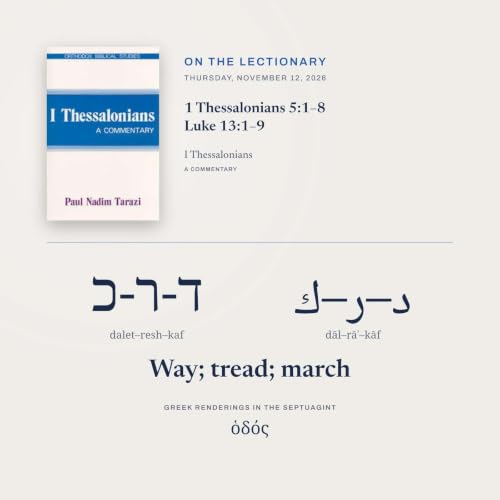
  • 1 Thessalonians 5:1-8 · Luke 13:1-9 — Thursday, November 12, 2026
    Nov 12 2026

    A daily note from the team at OCABS.ORG, drawing on the published works of Fr. Paul Nadim Tarazi, with citations to his books and lectures.

    Readings: 1 Thessalonians 5:1-8; Luke 13:1-9.

    Paul tells the Thessalonians they need no instruction about the times and seasons, for they themselves know well that the day of the Lord comes "like a thief in the night," precisely when people are saying "peace and security." Fr. Paul traces this teaching of suddenness and hardship to the early church tradition of Jesus' own words about the last days, pointing to the close similarity between this passage and the material preserved in Luke's Gospel. The point is not calculating dates but readiness: believers are children of the day, not of night or darkness, so sleep and drunkenness, the behavior of night, are to be put away.

    Fr. Paul shows that sobriety in this passage is bound up with judgment language elsewhere in Paul's letters: the same verb for being sober found here is used in First Corinthians to say that in order to recognize the Lord's coming among us, it is not enough to be awake, "one is to be sober." Putting on the breastplate of faith and love and the helmet of the hope of salvation echoes Isaiah's armor imagery, and this hope is not an already-given assurance but points to an outcome still ahead, since Paul later has to insist unequivocally that "the Lord has not come yet." In his lecture on Luke, Fr. Paul links this same light and darkness contrast to Jesus telling his disciples to watch lest their hearts be weighed down with dissipation and drunkenness, addressed to believers themselves, not outsiders.

    On the Galileans and the tower of Siloam, Fr. Paul explains that Jesus refuses the assumption that such sufferers were greater sinners than others; rather, all alike are told that unless they repent they will perish in the same way. The parable of the barren fig tree that follows is read as addressed basically to the Gentiles: what happened to Israel will happen to them too if they fail to bear fruit, even if judgment is delayed while the vinedresser works the ground a while longer. Elsewhere Fr. Paul connects this fig-tree image to the wider scriptural pattern of trees mentioned alongside judgment, where a tree is finally cut down for not producing, so that a people, like a tree, is judged by its fruit.

    The root pair of the day · ד-ר-כ dalet–resh–kaf, דֶּ֫רֶךְ derek · د–ر–ك dāl–rāʾ–kāf, أَدْرَكَ ʾadraka · way; tread; march. The root pair of the day, as in the Triliteral Root of the Day: דֶּ֫רֶךְ (derek) and أَدْرَكَ (ʾadraka), way; tread; march. Hear every passage of the pair at ocabs.org. cf. The Consolation of Consonants

    Sources: Tarazi, Decoding Genesis 1–11, p. 54; Tarazi, Ephesians and 2 Thessalonians: A Commentary, p. 41; Tarazi, 1 Corinthians: A Commentary, p. 283; Tarazi, I Thessalonians: A Commentary, p. 185; Tarazi, I Thessalonians: A Commentary, p. 42; Orthodox Audio Bible Commentary, Luke (vol. 42), part 2, at 2:32:21; Orthodox Audio Bible Commentary, Luke (vol. 42), part 2, at 43:54; Orthodox Audio Bible Commentary, Luke (vol. 42), part 2, at 41:46; Tarazi, Colossians and Philemon: A Commentary, p. 42.

    The note on ocabs.org

    Opening music: Taksim Arbi, Bichi Slama, oud (Tunis, Archives de la Parole, 1930s), public domain. Source: gallica.bnf.fr / BnF.

    The digital voice Fāṭima (فَاطِمَة) is named in honor of the learned women of al-Andalus, particularly Fāṭima bint Yaḥyā al-Maghāmī, Fāṭima al-Sharrāṭ, and Fāṭima bint al-Muthannā, whose legacies embody the Andalusian traditions of scriptural scholarship, jurisprudence, education, and wisdom.

    Show More Show Less
    6 mins