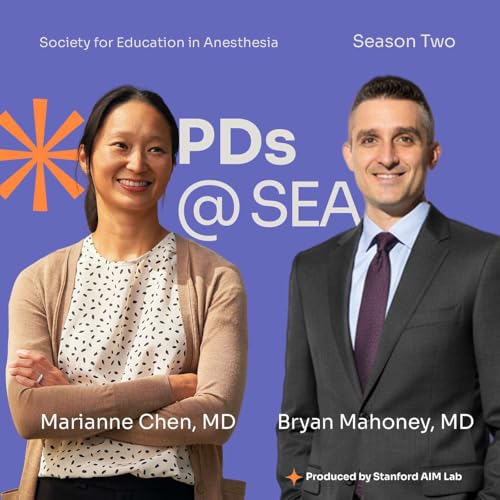
PDs @ SEA cover art

PDs @ SEA

PDs @ SEA

Written by: Stanford Anesthesia Informatics and Media (AIM)Lab
Listen for free

PDs @ SEA is a conversation series created for anesthesiology residency leaders, faculty, and trainees who want an honest look into the evolving world of anesthesia education. The show features Residency Program Directors from across the country discussing the decisions, challenges, and real-world considerations behind recruiting, training, and supporting residents.


Hosts Bryan and Marianne draw from their own experiences while inviting colleagues to reflect on practical issues such as changes to the interview and application process, transitions in leadership, and shifting expectations in graduate medical education. Each episode offers candid dialogue, shared lessons, and the sense of community that many program directors look for but often find difficult to access in day-to-day work.


The series includes in-depth conversations with current and former residency leaders, members of the American Society of Anesthesiologists Medical Student Component, and educators who are shaping how residents learn. Together, these discussions provide insight into how program directors think, how residency decisions are made, and how the field continues to adapt to the needs of students, residents, and institutions.


Produced by the Stanford AIM Lab on behalf of the Society for Education in Anesthesiology.


For questions, topic suggestions, or to join the conversation, email: pdsatsea@seahq.org

© 2026 PDs @ SEA
Episodes
  • Bryan Mahoney with Carol Diachun MD Season 2 Episode 7
    42 mins
  • Leading Beyond the OR: Lessons from U.S. Surgeon General Jerome Adams
    Aug 4 2026

    Technical excellence has always been central to anesthesiology. Increasingly, however, the future of the specialty will depend on something equally important: leadership, communication, and the ability to build trust.

    In this episode of PDs at SEA, Dr. Marianne Chen welcomes former U.S. Surgeon General Dr. Jerome Adams for a wide-ranging conversation about what anesthesiology educators should be teaching beyond clinical knowledge. Drawing on his experience as a practicing anesthesiologist, state health commissioner, U.S. Surgeon General, and current Director of Purdue University’s Center for Health Equity, Dr. Adams reflects on how trust shapes patient care, public health, and the future of medicine.

    The discussion explores why communication deserves to be taught with the same rigor as procedural skills, how advocacy should begin with the needs of patients rather than the profession, and why leadership training can no longer be viewed as optional for physicians. Dr. Adams also shares practical ideas for incorporating communication, systems thinking, artificial intelligence, and leadership development into residency education while encouraging educators to identify and cultivate future physician leaders.

    The conversation concludes with reflections on mentorship, service, and the importance of saying “yes” to opportunities early in one’s career. Throughout, Dr. Adams offers a compelling vision of anesthesiologists as clinicians, educators, advocates, and trusted leaders capable of improving not only individual patient encounters but the healthcare system itself.

    Key Takeaways From This Episode

    • Trust is one of the most important determinants of effective patient care and public health.
    • Communication should be taught, practiced, and assessed with the same intentionality as procedural skills.
    • Advocacy is most effective when it begins with patients’ interests rather than physicians’ interests.
    • Leadership, systems thinking, and health policy should become core components of anesthesiology training.
    • Artificial intelligence will change anesthesiology, making adaptability and critical evaluation essential skills.
    • Early involvement in organized medicine and advocacy creates opportunities for future leadership.
    • Mentorship shapes careers by helping learners recognize possibilities they cannot yet see in themselves.

    Especially Useful For

    Program directors, associate program directors, clerkship directors, faculty educators, residents interested in leadership and advocacy, department chairs, and anyone interested in preparing anesthesiologists to lead both inside and beyond the operating room.

    Related Episodes

    • Early Exposure, Better Advice: Medical Student Education and the Future of Anesthesiology
    • Everything You Wanted to Know About Being a Program Director
    • Global Health Opportunities in Anesthesia
    Show More Show Less
    36 mins
  • Match Day Reflections: What This Year Taught Program Directors
    Apr 19 2026

    Episode Summary

    Residency recruitment is often discussed in terms of outcomes, match rates, fill rates, and competitiveness. Less often is it examined as a continuous, year-round process shaped by strategy, signaling, and evolving applicant behavior.

    In this episode of PDs@SEA, Dr. Marianne Chen and Dr. Bryan Mahoney reflect on the most recent Match, sharing initial reactions and what this recruitment cycle reveals about the current state of anesthesiology training. From the sheer volume of work behind recruitment to the increasing competitiveness of the specialty, the conversation highlights how both programs and applicants are adapting in real time.

    The discussion explores how signaling continues to shape application review and match outcomes, including emerging trends in gold versus silver signals and the unintended consequences of applicants “gaming” the system. The episode also examines shifts in the applicant pool, including broader interests, growing demand for away rotations, and evolving expectations around career flexibility, innovation, and global health.

    These themes are grounded in the operational realities of recruitment: how programs screen applicants with limited data, how away rotations influence selection, and how program directors refine their internal processes over time. The conversation also offers practical insight for new program directors, emphasizing rank list integrity, iterative improvement, and the long-term value of investing deeply in recruitment.

    The episode closes with advice for applicants, including the importance of meaningful exposure to anesthesiology and a realistic understanding of the specialty’s day-to-day demands, particularly the unpredictability of clinical work. Taken together, this discussion captures a specialty in transition, where demand is high, systems are evolving, and both applicants and educators are recalibrating expectations.

    Key Takeaways From This Episode

    • The anesthesiology match remains highly competitive, with strong applicant pools and high fill rates across programs.
    • Signaling continues to improve application review and match alignment, with increasing differentiation between gold and silver signals.
    • Applicant behavior is evolving, including strategic use of signals and broader interests beyond traditional clinical pathways.
    • Away rotations remain the most reliable way to assess fit, while also introducing access and equity challenges.
    • Recruitment is a year-round effort, and early, intentional investment in the process improves downstream outcomes.
    • There is no single “correct” selection algorithm; programs must define success based on their own priorities and iterate over time.
    • Applicants benefit from deeper exposure to anesthesiology, including understanding the unpredictability of clinical practice.

    Especially Useful For

    Program directors, associate program directors, residency leadership teams, department chairs, and clinician-educators focused on recruitment strategy and the evolving anesthesiology workforce pipeline.

    Related Episodes

    • The Truth About Signaling, Letters of Intent, and The Match: A PD’s Unfiltered Guide
      A practical deep dive into signaling strategy, applicant behavior, and how programs interpret interest during the match process.
    • So the Applications Just Dropped: How Program Directors Actually Read Them
      A behind-the-scenes look at how PDs screen applications, manage volume, and make interview decisions.
    Show More Show Less
    38 mins
adbl_web_anon_alc_button_suppression_t1
No reviews yet