Season's Savings | ₹5/mo for 3 months

₹199/month after first 3 months. Renews automatically. Terms apply.
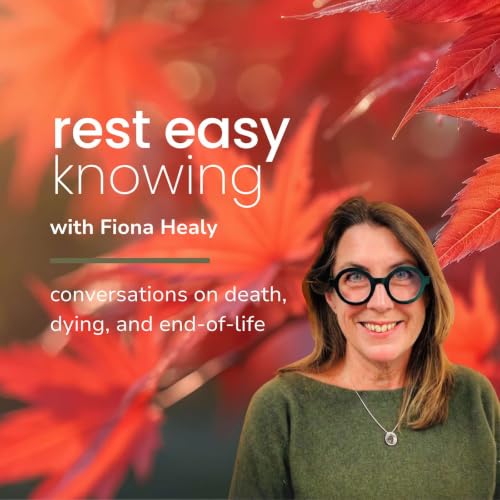
Rest Easy Knowing cover art

Rest Easy Knowing

Rest Easy Knowing

Written by: Fiona Healy
Listen for free

About this listen

Conversations with experts to help people better understand death, dying and end-of-life.


We talk with professionals working in end-of-life matters, and ask them the questions you might have been wondering about, but were not prepared to ask.

© 2026 Rest Easy Knowing
Hygiene & Healthy Living
Episodes
  • Want to work in the funeral sector? What you need to know.
    Oct 27 2026
    Send us Fan MailWorking in the funeral sector - with the Last Hurrah Funerals Co-Founder, Stass JonesHow much do we really know about the industry behind our loved one's funeral?In Australia, the funeral sector is a multi-billion-dollar industry made up of hundreds of businesses, from large corporate operators to small independent funeral directors. Yet the industry remains surprisingly unfamiliar to most of us.In this episode of Rest Easy Knowing, we step back from the experience of arranging an individual funeral and look at the funeral sector itself.Stass Jones, co-founder of The Last Hurrah Funerals, an independent funeral provider in Melbourne, discusses how the industry operates, how concentrated it has become, the push for greater regulation, the challenges facing smaller operators and what all of this means for consumers.In this episode we explore:The growth and consolidation of the funeral industryWho owns some of Australia's best-known funeral brandsHow people enter the funeral professionThe different roles within the sectorQualifications and training for funeral professionalsWhy the level of regulation in funeral care may surprise youThe debate around greater regulation of the sectorWhat “briefcase operators” means — and why they matterWhether regulation could unintentionally disadvantage small and culturally specific funeral providersThe role of funeral industry associationsPricing transparency and what consumers can expect to payWhy the cost of seemingly similar funeral services can vary dramaticallyThe commercial pressures facing independent funeral businessesHow funeral directors balance affordability with the need to run a sustainable businessThe cost of burial and cemetery spaceThe future of the funeral sectorWhy greater death literacy could change the relationship between families and funeral providersA highly concentrated industryThe funeral sector can feel very local. You might know the funeral home in your suburb and assume it's an independently owned local business.But the Australian industry is considerably more concentrated than many people realise.The episode looks at the role of large operators and the growth of consolidation, alongside the independent funeral directors trying to provide an alternative model.Stass doesn't see the future as necessarily being a battle between corporate and independent providers. Her view is that there is room for different models — provided they operate with the right ethics and attitude.How regulated is the funeral industry?Stass talks about regulations covering certain aspects of funeral and mortuary services, and the levels of oversight in practice. She argues that regulation, when done well, can play a helpful role in protecting families and maintaining standards.She then considers how the shape of regulation can affect different businesses. In particular, she points out that rules designed for larger funeral groups may unintentionally create barriers for smaller operators, including those that grow over time by bringing more services in-house after starting with outsourced support.The “briefcase operators”The term “briefcase operator” refers to smaller funeral businesses that can begin without owning a mortuary, hearse fleet or large funeral home.Instead, they can initially work with third-party providers for services such as mortuary care and transportation.Stass describes The Last Hurrah as having grown in this way and now bringing more services in-house as the business has developed.She argues that this model can provide an important pathway for smaller and more diverse funeral businesses — and that regulation needs to avoid unintentionally shutting them out.What does consolidation mean for consumers?Greater consolidation doesn't necessarily mean there is no competition.Stass points out that funeral companies are required to publish their pricing, although she questions how effectively that requirement is policed.She also gives an eye-opening example: direct cremation can range from around $1,800 to $7,000 for what may appear to be essentially the same service.The point isn't necessarily that the cheapest funeral is the best funeral.It's that consumers need enough information to understand what they're paying for and why prices differ.And increasingly, greater death literacy means people are asking more questions rather than simply accepting whatever is presented to them at a time when they're vulnerable.Can an independent funeral business survive?Running a funeral business isn't simply about charging families for a service.Stass talks candidly about the tension between keeping funerals affordable and running a sustainable business that employs people and pays its bills.The Last Hurrah has tried to keep prices as low as possible and has established a philanthropic fund to assist families who need additional support. But Stass also acknowledges that a funeral business needs to value the skills, time and experience of its...
    Show More Show Less
    35 mins
  • After a death: managing an estate
    Oct 13 2026
    Send us Fan MailThe Practicalities of Managing an Estate with Julia Tutt Senior Associate, de Groots Wills and Estates Lawyers. Most of us know we should have a Will. Far fewer of us understand what happens after someone dies.Who deals with the bank accounts? What happens to the house? Who pays the bills and taxes? What exactly does an executor have to do — and how long does it all take?And what happens when family members don't agree?In this episode of Rest Easy Knowing, Fiona is joined by Julia Tutt, Senior Associate at de Groots Wills and Estate Lawyers, to take us through what estate administration actually involves.Julia explains what an estate is, what an executor does, when probate is required, what happens when someone dies without a Will, and why administering an estate can become considerably more complicated than people expect.We also talk about family disputes, beneficiaries, charities, assets held overseas and the qualities to look for when choosing an executor.In this episode we explore:What actually forms part of someone's estateWhy superannuation doesn't automatically form part of an estateHow trusts can sit outside an estateWhat happens in the immediate period after someone diesHow funeral expenses can be paid from the deceased's bank accountWhat an executor is responsible forWhen an executor needs to obtain a grant from the courtWhat happens to property, bank accounts and other assetsWhy executors can face significant responsibilities and potential liabilityWhat happens when beneficiaries disagreeWhat happens when someone dies without a Will — intestacyWhat happens when assets are held in different Australian states or overseasWhy choosing an executor isn't simply about picking the eldest childWhether someone can refuse an appointment as executorWhat executor's commission isWhy keeping proper accounts and records mattersWhat can turn a straightforward estate into a very complicated oneWhy charities named in a Will are still entitled to their giftHow good preparation can make things much easier for the people left behindWhat does an executor actually do?Being named as an executor isn't just an honour or a formality.An executor may have to organise the funeral, obtain the necessary court grant, identify and collect assets, deal with banks and other institutions, manage property, arrange tax returns, deal with debts and potential claims, keep beneficiaries informed and ultimately distribute the estate according to the Will.And that's in a relatively straightforward estate.As Julia explains, executors can underestimate both the amount of paperwork involved and the potential liability they carry — particularly if someone makes a claim against the estate.Probate: what is it actually for?Probate is a grant made by the court confirming that the Will is the deceased person's last Will and that the named executor has the legal authority to administer the estate.Once probate has been granted, the executor can generally deal with assets that require that authority, such as selling estate property and collecting funds from institutions that require the grant.Not every asset necessarily requires probate before it can be dealt with, however. Requirements can vary between financial institutions and jurisdictions.What if there is no Will?When someone dies without a Will, they are said to have died intestate.Instead of an executor appointed by a Will, an administrator deals with the estate, and the distribution is determined by the relevant intestacy laws.Those laws differ between Australian states and territories, and family circumstances can make things particularly complicated — especially where there are separated spouses, blended families or estranged children.When families don't agreeThis is where estate administration can become very difficult.Disputes between beneficiaries, disagreements between co-executors, claims against the estate and delays in selling or distributing assets can turn an administrative process into litigation.Julia talks about the reality of family tensions surfacing after a parent or other family member dies — sometimes bringing conflicts that have been simmering for years to the surface.And beneficiaries aren't necessarily required to simply wait indefinitely. Executors have a responsibility to administer an estate in a timely manner, and beneficiaries can seek the court's intervention where an estate isn't being properly administered.Choosing an executorWho should you appoint?Julia's advice is to look beyond family hierarchy.Being the eldest child doesn't automatically make someone the best executor. An executor needs to be organised, motivated, practical, objective and honest — because there can be substantial work and responsibility involved.And there's a simple step that can prevent an awkward situation later:Ask them first.If you're considering appointing a friend or family member as your executor, talk to them about whether they're actually willing to ...
    Show More Show Less
    37 mins
  • Choosing the end: voluntary assisted dying
    Sep 29 2026
    Voluntary Assisted Dying - Understanding the Process and Your Options with VAD Navigator Nicky StittVoluntary assisted dying is something many of us know exists, but very few of us understand until we or someone we love is facing an advanced, life-limiting illness.In this episode of Rest Easy Knowing, Fiona speaks with Nicky Stitt, a registered nurse and VAD Navigator with the Victorian Statewide Voluntary Assisted Dying Navigator Service.Nicky explains what voluntary assisted dying actually is, who may be eligible, what the assessment process involves and, importantly, the role of the care navigator in supporting patients and their families.This is not a conversation about persuading anyone to choose VAD. It's about understanding an end-of-life option that is available under Australian law and knowing where to turn for accurate information and support.In this episodeWe talk about:What voluntary assisted dying is — and what it isn'tThe strict eligibility requirementsWhy the decision must be the person's ownThe importance of maintaining decision-making capacity throughout the processHow the VAD assessment process worksThe role of the VAD NavigatorHow navigators support patients, families and health professionalsWhy regional and rural access can be more complicatedThe importance of gathering medical and identity documentationWhy establishing a person's prognosis can sometimes be difficultHow long the VAD process generally takesWhat can happen when someone is very close to the end of their natural lifeWhy some people begin the process but don't ultimately use the medicationCommon misconceptions about VADThe importance of knowing about VAD before you urgently need itHow family members can support someone considering VADWhat is voluntary assisted dying?Nicky explains that VAD involves a person making a conscious decision about whether they want to access medication that can bring about their death, subject to strict legal eligibility requirements.The decision must be made by the person themselves. They must have decision-making capacity and maintain that capacity throughout the assessment process and when they choose whether or not to take the medication. Another person cannot make that decision on their behalf.In Victoria, current eligibility requirements include being aged 18 or over, being an Australian citizen or permanent resident, having lived in Victoria for at least 12 months, having an advanced disease that is expected to cause death within the relevant timeframe, and experiencing suffering that is unacceptable to the person. (Health Victoria)What does a VAD Navigator do?This is one of the most useful parts of the conversation.VAD Navigators aren't there simply to process paperwork. They provide information and support to patients, families, carers and health professionals, and can help connect people with doctors and other services.Nicky describes the role as a central source of support — particularly because doctors may be providing VAD care alongside their broader medical responsibilities. Navigators can bring additional nursing or social-work perspectives to the process and help patients and families work through practical issues.The Victorian Government similarly describes care navigators as nurses and allied health professionals who can explain the process, help people find eligible assessing doctors and connect patients and families with appropriate support. (Health Victoria)How long does the process take?Nicky explains that the process generally takes around four to six weeks in metropolitan areas, although it can take longer in regional areas because of access to doctors.For people with some neurodegenerative conditions, an additional specialist assessment can extend the timeframe further.In some circumstances, where a person is very close to the end of their natural life and the necessary doctors and requirements are in place, some timeframes may be shortened. Nicky says this is relatively uncommon.That makes one message particularly important: don't wait until the last minute to find out how the process works.The paperwork mattersOne of the less obvious challenges Nicky discusses is documentation.Navigators may need to establish a person's identity, citizenship or residency and gather medical information about their diagnosis, treatment and prognosis.Sometimes obtaining documents such as birth certificates can take significant time. Navigators may also need to work with a person's GP, specialists and hospitals to build a clear picture of their medical circumstances.Regional accessAccess can be more challenging outside metropolitan areas.Navigators may travel significant distances to meet people face-to-face, while access to doctors who can undertake the necessary assessments can be more limited.That doesn't mean people in regional areas can't access support. It does mean that planning ahead can be particularly important.A conversation worth having before you need itPerhaps the ...
    Show More Show Less
    53 mins
adbl_web_anon_alc_button_suppression_t1
No reviews yet