Episodes

  • Saturn: Crown Jewel of Our Solar System
    Sep 24 2026

    Hey! I'd love to hear your thoughts, send me a voice note.

    Saturn: Crown Jewel of Our Solar System | Solar System Odyssey

    Eight worlds behind us, and now we reach the one every telescope points at first — not because it's the biggest, not because it's the most violent, but because nothing else in the sky looks quite so deliberately beautiful. Saturn wears rings made of a trillion pieces of ice and rock, some no larger than a grain of sand, others the size of a house, all held in place by nothing but physics and patience.

    Imagine a planet so light it would actually float if you dropped it into a bathtub large enough to hold it — Saturn's density is lower than water, the only planet in the solar system that can make that claim. And yet this same "lightweight" world commands a ring system spanning nearly 175,000 miles across, while standing barely a kilometer thick in most places. Scale like that shouldn't make sense. It does anyway.

    Socho — think about it. Those rings aren't ancient leftovers from the solar system's birth, the way we once assumed. Data from the Cassini mission suggests they may be far younger, possibly just 100 million years old — meaning dinosaurs walked the Earth in a solar system where Saturn had no rings at all. What you're picturing when you picture Saturn might be one of the newest features in this entire odyssey, not one of the oldest.

    Saturn doesn't just wear beauty — it hides violence and mystery in equal measure. Winds in its atmosphere reach 1,800 kilometers per hour, and a perfectly hexagonal jet stream churns at its north pole, a six-sided storm pattern that shouldn't exist in nature, yet has persisted for decades. Bingo — sometimes the universe hands us geometry so precise it looks engineered, and it still isn't.

    Not so fast, though — Saturn's real treasures may not be the planet at all, but two of its 146 known moons. Titan, thick with an atmosphere denser than Earth's, holds rivers, lakes, and rain — not of water, but of liquid methane, the only other place in the solar system with stable liquid on its surface. Enceladus, smaller and icier, shoots geysers of water vapor from its south pole into space, hinting at a subsurface ocean that could, right now, hold the conditions for life. NASA's Cassini spacecraft spent 13 years orbiting this system before deliberately diving into Saturn's atmosphere in 2017, ending its mission by becoming part of the very planet it spent over a decade revealing to us.

    Ancient skywatchers saw Saturn without any of this, and still gave it the weight of an entire era — Babylonian astronomers associated it with their god of agriculture and time, Roman astronomers named it after the same, Saturn, father of Jupiter himself in their mythology, the god eventually overthrown by his own son, echoed strangely in the fact that Jupiter, the planet, is more massive than Saturn today. In 1610, Galileo saw something strange around Saturn but lacked the resolution to understand it — he described it as "ears," never realizing he'd become the first human to glimpse rings around another world.

    Here's the part worth sitting with: Saturn is proof that grandeur doesn't require density, violence, or mass to dominate a scene. Sometimes the most commanding presence in a room — or a solar system — is the one that simply understood elegance, and let that be enough. Read the mind of God, and here, you'll find it written in ice, light, and impossibly thin rings holding their shape across a hundred thousand miles.

    Researched and written by me. Voice and visuals produced with AI, so I can go deeper on every world in this series.

    🎧 Episode 9 of Solar System Odyssey — a Fall in Cosmos series. Subscribe, and let's fall in cosmos, together.

    Keywords: Saturn planet explained, Solar System Odyssey podcast, Saturn rings explained, Titan Enceladus moons, Cassini mission Saturn, Saturn hexagon storm, ringed planet facts, ancient astronomy Saturn.

    Show More Show Less
    23 mins
  • Jupiter: Cosmic Monarch of Our Solar System
    Sep 21 2026

    Hey! I'd love to hear your thoughts, send me a voice note.

    Jupiter: The Cosmic Monarch | Solar System Odyssey

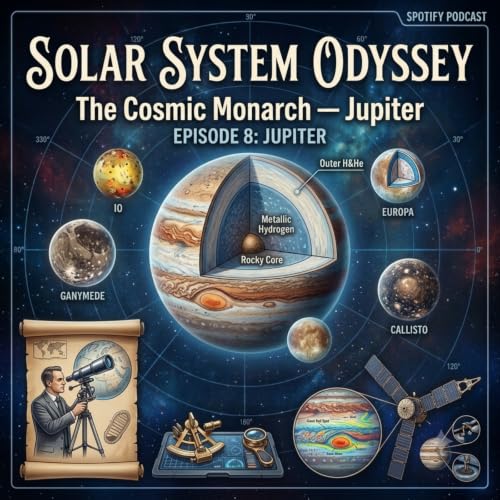
    Seven worlds behind us, and now we reach the one that almost wasn't a planet at all. Jupiter isn't just the largest world in our solar system — it's more massive than every other planet combined, twice over. If it had gathered just a little more mass during formation, it might have ignited into a second, smaller sun. Instead, it became something almost as commanding: a king that never quite claimed the throne.

    Imagine a storm larger than Earth itself, raging continuously for at least 190 years, with winds tearing across it at 640 kilometers per hour — the Great Red Spot isn't weather in any sense we experience. It's a permanent scar of violence, older than most nations on this planet, still spinning.

    Think about it — every planet before this one, we could imagine standing on. Not this one. Jupiter has no true surface at all. Descend far enough and the atmosphere doesn't end, it just thickens into a churning ocean of metallic hydrogen, under pressure so extreme that hydrogen itself starts behaving like a liquid metal, generating the most powerful magnetic field of any planet in the solar system.

    Jupiter doesn't just dominate through size — it dominates through gravity itself. It's the reason the asteroid belt never finished becoming a planet, the reason countless comets have been flung out of the solar system entirely, and the reason others, like Shoemaker-Levy 9 in 1994, were pulled in and torn apart on impact, live, in front of our own telescopes. That's not a metaphor for power. That's power, demonstrated.

    And yet Jupiter's real treasures aren't the planet itself — they're the 95 known moons orbiting it. Europa, hiding a liquid ocean beneath its icy shell, possibly more water than every ocean on Earth combined. Io, the most volcanically active body in the entire solar system, its surface repainted by eruptions faster than any geologist can map it. This isn't a planet. It's practically a solar system of its own, held in orbit around one dominant king.

    Here's what science still hasn't fully answered: what's actually happening at Jupiter's core. Does it even have a solid core at all, or does rock dissolve into that metallic hydrogen ocean entirely? NASA's Juno mission has been diving closer to Jupiter than any spacecraft before it specifically to find out — and every pass sends back data that complicates the picture further, rather than simplifying it.

    Ancient skywatchers had no telescopes, no way to see the storms or moons — yet they still recognized something commanding in that steady, bright wanderer. Babylonian astronomers associated it with their king of gods, Marduk. Roman astronomers named it after the king of their own pantheon, Jupiter — a name that's outlasted the empire that gave it. And in 1610, Galileo pointed a primitive telescope at it and discovered four moons orbiting another world for the first time in human history — a single observation that helped dismantle the idea that everything in the universe circled Earth.

    Here's the part worth sitting with: Jupiter never became a star, never had the mass to ignite. It spent 4.6 billion years as close to that threshold as any planet ever gets, and stayed a planet anyway. Sometimes the most powerful thing in a system isn't the one that burns brightest — it's the one whose gravity quietly shapes everything else without needing to.

    Researched and written by me. Voice and visuals produced with AI, so I can go deeper on every world in this series.

    🎧 Episode 8 of Solar System Odyssey — a Fall in Cosmos series. Subscribe, and let's fall in cosmos, together.

    Keywords: Jupiter planet explained, Solar System Odyssey podcast, Great Red Spot, Jupiter moons Europa Io, Juno mission NASA, largest planet solar system, Jupiter magnetic field, gas giant explained.

    Show More Show Less
    23 mins
  • The Asteroid Belt: The Untold Story of scattered Debris.
    Sep 18 2026

    Hey! I'd love to hear your thoughts, send me a voice note.

    The Asteroid Belt: The Untold Story of scattered Debris.

    Six worlds in, and we finally reach the gap — the wide, rubble-strewn stretch between Mars and Jupiter that most solar system tours skip past entirely, as if it's empty space between the "real" planets. It isn't empty. It's a graveyard, a nursery, and an untold origin story, all scattered across millions of fragments no one bothered to name.

    Imagine a region containing over a million known asteroids, ranging from house-sized boulders to Ceres, a dwarf planet large enough to be round under its own gravity — and yet, if you gathered every single object in the entire belt together, it would still add up to less than 4% of the mass of our own Moon. This isn't a destroyed planet, despite what science fiction loves to claim. It's a planet that never got the chance to form at all.

    Socho — think about it. Every asteroid out there is a fossil, a piece of the original disk of dust and gas that built Mercury, Venus, Earth, and Mars, except frozen in its unfinished state — because Jupiter's gravity kept stirring the region too violently for these fragments to ever come together into a world.

    The belt isn't as crowded as movies make it look, but it isn't gentle either. Vesta carries a crater so massive it blasted off enough material to seed a whole family of meteorites that have landed on Earth. Ceres hides bright salt deposits and possibly a subsurface layer of brine, making it one of the more surprising ocean-world candidates in the entire solar system. Bingo — a "leftover" region turning out to hold some of the most chemically interesting real estate we've found.

    Not so fast, though — the asteroid belt still holds an uncomfortable, active mystery: which of these fragments are on a path that eventually crosses Earth's orbit. NASA's DART mission already proved in 2022 that we can physically alter an asteroid's trajectory by slamming a spacecraft into it — turning the ancient threat of impact into, for the first time in our species' history, a problem with an actual engineering solution.

    Ancient skywatchers had no idea this belt existed — the first asteroid, Ceres, wasn't even discovered until 1801, by Giuseppe Piazzi, initially mistaken for a new planet entirely. But the deeper irony is older: astronomers for centuries assumed there simply had to be a "missing planet" in that gap, following the neat mathematical pattern of planetary spacing known as the Titius-Bode law — and in a strange way, they were right that something belonged there. It just never finished becoming one.

    Here's the part worth sitting with: the asteroid belt is proof that not every beginning gets to become something whole — and that "unfinished" doesn't mean "meaningless." These fragments carry the rawest, least-altered material from the solar system's birth, more chemically pristine in some ways than the planets that succeeded. Sometimes the untold stories carry the oldest truths. Read the mind of God, and here, you'll find it written in rubble, not in worlds.

    The asteroid belt isn't a gap between planets. It's the origin story none of the planets got to finish telling.

    🎧 Episode 7 of Solar System Odyssey — a Fall in Cosmos series. Subscribe to journey through the solar system, one world at a time.

    Keywords: asteroid belt explained, Solar System Odyssey podcast, Ceres dwarf planet, Vesta asteroid, DART mission NASA, asteroid impact threat, Titius-Bode law, planetary science podcast, astronomy podcast series, space exploration podcast, history of asteroid discovery, near Earth asteroids, astrophysics for beginners, science and philosophy podcast, planetary geology podcast

    Show More Show Less
    22 mins
  • Mars: Ancient Water & The Search for Past Life
    Sep 16 2026

    Hey! I'd love to hear your thoughts, send me a voice note.

    Mars: Ancient Water & The Search for Past Life | Solar System Odyssey

    Five worlds in, and this is the one humanity keeps returning to — not because Mars is beautiful, or forgiving, but because it might once have been us. A world that could have had oceans, rivers, and rain, now reduced to red dust and silence. Mars isn't just the next planet in this odyssey. It's the closest thing we have to a mirror of a road not taken.

    Imagine standing on a surface carved by ancient river deltas and dried lakebeds, on a planet that today can't hold liquid water on its surface at all. Mars once had an atmosphere thick enough to keep water flowing — and lost most of it to space, stripped away when the planet's magnetic field shut down and the solar wind was finally let in, unopposed.

    Socho — think about it. Somewhere under that dust are minerals that only form in water, sediment layers laid down by rivers that no longer exist, and rocks that may be holding a four-billion-year-old record of a habitable world we arrived at just a little too late to see alive.

    Mars wears its history in layers, almost like a diary. Olympus Mons, the largest volcano in the entire solar system, nearly three times the height of Everest. Valles Marineris, a canyon system so vast it would stretch across the continental United States. Bingo — this is a planet that didn't just have water once. It had geology violent and grand enough to rival anything Earth has ever produced.

    Not so fast, though — the biggest question about Mars still has no answer. Did life ever actually start here? NASA's Perseverance rover is right now caching rock samples in Jezero Crater — an ancient river delta — specifically so a future mission can bring them back to Earth and settle the question directly. We're not guessing anymore. We're collecting the evidence.

    Ancient skywatchers saw Mars differently, but were drawn to the same thing we are now — its unmistakable red glow. Babylonian astronomers tracked it as an omen tied to war and conflict, Egyptian priests called it "Her Desher," the red one, and Greek and Roman astronomers eventually named it after their god of war. None of them knew they were looking at a planet that might once have looked like home.

    Here's the part worth sitting with: Mars may be the only place in the solar system where we get to ask "what if" and actually go find out. Not a hypothetical. A real search, happening right now, in real rock, on a real planet. If we ever find that life started twice in one solar system, everything we think we know about how rare we are changes overnight. Read the mind of God, and on Mars, we may finally get to check our answer.

    Mars isn't just the red planet. It's the question our entire species is currently trying to answer — did water, once, mean life here too?

    🎧 Episode 6 of Solar System Odyssey — a Fall in Cosmos series. Subscribe to journey through the solar system, one world at a time.

    Keywords: Mars planet explained, Solar System Odyssey podcast, Mars ancient water, search for life on Mars, Perseverance rover Jezero Crater, Mars atmosphere loss, Olympus Mons Valles Marineris, planetary science podcast, astronomy podcast series, space exploration podcast, ancient astronomy history, astrobiology Mars, Mars sample return mission, astrophysics for beginners, science and philosophy podcast, planetary geology podcast

    Show More Show Less
    21 mins
  • Earth: Our Only Home
    Sep 13 2026

    Hey! I'd love to hear your thoughts, send me a voice note.

    Earth: Our Only Home | Solar System Odyssey

    Four planets in, and we finally arrive somewhere we don't need a spacecraft to explore. After Mercury's scars and Venus's fury, Earth should feel ordinary by comparison. It isn't. Out of every world in this series — every world we know of, anywhere — this is the only one where the story doesn't end in silence.

    Imagine a planet sitting in exactly the right band of distance from its star, where water can exist as liquid instead of vanishing into vapor or locking into ice. Not too close to burn like Venus. Not too far to freeze like Mars. A margin so narrow it's almost uncomfortable to think about — and somehow, we landed right inside it.

    Socho — think about it. Every ocean, every breath of oxygen, every heartbeat happening on this planet right now exists because of a habitable zone a few million kilometers wide, in a galaxy that stretches a hundred thousand light-years across. That's not just luck. That's a thread this thin holding up everything we are.

    Earth carries its own violent history too, just better hidden under green and blue. A molten birth. A collision with a Mars-sized world that likely tore off the material that became our Moon — a wound that gave us tides, stabilized our tilt, and made complex life possible at all. Bingo — the same kind of impact that scarred Mercury and resurfaced Venus is the reason Earth has seasons and a night sky worth watching.

    Not so fast, though — Earth guards its own unresolved mystery, the biggest one in this entire series: how did chemistry become biology? We can trace plate tectonics, magnetic fields, and atmospheric evolution in remarkable detail, but the exact moment non-living matter crossed into life remains one of science's deepest open questions — one missions to Mars and icy moons like Europa are partly designed to help us understand, by searching for how it might have happened elsewhere too.

    Every ancient culture that ever looked up was really just Earth trying to understand itself — Vedic astronomers mapping cycles of sun and season, Egyptian priests aligning temples to solstices, Polynesian navigators reading stars to cross entire oceans without instruments. Long before satellites, humanity was already doing what this series does: trying to place one small world in context against everything above it.

    Here's the part worth sitting with: of every planet and moon we've studied, sent probes to, or dreamed about, this is still the only one where the story has narrators. Mercury can't wonder about itself. Venus can't ask why it turned out the way it did. We can. Read the mind of God, and for now, you'll only find it written in one place — here.

    Earth isn't just another stop in this odyssey. It's the reason there's an odyssey at all — the only world we've found that looked back up and started asking questions.

    🎧 Episode 5 of Solar System Odyssey — a Fall in Cosmos series. Subscribe to journey through the solar system, one world at a time.

    Keywords: Earth planet explained, Solar System Odyssey podcast, habitable zone explained, Earth Moon formation, giant impact hypothesis, origin of life on Earth, planetary science podcast, astronomy podcast series, space exploration podcast, ancient astronomy history, plate tectonics Earth, Earth magnetic field, astrobiology podcast, astrophysics for beginners, science and philosophy podcast, planetary geology podcast

    Show More Show Less
    21 mins
  • Venus : Earth's Wicked Twin
    Sep 12 2026

    Hey! I'd love to hear your thoughts, send me a voice note.

    Venus: Earth's Wicked Twin | Solar System Odyssey

    Almost the same size as Earth. Almost the same mass. Almost the same distance from the sun, in cosmic terms. Venus should have been our sibling — and instead, it became the closest thing to hell our solar system has to offer.

    Imagine a world with a surface hot enough to melt lead, at 465°C, hotter than Mercury despite sitting nearly twice as far from the sun. A crushing atmosphere 90 times the pressure of Earth's — the same force you'd feel nearly a kilometer underwater — made almost entirely of carbon dioxide, wrapped in clouds of sulfuric acid. Venus isn't just inhospitable. It's a warning.

    Socho — think about it. Two planets, built from the same disk of dust, at nearly the same distance from the same star, and one became a garden while the other became a furnace. That divergence is the entire story of this episode.

    Venus wears its violence differently than Mercury — no ancient craters frozen in time here, but a surface resurfaced by massive volcanic eruptions roughly 500 million years ago, wiping the slate clean planet-wide. It spins backward compared to almost every other planet, and so slowly that a single day on Venus lasts longer than its entire year around the sun. Bingo — that's a planet that seems to be moving through time in reverse.

    Not so fast, though — Venus still guards its biggest mystery in plain sight. Its runaway greenhouse effect is the clearest natural example we have of climate catastrophe, and scientists still debate exactly when and how it tipped from a possibly ocean-covered world into the inferno we see today. Missions like NASA's DAVINCI and VERITAS, launching later this decade, are being sent specifically to find out whether Venus once had oceans — and whether Earth could ever follow the same path.

    Ancient civilizations couldn't see the surface, but they never stopped watching Venus — Babylonian astronomers tracked it obsessively as the brightest wanderer in the sky, Mayan astronomers built entire calendars and even timed wars around its movements, and the Greeks named it after the goddess of beauty, unaware that beneath those brilliant clouds waited one of the most hostile surfaces in the solar system.

    Here's the part worth sitting with: Venus is often called Earth's twin, but twins can grow into completely different lives. Same birth, same raw materials, same starting distance from the flame — and one path led to oceans and life, the other to acid clouds and crushing heat. The line between a living world and a dead one may be thinner than we'd like to admit. Read the mind of God, and you'll find it written not in fate, but in atmospheric chemistry.

    Venus isn't just Earth's twin. It's Earth's warning — a mirror showing us exactly what's at stake if a garden planet ever tips too far.

    🎧 Episode 4 of Solar System Odyssey — a Fall in Cosmos series. Subscribe to journey through the solar system, one world at a time.

    Keywords: Venus planet explained, Solar System Odyssey podcast, Venus facts, hottest planet, runaway greenhouse effect, DAVINCI VERITAS mission, Venus atmosphere sulfuric acid, planetary science podcast, astronomy podcast series, space exploration podcast, ancient astronomy history, Venus retrograde rotation, Earth Venus comparison, astrophysics for beginners, science and philosophy podcast, planetary geology podcast

    Show More Show Less
    23 mins
  • Mecury: First Form the Flame
    Sep 10 2026

    Hey! I'd love to hear your thoughts, send me a voice note.

    Mercury: First from the Flame | Solar System Odyssey

    Closest to the sun. Hottest neighbor, yet trapped in permanent ice. Fastest planet in the solar system, yet the slowest to spin. Mercury shouldn't make sense — and that's exactly why it's the perfect place to begin this odyssey.

    Imagine being born so close to a star that daytime temperatures hit 430°C, hot enough to melt lead, while permanently shadowed craters near its poles hide water ice that's never once seen sunlight. Mercury doesn't just survive next to the flame — it holds contradiction in its very bones.

    Socho — think about it. This is a world with almost no atmosphere to protect it, no moons to keep it company, orbiting the sun in just 88 days, yet rotating so slowly that a single day on Mercury lasts longer than its entire year. Time itself behaves differently here.

    Mercury is a planet of survivors' scars — a surface so heavily cratered it looks frozen in the exact moment of its violent birth, dominated by the massive Caloris Basin, a crater so large it reshaped the terrain on the opposite side of the planet when the impact hit. Bingo — that's the kind of collision that leaves a planet permanently changed, inside and out.

    Not so fast, though — Mercury still guards real mysteries. Why is its core so unusually massive, taking up nearly 85% of the planet's radius? Why does it have a magnetic field at all, when a world this small shouldn't generate one? Missions like NASA's MESSENGER and the ongoing BepiColombo probe are still piecing together answers about a planet that, despite being the closest, remained one of the least understood for decades.

    Ancient skywatchers noticed Mercury's strange behavior long before any of this was explained — Babylonian astronomers tracked it across mud tablets as a fast-moving messenger in the sky, Greek astronomers debated whether it was even one object or two, appearing so differently at dawn and dusk. They named it after the swift messenger god for a reason: nothing else in the sky moved quite like it.

    Here's the part worth sitting with: Mercury formed from the exact same swirling disk of dust and gas as Earth, Venus, and every other planet in this series — yet ended up as a scorched, airless survivor instead of a living world. The difference between a planet that burns and a planet that blooms may come down to nothing more than distance, chance, and time. Read the mind of God, and you'll find it written in orbital math, not fate.

    Mercury isn't just first in distance from the sun. It's first in this odyssey because it asks the question every other episode in this series will answer differently: what does it take for a world to survive so close to its own creation?

    🎧 Episode 3 of Solar System Odyssey — a Fall in Cosmos series. Subscribe to journey through the solar system, one world at a time.

    Keywords: Mercury planet explained, Solar System Odyssey podcast, Mercury facts, closest planet to the sun, MESSENGER mission, BepiColombo Mercury, Caloris Basin, planetary science podcast, astronomy podcast series, space exploration podcast, ancient astronomy history, ice on Mercury, ancient sun deities astronomy, astrophysics for beginners, science and philosophy podcast, planetary geology podcast.

    Show More Show Less
    22 mins
  • Our Blazing Sun
    Sep 8 2026

    Hey! I'd love to hear your thoughts, send me a voice note.

    Our Blazing Sun ☀️ | Fall in Cosmos

    Ninety-three million miles away sits a nuclear furnace so violent, one second of its output could power human civilization for half a million years — and every single day, you stand in its light without a second thought. What if I told you the sun isn't just keeping you warm... it's the reason you exist at all?

    Every sunrise you've ever seen is the tail end of a journey that began 8 minutes and 20 seconds ago, deep inside a fusion reactor with no walls and no off switch.

    Think of the sun as a single, ceaseless drone note holding the entire solar system in tune — gravity is the string, and every planet orbiting it is a note playing along to that one eternal frequency. Strip away the poetry, and the raw science is just as staggering: 600 million tons of hydrogen fused into helium every second, a core hotter than 15 million degrees Celsius, and a corona that is, bizarrely, hundreds of times hotter than the surface directly beneath it — one of the biggest unsolved mysteries in modern astrophysics.

    Not so fast, though. This same star that gives us photosynthesis, seasons, and warmth can also unleash solar flares powerful enough to fry satellites and knock out entire power grids — a threat civilizations across history feared as omens, and one we're only now learning to actually forecast.

    Long before telescopes, nearly every ancient culture stopped and stared at this same star — Egyptian priests tracking it as Ra, Babylonian astronomers charting its path across mud tablets, Mayan calendars built entirely around its cycles. Different languages, different gods, same question: what is that thing, and why does it control everything down here? Modern solar physics — and missions like NASA's Parker Solar Probe, which has now flown closer to the sun than any human object in history — are finally answering a question humanity has been asking since we first stood upright and looked up.

    On the Kardashev Scale, a true Type I civilization fully commands the energy of its home star. We're not there yet — we're barely scratching Type 0.7, still burning dead plants and ancient carbon while the actual answer radiates 93 million miles above us, releasing more energy in a single second than humanity has used in all of recorded history.

    Here's the part that should stop you cold: every atom in your body — the calcium in your bones, the iron in your blood — was forged inside a star like this one before it ever became you. So when sunlight touches your skin, you're not just feeling heat. You're touching the very furnace that built you. Read the mind of God, and you'll find it's written in sunlight.

    🎧 New episode of Fall in Cosmos — where ancient wonder meets modern astrophysics. Subscribe for weekly journeys into space, science, and the philosophy of existence.

    Keywords: the sun explained, solar physics podcast, how the sun works, Parker Solar Probe, solar flares explained, Kardashev scale, space podcast, astrophysics for beginners, science and philosophy podcast, ancient astronomy history.

    Show More Show Less
    23 mins