• Betting on Broadway — The Producer's Playbook for Spotting a Hit
    Jun 2 2026

    Broadway is one of the highest-risk industries in the world. Every new production requires millions of dollars, years of development, and countless creative decisions—yet most shows never recoup their investment. So how do producers decide which stories are worth betting on?

    In this episode of Sue Gilad: Curtain Call Conversations, Sue Gilad takes listeners inside the decision-making process behind Broadway producing. Drawing from her experience producing and co-producing acclaimed productions, she explores how producers evaluate scripts, assemble creative teams, assess audience demand, and navigate uncertainty in pursuit of extraordinary outcomes.

    Along the way, Sue examines the relationship between intuition and analysis, the similarities between Broadway and entrepreneurship, and the lessons that come from both success and disappointment. Whether you're a business leader, entrepreneur, investor, or creative professional, this episode offers valuable insights into making high-stakes decisions when the future is impossible to predict.

    In this episode:

    • The economics and risk profile of Broadway productions
    • How shows move from concept to opening night
    • What producers look for when evaluating a project
    • The role of intuition, expertise, and decision-making science
    • Lessons from successful productions and industry challenges
    • Why Broadway producing shares so much with entrepreneurship

    For additional information about Sue Gilad’s work and initiatives: www.suegilad.com

    www.suzannegilad.org

    Show More Show Less
    44 mins
  • The Empathy Engine — The Science Behind Why Broadway Changes Us
    Jun 2 2026

    What happens inside the human brain when the lights dim, the music begins, and a story unfolds on stage?

    In this episode of Sue Gilad: Curtain Call Conversations, Sue Gilad explores the fascinating science behind live theatre and why it remains one of the most powerful forces for human connection. Drawing on research from neuroscience, psychology, and behavioral science, she examines how storytelling influences empathy, shapes emotional understanding, and brings audiences together in ways that digital experiences cannot replicate.

    From mirror neurons and neural coupling to the role of music, shared experiences, and emotional engagement, Sue unpacks the mechanisms that make live performance uniquely transformative. She also reflects on her experiences producing acclaimed Broadway productions and what she has witnessed from the audience's perspective when stories resonate on a deeply human level.

    At a time marked by loneliness, division, and disconnection, this episode explores why theatre may be one of the most effective tools we have for building understanding, strengthening communities, and reminding us of our shared humanity.

    In this episode:

    • The neuroscience of empathy and storytelling
    • How mirror neurons influence emotional connection
    • Why live performance affects audiences differently than screens
    • The role of music in creating emotional and social bonds
    • Research on audience synchronization and shared experiences
    • Why theatre remains essential in an increasingly disconnected world

    For additional information about Sue Gilad’s work and initiatives: www.suegilad.com

    www.suzannegilad.org

    Show More Show Less
    35 mins
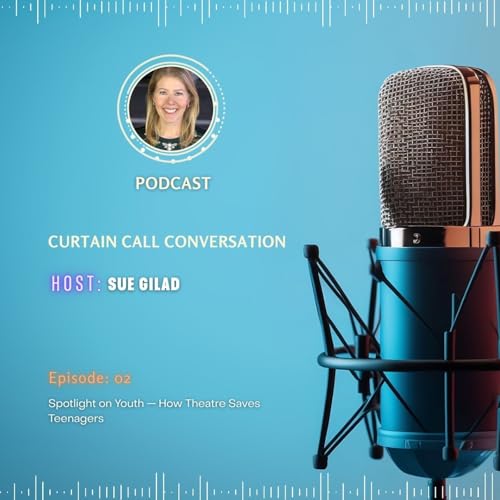
  • Spotlight on Youth — How Theatre Saves Teenagers
    Apr 22 2026

    Teen mental health is facing unprecedented challenges—but what if one of the most effective solutions is already within reach?

    In this episode of Sue Gilad: Curtain Call Conversations, Sue Gilad examines the growing crisis affecting young people today and presents a compelling, research-driven perspective on the role of theatre education in addressing it. Drawing from real-world experience and data, she explores how participation in theatre fosters belonging, strengthens emotional resilience, and develops the interpersonal skills that young people need to navigate an increasingly complex world.

    This episode goes beyond advocacy to examine the measurable impact of arts education—on academic performance, mental health, and long-term outcomes. It also addresses the systemic challenges facing arts programs, including funding cuts and unequal access, and why the students who would benefit most are often the least likely to have these opportunities.

    Through both data and lived experience, Sue highlights the unique role theatre plays in helping young people build confidence, process emotions, and discover their voice in environments that prioritize collaboration, expression, and growth.

    In this episode:

    • The current state of youth mental health and contributing factors
    • The measurable academic and developmental benefits of theatre education
    • How live performance builds empathy, resilience, and communication skills
    • The critical role of theatre teachers and mentorship
    • The impact of funding cuts and inequity in arts access
    • Why theatre programs are essential—not optional—in education

    For additional information about Sue Gilad’s work and initiatives: https://suegilad.com

    https://suzannegilad.org

    Show More Show Less
    27 mins
  • The Rehearsal Room Blueprint — What Corporate America Can Learn from Broadway
    Apr 22 2026

    What if one of the most effective models for leadership and team performance has been hiding in plain sight—inside a Broadway rehearsal room?

    In this opening episode of Sue Gilad: Curtain Call Conversations, Sue Gilad draws on her experience producing award-winning Broadway productions to explore how high-performing creative teams operate under pressure. She examines the systems, behaviors, and cultural dynamics that allow dozens of individuals—often meeting for the first time—to build something precise, cohesive, and extraordinary in a matter of weeks.

    From the structure of the table read to the importance of psychological safety, from real-time feedback to the operational leadership of the stage manager, this episode presents a practical framework for collaboration and execution. It also explores how the ensemble mindset—prioritizing collective excellence over individual recognition—enables consistency, adaptability, and resilience in one of the most demanding performance environments in the world.

    This conversation is designed for leaders, entrepreneurs, and professionals across industries who are seeking more effective ways to build trust, improve communication, and drive results through collaboration.

    In this episode:

    • Why alignment on purpose is the foundation of high-performing teams
    • The role of psychological safety in driving innovation and accountability
    • How immediate, specific feedback improves performance
    • The operational leadership model behind every successful production
    • Why the ensemble mindset outperforms siloed organizations
    • How iterative processes lead to stronger outcomes

    For additional information about Sue Gilad’s work and initiatives: https://suegilad.com

    https://suzannegilad.org

    Show More Show Less
    26 mins