• Building Trust: Awards, Applause & the Occasional Ego Trip
    Nov 9 2026

    Are business awards genuine badges of excellence, or just trophies?

    This week, we're continuing our series on building trust by tackling the surprisingly complicated world of awards and recognition.

    We start with a little trade show wisdom from Indianapolis, where we've discovered that the best networking strategy isn't necessarily collecting business cards—it's building relationships with people who introduce you to even more people.

    Then we get into the shiny stuff. Are industry awards worth the investment? Can they actually help win customers? And does anyone really care that you've been named an award-winning something-or-other?

    We also explore the other side of recognition: celebrating employees, motivating sales teams, and giving clients the credit they deserve.

    Along the way, we discover that one of us has become considerably less cynical about business awards, while the other still believes there's a place for a good old-fashioned Salesperson of the Month competition.

    The takeaway? Recognition can build trust, but only when it's credible, relevant, and backed by real achievement. A trophy alone won't close the deal—but it might just open the door.

    Grab your tea, your Timbits, and perhaps that dusty participation trophy. Let's talk about what recognition is really worth.

    Show More Show Less
    21 mins
  • LIVE from Abbey Road Studios: Building Trust in an AI World
    Nov 8 2026

    Recorded on location at Abbey Road Studios, London

    Coming to you from the legendary Abbey Road Studios in London, we're talking about something that never goes out of style: trust. And no, apparently AI hasn't replaced the good old-fashioned handshake just yet!

    In this episode, we explore how the right messaging, genuine customer testimonials, and meaningful relationships can help businesses stand out in an increasingly noisy digital world.

    From the scramble to get noticed by AI search engines to the importance of knowing your audience, we discuss why shouting louder isn't necessarily the answer. Sometimes the smartest marketing strategy is simply going back to basics: listen, deliver value, and let your happy customers do some of the talking.

    We also explore why a great testimonial needs more than a polite "they were lovely to work with" and how real-world connections still matter in a world of algorithms.

    So grab a tea, a Timbit, or perhaps a recording contract (we are at Abbey Road, after all), and join us for a conversation about building trust that lasts.

    Because while the way people discover businesses is changing, the fundamentals of earning their trust haven't.

    Show More Show Less
    16 mins
  • Your client logos aren't case studies. Sorry.
    Oct 12 2026

    We've all seen them. A wall of impressive logos, a few glowing claims, and perhaps a suspiciously round percentage improvement.


    But does any of that actually build trust?


    In our latest episode, we're talking about how case studies can become genuine business development tools rather than expensive exercises in congratulating ourselves.


    We explore:

    • Why evidence beats a polished sales pitch.
    • How to tell meaningful success stories without exposing confidential client details.
    • Why independent perspectives can make your credibility stronger.
    • How to turn a case study into something that benefits BOTH you and your client.


    And here's the idea that got us particularly excited:


    Instead of asking clients to help tell our success stories, why don't we help them tell theirs?


    It's a subtle shift, but one that could make the whole conversation much more interesting.


    We also manage a detour into emotional intelligence, team culture, and the value of actually checking in with people before racing through the meeting agenda.


    Another 20 minutes of British and Canadian business wisdom. Or at least two people enthusiastically discovering ideas they probably should have implemented years ago.


    #TeaAndTimbits #BuildingTrust #BusinessDevelopment #CaseStudies #B2BSales

    Show More Show Less
    20 mins
  • BONUS: Due Diligence: How Much Is Enough?
    Oct 11 2026

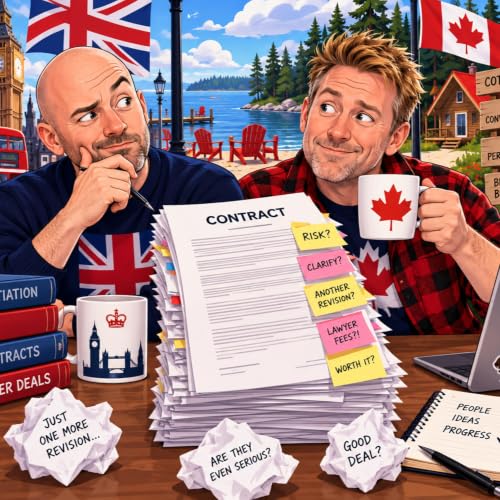
    We’re back with a bonus episode on negotiations, because apparently four weeks of talking about contracts, deals, and difficult decisions just wasn’t enough.

    This time, we’re tackling due diligence. How much homework should you really do before signing on the dotted line? And at what point does being thorough turn into chasing certainty that simply doesn't exist?

    We explore the dangers of rushing into agreements, the equally frustrating trap of analysis paralysis, and why understanding the people behind a deal can be just as important as understanding the numbers.

    Along the way, we take an unexpected detour into British political conferences, what they can teach businesses about running better events, and why building genuine relationships delivers value long after everyone has gone home.

    It's a bonus helping of Tea and Timbits, complete with practical business lessons, a few tangents, and the occasional reminder that even the best preparation can't guarantee a perfect outcome.

    Show More Show Less
    23 mins
  • Negotiation Tools: Because “I Thought We Agreed…” Is Not a Strategy
    Sep 30 2026

    “Just sign the contract. It’ll be fine.”Possibly one of the least reassuring sentences in business.In this week’s Tea and Timbits, we’re talking about negotiation tools — and not the kind that require another software subscription, three dashboards and a consultant to explain the dashboard.We mean the practical stuff:• A letter of intent that records what everyone thought they were agreeing to • A negotiation brief that captures objections, boundaries and desired outcomes • A commercial model that makes sure the deal can actually be delivered profitably • A proper handover document so the delivery team doesn’t have to interrogate the salesperson afterwardsBecause the contract is only part of the story.The real danger is all the promises, assumptions and “oh yes, we talked about that” details floating around outside it.We also get into a recent negotiation where changing expectations and a slightly casual attitude to contracts raised a much bigger question: is this actually a business relationship we want?Sometimes the smartest negotiation move isn’t getting the deal signed.It’s knowing when not to.🎙️ Tea and Timbits — global perspectives on business development to help you prosper.#Negotiation #BusinessDevelopment #Sales #Contracts #Leadership

    Show More Show Less
    22 mins
  • The Negotiation Playbook: Prepare the Plays, Don’t Script the Customer
    Sep 28 2026

    Negotiations have an annoying habit of refusing to follow the script.

    In this episode, we look at why a negotiation playbook isn’t about memorising clever lines or predicting every possible objection. It’s about doing the thinking before the pressure is on.

    We dig into setting principles and walk-away points, agreeing internally on what success actually looks like, preparing alternative packages, involving the people who’ll eventually have to deliver what you’ve promised, and even doing a bit of role play before the big conversation.

    We also wander into the dangers of waiting for the “perfect” moment to launch something — because sometimes the best validation is simply putting it in front of the market.

    Our conclusion? Standardise the preparation, not the customer. Have a playbook, know your boundaries, prepare some alternatives…and then be ready for the other side to completely ignore your beautifully prepared scenario.

    Show More Show Less
    25 mins
  • Don’t Let the Contract Kill the Deal
    Sep 9 2026

    A deal can survive months of selling, negotiating and relationship-building… only to wander into legal and emerge looking like it’s been through customs twice.

    In our latest episode, we talk about contract reviews and one of the biggest mistakes we see: treating the legal stage as a handoff.

    It isn’t.

    Legal teams are there to identify and manage risk. Commercial teams still need to stay involved so the agreement reflects what was actually promised, what the customer values, and what the business can realistically deliver.

    We cover:

    • Why “standard terms” aren’t always commercially neutral
    • Why a legally acceptable clause can still be operationally painful
    • Why sales shouldn’t disappear once the lawyers arrive
    • Why reading the contract yourself is still worth the effort
    • And why legal should be an adviser, not automatically the gatekeeper

    Our basic rule: if the contract makes a good deal impossible to deliver profitably, the paperwork hasn’t protected the deal—it’s changed it.

    And yes, we have a few contract-war stories. Apparently we’ve collected more of them than we realised.

    #BusinessDevelopment #Negotiation #Contracts #Sales #CommercialStrategy #Legal #B2B

    Show More Show Less
    22 mins
  • Negotiation Without the Arm-Wrestling: Why Collaboration Wins
    Sep 2 2026

    Negotiation has a bit of a reputation. It can sound like two sides digging in, guarding their territory, and waiting to see who blinks first.

    In this episode, we talk about why the best negotiations rarely feel like that.

    We explore the difference between collaboration and negotiation, why the two should work together rather than compete with each other, and how a collaborative mindset can take a lot of unnecessary friction out of pricing, contracts, scope, liabilities, payment terms and all the other cheerful topics that make everyone suddenly very interested in their coffee.

    We also kick things off with a customer-service story involving a digital platform that was apparently working perfectly… apart from the small detail that customers couldn’t actually use it.

    The bigger lesson? Whether you’re selling, buying, troubleshooting or finalizing a contract, good outcomes usually start with empathy, curiosity and a willingness to solve the problem together.

    Because negotiation doesn’t have to mean buyer versus seller. Sometimes it’s simply two sides trying to find a version of the deal that works for everyone.

    Show More Show Less
    21 mins