• Why GTM Rebuilds for the Enterprise Start With Clarity, Not Campaigns, with Corey Livingston
    Jul 28 2026
    A company reaches a key moment. The strategy changes, the target buyer shifts, and leadership decides to focus on the enterprise market. But the go-to-market system underneath the business may still be built for an earlier stage of growth. Corey Livingston shares why rebuilding your GTM should start with understanding and clarity, how marketing can build trust with sales before results appear, and what leaders should measure before the pipeline is visible. About this episode Financial reports show how a business is doing, but they don’t show if the go-to-market engine is ready to support the company’s next phase of growth. That is the tension at the center of this conversation with Corey Livingston, Vice President of Marketing at DartPoints. Corey has spent more than two decades leading B2B marketing through growth and change. She has worked inside companies moving upmarket, entering new segments, and trying to build several GTM motions at once. Her starting point is not another campaign. It is understanding the growth hypothesis, determining whether each motion is in the build, activate, or scale phase, and getting the organization aligned around what it can realistically produce next. We talk about why moving into enterprise requires more than changing the target account list, how marketing earns credibility with sales, why alignment must extend below the CRO, and what leaders often get wrong during the first 90 days of a GTM rebuild. About Corey Livingston Corey Livingston is the Vice President of Marketing at DartPoints. She has more than two decades of B2B marketing experience, including leadership roles at Level 3 Communications and OneNeck Solutions, as well as fractional CMO work across multiple companies. Her work focuses on GTM strategy, sales and marketing alignment, enterprise growth, and helping companies build the operating systems required for their next stage of growth. Connect with Corey Follow Corey Livingston on LinkedIn Chapters 00:00 Why healthy dashboards can hide a broken GTM system 00:49 What dashboards miss in a GTM rebuild 02:36 Why moving upmarket changes the entire motion 05:35 How to diagnose the gap between strategy and execution 09:02 How marketing earns sales’ trust before results 17:58 How to decide which GTM motion comes first 21:00 What to measure before pipeline shows up 26:23 What leaders get wrong in the first 90 days A few things worth taking away Financial reports show business performance. They do not show whether the GTM system is mature enough to support the next stage of growth. GTM is a lifecycle, not a switch. Leaders need to know whether a motion is being built, activated, or scaled before deciding what to measure. Moving upmarket is not just a strategy shift. Enterprise buyers require more credibility, stronger proof, deeper content, and tighter coordination with sales. A corporate strategy is not the same as a go-to-market strategy. The organization still needs clarity about how growth will actually happen. Sales trust comes from clarity, follow-through, and quick wins, especially while the longer-term GTM system is still being built. Alignment with the CRO is not enough. Marketing also needs to earn the trust of frontline sales leaders and the people doing the work every day. You cannot scale every motion at once. Investment decisions should connect to the company’s growth hypothesis, resources, timing, and near-term revenue needs. Pipeline is a lagging indicator. Operational readiness, engagement from the right accounts, and qualified meetings can show whether the motion is beginning to work. For an early enterprise motion, one of the most useful questions is: are we meeting with the right person at the right account, and are they moving to a next step? The first 90 days of a GTM rebuild should begin with diagnosis. Leaders often create problems by trying to fix the system before they understand it. A few lines that stuck with me “I look at GTM as more of a lifecycle, not a switch.” “A corporate strategy and vision is not a go-to-market strategy.” “Sales trust comes from creating clarity. It comes from follow-through and quick wins.” “You can’t scale everything at once.” “You can’t get to pipeline without engagement.” “Are we getting a meeting with the right person at the right account?” “Most leaders try to fix things too fast in the first 90 days.” Listen and subscribe Subscribe to The B2B Roundtable wherever you listen to podcasts. Transcript Brian Carroll: Welcome to The B2B Roundtable. I’m Brian Carroll, and we’re going to talk about something people don’t often talk about. A company hits an inflection point. The strategy shifts, the buyer changes, and the dashboard shows green. But the system underneath was built for a different version of the business. The gap doesn’t show up in a report. It shows up when things start to stall, and nobody can explain why. My guest today is Corey Livingston. She has...
    Show More Show Less
    31 mins
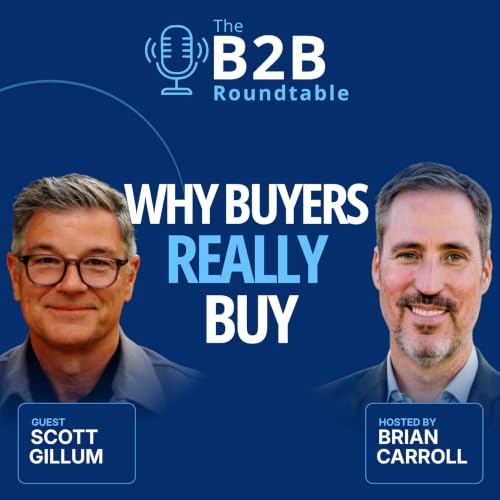
  • Why B2B Buyers Really Buy: The Hidden Buyer Journey with Scott Gillum
    Jul 14 2026
    Most GTM teams have gotten very good at tracking what buyers do. They can see form fills, intent signals, CRM activity, demo requests, and pipeline movement. But those systems often miss the people, pressure, risk, trust, and hidden stakeholders shaping the actual decision. In this conversation, Scott shares what he learned from studying more than 10,000 buyers across 15 industries, including why so many people who influence a deal never appear in the CRM, why B2B buying is more emotional than we admit, and how personality, culture, and hidden stakeholders shape complex deals. The big question behind this episode is simple: Even if our lead systems worked perfectly, would they really explain what drives a buying decision? About this episode In complex B2B sales, the visible buyer journey is often only part of the story. The CRM may show one set of contacts. The real buying group may include several others. The business case may look rational. The actual decision may be shaped by fear, trust, confidence, internal pressure, and personal risk. Scott Gillum calls this The Hidden Buyer Journey. His research shows that many of the people who influence deals are never entered into the database, and many of the signals that matter most are not captured by traditional lead and pipeline systems. Scott and Brian discuss: Why human-to-human selling still matters as AI and rep-free buying growHow one sales team nearly missed the real executive concern in a dealWhy 85% of buyers in a buying group may not be visible in the databaseWhy complex B2B buying is emotional, even when the process looks rationalHow personality and culture influence buying decisionsWhy empathy is not a soft skill in complex salesHow sellers can use AI to become better with people, not just louder at scale About Scott Gillum Scott Gillum is the founder and CEO of Carbon Design, a marketing services firm focused on understanding buyer behavior and improving B2B growth. He is the author of The Hidden Buyer Journey: How Personality, Culture, and Hidden Stakeholders Decide Your Deals. Scott’s work focuses on the hidden forces that shape B2B buying decisions, including personality, buying-group dynamics, organizational culture, and the stakeholders who influence deals but often never appear in CRM or marketing automation systems. Scott Gillum on LinkedIn Chapters 00:00 Introduction: Scott Gillum and The Hidden Buyer Journey 01:06 The human-to-human selling relationship 02:15 When the CRM tells the wrong story 04:10 The 85% of buyers missing from the database 06:14 The emotional gap in complex sales 08:03 Buyer confidence versus vendor confidence 11:28 The two-thirds rule and personality-based selling 15:16 Why empathy is not a soft skill 18:18 How sellers should adapt under pressure 20:44 Using AI to move closer to the customer 23:42 Closing thoughts A few things worth taking away 1. The CRM may not show the real buying group Scott shared an example of a deal where the sales team thought the need was real-time project profitability. But late in the deal, the CEO’s behavior showed a very different concern: cash flow. The visible activity told one story. The person with the most influence over the decision was telling another. 2. Hidden stakeholders are not a small problem Scott said his team found that 85% of buyers in a buying group were not in the database. In one example, a company gave its team 100 contacts for an opportunity. After reading the email threads, they found nine people in the actual buying group, and only two of those nine were in the system. That changes how we think about attribution, lead management, sales process, and account strategy. 3. Complex B2B buying is emotional because the risk is real Scott put it plainly: buying the wrong iPhone may be frustrating, but nobody gets fired for it. Making the wrong million-dollar SaaS decision is different. That risk creates pressure. And that pressure shapes how people make decisions. 4. Buyers need confidence in themselves, not just confidence in the vendor One of the most important ideas in the conversation is that sellers often believe their job is to make the buyer confident in the vendor. But in a complex sale, the buyer also needs confidence in their own decision. They need to believe they can defend the choice internally, manage the risk, and survive the consequences if things do not go perfectly. 5. Personality and culture shape how people buy Scott explains what he calls the two-thirds rule: certain personality patterns tend to concentrate in industries, roles, accounts, and buying groups. That does not mean every person is the same. But it does mean sellers and marketers can get smarter about how different buyers process information, evaluate risk, and build trust. 6. Empathy is not soft. It changes outcomes. Scott shared an example from email analysis where a seller who showed empathy and understood the buyer’s situation had a much better path through the deal than ...
    Show More Show Less
    24 mins
  • B2B Brands Are Too Measurable to Be Memorable, with Lindsay Cournoyer
    Jun 23 2026
    About this episode Here’s something most B2B marketers know but do not always say out loud. We have gotten very good at measuring things. Attribution. Pipeline metrics. Sourced revenue. Influenced revenue. Cost per lead. And yet, a lot of B2B brands are still forgettable. Not because the marketers are bad. Because the system keeps pulling them toward what can be tracked, reported, and defended in the next pipeline review or board meeting. That is the tension at the center of this conversation with Lindsay Cournoyer, Fractional CMO and Brand Marketing Consultant at LC Consulting, and former CMO at Blue J. Lindsay has led marketing at companies including Axonify, Coconut Software, and Blue J. At Blue J, an AI-powered tax research company, she helped 5x revenue and raise $122 million in Series D funding. But that is not the main reason I wanted to talk with her. I wanted to talk with Lindsay because while that growth was happening, she made a brand bet that many B2B marketers would struggle to defend on a dashboard. She invested in out-of-home advertising. Billboards. Elevator ads. Radio. Physical media in a B2B SaaS company. That is not the usual B2B playbook. But Lindsay believed the company needed something that the usual performance channels were not delivering: awareness, trust, and memory in buyers’ minds before they were ready to enter a sales process. Her line from LinkedIn captures the problem clearly: “B2B brands are so obsessed with being measurable that they forget to be memorable.” That is where this conversation starts. We talk about why performance marketing can capture demand but cannot create all of it, how Lindsay made the case for out-of-home inside a B2B SaaS company, what she measured before and after the campaign, and why brand work can feel risky when marketing already has to justify itself more than other functions. If you have ever felt pressure to optimize for a metric instead of an outcome, this episode is for you. About Lindsay Cournoyer Lindsay Cournoyer is a Fractional CMO and Brand Marketing Consultant at LC Consulting. She has led marketing at B2B companies including Axonify, Coconut Software, and Blue J, where she most recently served as CMO. At Blue J, she helped the company grow revenue 5x and raise $122 million in Series D funding. Lindsay works with B2B SaaS founders and leadership teams on brand strategy, messaging, and go-to-market. Connect with Lindsay Connect with Lindsay Cournoyer on LinkedIn Chapters 00:00 Introduction: B2B Brands Are Too Measurable to Be Memorable 01:53 Why Brand Has to Create Demand Before Performance Captures It 03:29 The CEO Saw the Brand Problem 04:24 The Marketing Tax and Why Brand Needs CEO Support 07:35 Making the Case for Brand Inside the Business 10:11 How Lindsay Measured Awareness and Consideration 13:50 Staying Steady When the Bet Feels Risky 16:55 What to Do When Your Company Doesn’t Value Brand 22:26 How to Make the Case for Brand Investment A few things worth taking away Performance marketing has a role, but it mostly captures existing demand. Brand helps create the demand performance later captures. B2B buyers need to remember you before they are ready to buy. If you are not already planted in their mind, you may never make the shortlist. Out-of-home can be targeted in B2B when you know where your buyers work, commute, gather, and pay attention. The marketing tax is real. Many marketing leaders spend too much time justifying their function rather than doing the work that creates long-term value. A CEO who understands brand changes the entire marketing environment. Without that support, big brand bets are much harder to make. Brand can be measured, but not always through the same dashboard logic as demand generation. Lindsay used pre- and post-campaign surveys to measure awareness, perceptions, consideration, and likelihood of purchase. A brand campaign can move more than awareness. In Lindsay’s case, they saw an increase in awareness and purchase consideration. Sometimes the best thing a marketer can do is accept the reality of where they are, protect their sense of worth, and look for a better environment where marketing is understood. If a CEO does not understand brand, use examples from their own life. Show them how brands earn memory before the buying moment. Sometimes you have to earn the right to make a brand investment by first showing how marketing contributes to pipeline and revenue. A few lines that stuck with me “B2B brands are so obsessed with being measurable that they forget to be memorable.” — Lindsay Cournoyer “Marketing’s true job is to carve out that place in your buyers’ brains.” — Lindsay Cournoyer “We have to build brand awareness and trust and credibility before you really step on the gas of performance marketing.” — Lindsay Cournoyer “There are companies out there who actually get it. They are very hard to find, but they are out there.” — Lindsay Cournoyer “Sales ...
    Show More Show Less
    25 mins
  • Growth Isn’t a Headcount Problem. You’re Scaling Imprecision, with DeAnna Ransom
    Jun 16 2026
    DeAnna Ransom explains why more reps, more tools, and more activity aren’t fixing pipeline, and why modern GTM teams need more precision, stronger retention, and deeper customer understanding. About this episode Most B2B growth teams are doing more than ever. More reps. More tools. More signals. More outbound. More dashboards. And yet, for many teams, the pipeline still doesn’t follow. That’s the tension at the center of this conversation with DeAnna Ransom, Chief Growth Officer at Betterbot. DeAnna is rebuilding a GTM motion in real time from the inside. She’s not talking about this from the sidelines. She’s in the seat, doing the work, and seeing firsthand where the old growth math is breaking. Her argument is clear: growth in 2026 is not a headcount problem. It’s a precision problem. When teams add people to a motion that isn’t precise, they don’t fix the problem. They scale imprecision. We get into why AI didn’t break outbound but held it up to a mirror, why teams often have data about people without actually knowing them, why visibility has to come before scale, and why retention is no longer just a customer success issue. It’s a growth strategy. We also talk about the CMO tax, what it takes for marketing leaders to be seen as business leaders, and why the modern growth leader has to build a system precise enough to scale and human enough to trust. If your team is doing more but getting less back, this conversation is worth sitting with. About DeAnna Ransom DeAnna Ransom is the Chief Growth Officer at Betterbot, an AI platform serving the multifamily industry. She has more than 20 years of growth and leadership experience across B2B and nonprofit sectors. Her background spans sales, marketing, and customer experience, which gives her a different view of the revenue motion. Instead of treating marketing, sales, and customer experience as separate functions, DeAnna looks at them as one growth system designed around the customer. Chapters 00:00 Introduction: Growth Is a Precision Problem 01:13 More Activity Isn’t Creating More Pipeline 03:21 Data Isn’t the Same as Knowing the Buyer 04:48 Building a GTM Motion from the Ground Up 07:13 Using Retention to Sharpen Your ICP 09:26 Overcoming the CMO Tax 16:03 Why Retention Is Durable Growth 20:01 How to Start: Audit the Customers You Already Have 23:14 The Modern Growth Leader’s Role A few things worth taking away Growth teams don’t have an activity shortage. They have a precision problem. Adding people to a motion that isn’t working can make the problem worse because it scales imprecision. AI is not the core problem. It exposes whether your outbound motion is relevant or just louder. Having data about a buyer is not the same as knowing the buyer. Before you scale, you need visibility: attribution, forecasting, lead to cash, handoffs, leaks, stalls, and where relationships are weak. Retention is not just a customer success metric. It’s one of the most capital-efficient growth levers a company has. The best customers should teach you who to pursue next. A quiet customer is not always a happy customer. Marketing leaders need to come in as business leaders, not just campaign leaders. The modern growth leader has to be both systems architect and translator. A few lines that stuck with me “When you add people to a motion that isn’t precise, it isn’t working. You’re scaling imprecision.” — DeAnna Ransom “AI didn’t break outbound. It held it up to a mirror.” — DeAnna Ransom “You can’t scale what you can’t see.” — DeAnna Ransom “A quiet customer does not automatically equate a happy customer.” — DeAnna Ransom “Your customers are your business.” — DeAnna Ransom “The modern growth leader’s job is to build a system that is precise enough to scale, yet human enough to trust.” — DeAnna Ransom Resources mentioned Betterbot DeAnna Ransom on LinkedIn Transcript Brian Carroll: Hello everyone, welcome to The B2B Roundtable. I’m Brian Carroll. Excited to be with all of you today. What I keep hearing from leaders right now is this: they hired the SDR team, added the signals, added the technology, and their budget went up, but the pipeline doesn’t follow. And so they hired more and they switched tools and they started a new initiative and the results still didn’t move. I’ve come to believe that this problem isn’t capacity, it’s precision. And most teams have more activity than ever, but they have less signal from real buyers. My guest today said AI didn’t break outbound, it held it up to a mirror. And DeAnna Ransom is the Chief Growth Officer at Betterbot. She’s rebuilding the GTM motion in real time from the inside. Now, if you’re a CMO, growth leader, or GTM operator who’s felt the squeeze between AI noise and being able to connect with your buyers, this conversation’s for you. So, DeAnna, you said that growth in 2026 isn’t a headcount problem. It’s a precision problem...
    Show More Show Less
    26 mins
  • The Gumball Machine Is Broken: Jon Miller on What Comes After the MQL
    Jun 3 2026
    About this episode Most B2B marketing still runs on a single number: the marketing qualified lead. Jon Miller is one of the few people who can tell you where that number came from, because he helped build the system that produced it — first at Marketo, where he helped create the marketing automation category, then at Engagio, then at Demandbase. What makes this conversation different is that Jon went back and diagnosed his own creation. He’s not quietly onto the next thing. He’s saying, out loud, what the MQL got wrong about how people actually buy — and he’s careful to credit what it got right before he takes it apart. The short version: roughly 95% of buyers have built their shortlist before they ever talk to a seller. The MQL was designed to catch the last 5% who raise their hand. So the real question isn’t how to optimize lead capture. It’s what you do with everyone who isn’t ready yet — the 95% the old model was built to ignore. We get into why buying behaves more like weather than a vending machine, the three-tier model Jon uses instead of MQLs, why he thinks legacy automation tools can’t keep up, and how the best CMOs are quietly rewiring what they report to the board. If you’ve ever felt like you were pedaling into a headwind running the playbook that used to work, this one’s for you. About Jon Miller Jon Miller founded Marketo in 2006 and helped define the marketing automation category. He went on to found Engagio, which was acquired by Demandbase in 2020, served as CMO at Demandbase, and is now building Phave, an AI-native marketing automation platform. Chapters 00:00 Introduction to Jon Miller and his journey 01:24 Diagnosing the MQL model 03:27 The gumball machine / nonlinear buying idea 07:23 What the MQL got right 10:14 The three-tiered model of engagement 14:22 The role of CMOs in modern marketing 18:17 AI’s impact on marketing automation 19:55 The Spotify playlist analogy 22:53 The Peppers and Rogers/one-to-one thread 24:43 Common mistakes moving off the MQL 25:25 The three CMO dashboards 27:25 Advice for CMOs making the shift A few things worth taking away The MQL started as a good idea — a contract between marketing and sales — and got gamed over time as teams chased volume.Buying isn’t linear. With six to sixteen people on a buying committee researching in places you can’t even track, “run a campaign, get a lead” no longer describes reality.Hand raisers are the gold standard, but waiting for them means you only ever talk to the 5% who already built their shortlist without you.Jon’s three tiers — hand raisers, MQX, and MEX — give you a way to work the 95% instead of ignoring them.When you move off MQL volume as your headline metric, expect the numbers to drop before quality and conversion rise. Set that expectation early, or you’ll hit a buzzsaw.The strongest CMOs report pipeline across all sources to the board and stop fighting over who sourced what. A few lines that stuck with me “Put your quarter in, get your gumball out. Put your campaign in, get your MQL out. I just don’t think that’s the way buying works.” — Jon Miller “If you only wait for somebody to raise their hand, you’re talking to the 5% in market. And they’ve already built their shortlist without you.” — Jon Miller “You can’t get there with a rules-based system. You just end up with spaghetti.” — Jon Miller Resources mentioned The B2B CMO Project — research on the strategic CMO and the three-dashboard modelMike Bosworth, Solution SellingDon Peppers and Martha Rogers, The One to One FutureKathleen Schaub, Marketing in the Great Big Messy Real World Transcript Brian Carroll (00:05) Welcome to The B2B Roundtable, where we go inside the ideas, people, and decisions shaping modern revenue teams and how they actually work. I’m Brian Carroll, and today my guest is Jon Miller. I first met Jon way back in 2006, when he founded Marketo and helped build the marketing automation category as we know it today. In 2015 he founded Engagio, which was acquired by Demandbase in 2020. Now he’s building Phave, an AI-native marketing automation platform. Here’s what makes this conversation different from other podcasts you’ve listened to: Jon didn’t just build the next thing and quietly move on, the way a lot of founders do. He’s gone back and started diagnosing the problems with something he previously created. He’s talking about what’s wrong, and why it’s failing buyers today. And here’s why it matters right now. Before they ever talk to a seller, 95% of buyers have already designed their shortlist. The MQL is built to capture the last 5% who self-identify. What about the 95% who haven’t yet? So, Jon — when did you first start thinking the MQL model was broken, not just underperforming? How did you get there? Jon Miller (01:24) It started, more than anything else, during my time at Demandbase. After we merged Engagio and Demandbase together ...
    Show More Show Less
    29 mins
  • Why 75% of Buyers Don’t Want Reps and How Framemaking Helps Them Decide with Brent Adamson
    Oct 13 2025
    About this episode Most B2B buyers say they would rather buy without talking to a sales rep. That sounds like a sales problem. Brent Adamson says it is deeper than that. Buyers are not just avoiding sellers. They are struggling to make confident decisions. Brent is one of the clearest voices in modern B2B sales. He is co-author of The Challenger Sale, the book that changed how many sales and marketing teams think about commercial conversations. In this episode, we talk about his new book, The Framemaking Sale, and why the next era of sales depends less on persuasion and more on helping buyers make sense of complexity. The short version: buyers do not need more information. They already have too much. They need help knowing what matters, what to ignore, who to involve, what questions to ask, and how to move forward with confidence. We get into why 75% of B2B buyers prefer a rep-free buying experience, why customer confidence matters more than supplier confidence, how framemaking differs from Challenger, why thought leadership can make buying harder, and what AI changes about the role of the human seller. If your sales or marketing team is still trying to prove value by adding more content, more insight, or more follow-up, this conversation will make you rethink the job. About Brent Adamson Brent Adamson is a researcher, speaker, and author best known for co-authoring The Challenger Sale and The Challenger Customer. He spent years leading research at CEB, later Gartner, on B2B buying, sales effectiveness, and commercial transformation. His latest book, The Framemaking Sale, focuses on how sales professionals can help buyers make confident decisions in a world of complexity, information overload, misalignment, and uncertainty. Connect with Brent on LinkedIn Get the book: The Framemaking Sale Chapters 00:00 Why buyers prefer rep-free buying 04:12 Becoming the seller buyers want 09:40 What buyers need from salespeople 11:35 Why decision confidence matters 16:05 What framemaking means 21:26 Framemaking and The Challenger Sale 25:39 Buyers need sensemaking 28:18 Helping teams become framemakers 35:01 Marketing’s role in framemaking 39:34 AI and the future of human selling A few things worth taking away B2B buyers are not always trying to avoid humans. They are trying to avoid sales interactions that make buying harder.The 75% rep-free statistic measures buyer preference, not buyer reality. Many buyers still have to talk to sellers, but that does not mean they want to.Decision confidence is one of the strongest drivers of high-quality, low-regret deals.The confidence that matters most is not the buyer’s confidence in your company. It is the buyer’s confidence in themselves and their own decision.Most sales and marketing teams are still trying to build supplier confidence. Framemaking shifts the goal toward customer self-confidence.Buyers are overwhelmed by complexity, information overload, internal misalignment, and uncertainty about outcomes.The Challenger Sale helped sellers reframe the customer’s thinking. The Framemaking Sale helps customers make sense of competing ideas so they can decide.Thought leadership created a new problem. Everyone sounds smart, so buyers are left with more content, more claims, and less clarity.Marketing can support framemaking by interviewing customers about the buying journey, not just the product outcome.The best question from Brent: “If you had to do it all over again, what might you do differently just to make your lives a little bit easier?”AI may answer questions, summarize options, and produce tables. But buyers may still want to talk to someone they trust before making a hard decision. A few lines that stuck with me “The data does not say 75% of B2B buyers would prefer a human-free experience.” — Brent Adamson “What would it take to be the one seller, the one sales team, that your customers actually do want to talk to?” — Brent Adamson “It’s not customers’ confidence in us that matters. It’s customers’ confidence in themselves.” — Brent Adamson “While we’re all in sales and marketing solving for getting customers to know something, the single biggest secret passage to growth is getting customers to feel something.” — Brent Adamson “What if your value as a seller isn’t your expertise, but your access to the experience of other companies like them?” — Brent Adamson Resources mentioned The Framemaking Sale by Brent AdamsonThe Challenger Sale by Matthew Dixon and Brent AdamsonThe Challenger Customer by Brent Adamson, Matthew Dixon, Pat Spenner, and Nick TomanGartner research on rep-free buying experiencesRobert Cialdini, Influence, and the idea of social proofCEB / Gartner research on decision confidenceEcosystems and value management maturity models Listen and subscribe If you found this episode helpful, subscribe to the B2B Roundtable Podcast wherever you listen. Full transcript Brian Carroll: Welcome to the B2B ...
    Show More Show Less
    43 mins
  • Brand Activism Isn’t a Campaign. It’s a Company Decision with Philip Kotler
    May 25 2021
    About this episode Customers care more than ever about the values of the companies they buy from. It is more than purpose. It is more than what you sell. They want to know what kind of company you are, what you care about, and whether your company exists to do more than drive profits. That is why I interviewed Dr. Philip Kotler, known as the father of modern marketing. Dr. Kotler is the S.C. Johnson & Son Distinguished Professor of International Marketing at the Kellogg School of Management at Northwestern University and co-author of Brand Activism: From Purpose to Action. In this conversation, Dr. Kotler explains what brand activism is, why trust in institutions has fallen, how customer expectations have changed, and why companies need to think carefully about purpose, reputation, and action. We also talk about what brand activism means for B2B companies, why it cannot be treated as a marketing campaign, and how leaders can use frameworks, scorecards, and customer research to make sure their actions are authentic rather than superficial. About Dr. Philip Kotler Dr. Philip Kotler is widely known as the father of modern marketing. He is the S.C. Johnson & Son Distinguished Professor of International Marketing at the Kellogg School of Management at Northwestern University. He is the author and co-author of many influential marketing books, including Brand Activism: From Purpose to Action. Chapters 00:00 What is brand activism? 02:21 Why brand activism matters now 04:05 The evolution of branding 06:53 How customer expectations changed 09:01 Brand activism in B2B 14:24 Why this is not just marketing 16:59 What marketers can do 20:47 A framework for brand activism 24:49 Authenticity, empathy, and action 28:41 Where to learn more What is brand activism? Dr. Kotler: Brand activism is a movement toward making a brand do more than just tout the virtues of a product or a service, its usual function, and to identify some value or values that the company has and cares about. For example, The Body Shop, when it started under Anita Roddick, was not only selling skincare products. The company was also fighting for animal rights, civil rights, fair trade, and environmental protection. So, her brand was active. I do not mean that all other brands are passive, because they do a lot of work. But the implication is that companies carry reputations, and they want to carry a good reputation. More and more consumers would like to know what kind of company this is and what it cares about. Our society is saddled with many problems. Does the company care about any of these problems, or does it just think it is supposed to make money? An increasing number of companies would like an identity that goes beyond just making the product or service. That is what we are calling brand activism: the brand that connects with some cause or causes. A lack of trust in society Brian: That is a helpful distinction. You recently wrote a book on this topic. I would love to know the story behind why you wrote Brand Activism and why now. Dr. Kotler: If you look at barometers, like the Edelman Trust Barometer, the level of trust in society today has certainly been falling. As a result, many companies are not going to be trusted either, as part of government not being trusted and other institutions not being trusted. Companies ought to be the first to fight against bad companies, rather than stand near them or be part of them. At this time, companies want to be profiled in a certain way. The reputation a company has could be whatever happens in its course of behavior. Or it could be something designed better. Consciously better. What are the stages of branding? Dr. Kotler: The whole idea of a brand has gone through several stages. I think brand activism is probably the highest stage. Brian: That would be great. Evolution of brands from marketing-driven to values-driven Dr. Kotler: The first stage is when the company simply does its best to feature the good side of its product and services. The brand name was an identifier. Then brands moved into trying to define the company’s positioning, but not social positioning. Just their positioning: Walmart is lowest price, Disney is family entertainment, DuPont is highest quality, and Toyota is long-lasting, reliable performance. In that second stage, the brand became not just one mentioning a product, but positioning the product. Then the brand moved further to define a set of qualities about the company. For example, John Deere might describe itself by its quality, integrity, and innovation. This is really positioning, but it is multi-positioning. It says the company stands high on a number of traits that most people value. But this could move into a fourth stage where the brand adopts a very specific cause. A company may say it cares about the climate problem and wants to help move solutions toward keeping a safe climate in the world. Or it could be some other cause. Then brand activism is alive with ...
    Show More Show Less
    27 mins
  • Mean people suck in marketing and what to do about it with Michael Brenner
    Nov 9 2019
    About this episode Why does so much marketing stink? Michael Brenner has a direct answer: “Most of the marketing that we do that stinks and doesn’t work is because some executive with a big ego asked us to do it.” That line gets to the heart of this conversation. Bad marketing usually starts inside the company. It starts when teams make decisions around internal pressure, executive preference, sales requests, product priorities, or ego instead of asking what actually helps the customer. In this episode of the B2B Roundtable Podcast, I talk with Michael Brenner, Former CEO of Marketing Insider Group and author of Mean People Suck, about why empathy matters in marketing, leadership, and business. Michael argues that empathy is not soft. It is one of the most practical ways to improve marketing, build stronger cultures, help employees feel more engaged, and create better customer experiences. We get into why marketers feel frustrated, why many companies still create marketing customers do not care about, how to put the customer back at the center of the business, and why the simple question “What’s in it for the customer?” can change the work. If your team is tired of creating marketing that checks internal boxes but fails to help buyers, this conversation is worth your time. About Michael Brenner Michael Brenner is the Former CEO of Marketing Insider Group. After a 25-year career inside corporate marketing departments, Michael built his work around content marketing, employee activation, thought leadership, and helping companies create marketing that serves customers. He is the author of Mean People Suck and The Content Formula. Connect with Michael: Mean People Suck@BrennerMichael on X/Twitter Chapters 00:00 Introduction to Michael Brenner 01:20 Why Michael wrote Mean People Suck 03:35 Why so many marketers feel miserable 05:15 Why empathy matters in marketing 09:20 Why customers do not care about brands 13:30 Why the buying journey does not start with your product 16:00 Putting the customer at the center 23:00 Asking “what’s in it for the customer?” A few things worth taking away Most bad marketing is created to satisfy internal requests, not customer needs.Marketers struggle to care for customers when they do not feel cared for inside their own companies.Empathy is tied to employee engagement, customer loyalty, retention, and business performance.Customers do not care about your brand as much as your company thinks they do.The buying journey usually starts with the customer’s question, not your product name.Marketing should help customers solve problems, not just promote the company.A better org chart would put the customer at the center, with every department asking how to serve them.The best marketing and selling feels like helping because it is helping.The question “What’s in it for the customer?” can stop a lot of wasted marketing activity.The three pushback questions are simple: Who is this for? Why is it important? How are we going to measure the impact? A few lines that stuck with me “Most of the marketing that we do that stinks, that doesn’t work, is because some executive with a big ego asked us to do it.” — Michael Brenner “The math isn’t enough to get people over the challenges that we’re facing and how to do marketing that doesn’t suck.” — Michael Brenner “The companies that have effective marketing are those that are empathetic.” — Michael Brenner “We just aren’t that important. We’re not as interesting or important as we think we are.” — Michael Brenner “The buying journey doesn’t start with a search for our product.” — Michael Brenner “We wouldn’t do half of what we do if we asked what’s in it for the customer.” — Michael Brenner Resources mentioned Mean People Suck by Michael BrennerThe Content Formula by Michael BrennerMarketing Insider Group2019 Marketer Happiness Report from MarketingProfsThe Service Profit Chain from Harvard Business ReviewMean People Suck Companion Guide PDF You may also like Bring more innovation to your demand generation now4 Steps to Do Lead Nurturing That Helps More Customers Buy8 Questions to Steer Your Marketing Priorities Listen and subscribe If you found this episode helpful, subscribe to the B2B Roundtable Podcast wherever you listen. Full transcript Brian Carroll: Michael, welcome to our show. I’m so excited to have you here with us today. Can you tell our listeners just a little bit about yourself? Michael Brenner: Yeah, sure. Thanks for having me, Brian. It’s great to talk to you today. As you know, I’m Michael Brenner. I’m the CEO of Marketing Insider Group. After a 25-year career inside corporate marketing departments, I went out on my own and started squarely in the B2B marketing and content marketing space, now branched out into content development, employee activation, and thought leadership programs. I’m fortunate enough to get to run around the world ...
    Show More Show Less
    19 mins