• Book Talk: The Caribbean Cookbook with Rawlston Williams
    Apr 28 2026

    In this episode Hema chats with Rawlston Williams, author of The Caribbean Cookbook, graduate of the French Culinary Institute, and he was the chef-owner of the award-winning Brooklyn restaurant The Food Sermon. He shares stories from his childhood growing up in St. Vincent and the Grenadines, where his connection to food began. From cooking in the kitchen of his aunt Gloria to helping the neighbour handmake chocolate from cacao growing in her yard, and learning how to churn butter before moving to the United States to join his family.

    Rawlston shares a behind-the-sceens look at developing the cookbook and discusses how Caribbean food is rooted in scarcity, culture, and resourcefulness. This episode is a great companion piece to his debut cookbook from Phaidon, The Caribbean Cookbook.

    Connect with Rawlston Williams

    Rawlston Williams is a Caribbean chef with a deep passion and knowledge for his region’s food culture. Born in Kingstown in Saint Vincent and the Grenadines, he has lived in New York since 1987. A graduate of the French Culinary Institute, for many years he was the chef-owner of the award-winning Brooklyn restaurant The Food Sermon, which focused on dishes inspired by Caribbean cuisine.

    Instagram I Am Rawlston and The Food Sermon

    The Caribbean Cookbook is an exploration of Caribbean cuisine and culinary history, featuring more than 380 authentic home cooking recipes from across the region.

    Rawlston Williams, with photographs by Nico Schinco

    Book Tour events

    Resources

    Yan Can Cook

    Show More Show Less
    1 hr and 13 mins
  • Doubles: The Origin Story with Vinay Harrichan
    Apr 14 2026

    The History of Doubles: Trinidad's Iconic Street Food

    Doubles is the quintessential Trinidadian street food, and often the dish that people most associate with Trinidad. In this episode, Hema chats with Vinay Harrichan, founder of The Cutlass Magazine, to talk about the origins of doubles, local lore and stories behind the dish, variations, and they each share their doubles order. It turns out that Hema’s order is what Vinay would describe as starter doubles, or what you would order for a small child!

    Vinay shares the etymology of bara and channa, and talks a bit about Bhojpuri and Hindustani words that have become part of the everyday language in Trinidad.

    About Vinay Harrichan

    Vinay Harrichan is the founder and curator of The Cutlass Magazine. Founded in August of 2020, it is a social media platform dedicated to the Indo-Caribbean community and descendants of Indian indentureship. TCM covers topics such as history, religion, politics, music, dance, and linguistics in the name of cultural preservation. You may follow The Cutlass Magazine (@cutlassmagazine) on Instagram, Facebook, X/Twitter, Threads, and TikTok.

    https://linktr.ee/cutlassmagazine

    Resources

    Book: Out of the Doubles Kitchen by Badru Deen

    Movie: Doubles with Slight Pepper - Ian Harnarine

    Doubles Movie

    NYT Cooking Doubles

    This is Doubles IG

    Recipes

    Trini Cooking with Natasha - Doubles Masterclass

    Taste of Trinbago with Reshmi

    Cooking with Ria - Doubles Recipe

    Episodes Referenced

    Tobago History with Devonne Adanna

    Show More Show Less
    35 mins
  • The Virgin Islands of the United States: A Journey Through History and Identity with Stephanie Chalana Brown
    Mar 31 2026

    Exploring the US Virgin Islands: History, Identity, and Cultural Shifts

    Stephanie Chalana Brown joined me to discuss the history of the Virgin Islands, a territory of the United States. Comprised of St. Thomas, St. Croix, St. John plus smaller islets and cays, it’s often described as laid-back, with quaint towns, turquoise waters, a perfect vacation spot for sailing, divers, and sun-seekers.

    In this episode we go beyond that. From its indigenous Taino roots, colonial past with strong Danish influences, and present-day struggles, Chalana shares her personal insights into citizenship issues, her ancestral family history, and the importance of local scholarship, digital archives, and historical narratives.

    About Stephanie Chalana Brown

    Stephanie Chalana Brown is a Virgin Islands–based photographer, cultural thinker, and public intellectual whose work explores African diasporic history, place, and memory across the Caribbean.

    Her practice moves between photography, archival inquiry, and cultural interpretation. She documents everyday life, heritage spaces, and community rituals with an eye toward how history lives in bodies, streets, buildings, and shared traditions. Her work treats culture as a living record, something carried, practiced, and remembered rather than frozen in the past.

    Chalana’s interests sit at the intersection of African studies, Caribbean history, visual literacy, and public education. She is particularly engaged in how communities preserve memory outside of formal institutions, and how photography can function as both documentation and archive.

    Her work has appeared in exhibitions, publications, and national media, and she regularly contributes to conversations about heritage, representation, and cultural accountability in the Virgin Islands and the wider Black Atlantic world.

    She lives and works in the U.S. Virgin Islands, where she continues to photograph, research, and write in dialogue with place.

    Instagram

    These islands were bought by the US. Now they have a message for Greenland.

    Resources

    Virgin Islands Taino Welcome Tribal Members from Caribbean

    The Danish National Archives

    National Museum of Denmark

    Society of Virgin Islands Historians

    The 1733 Akwamu Insurrection

    Fireburn: The Uprising of 1878

    The Fireburn Files

    The St. Croix Educational Complex Drama Club

    Show More Show Less
    1 hr and 13 mins
  • The History of Jerk in Jamaica with Alyssa Sperry Bertrand
    Mar 17 2026

    Many foods come to mind when people think of Jamaica, and one most often associated with Jamaican cuisine is jerk chicken. In this episode Hema is joined by Alyssa Sperry Bertrand, a retired pastry chef turned academic and historian, to discuss the evolution of jerk, from traditional methods to modern interpretations. They explore the origins as a food preservation method, the influence of the Taino people, Maroons and African cultures, and pimento wood, the one must have for authentic jerk.

    Listen as we dive into the history and cultural significance of jerk in Jamaican cuisine, the must-have spices in its modern flavour profile, and the global influence of the dish.

    Episodes Referenced

    Caribbean Foodways with Dr. Candice Goucher

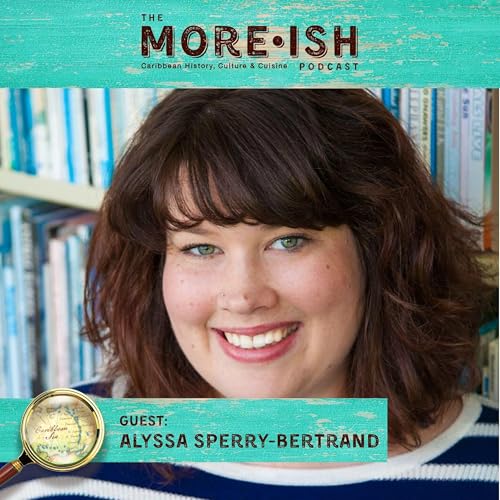
    The connection between salt and spirituality with Alyssa Bertrand (Sperry)

    Exploring Caribbean Heritage through food with Marie Mitchell

    Belly Full Cookbook, Caribbean Food & Ingredients with Lesley Enston

    Caribbean Culinary History with Keshia Sakarah

    Resources and Links

    Friends of Jamaica https://servejamaica.org/

    Eating Jamaica: How Food is Used as a Tool to Create and Reinforce Cultural Identity

    What is moreish? | more·​ish ˈmōrish | informal, of food, causing a desire for more

    Join us onTikTok,Instagram andYouTube to continue the conversation. Music from #Uppbeat (free for Creators!)https://uppbeat.io/t/andrey-rossi/jerk-sauce

    Alyssa Bertrand (Sperry) is a leading expert on salt, and its relationship to Jamaican culture(s). As a former chef, and historical ethnographer she provides insight into the role salt played in the development of culture and identities among the Maroons and Rastafarians by understanding salt’s role during the Atlantic Slave Trade and how it shaped the cultural identities of the past and present. Alyssa received her master’s degree at the Department of Global Studies at the University of Oregon and her bachelor’s degree at Washington State University in Anthropology and History. Alyssa has received numerous awards and grants for her research including the Oregon International Research Grant, Folger Shakespeare Library Scholarship, and Library Research Excellence Award at Washington State University.

    Show More Show Less
    24 mins
  • Jamaica: The connection between salt and spirituality with Alyssa Bertrand (Sperry)
    Feb 17 2026

    How salt shaped Jamaica’s culture and subcultures

    Hema is joined by Alyssa Bertrand Sperry, a retired pastry chef turned academic and historian, about her research on the historical and cultural significance of salt in Jamaica. Starting with the colonial era and the Spanish followed by the British, they explore the transition of Jamaica from a salt-producing island to a sugar-centric economy, the role of women in salt production, and the spiritual and practical implications of salt in the lives of Jamaican Maroon and Rastafarian communities.

    Alyssa shares how she got the nickname ‘Salt Woman’ and the amusing quest to find an out-of-the-way salt pond in Jamaica, complete with rum and a game of dominoes.

    Alyssa talks about her research methodology and the importance of honouring the voices of the communities she studied. The conversation highlights the multifaceted nature of salt, its impact on culture, and the ongoing relevance in understanding Caribbean history.

    About Alyssa Bertrand (Sperry)

    Alyssa Bertrand (Sperry) is a leading expert on salt, and its relationship to Jamaican culture(s). As a former chef, and historical ethnographer she provides insight into the role salt played in the development of culture and identities among the Maroons and Rastafarians by understanding salt’s role during the Atlantic Slave Trade and how it shaped the cultural identities of the past and present.

    Alyssa received her master’s degree at the Department of Global Studies at the University of Oregon and her bachelor’s degree at Washington State University in Anthropology and History. Alyssa has received numerous awards and grants for her research including the Oregon International Research Grant, Folger Shakespeare Library Scholarship, and Library Research Excellence Award at Washington State University. Alyssa is also a contributing writer to the books Salt in Eastern North America and the Caribbean (University of Alabama Press, 2021) and Women Who Changed the World (ABC-CLIO, 2021). She also published an article in the World History Connected, “Eating Jamaica: How Food is Used to as a Tool to Create and Reinforce Cultural Identity,” (Vol. 18, No.1, 2021). Currently,

    Alyssa serves on the board of Friends of Jamaica, a non-profit organization, helping to raise funds and provide grants to community-based projects around the island of Jamaica.

    Resources and Links

    Remembering Jah Calo

    William Berryman art

    Episodes Referenced

    Caribbean Foodways with Dr. Candice Goucher

    Music from #Uppbeat (free for Creators!) https://uppbeat.io/t/andrey-rossi/jerk-sauce

    Show More Show Less
    56 mins
  • Book Talk: The Last Turtlemen of the Caribbean with Sharika D. Crawford
    Feb 3 2026

    The Story of the Turtlemen: Navigating the Waters of Caribbean History

    Who are the turtlemen of the Cayman Islands? In this episode of The Moreish Podcast, Sharika Crawford, historian and author of The Last Turtleman of the Caribbean delves into the history and cultural significance of sea turtle hunting in the Caribbean, particularly focusing on the turtlemen of the Cayman Islands. She discusses the rich maritime culture that has often been overshadowed by plantation histories in the Caribbean, how turtle hunting evolved from a subsistence activity to a commercial enterprise, driven by demand for turtle meat and tortoiseshell products in global markets, the socio-economic dynamics of turtle hunting, including the class structures that emerged and the environmental implications.

    Connect with Sharika Crawford

    www.sharikacrawford.com

    https://x.com/SharikaCrawfo17

    The Last Turtlemen of the Caribbean Waterscapes of Labor, Conservation, and Boundary Making

    Episodes referenced

    Caribbean Foodways with Dr. Candice Goucher

    Resources and Articles

    Lions in Africa: Lincoln University Alumni in Kwame Nkrumah’s Ghana, 1951–1966

    Dr. Archie Carr

    The Sea Around Us, Rachel Carson

    Peter Matthiessen

    World History Connected review of The Last Turtlemen

    Support the show

    What is moreish? | more·​ish ˈmōrish | informal, of food, causing a desire for more

    If you are enjoying the podcast, consider supporting the show to help us continue to make great content. Join us on TikTok, Instagram and YouTube to continue the conversation. Music from #Uppbeat (free for Creators!) https://uppbeat.io/t/andrey-rossi/jerk-sauce

    Show More Show Less
    1 hr and 14 mins
  • Book Talk: Exploring Caribbean Heritage Through Food with Marie Mitchell
    Jan 20 2026

    We'd love to hear from you!

    Exploring Caribbean Identity, Food, and Family Stories with Marie Mitchell

    Marie Mitchell, a chef, writer, and author of Kin: Caribbean Recipes for the Modern Kitchen joins Hema to talk about her Caribbean heritage and stories through the lens of her narrative cookbook, that blends Caribbean history, culture, and cuisine.

    Marie’s book shares an intimate look at her family's journey, sadness & joy, and their resilience, plus her personal journey of connecting with her roots through cooking. Highlighting the significance of her family's legacy and the broader Caribbean experience, Marie's insights offer a profound exploration of identity, loss, and resilience. Listen to discover how food can serve as a bridge to understanding and celebrating the vibrant and layered Caribbean culture.

    Connect with Marie MitchellWebsite

    Instagram

    Slow Rituals on Substack

    Kin: Caribbean Recipes for the Modern Kitchen

    Episodes mentioned:Culinary Colonialism with Keja Valens

    Photo Credit: Chiron Cole

    Support the show

    What is moreish? | more·​ish ˈmōrish | informal, of food, causing a desire for more

    If you are enjoying the podcast, consider supporting the show to help us continue to make great content.Join us on TikTok, Instagram and YouTube to continue the conversation.Music from #Uppbeat (free for Creators!) https://uppbeat.io/t/andrey-rossi/jerk-sauce

    Show More Show Less
    54 mins
  • The Repair Campaign: Caribbean Reparations Explained with Brian Royes
    Jan 6 2026

    We'd love to hear from you!

    Understanding Reparations and Caribbean Justice with Brian Royce, Campaign Manager for The Repair Campaign

    Hema is joined by Brian Royes, Campaign Manager for The Repair Campaign, an organization that amplifies for the call for former colonial powers to acknowledge their role in the transatlantic trafficking of enslaved Africans.

    They delve into CARICOM's 10-point plan for reparations and reparatory justice, emphasizing the importance of an apology and accountability from those who benefitted from chattel slavery, the long-term socioeconomic and cultural impacts still being felt today, and the critical role of education on the topic. Brian passionately shares the necessity for reparations to foster true development and equity in the Caribbean.

    The Repair Campaign is an advocacy organisation supporting the Caribbean's reparatory justice movement guided by CARICOM's Ten-Point Plan for Reparatory Justice. We call on the UK and other European governments, institutions and individuals who perpetrated and benefited from chattel slavery and its legacy to apologise for these atrocities and commit to repair. We ask all who stand with this call to show their support by signing in solidarity at repaircampaign.org/sign.

    Instagram

    Facebook

    TikTok

    Connect with Brian

    Instagram

    YouTube

    Resources

    CARICOM Reparations Commission

    CARICOM 10 Point Plan for Reparatory Justice

    Mapping the Legacy of Slavery in London’s Docklands

    Heirs of Slavery

    William Gladstone’s Family apologises for role in slave trade

    Olaudah Equiano: Writer & Abolitionist

    Episodes referenced

    Slave Voyages: Documenting the Trans-Atlantic Slave Trade with Dr. Gregory O’Malley and Dr. Nafees M. Khan

    Support the show

    What is moreish? | more·​ish ˈmōrish | informal, of food, causing a desire for more

    If you are enjoying the podcast, consider supporting the show to help us continue to make great content.Join us on TikTok, Instagram and YouTube to continue the conversation.Music from #Uppbeat (free for Creators!) https://uppbeat.io/t/andrey-rossi/jerk-sauce

    Show More Show Less
    54 mins