Season's Savings | ₹5/mo for 3 months

₹199/month after first 3 months. Renews automatically. Terms apply.
The Purpose Podcast cover art

The Purpose Podcast

The Purpose Podcast

Written by: Siddhant Pusdekar
Listen for free

About this listen

Through the purpose podcast we will meet people involved in the Biological Purpose Project. They include experimentalists, theoreticians, and philosophers working on a range of problems from curing cancer to the conservation of the biosphere. In each episode, we delve into the unexpected ways in which they're blending philosophy and science.

Siddhant Pusdekar, The Biological Purpose Project 2023
Biological Sciences Philosophy Science Social Sciences
Episodes
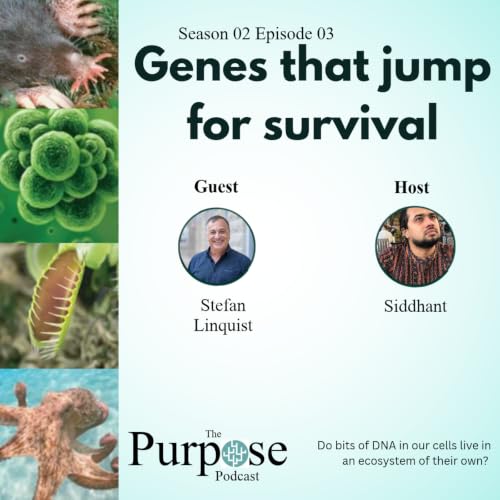
  • Genes that jump for survival
    Oct 30 2026

    Around the mid twentieth century Barbara McClintock revolutionized the way we study cells. She was studying corn or maize and developed a way to look at their chromosomes. These are large DNA molecules containing multiple genes packaged into a single structure. Most people have between 45-47 chromosomes in ever cell of their body. McClintock identified different part of the chromosomes and what they might be doing. But her most controversial work happened in the 1940s and 1950s when she was cross-breeding maize to understand why some kernels had different colors. Based on her results, she proposed that this happens, when some genetic elements—basically bits of DNA— jump to a different chromosomal position. Science is always conservative and any new idea is challenged, and because she was a woman, it was probably a little worse for her. But the idea was solid. It survived the scrutiny. In 1984, she was awarded the Nobel Prize for Physiology and Medicine. The only woman to have won it unshared. And the idea that bits of DNA can jump around is well accepted. These things are called transposable elements and they are far from rare. By some estimates, they are about 40-50% of our DNA and in some plants they might be even more.

    But what is less settled is what they are doing in our cells.

    They might have some function. But could they also just be rogue elements that are out for themselves?

    Researchers have gone back and forth on this debate for a while.

    In today’s episode, I will be talking to Stefan Linquist about a different idea. You see selfish genetic elements or transposable elements they don’t always jump around, but in some cells in some species, they are more active. Why? According to Stefan, we might begin to understand this by looking at the cell through the eyes of the selfish genetic element – an ecosystem approach, if you will.

    References

    1. Linquist, S. et al. Transposon Ecology and the Octopus Genome. BioEssays 48, e70124 (2026).
    2. Bonar, M., Elliott, T. A., Ahmadi, M. A. M., Cottenie, K. & Linquist, S. Biological Implications of a Detailed Repeat Annotation in Octopus vulgaris. Genome Biology and Evolution 18, evag137 (2026).

    Podcast production was supported in part by the Consortium for Advancing a Science of Purpose (#63716; John Templeton Foundation). The opinions expressed are those of the participants and do not necessarily reflect the views of the John Templeton Foundation.

    Show More Show Less
    3 mins
  • No way back - When evolution makes irreversible changes
    Oct 8 2026

    We live in a social world as full of cooperation as it is of competition. How should ecologists and evolutionary biologists tell them apart?

    Podcast production was supported in part by the Consortium for Advancing a Science of Purpose (#63716; John Templeton Foundation). The opinions expressed are those of the participants and do not necessarily reflect the views of the John Templeton Foundation.

    Show More Show Less
    55 mins
  • How the earth shapes life and natural selection with Richard Boyle
    Aug 20 2026

    In the 1960s the search for alien life inspires the chemist James Lovelock to imagine that life, if it occurred anywhere in the universe would be accompanied by an atmosphere that was in constant flux. He called this the Gaia hypothesis. Since then the idea has been subject to constant misinterpretation. In this episode, Siddhant talks to Richard Boyle about what the Gaia hypothesis is, what it isn't how planetary scale dynamics interact with life and natural selection.

    This episode assumes some knowledge of earth systems and evolution.

    Richard's paper describing an attempt to Darwinize Gaia

    https://royalsocietypublishing.org/doi/reader/10.1098/rstb.2024.0087

    Podcast production was supported in part by the Consortium for Advancing a Science of Purpose (#63716; John Templeton Foundation). The opinions expressed are those of the participants and do not necessarily reflect the views of the John Templeton Foundation.

    Does Earth’s habitability for life exist due to or in spite of Darwinian evolution by natural selection? (#63450; John Templeton Foundation)

    Show More Show Less
    42 mins
adbl_web_anon_alc_button_suppression_t1
No reviews yet