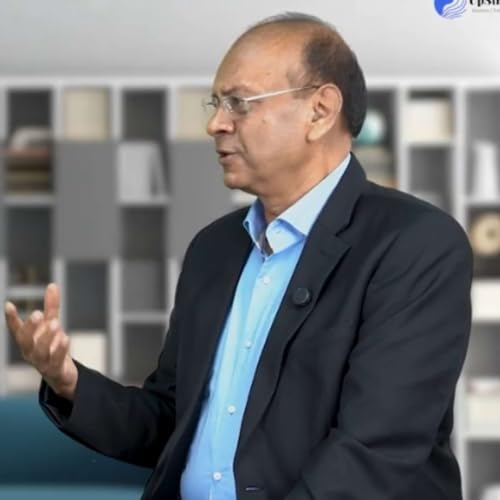
• Why a ₹100 Crore Chip Startup Was Worth ₹680 Crore 9 Months Later: a quick chat with Unicorn India Ventures
    Oct 7 2026

    A semiconductor startup went from a ₹100 crore valuation to ₹650–680 crore in nine months, and its auditors couldn't understand how. Bhaskar Majumdar, Managing Partner at Unicorn India Ventures, which has just launched a deep tech fund with IIT Madras, explains how deep tech actually gets valued, and why it needs different rules.

    On 26 September 2026, IIT Madras and Unicorn India Ventures announced the ₹450 crore first close of IITM Unicorn Frontier Fund I, a deep tech fund with a ₹1,000 crore target. The same day, UpStreamVoice sat down with Bhaskar Majumdar.

    He explains why deep tech is "not a gut-feel business", what a fund inside a university can see that other VCs can't, why his firm now recruits PhDs instead of MBAs, why two-thirds of its investments are outside Bengaluru, NCR and Mumbai, and how you keep investors patient over a 10–12 year fund.

    00:00 Deep tech needs different rules
    00:36 A fund born inside a university
    03:38 Not a gut-feel business
    05:00 Beyond Bombay, Bangalore and Delhi
    07:30 Build the portfolio, back the winners
    08:12 Two ecosystems, two DNAs
    09:45 Valuing what has no cash flow yet
    10:36 From measuring air to cleaning it
    11:44 Keeping investors patient

    Guest: Bhaskar Majumdar, Managing Partner, Unicorn India Ventures
    Host: Shreyas Mishra
    Recorded 26 September 2026.

    Fund figures on screen are from IIT Madras and Unicorn India Ventures' first-close announcement (26 Sept 2026). Figures about Unicorn India's own portfolio are as described by Bhaskar Majumdar in this interview. Maps show boundaries as recognised by India.

    Support the show

    Thanks for Listening! Follow Us on Facebook, Instagram, Twitter, LinkedIn or Find us on YouTube

    Show More Show Less
    13 mins
  • The story behind each company - the learning of Prequate from advising 700 businesses
    Sep 1 2026

    In this episode we bring you a company that has been growing with all the startups and SMBs in India.

    00:00 - Introduction
    06:30 - Working Startups and SMEs
    11:40 - Finding a solution for business.
    15:51 - Finding the continuity for legacy business transformation.
    22:47 - Building a consulting business.
    35:31 - The evolution of technology and business: AI transformation.
    48:17 - All things AI don't work for the moment.
    01:03:00 - Going beyond services.
    01:12:00 - Ensuring legacy business transforms.

    Support the show

    Thanks for Listening! Follow Us on Facebook, Instagram, Twitter, LinkedIn or Find us on YouTube

    Show More Show Less
    1 hr and 19 mins
  • Business management simplified: Tally's path towards enabling SMEs in the AI era
    Aug 4 2026

    In this episode I talk with Tejas Goenka, the Managing Director of Tally Solutions. TheUpStreamLife delves deeper into the soul of the company that has built India's accounting software story. Find out what the path of Tejas Goenka would be in making this company go deeper into the Indian and global SME industry. Already running into the millions of users, its one of the most valuable software companies built in India and its truly Indian in every essence.

    00:00 - Introduction
    00:50 - Tally as an operating system.
    02:38 - Built for the Indian SME.
    06:18 - SMEs being similar globally.
    09:23 - The different layers of Tally.
    17:55 - Creating an insights layer for the Banks.
    22:07 - Building market winning products and DPIIT
    28:01 - India's entrepreneurial stories.
    33:13 - Tally 7.1 and scaling up AI initiatives.
    38:00 - Books and other inspirations.

    Support the show

    Thanks for Listening! Follow Us on Facebook, Instagram, Twitter, LinkedIn or Find us on YouTube

    Show More Show Less
    43 mins
  • Rise of social impact startups in IIM-CIP & the North-East: in-conversation with chairman Ajay Jain
    Jul 6 2026

    In this episode we talk with Chairman of the IIMCIP, Ajay Jain, who has been through forty years of entrepreneurship and is now paying it forward as a professor and startup mentor. He talks about how the North-East part of India is going to attract several startups in the years to come and why IIMCIP is playing a vital role in its growth. @iimcalcutta

    00:00 - Introduction to the podcast
    01:21 - Learning from the Corporate world
    05:20 - Career in Kuwait and the stepping stone to business.
    08:44 - Why Institutions will create social impact going forward.
    14:33 - The balance to create innovation that makes impact.
    18:11 - Academia/Corporate partnership - will it become mainstream.
    23:12 - Carrying empathy to build a business.
    29:00 - Supporting the North-East Corridor to become a startup centre.
    33:03 - Why North East supports some great opportunities.
    35:55 - The North East will change going forward.
    41:03 - Role of government, going beyond grants.
    49:00 - What does it take for innovation to work in the future
    54:42 - Building future leaders.

    Support the show

    Thanks for Listening! Follow Us on Facebook, Instagram, Twitter, LinkedIn or Find us on YouTube

    Show More Show Less
    5 mins
  • Why schools still need edtech, STEM interventions & test prep that matters: the SpeEdLabs story
    Jun 22 2026

    In this episode I talk with Vivek Varshney, the founder of SpeEdLabs, a test prep company that has survived the test of being a startup and is now growing to become a preferred partner for schools in smaller towns. How did Vivek and team do this, lets find out.

    00:00 - Introduction.
    01:22 - Being an IIT/IIM grad and going on to set up a startup.
    05:25 - Education is the only currency to come out of poverty.
    10:30 - Building a startup is all about product market fit, the first customer.
    15:30 - Outcomes decide the future of a startup, why B2B worked.
    20:09 - The elements that worked for SpeEdLabs.
    30:00 - How should one prepare for tests?
    34:00 - Having the playbook ready?
    42:00 - Why schools are going to enable parents?
    45:33 - The AI in the app and the future playbook.
    49:50 - How is the SpeEdLabs journey going into AI?
    55:15 - The future of education in India.

    Support the show

    Thanks for Listening! Follow Us on Facebook, Instagram, Twitter, LinkedIn or Find us on YouTube

    Show More Show Less
    1 hr and 3 mins
  • The journey of Prequate, how Pradyumna went from Yeshas Academy to setting up an advisory firm
    Jun 18 2026

    In this episode we talk about the growth of an idea, how Pradyumna went from being a back bencher to setting up an advisory/investment banking firm that works with the brightest startups and large corporations.

    This interview covers his student days and also covers how investment banking works.

    00:00 - Introduction
    00:34 - The objective of the Disha Series with Mentorsforkids.in - an introduction by Pavan Sharma, partner at BCL India
    04:00 - The reason why MentorsForKids wants employability.
    06:00 - The journey of Pradyumna
    16:20 - Building a network for I-Banking
    24:15 - Working with engineers to build business, commerce students deploy money.
    27:28 - Why AI is expensive and how Prequate works with technology.
    41:00 - Being ready for work life.
    45:00 - Conversation with students

    Support the show

    Thanks for Listening! Follow Us on Facebook, Instagram, Twitter, LinkedIn or Find us on YouTube

    Show More Show Less
    58 mins
  • Lab to business: AI native platform LatentForce fixes enterprise code migration with scale & context
    Jun 15 2026

    In this episode Ideaspring Capital's Naganand Doraswamy talks with deep tech startup LatentForce, which has a special combination of a research professor and his students who are building the business as founders. This fascinating story showcases how Indian science is scaling globally.

    00:00 - Introduction
    00:34 - Genesis of LatentForce
    05:40 - From lab to business
    06:59 - Keeping in touch with disruptions in AI
    15:00 - From professor to thinking business
    17:53 - LatentForce is solving code migration with context
    22:00 - Taking the business to customers
    25:25 - Getting great talent.
    35:39 - Revenue pipeline of the company

    Support the show

    Thanks for Listening! Follow Us on Facebook, Instagram, Twitter, LinkedIn or Find us on YouTube

    Show More Show Less
    38 mins
  • India's Sovereign Path: the Rupee, the Future, the need to "Change" the geo-political game
    May 26 2026
    In this short video I analyze where India is heading and how it has to reflect about its relationship between powerful nations.Here is a brief text of the essay:It is time for India to reflect on its position in the world order as the rupee slides further thanks to the USA’s adventures around the world.The USA’s war in Iran and its forceful tariff diplomacy has not bode well for the world. The current tensions have led to foreign capital’s flight from India’s stock markets. Combine this with the rise of AI technology, job losses are going to hurt India’s IT industry and many more. It is never good for an old civilization to be kicked around, but it is good for it to be reminded that it has to make its own fortune. Unlike China, India has to come together sooner than later. At the moment it loves its cricket, its consumer business valuations, its uncontrollable carbohydrate addiction, and ever so occasionally, the inconspicuous army that protects its borders from several rogue nations. But India’s dependence on foreign markets have led the rupee to slide. Come to think of it, the very idea of its independence was to overcome imperial powers, but it is caught between powers such as China and the USA. The fix for all the fall of the rupee is not in economic austerity, but a massive, gradual overhaul of its systems that will make it stronger in the long run. It's not easy to change India’s institutions because it is a complex legal bureaucracy whose only bells and whistles are a bag or rules, and unaccountable practices. Yet the idea of India works brilliantly because of its diversity. But, can it notch one up in the geo-political chaos of this decade? Let's look at some real cases that should wake people up. India does not control commodities that run the world - oil, phosphorus, rare earths, and helium. To top it up India does not have any sort of grip on the hardware ecosystem. Entire industry verticals such as agriculture, automobile and energy sectors are dependent on either the USA, Russia or China. Its dependence on imported hardware systems that support robotics and AI compute has tied it to Corporations of US, Chinese, Japanese and European origins.So, where must the change begin?It has to centralize aspects that will define its future and make accountability the core of everything. It must remove all the weeds that don't want the system to function. It must begin with its education system, which builds talent for a bureaucratic and managerial legacy. It must centralize the education system and remove the capitalistic nature of education, let the pedagogy encourage thinkers, builders and risk takers. It must remove any religious or identity led affiliation. By doling out degrees we have impractical youth who don't know how a system works and don't have the initiative to think how systems function. India must blend critical thinking of history with research and combine the best of modern science to build businesses. Until schools and colleges are owned by pro-western religious institutions and selective Jati led ecosystems, it is going to be harder for the idea of India to further itself. It is going to have an even harder time with neo-capitalists who propose a western style system that furthers a consumption economy. This tendency can destroy India’s environment and natural resources only to usher in ecological imbalances.India must find a way as it has strong foundations of a scientific society to foster mega transitions that are inclusive of all life. The country has already made plans to transition into green energy by 2075 and has increased investments in deep tech significantly. But as a nation it must plan industrial transitions along with its biggest strength- “people” - as a resource. Its scientific foundations must find ideas to rid the nation from its dependence on importing oil, fertilizers, electronics and rare earths from these powerful nations. There must be enormous effort to build practical new industrial ecosystems that create new fuels, batteries along with cutting edge manufacturing systems. The contradiction is that we have to be dependent on various nations in the short term who have resources. India must continue to make political overtures to resource rich nations such as Vietnam, Australia and Brazil. It must continue its relationship with Russia and China in the near short term for chemical fertilizers. India’s agriculture industry must move towards using nano fertilizers in order to put an end to volume based farming which uses chemicals. There are some investments going into green ammonia and green hydrogen, which perhaps will be the future of Indian agriculture and energy. India must also put an end to importing anything that can be manufactured locally. Over time its scientists, civil society and government must find a way to work together more often than not otherwiseSupport the showThanks for Listening! Follow Us on...
    Show More Show Less
    6 mins