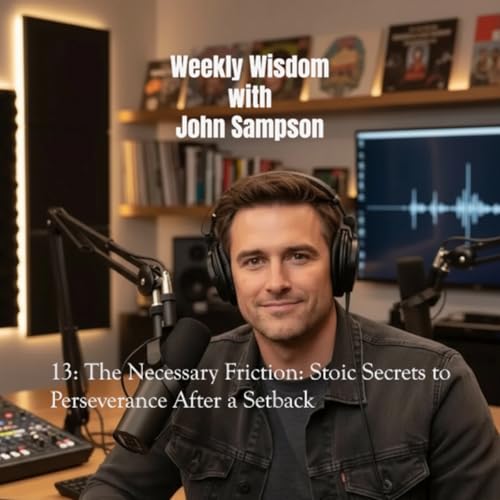
• The Necessary Friction: Stoic Secrets to Perseverance After a Setback
    Jan 20 2026

    Are you struggling to get back on track after a failed goal or a broken New Year's Resolution? You set a big goal—a new career, better fitness, a serious habit—but the inevitable setback crushed your momentum. Most people quit here. But the most successful people understand that this "friction" is a required step, not a sign of failure.

    In this deep-dive episode of Weekly Wisdom with John Sampson, we explore the ancient philosophy, modern psychology, and hard neuroscience that provides a proven roadmap to turn setbacks into your greatest fuel.

    In this episode, you will learn:

    • The Stoic Dichotomy of Control: How to instantly reframe a setback by separating what you can control (your attitude, your effort) from what you cannot (the past outcome).
    • The Neurobiology of Self-Compassion: Why beating yourself up after a failure is the worst possible strategy, and how kindness is the most powerful catalyst for future achievement and strong perseverance.
    • Nietzsche’s "Long Obedience": Why anything worth pursuing must be difficult, and how to embrace the struggle as the very definition of a meaningful life.
    • The Aristotelian Truth: Why true flourishing (Eudaimonia) is not a destination but a continuous activity, making sustained effort (perseverance) mandatory.
    • 3 Practical Tools for Unstoppable Discipline: Actionable steps—including the Stoic Pause and the Process Goal—to immediately integrate these lessons and guarantee success in your most challenging goals.

    Don't let a temporary dip define your future. It's not over until you give up. Tune in and discover how to use the "necessary friction" to achieve your major life goals.

    Subscribe to Weekly Wisdom with John Sampson for practical solutions that merge philosophy, psychology, and neuroscience every week.

    Show More Show Less
    24 mins
  • Stop The Chase for "More" | Stoic Philosophy, Neuroscience, & Finding What is Enough
    Jan 13 2026

    This week, we tackle the relentless psychological burden of Status Anxiety and the central question: What is Enough?

    We all feel the pull of the Hedonic Treadmill, constantly chasing more success, money, and recognition, only to find contentment always out of reach. If you don't define What is Enough, nothing ever will be.

    In this powerful episode, John Sampson fuses ancient Stoic Philosophy (Epictetus, Marcus Aurelius, Seneca) and modern Neuroscience to reveal the toxic loop that keeps your brain trapped in a state of Never Enough.

    You will learn:

    • 🧠 The Psychological Trap: What happens in your brain (the amygdala & HPA axis) when you are constantly chasing status, and how Hedonic Adaptation keeps you running up a hill to nowhere.
    • 🏛️ Ancient Keys to Self-Discipline: Wisdom from Marcus Aurelius on reputation and Seneca on voluntary poverty to build an Internal Citadel of sufficiency.
    • ⚠️ The High Cost of Fame: Cautionary tales from the lives of Robin Williams, Heath Ledger, and Matthew Perry that prove external success does not equal internal peace.
    • Practical Steps: A clear, four-step plan to define your true "enough," overcome comparison, and gain true Self-Discipline.

    Stop letting external validation control you. It's time to win the war against Status Anxiety.

    SUBSCRIBE for more Weekly Wisdom every week!

    Show More Show Less
    26 mins
  • Discipline Equals Freedom: The Neuroscience of Unbreakable Self-Control, Stoic Wisdom, and How to Grow Your aMCC
    Jan 6 2026

    Tired of Akrasia (weakness of will)? Learn how the mantra "Discipline Equals Freedom" is supported by cutting-edge brain science and ancient Stoic wisdom.

    This episode provides a complete breakdown of self-mastery, explaining why you struggle and giving you the tools to stop. We dive deep into the Neuroscience of Self-Discipline, revealing the battle between your impulsive limbic system and your Prefrontal Cortex (PFC). You’ll discover the critical brain region for effort—the Anterior Mid-Cingulate Cortex (aMCC)—and the scientific studies showing how engaging in hard things (Askēsis) can cause this area to literally grow (neuroplasticity), making self-control automatic.

    We explore the philosophical roots of Temperance and Delayed Gratification from Plato and Seneca. Crucially, we deliver four immediate, actionable steps to rewire your habits, including:

    • Environmental Engineering to remove temptation.
    • Using Implementation Intentions to automate action.
    • Protecting your willpower by managing Cognitive Load and Stress.

    Start building your Inner Citadel today. Listen now to unlock unbreakable self-control and achieve true self-mastery.

    Show More Show Less
    27 mins
  • The 8% Solution: Master Goal Execution & Overcome the Intention-Action Gap (Stoic & Neuroscience)
    Dec 30 2025

    Are you tired of setting goals only to quit by February? Join John Sampson on Weekly Wisdom as he tackles the #1 struggle in personal development: execution. With only 8% of people succeeding at their New Year's resolutions, this episode delivers the blueprint to be one of them.

    This episode is your deep-dive guide to bridging the intention-behavior gap, combining ancient philosophical rigor with modern brain science.

    What You Will Learn:

    • The Psychological Challenge: Why our brains are wired to prioritize immediate comfort (Present Bias) over long-term success, and how Plato’s Tripartite Soul diagnoses your inner conflict.
    • The Execution Blueprint: What happens in your Prefrontal Cortex and Basal Ganglia when you successfully build a habit, and how to stop relying on fragile willpower.
    • The Stoic Toolkit: How to apply the wisdom of Epictetus’s Dichotomy of Control and Seneca’s Premeditatio Malorum (Negative Visualization) to make your motivation unbreakable.
    • 5 Practical Steps: Learn the science-backed strategy of Implementation Intentions (If X, then Y) and Habit Stacking to automate your behavior and ensure consistency, even when motivation fails.

    Stop just setting goals. Start mastering the execution of them. This is the ultimate guide for anyone ready to turn intentions into life-long achievements.

    Show More Show Less
    25 mins
  • Stop Failing Your Resolutions: Stoic Wisdom & Brain Science for Goals That Stick
    Dec 23 2025

    The New Year's resolution failure rate is a staggering 80-90%. This week on Weekly Wisdom with John Sampson, we stop relying on false hope and reveal the evidence-based blueprint for setting goals that stick.

    Host John Sampson dives into the vital psychological benefits of goal setting, the high cost of stagnation, and the neuroscience of success—mapping the journey from your planning Prefrontal Cortex to your habit-forming Basal Ganglia. Most importantly, he connects modern behavioral science (Micro-Actions, Implementation Intentions) with the timeless Stoic philosophy of Marcus Aurelius and Epictetus, and the virtue ethics of Aristotle.

    Discover the optimal strategies to overcome procrastination, avoid the "False Hope Syndrome," and build automated habits for self-mastery. Learn how to frame your resolutions according to the Dichotomy of Control and design a life of purpose. This episode is your comprehensive guide to turning fleeting intentions into lasting personal transformation.

    Show More Show Less
    30 mins
  • The Radical Necessity of Stillness: Stoic Wisdom, Neuroscience, and the Cure for Burnout
    Dec 16 2025

    Stop the hustle. This episode of Weekly Wisdom with John Sampson proves that stillness is a biological and existential necessity, not a luxury. We expose the devastating cost of chronic busyness, examining the tragic mental collapses of historical figures like John Stuart Mill, Nikola Tesla, and Friedrich Nietzsche. Drawing on Stoic philosophy—especially Seneca's concept of tranquillitas (abiding stability of mind)—and modern neuroscience, we show how downtime activates the Default Mode Network (DMN), lowers cortisol (stress hormones), and restores attentional capacity. Learn practical, actionable steps to achieve otium (philosophical leisure) and use stillness to cultivate resilience, enhance creativity, and find true inner peace.

    Show More Show Less
    24 mins
  • The Hubris Trap: Why Humility Is the #1 Leadership Trait | Freud, Stoics & The Titanic Disaster
    Dec 9 2025

    Humility is not weakness—it's your greatest psychological strength.

    In this powerful episode, we reveal why hubris (excessive pride) is the single most dangerous flaw in leadership. We analyze the catastrophic cost of arrogance, from the Titanic and Challenger Disaster to modern AI CEOs and polarized politics.

    You will learn:

    • The Science: Why your brain is neurologically addicted to certainty and how to use the Prefrontal Cortex to fight the "Hubris Trap."
    • The Philosophy: Lessons from the Stoics (Marcus Aurelius, Epictetus) on why acknowledging ignorance is the first step to wisdom.
    • The Psychology: How Freud's work on narcissism explains why a brittle ego shuts down learning.
    • The Action: Practical strategies for cultivating humility, including why being willing to admit mistakes and learn from them is core to a growth mindset.

    Stop risking it all on certainty. Start building resilience through self-awareness.

    Tune in to rewire your mind for long-term success.

    Show More Show Less
    20 mins
  • How to Find Your Role Model: Advice from the Stoics, Aristotle, Nietzsche, Frankl, and Neuroscience
    Dec 2 2025

    Are you living in an "existential vacuum," unsure who you are or who you should be? The key to a meaningful life isn't just self-discovery; it's self-creation through the power of the ideal.

    Host John Sampson explores the necessity of having an aspirational guide—a role model—to shape your character and direction.

    In this episode, you will learn:

    • The Philosophical Imperative: Discover why Aristotle viewed the emulation of excellence as the pathway to virtue, and how Nietzsche's concept of self-overcoming demands a constant striving toward a better self. We also examine Viktor Frankl's warning about the danger of living without a clearly defined ideal.
    • The Science of Emulation: Dive into the fascinating neuroscience that explains exactly why we are wired to admire and learn. Understand the role of dopamine and mirror neurons in turning observation into motivation, making the ideal not just a philosophical concept but a neurological process.
    • The 5-Step Roadmap: Get a practical framework for implementation, including how to:
      1. Clarify your three most important values.
      2. Identify a historical figure, mentor, or fictional character who embodies those values.
      3. Use your ideal as a "constellation of wisdom"—a guide, not a destination—to prevent existential drift.

    Stop arguing about what a good person should be, and start being one. Use the ideal self as your compass to write the script for your self-mastered life.

    Show More Show Less
    22 mins